
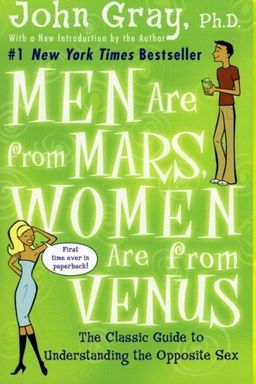
Men Are from Mars, Women Are from Venus cover

Men Are from Mars, Women Are from Venus

by John Gray

Men Are from Mars, Women Are from Venus offers a transformative approach to understanding the opposite sex. By exploring distinct communication styles and emotional needs, John Gray provides actionable insights to foster intimacy and harmony, helping couples build stronger, more fulfilling relationships.

Understanding Love Across Planets

Have you ever felt as if your partner came from another world? That somehow, no matter how much you love each other, you just keep misunderstanding what the other really needs? In Men Are from Mars, Women Are from Venus, John Gray argues that this isn't far from the truth at all — metaphorically speaking. He contends that men and women operate as if they come from separate planets with distinct emotional languages, expectations, and psychological wiring. The book’s central premise is simple yet profound: to experience lasting love and harmony, you must recognize, accept, and honor these fundamental differences instead of resisting them.

Gray suggests that when men and women forget their differences, relationships slide into frustration and conflict. The book expands on this idea through vivid metaphors, especially Mars (men) and Venus (women), which define contrasting instincts and communication styles. Men’s stress responses, motivations, and values differ significantly from women’s, and misunderstanding those gaps leads to pain. Gray's fundamental argument offers hope: when you learn to speak the emotional language of the opposite sex, love stops being a battle and becomes a collaboration.

The Core Idea: We’re Hardwired Differently

Men, according to Gray, value autonomy, competence, and power; their identity rests on their ability to achieve goals and solve problems. Women, conversely, define themselves through relationships, empathy, and communication. This difference explains why men often retreat into their “caves” when stressed, while women seek connection through talking. When these instincts collide, conflict arises — for example, when a woman seeks to share her feelings and her partner simply offers solutions, believing that’s the best way to help. Each feels misunderstood because they’re operating from different emotional playbooks.

Gray’s metaphor of planets isn’t just poetic; it anchors a deeply practical approach. He walks readers through patterns that almost every couple faces: men’s impulse to fix problems rather than listen, women’s tendency to help him improve rather than trust his abilities, and the way stress triggers opposite coping strategies. These concepts explain why well-intentioned love often leads to disappointment. As Gray puts it, “The effects of Earth’s atmosphere took hold, and one morning everyone woke up with selective amnesia.” In other words, couples forget they are supposed to be different.

The Book’s Structure and Promise

The book unfolds through thirteen chapters that detail the many aspects of male-female dynamics — from communication and emotional needs to conflict resolution, intimacy, motivation, and love’s evolutionary cycles. You’ll learn how men go into their caves, how women ride emotional waves, how they speak different languages, and how they keep score differently. Each chapter is like decoding a secret law of nature. By seeing these patterns, Gray shows that what feels irrational or unfair in love is actually predictable — and, with awareness, fixable.

Why does this matter? Because according to Gray, confusion and disappointment come not from a lack of love but from mismatched expectations. Men expect women to think and react like men, and women expect men to feel and respond like women. When these expectations go unmet, both sides hurt. Gray’s advice is that couples need to learn emotional translation: men must listen without trying to solve, women must trust without trying to improve, and both must understand the rhythm of closeness and distance that keeps love alive over time.

Why Remembering Our Differences Restores Harmony

Gray’s vision is neither about hierarchy nor blame. Instead, he promotes accepting difference as an act of respect. He argues that good intentions alone aren’t enough — that men and women with the best of intentions still fail because they apply their own planet’s logic to the other. “Falling in love is magical,” he writes, “but as the magic recedes and daily life takes over, men continue to expect women to think and react like men, and women expect men to behave like women.” Awareness is the key to restoring that magic. Once you understand that conflicts spring from difference, not deficiency, you begin to respond with empathy instead of frustration.

Throughout this summary, you’ll journey through each of Gray’s major frameworks: why men become Mr. Fix-It and women form the Home-Improvement Committee; how Mars and Venus deal with stress; how love alternates between distance and closeness; and how couples can keep the magic alive. You’ll also discover practical tools — from “Love Letters” to emotional translation guides — that anyone can use to deepen connection. By the end, you’ll see that Gray’s message isn’t just about romance; it’s about reclaiming compassion in conversation, understanding rather than defending, and learning to love someone whose emotional gravity pulls differently than yours. That’s how two planets can orbit together—without colliding.


Mr. Fix-It and the Home-Improvement Committee

Have you ever tried to vent about a bad day, only for your partner to immediately jump in with advice you didn’t ask for? Or have you ever tried to help your partner fix his habits, only to watch him seem oddly hurt or defensive? In chapter two, John Gray crystallizes one of the most common gender clashes: men’s instinct to play ‘Mr. Fix-It’ versus women’s tendency to form the ‘Home-Improvement Committee.’

The Martian Instinct to Solve

On Mars, identity is built around competence, efficiency, and autonomy. Men feel valuable when solving problems, and they show love through action. So when a woman expresses distress, he instinctively assumes she wants him to find a solution. He puts on his ‘Mr. Fix-It’ hat and begins advising, repairing, or dismissing her discomfort with rational solutions. It’s his way of showing care — not realizing she feels unheard. To a Venusian mind, offering advice too soon sounds like invalidation, not support.

Gray uses numerous examples, like Tom and Mary’s conversation after her long day: when Mary said, “I have so much to do,” Tom offered solutions; when Mary sighed, “I forgot to call my aunt,” Tom reassured her not to worry. Each attempt made her angrier because Tom misunderstood her goal. She didn’t want efficiency; she wanted empathy. On Venus, problems are solved through sharing, not fixing.

The Venusian Urge to Improve

Meanwhile, women often try to help men become better partners by gently advising them — forming what Gray calls the ‘Home-Improvement Committee.’ When a woman loves, she feels responsible for growth and nurturance. She assumes that offering suggestions is caring. For men, this feels like criticism. Their identity revolves around proof of competence. So when she says, “You should take a day off,” or “You’re driving too fast,” he hears, “You’re failing.”

The dynamic is ironic: while women feel loved when men offer unsolicited help (“He wants to take care of me!”), men feel controlled when women do the same. As Gray explains, “To offer a man unsolicited advice is to presume that he doesn’t know what to do or can’t do it on his own.” Mars and Venus simply differ on what love looks like.

Turning Conflict into Partnership

Gray’s advice is clear: the issue isn’t the traits themselves — men’s problem-solving or women’s caretaking are actually positive. It’s about timing and awareness. A woman loves Mr. Fix-It as long as he doesn’t appear when she’s upset. Men should learn to listen, breathe, and show empathy before suggesting anything. Similarly, men appreciate improvement advice when it’s invited, not imposed. Women should let go of unsolicited advice and trust men’s competence. Acceptance, not correction, motivates change.

Key lesson:

Men show love by solving problems; women show love by nurturing improvement. When each misunderstands the other’s intention, love feels like criticism. Learning to give empathy before advice and acceptance before correction transforms communication from conflict to connection.

Gray asks both partners to practice for a week: men should listen without offering solutions; women should avoid giving unsolicited advice. The result, he promises, is transformative. You’ll notice more appreciation and responsiveness because both sides finally feel respected. This simple yet radical shift — empathy before efficiency and acceptance before advice — reshapes how love is understood on Earth.


Men Go to Their Caves, Women Talk

Picture this: you’ve had a terrible day and want to vent, but your partner retreats behind a screen, mutters “I’m fine,” and disappears into silence. Or maybe you need space but your partner keeps asking, “What’s wrong?” until you feel smothered. In chapter three, John Gray introduces one of his most famous insights: men cope with stress by retreating into their “caves,” while women cope by talking. These opposite instincts almost guarantee misunderstanding — unless you learn to see them as complementary rather than conflicting.

The Cave: Men’s Solitary Sanctuary

When a Martian feels stressed, he instinctively withdraws. His mind narrows to focus on the biggest problem and he becomes distant or preoccupied. This “cave” may be literal (his office, garage, or couch) or mental (daydreaming, reading, browsing, or watching sports). He isn’t rejecting his partner — he’s trying to regain control through solitude. Martians believe talking about problems is a burden unless expert advice is needed, so silence feels like strength. To Venusian ears, silence feels like indifference.

Gray tells stories like Tom reading the newspaper while Mary attempts conversation. She interprets his quiet as neglect. On Mars, however, that newspaper is therapy. Gray advises women not to invade the cave — “Never go in or you’ll be burned by the dragon guarding it.” A man in his cave needs space to process before reconnection. Interrupting him only delays his return.

The Talking Cure: Women’s Emotional Release

Venusians, under stress, do the opposite. They talk to relieve emotional tension. Discussion isn’t about solutions but catharsis and connection. By verbalizing, they transform confusion into clarity. A woman may talk about five different topics, interwoven with emotion rather than logic. To men, this seems random or exhausting; to women, it’s healing. As Gray beautifully puts it: “To feel better, women talk about past problems, future problems, even problems that have no solutions.”

When men hear this, they assume she’s blaming them or seeking fixes. He dons his Mr. Fix-It helmet again, offering solutions that worsen her frustration. Or he tries to defend himself, thinking she’s attacking. What she needs is empathy—simple phrases like “That sounds hard,” “I understand,” or “Tell me more.” Listening is her equivalent of love.

Finding Peace Between Mars and Venus

Understanding these coping strategies transforms stress management in relationships. Women learn that a man’s cave isn’t rejection; it’s restoration. Men learn that a woman’s talking isn’t nagging; it’s bonding. Couples who grasp this rhythm stop misreading each other’s behavior. When both respect these instincts, love deepens: he returns from his cave renewed, and she finishes her talk feeling heard, not hurried.

Key lesson:

For men, stress demands solitude; for women, it demands connection. When partners respect these cycles — letting him withdraw and listening to her talk — tension transforms into trust.

Gray’s famous “cave and talking” framework has influenced countless counselors and writers who followed. (Deborah Tannen’s You Just Don’t Understand echoes this in her study of men’s ‘report talk’ vs. women’s ‘rapport talk.’) The insight may seem simple, but its implications are vast: stop expecting sameness and start honoring difference. When you do, Mars and Venus can finally share the same orbit.


How to Motivate the Opposite Sex

What truly drives someone to give more in love? John Gray answers this in chapter four with another elegant symmetry: men thrive when they feel needed; women thrive when they feel cherished. Understanding this distinction is the foundation of motivating and sustaining love. When couples fail to meet these emotional motivators, relationships become depleted and mechanical.

Men’s Motivation: The Power of Being Needed

Men are natural providers. They feel alive and purposeful when their efforts make a difference. When a woman trusts that he can meet her needs, he becomes energized; when she doubts him, he loses drive. A man without a sense of being needed becomes passive and withdrawn, as though he has nothing left to prove. Gray calls this the Martian depression—a loss of purpose. The cure isn’t more success but feeling his efforts matter to someone he loves.

In Gray’s retelling of the Martian-Venusian myth, men left their caves because seeing the beautiful Venusians inspired them to give. The sight of someone who needed their strength reawakened their spirit. This metaphor highlights how intrinsic being valued is to male motivation.

Women’s Motivation: The Joy of Feeling Cherished

For Venusians, growth takes a different path. They already give generously but risk exhaustion from overgiving. Women feel alive not when they give more but when their care is reciprocated and valued. Gray explains that women are motivated when they feel loved, special, and safe — when they know they don’t have to earn devotion. A woman who feels cherished relaxes her compulsive responsibility and opens to receive love; when she doesn’t, she overfunctions and burns out.

As with Venus, this motivation stems from the cosmic myth: Venusians were depressed until they sensed strong, caring Martians coming across the universe to love and support them. The promise of being cherished restored their vitality. In life, that same promise lifts emotional fatigue.

From Blame to Empowerment

Confusion arises when men don’t feel trusted and women don’t feel cherished. She blames him for giving less; he blames her for being unhappy. Gray teaches both to take responsibility: men must offer love freely, and women must set boundaries to receive it. His case study of Jim and Susan — a wife who gave until resentment drained her joy — shows how emotional limits restore balance. Through learning to ask for support and say no to overgiving, Susan rebuilt connection and energy.

Key lesson:

Men are recharged by feeling needed; women are recharged by feeling cherished. When partners meet these motivational needs—trust for him, affection for her—love stops draining and starts multiplying.

Gray’s mantra is that it’s not selfish to recognize your limits or needs; it’s strategic. As Esther Perel later echoed in Mating in Captivity, intimacy thrives when both autonomy and connection coexist. Helping a man feel needed and helping a woman feel cherished don’t oppose each other—they complete the circle of emotional sustainability that every relationship requires.


Speaking Different Languages

Ever had a conversation where you swore you said something clearly, but your partner heard something completely different? Welcome to chapter five, where John Gray explains that men and women not only think differently but speak entirely different emotional dialects. Misinterpretation, not malice, is what causes most fights.

How Literal Translation Breaks Connection

Men use language to convey facts, while women use it to express feelings. So when a woman says, “You never listen,” she doesn’t literally mean never; it’s emotional shorthand for “I feel unheard right now.” But a man hears an accusation of failure and defends himself: “That’s not true, I listened yesterday.” Gray offers a chart of common complaints (“We never go out,” “No one listens to me anymore”) and shows how each statement, filtered through Martian logic, leads to frustration. Words carry emotional weight on Venus but factual precision on Mars.

When a woman exaggerates to express emotion, she assumes poetic license; when a man interprets those words literally, he invalidates her feelings. This mismatch explains why men think women “overreact” and women think men are “cold.” They are literally speaking separate languages.

The Venusian Phrasebook

Gray introduces his humorous yet invaluable “Venusian/Martian Phrase Dictionary.” Translations reveal hidden meanings behind emotional speech — “We never go out” truly means “I miss spending time with you.” “You don’t love me anymore” means “I’m feeling insecure—please reassure me.” Once men learn these translations, they stop arguing facts and start validating feelings. Likewise, women benefit from learning Martian shorthand like “I’m fine” or “It’s no problem,” which often mean “I need space; please don’t worry.”

Gray notes that miscommunication isn’t character failure; it’s habit. Martians process internally before responding, while Venusians think out loud. Silence to men means processing; to women, silence means rejection. Words, tone, and timing all have planetary accents.

From Misunderstanding to Mastery

To bridge these planetary dialects, Gray suggests listening for emotional translation before reacting. When a man hears exaggeration, he should interpret feeling—not fact. When a woman hears silence, she should respect space—not fear abandonment. The aim isn’t perfection but patience; the reward is empathy replacing argument.

Key lesson:

Communication fails not because couples don’t speak—but because they translate through their own planet’s code. When you decode affection and frustration correctly, conflict dissolves into understanding.

Gray’s insights mirror linguist Deborah Tannen’s research on “rapport vs. report talk,” where men aim for status and women for connection. The brilliance of Gray’s metaphor is its emotional accessibility: you don’t need linguistic theory, just curiosity and compassion. The next time your partner says “You never help,” hear it not as measurement but as heart language—and you’ll hear love instead of accusation.


Men Are Like Rubber Bands, Women Are Like Waves

Two of Gray’s most memorable metaphors—the Rubber Band and the Wave—explain the cyclical rhythms of intimacy. Men and women don’t move toward or away from love in linear ways; they expand and contract emotionally through predictable phases. Understanding these rhythms prevents panic over distance and misreading of mood.

Men’s Intimacy Cycle: The Rubber Band

Men grow close and then instinctively pull away. Like a stretched rubber band, they need space to restore independence before returning with renewed affection. These cycles aren’t rejection—they’re balance. When women chase after them during the pulling-away stage, the band never gets to reset. The more she pursues, the less tension he can build, and therefore the less passion he feels upon returning. Gray’s example of Maggie and Jeff—whose relationship healed once she stopped chasing—is a guide for every partner who fears distance.

The lesson is not to panic. A man’s emotional retreat fulfills his autonomy need, after which he naturally rebounds with deepened desire. Women who understand this pullback as temporary create trust; those who take it personally create tension. Gray urges women to occupy themselves positively while he’s away—connecting with friends, hobbies, or self-care—so that when he returns, intimacy revives instead of resentment.

Women’s Emotional Rhythm: The Wave

A woman’s self-esteem rises and falls rhythmically, like a wave. When she feels loved and secure, her confidence peaks; when stress or suppressed feelings accumulate, her mood crashes into the ‘well.’ At the bottom, she needs empathy, not judgment. This downturn isn’t dysfunction—it’s emotional housekeeping. As Gray writes, “When she hits bottom, it’s a time for emotional housecleaning.” Denying a woman’s wave deprives her of renewal; listening through it rebuilds trust.

Men often try to fix or dismiss these lows—telling her not to feel bad—unaware that this interrupts healing. Instead, staying present, listening, and comforting allows her to rise naturally. Women, too, misunderstand rubbers bands, assuming withdrawal equals rejection. Both patterns require patience: allow the pullback, honor the plunge.

The Dance of Timing

Together, these metaphors reveal how emotional timing matters more than logic. Men’s energy contracts before reconnecting; women’s emotions crash before rising. When a man retreats to his cave while a woman’s wave hits bottom, conflicts surge. When they understand these rhythms, couples stop taking each other’s states personally. What looks like inconsistency becomes predictability.

Key lesson:

Men require space to renew desire; women require expression to regain balance. When partners honor each other’s emotional cycles instead of fearing them, love becomes resilient rather than reactive.

Gray’s rubber band and wave metaphors remain groundbreaking decades after publication, influencing modern relationship psychology and even neuroscience studies on gender-specific stress regulation. They teach the simple truth that love isn’t static; it’s rhythmic. And like tides and elasticity, healthy relationships stretch and flow but never break.


Discovering Different Emotional Needs

In chapter eight, Gray moves from behavior to emotion, mapping twelve distinct types of love that define human needs. Men and women may both want love, but they define it in different currencies. He claims: men primarily need trust, acceptance, appreciation, admiration, approval, and encouragement; women primarily need caring, understanding, respect, devotion, validation, and reassurance.

Six Loves for Women, Six Loves for Men

For women, love feels nourishing when her partner shows care and empathy, listens deeply, and gives affection that makes her feel safe. When those emotional needs are met, she returns trust and praise. For men, love feels empowering when his partner believes in him, accepts him as he is, acknowledges his efforts, and expresses admiration. When these needs are filled, he naturally grows more attentive and giving.

Gray sees these desires as reciprocal: caring inspires trust; understanding cultivates acceptance; respect inspires appreciation; devotion fosters admiration; validation earns approval; reassurance invites encouragement. Couples often give the kind of love they themselves want, not realizing the opposite sex interprets it differently.

When Love Misfires

Without awareness of these distinct emotional vocabularies, good intentions turn counterproductive. A woman offering advice to improve him robs him of acceptance; a man offering solutions to fix her pain robs her of understanding. Each thinks they’re loving, but the other feels belittled. Gray makes this tangible through the “Knight in Shining Armor” parable, where a princess’s repeated instructions eventually strip her knight of pride. The moral: trying to improve someone erodes the very spirit that makes them love you.

From Mistrust to Mutual Support

Gray encourages partners to stop changing each other and start empowering one another. Men empower women by listening instead of fixing, offering validation and reassurance. Women empower men by trusting, appreciating, and approving without criticism. When these emotional nutrients flow, love flourishes naturally — no manipulation required.

Key lesson:

Men and women crave different flavors of love. Fulfill your partner’s primary emotional needs, not just your own, and you’ll create reciprocal fulfillment instead of resentment.

This chapter parallels Gary Chapman’s Five Love Languages yet expands them across gender psychology. Gray’s take integrates empathy with empowerment: don’t fix—listen; don’t prove—trust. Doing this transforms relationships from competing needs into coordinated care, where everyone finally feels loved in their own language.


Keeping the Magic of Love Alive

The book’s final chapter ties everything together with emotional ecology—the seasons of love. Even healthy relationships shift through cycles of connection, withdrawal, renewal, and gratitude. Gray warns that couples often misread these transitions as signs of failure when they’re simply natural phases of growth.

Love’s Seasons

Spring is the passionate beginning, when everything feels flawless. Summer is the hard work stage, when imperfections surface and maintenance matters. Autumn brings the mature harvest of gratitude and acceptance. Winter is introspection—a time when unresolved pain resurfaces, and partners turn inward to heal before rebirth. Understanding these seasons reframes challenge from collapse to cycle.

Gray’s metaphor mirrors psychological development: love’s early euphoria (spring) gives way to realistic adjustment (summer), integrated maturity (autumn), and reflective solitude (winter). People often divorce in winter thinking love has died, but it’s simply resting. He teaches patience: remain in love through its ebb, and spring inevitably returns.

Healing Past Patterns

A crucial insight in this closing section is the 90/10 principle: 90% of emotional overreactions stem from past wounds rather than the present situation. Love naturally triggers these buried pains. When couples learn to process feelings—through techniques like the Love Letter exercise—they stop projecting old hurt and start healing it in the safety of affection. Love becomes both mirror and medicine.

Gray encourages readers to see therapy and emotional work not as failure but as maintenance. Like gardens, relationships need pruning and nourishment. Awareness transforms winter’s chill into a time of preparation for future warmth.

Key lesson:

Love changes because people heal. When you embrace the natural cycles of closeness and distance—both within yourself and with your partner—you stop fearing change and start sustaining magic.

This chapter resonates with later thinkers like David Schnarch or Harville Hendrix, who see conflict as catalyst, not catastrophe. Gray ends with hope and realism: “Love is seasonal. In Spring it is easy, in Summer it is hard work, in Autumn it is golden, and in Winter it rests.” Understanding that rhythm is the book’s ultimate gift—a cosmic reminder that men from Mars and women from Venus aren’t doomed after all. They’re just living under the same universal sun.

Dig Deeper

Get personalized prompts to apply these lessons to your life and deepen your understanding.

Go Deeper

Get the Full Experience

Download Insight Books for AI-powered reflections, quizzes, and more.