
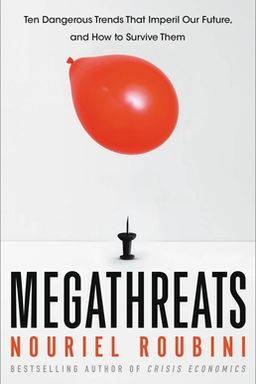
MegaThreats cover

MegaThreats

by Nouriel Roubini

MegaThreats explores ten critical global risks, including climate change and economic instability, challenging us to recognize and address these interconnected threats. Author Nouriel Roubini provides a compelling analysis and urgent call for innovative solutions to secure our future.

The Age of Megathreats

You live in a century defined not by a single crisis but by overlapping megathreats. In Megathreats, economist Nouriel Roubini—nicknamed “Dr. Doom” for anticipating the 2008 financial collapse—argues that the next era will not bring mild recessions but systemic shocks that interact: debt excess, stagflation, deglobalization, aging societies, technological upheaval, and climate catastrophe. These forces, once separate, now reinforce one another in a network of global fragility.

Roubini’s core argument is simple but sobering: the policy tools that saved the world in 2008 and 2020—cheap money, fiscal stimulus, and globalization’s efficiency—no longer work. The system itself has consumed its buffers. What used to be cyclical financial crises are now structural risks embedded in the global economy.

From easy money to systemic debt

Over two decades of low interest rates, quantitative easing, and fiscal expansion created a global debt supercycle. The world’s total debt surged past 350 percent of GDP by 2021, far above sustainable levels. Governments borrowed to smooth crises, corporations leveraged balance sheets to buy back stock, and households took on cheap mortgages. These trends produced asset booms but also fragility. Argentina’s serial defaults, Greece’s austerity nightmare, and U.S. pandemic stimulus show debt’s democratic reach: when rates rise, everybody feels the squeeze.

Interacting megathreats

Debt, demographics, and geopolitics reinforce one another. Aging societies (Japan, Germany, South Korea, and soon China) create fiscal strain through pensions and healthcare, shrinking tax bases and raising borrowing needs. Globalization—which once offset these pressures through cheap labor and trade growth—is reversing. Populism and protectionism dismantle supply networks, raising costs and inviting stagflation. Meanwhile, digital technologies like AI erode middle-class jobs and amplify inequality, which depresses aggregate demand and heightens political volatility.

Declining policy capacity

Roubini’s warning centers on lost policy space. Central banks stretched their mandates beyond price stability—into climate, employment equity, and national security—blurring fiscal and monetary lines. Massive balance sheets and zero or negative rates have removed dry powder. Inflationary pressures from deglobalization and geopolitics (for example, Russia’s war, U.S.–China decoupling) leave central banks trapped: hike rates and trigger defaults, or hold rates and lose credibility. Fiscal authorities still spend heavily, but unfunded promises—especially pensions—exceed what taxed economies can sustain.

Great stagflation and geopolitics

Roubini predicts a return to 1970s-style stagflation, intensified by modern debt and supply shocks. Aging populations, migration restrictions, resource nationalism, and decarbonization raise costs just as productivity slows. U.S.–China rivalry compounds the stress: sanctions, technology bans, and friend-shoring fragment trade and finance. The weaponization of currencies and sanctions undermines trust in the dollar, prompting countries to diversify reserves. The world now faces a “geopolitical economy”—where economic policy obeys security imperatives rather than market logic.

Technology and climate feedback

AI adds a double risk: economic inequality and existential uncertainty. As cognitive automation spreads, employment collapses across skills, weakening demand while enriching capital owners. Combined with climate shocks—floods, droughts, and migrations—the result could be mass social disruption. Climate change becomes both an environmental and financial crisis, as trillions in coastal assets and insurance markets face mounting losses. (Nordhaus estimates mitigation costs at 2–6 percent of global income annually; inaction costs many times more.)

The choice: dystopia or renewal

The book ends with divergence: either cascading collapse or deliberate reform. A dystopian path unites crises—defaults, inflation, authoritarian politics, war, and ecological decline. The more utopian path depends on coordination: innovation in clean energy, AI regulation, social safety nets, and multilateral cooperation on debt and climate. Yet Roubini doubts such alignment will arrive easily. For individuals, he urges pragmatic hedging—assets resilient to inflation and geopolitics—and civic engagement to demand structural reforms.

The defining message

You inhabit an era of accumulated risk, where past remedies now generate new fragilities. Roubini’s megathreats are not independent—they are a converging system poised to reshape global prosperity and security.

If you want to navigate this century wisely, you must read patterns across domains—not just finance or technology but the full web of causes—and act at both personal and political levels. The world no longer offers easy resets; only systemic understanding and adaptability can avert the mother of all crises.


Debt, Defaults, and Fiscal Fractures

Debt is the backbone of modern prosperity—and its potential undoing. Roubini traces how decades of policy created a global debt supercycle far beyond historical norms. Public and private debt now exceeds 350 percent of world GDP, leaving governments, firms, and households highly sensitive to rising rates.

The mechanics of fragility

Low interest policies (ZIRP, QE) made borrowing seem costless. Governments borrowed for stimulus; corporations used leverage for buybacks; households expanded credit to maintain living standards. When inflation returns, rates rise—and repayment costs explode. The result: even modest rate hikes can trigger cascading defaults and asset devaluation.

Bailouts and moral hazard

Policymakers rely on bailouts to prevent collapse. But bailouts breed risk-taking, as rescued institutions expect future salvation. Roubini recalls Argentina’s serial defaults and repeated IMF rescues that reset liquidity but never discipline spending. Zombie firms—kept alive by low rates and easy credit—now occupy large slices of advanced economies, reducing productivity.

Stealth defaults via inflation

Inflation and financial repression serve as indirect defaults. Governments tolerate rising prices or cap interest rates, eroding debt in real terms. Yet inflation transfers wealth from savers to debtors and risks runaway expectations. When currencies weaken or inflation expectations break, central banks lose credibility—forcing the harsh medicine of austerity or restructuring.

The policy trap

Every option—bailouts, defaults, inflation—carries pain. Bailouts save time but entrench fragility; defaults cleanse balance sheets but destroy confidence; inflation shrinks liabilities but ravages savings. Roubini calls for confronting structural mismatches early—maturity, currency, and capital structure—before they metastasize into sovereign crises. History shows waiting worsens costs.

A personal implication

If you treat high debt as abstract, remember: inflation erases your savings; defaults cripple credit availability; austerity cuts services you depend on. The macro economy’s balances eventually touch your daily life.

To prepare, monitor debt metrics and seek resilience: shorter-term exposures, diversified currencies, and real assets that retain value through inflationary resets. Fiscal integrity, once optional, has become a survival condition for stability.


Stagflation and Policy Exhaustion

You may think inflation and recession alternate—but Roubini warns they can arrive together as stagflation. When supply shocks hit an indebted world, the result is slow growth and high prices. The 2020s combine pandemic disruptions, war, demographic decline, and protectionism—a far more complex replay of the 1970s dilemma.

Eleven supply shocks

Roubini lists causes from aging populations and migration curbs to climate damage and geopolitical fragmentation. Production costs climb while innovation slows. Deglobalization and climate transition raise input prices. Cyberattacks and sanctions destabilize supply chains and finance. Inflation becomes embedded in expectations even as growth wanes.

The central-bank dilemma

Monetary authorities must choose between inflation control and debt stability. Tightening rates curbs prices but spikes debt service; easing preserves solvency but fuels inflation. With debt ratios near record highs, neither choice offers comfort. Roubini warns that “easy money” era illusions are over—policy tools are depleting just as structural headwinds rise.

Living with low growth and high volatility

Stagflation reshapes finance: stocks and bonds fall together, breaking the classic negative correlation. Portfolios relying on diversification lose protection. Employment becomes unstable as central banks oscillate between restraint and rescue. Political anger mounts when real wages shrink while asset owners hold inflated wealth.

Watching for the fault lines

You should track inflation expectations, commodity prices, and geopolitical flashpoints. Roubini suggests stagflation could emerge more deeply than the 1970s case, because debt now magnifies the economic pain. The next recession may combine financial and inflation crises simultaneously—a scenario few investors today have experienced firsthand.

Historical echo

Like the oil shocks and monetary missteps of Nixon’s 1970s, today’s supply chain fractures and geopolitical rivalries expose how easily policymaking loses anchor once real constraints collide with political expedience.

To adapt, accept that volatility is now structural. Balance portfolios for inflation resilience, and support institutions that rebuild fiscal space. Stagflation is not temporary—it’s the symptom of deeper systemic exhaustion.


Deglobalization and Rival Powers

Globalization once spread prosperity; now its retreat spreads risk. Roubini portrays deglobalization as both symptom and amplifier of global fragility: trade fragmentation, friend-shoring, technological decoupling, and geopolitical rivalry—especially between the U.S. and China—reshape the economic map.

From hyperglobalization to fragmentation

After decades of liberalization, the backlash hit. The “China shock” displaced millions of manufacturing workers, fueling populism and protectionism. Brexit, Trump-era tariffs, and European strategic autonomy reflect the new political economy: voters resist open trade when compensation fails. What began as economic adjustment became political revolt.

Technology and data nationalism

Global flows now hinge on data and technology. Restrictions on Huawei, TikTok, and semiconductors illustrate how intangibles define modern power. Baldwin’s concept of “globotics” shows even services now trade through telemigration, putting white-collar jobs at risk. Data localization laws fragment networks and raise costs, turning information into a geopolitical weapon.

US–China rivalry and Cold War 2.0

China’s Made in China 2025 plan and Belt and Road Initiative underwrite state-led dominance in AI, biotech, and green energy. The U.S. responds with alliances—Quad, AUKUS—and sanctions. Taiwan’s status, tech control, and financial sanctions mark flashpoints. Weaponizing finance, including dollar reserves, accelerates diversification away from Western systems. Geopolitics, not markets, now dictate economic outcomes.

Consequences for daily life

Expect higher import costs, slower growth, and politicized supply chains. Reshoring will use automation, not mass rehiring. Businesses must navigate parallel systems—Western and Chinese standards. For investors, it means regional portfolio segmentation; for policymakers, reduced globalization buffers make local shocks more potent.

Core reality

Deglobalization marks a world returning from efficiency to security—an expensive migration that raises inflation and geopolitical mistrust as the new normal.

To endure, plan for regionalization: siloed markets, differentiated technology regimes, and geopolitical currency competition. Global integration, once the stabilizer, now fractures into multipolar dependence.


Demographic Decline and Inequality

Behind fiscal fragility lies a demographic squeeze. Aging populations, low fertility, and longer lifespans rewrite social contracts. Roubini calls this the demographic time bomb—a slow-motion fiscal crisis that intersects with inequality and automation.

Shrinking workforces, rising promises

Pay-as-you-go systems depend on worker-to-retiree ratios that are collapsing—from 5:1 in 1960 toward 2:1 in coming decades. Programs like U.S. Social Security and Japan’s pensions face insolvency. Health care consumes 20 percent of U.S. GDP, while unfunded liabilities run into hundreds of trillions when future promises are counted.

The political impasse

Reform means raising taxes, cutting benefits, delaying retirements, or embracing immigration—each politically volatile. Aging voters wield power; younger workers bear costs. Wealth taxes provoke avoidance; payroll hikes punish labor. Immigration could rebalance demographics, but populism blocks it. The result: escalating fiscal ratios and intergenerational tension.

AI and inequality reinforce decline

Automation shrinks median incomes and demand while boosting capital income for elites. Studies (Frey and Osborne; Acemoglu and Restrepo) show nearly half of jobs face computerization risks, and each robot added reduces wages and employment locally. Declining labor share means aging societies rely more on investment than work—a fragile base for funding entitlements.

Social consequences

Combined, demographics and automation breed inequality and resentment. Falling consumption undermines growth, increases debt, and empowers populist movements promising easy fixes. (Martin Ford parallels this with a “demand collapse” scenario for capitalism.) Roubini advocates proactive redistribution—taxing capital, creating universal basic provision, and offering broad asset ownership—but doubts political will exists.

Warning

Ignore demographics and inequality, and the result is fiscal implosion disguised as political revolt. The future belongs to nations that rebuild labor and balance age with innovation.

To safeguard your own future, save more, diversify retirement instruments, and support structural labor reforms—delayed adaptation ensures harsher adjustments ahead.


Climate, Technology, and the Dystopian Web

Roubini ends by merging technological and environmental fronts into one systemic warning. Climate disruption and AI expansion form feedback loops that threaten not only economies but civilization’s cohesion.

Climate tipping points

Human activity drives irreversible damage: glaciers melt, seas rise, and coastal assets worth trillions face exposure. Adaptation and mitigation now cost hundreds of billions annually, and fossil fuel subsidies—$6 trillion in 2020—block progress. Politics lag behind physics: carbon taxes spark protests, rich nations underfund global aid, and time runs short.

Technology’s paradox

AI could aid climate solutions but also accelerate inequality and job loss. Decentralized crypto, DeFi, and CBDCs add monetary fragility and surveillance risks. Central banks assuming roles in climate and security stretch already weakened credibility. Technology thus multiplies instability: the same innovation that could rescue the planet may deepen its divides.

Feedback loops

Debt, inequality, populism, and environmental collapse interlock. Economic downturns stall green investment; disasters worsen fiscal positions; political anger erodes cooperation. The dystopian chain ends in migration crises, resource wars, and authoritarian resurgence. The National Intelligence Council’s Global Trends 2040 foresees possible state failures if feedbacks remain unchecked.

Paths to resilience

Reversing dystopia demands integrated reform: renew multilateral cooperation, regulate technology ethically, invest in adaptation, and broaden inclusion. Financially, diversify into inflation-protected, real, and green assets. Politically, back climate realism over denial, and internationalism over isolation. The window for rational coordination narrows quickly.

Final message

You stand where technological promise meets environmental peril. Whether these megathreats end in collapse or transformation depends on your collective capacity to act—not tomorrow, but now.

Roubini’s synthesis is grim yet mobilizing: systemic risk demands systemic reform. Utopian outcomes require realism, innovation, and courage in equal measure.


Hedging and Hope

Amid dread, Roubini insists on pragmatic optimism. Financially, you can hedge; politically, societies can still reform. But both require clear-eyed realism.

Your financial response

The classic 60/40 portfolio—stocks for growth, bonds for stability—fails when inflation rises and growth slows together. Rising yields crush bond prices while stagflation hits equities. Instead, rotate into short-duration government securities, inflation-protected bonds (TIPS), gold, and resilient real estate outside climate zones. Hold cash for optionality during deep recessions. These are not speculative moves—they are survival strategies in volatile regimes.

The public-policy dimension

The only sustainable fix, Roubini argues, lies in growth and cooperation. High productivity (through technological breakthroughs like fusion or biotech) could restore fiscal space. Redistribution—universal basic income, broadened capital ownership—could rebalance demand and reduce political stress. Global coordination on climate and data rules could rebuild trust.

Realistic optimism

Utopia is not naive optimism but disciplined innovation: cheap clean energy, ethical AI, efficient multilateralism. These paths remain hard but crucial. If the world can “grow its way out of danger,” as Roubini puts it, megathreats become manageable—yet without growth, every vulnerability compounds.

Core insight

Hope requires structure. You must both hedge personally and advocate collectively. Stability won’t emerge spontaneously—it must be designed, invested in, and defended.

Whether through balanced portfolios or global reform, resilience begins with realism. Roubini leaves you with neither despair nor comfort—but a call for disciplined prudence and long-range thinking that treats risk as a design challenge, not an accident.

Dig Deeper

Get personalized prompts to apply these lessons to your life and deepen your understanding.

Go Deeper

Get the Full Experience

Download Insight Books for AI-powered reflections, quizzes, and more.