
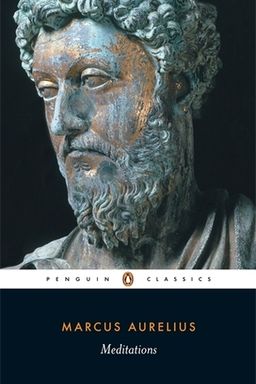
Meditations cover

Meditations

by Marcus Aurelius

Meditations by Marcus Aurelius is a timeless philosophical exploration of Stoicism, offering profound insights on death, justice, and the nature of the world. Through personal reflections, Aurelius guides readers to embrace life’s inevitable challenges with calmness and reason.

Living According to Nature and Reason

Have you ever wondered how to remain calm and purposeful in a world driven by confusion, desire, and constant change? In Meditations, the Roman emperor and philosopher Marcus Aurelius confronts this exact question. As the ruler of a vast empire, he faced war, disease, political intrigue, and personal loss—yet his reflections reveal an unwavering commitment to virtue, reason, and inner peace. Marcus argues that happiness and strength come from aligning yourself with nature’s rational order. Everything—even pain, death, and misfortune—becomes bearable when viewed as part of the universe’s plan.

Marcus Aurelius contends that the world operates according to reason, and since human beings are rational creatures, their fulfillment lies in acting according to this same reason. For him, philosophy is not an abstract exercise; it’s a daily discipline. It’s the practice of seeing through illusion—the false judgments, the fleeting emotions, and the restless desires—and living in harmony with what truly matters. He writes not as a distant scholar but as someone urging himself to stay anchored amid chaos.

The Core Argument: The Universe Is Orderly

Marcus begins with a striking premise: the universe is governed by an intelligent, divine order. Everything happens according to nature’s plan—nothing is random. To resist what happens is foolish, because it’s like fighting the laws of gravity. Instead, the wise person seeks to “live according to nature,” embracing both joy and hardship as part of the same grand design. Death, decay, and suffering are not evils but natural transitions. As he writes, “Whatever happens to every one of us is useful to the whole.”

This belief forms the foundation for his Stoic ethics. If the universe is rational, then the only true good is to live rationally—that is, virtuously. Everything else—health, wealth, reputation, pleasure—is indifferent. Good and evil are matters of choice, not circumstance. A person’s character, not their fortune, determines their happiness. Thus, Marcus’ meditations are reminders to act justly, to accept fate without complaint, and to look inward for peace.

The Inner Citadel: Protecting the Mind

One of Marcus’s most enduring metaphors is the “inner citadel,” the fortress of rational thought within you. While external events are beyond your control, your mind’s judgments are yours alone. If you guard this citadel—keeping your thoughts disciplined, just, and kind—no misfortune can truly harm you. He insists that even a slave could be freer in spirit than an emperor enslaved to desire or fear. In Book 4, he writes: “Retire into yourself, for there is nowhere more peaceful than your own soul.”

This psychological clarity gives Stoicism its emotional resilience. When anger or grief arises, the Stoic examines the impression beneath it. “What is happening inside me?” Marcus asks repeatedly. If suffering is just a perception—an opinion, not a fact—it can be transformed by reason. This approach parallels Epictetus’s teachings (whose writings Marcus studied diligently): while you cannot control what happens, you can control how you think about it.

Virtue: The Only True Good

Marcus defines four cardinal virtues—wisdom, justice, temperance, and courage. Living virtuously is both the path and the goal. Wisdom guides perception, justice governs action, temperance restrains desire, and courage sustains integrity amid adversity. Unlike modern pursuits of pleasure or success, Marcus’s virtue ethics demand daily self-examination: “The soul becomes dyed with the color of its thoughts.” You are what you continually think and do.

This idea connects strongly with other classical thinkers. Socrates saw virtue as knowing good; Aristotle saw it as living in accordance with reason and habit; and Epictetus taught that virtue is freedom from the tyranny of passion. Marcus unites these traditions into practical reflection: philosophy as action, not abstraction.

The Universal City: Brotherhood and Duty

In his Stoic cosmopolitanism, Marcus calls humanity “citizens of one universe.” Every person shares in divine reason, making us parts of one body. To act unjustly toward another is impious—a treason against nature itself. This belief shaped his leadership as emperor. He sought self-restraint, compassion, and fairness, reminding himself not to rage against “idle, curious, unthankful men” but to understand them. All wrong acts stem from ignorance; the Stoic teaches by example rather than vengeance.

Marcus’s political outlook contrasts sharply with Machiavelli’s worldly realism or Nietzsche’s will to power. Whereas Machiavelli values cunning and control, Marcus values cooperation and sincerity. True greatness, he insists, lies not in domination but in moral harmony: “To care for all men generally is agreeing to the nature of man.”

Why These Ideas Matter

Marcus Aurelius wrote Meditations as personal notes—not public teachings. His purpose was self-correction. Yet his private reflections have become timeless guidance for anyone seeking peace in an uncertain world. In an era of anxiety and distraction, his message feels modern: learn to dwell within reason, do good, accept what you cannot change, and remember that all things pass. You are a small part of a vast whole; your dignity lies in choosing goodness moment by moment.

Marcus Aurelius’s Central Principle

Live each hour as though it were your last, free from distraction, deceit, and self-hatred; tranquil in spirit, aligned with nature, and working for the common good.

That lasting serenity—the clarity of living well “in accord with nature and reason”—is the heart of Marcus Aurelius’s philosophy and the foundation for all that follows.


Mastering the Inner Citadel

For Marcus Aurelius, the mind is a fortress—the citadel of freedom and virtue. All pain, fear, and loss originate not in the external world but in our judgments of it. If you cultivate the ability to govern your thoughts, you become unconquerable. The emperor constantly reminds himself: “Keep thyself to the first bare and naked apprehension of things.” Events are neither good nor bad; they simply are. It’s your interpretation that adds pain or joy.

Understanding the Power of Judgment

Throughout Meditations, Marcus repeats that your opinion creates suffering. A delay, insult, or illness cannot harm your soul unless you grant permission. This echoes Epictetus’s famous dictum: “Men are disturbed not by things, but by the views which they take of them.” Marcus applies this practically—when criticized, he imagines the offender’s ignorance and reminds himself that virtue lies in patience, not retaliation. This perspective can help modern readers manage anxiety and anger by reframing emotional reactions as choices, not inevitabilities.

Freedom Through Discipline

Freedom for Marcus is internal discipline. In Book 6, he writes, “Whensoever thou art offended with any man, presently reflect upon thyself, and consider what thou thyself art guilty of.” Philosophy becomes a daily practice of self-scrutiny. The mind corrects itself by recalling reason’s authority—the recognition that the universe follows rational order. You achieve peace not by controlling fate but by governing your own moral responses. Marcus compares the mind to a millstone that grinds whatever comes to it but remains unchanged.

Practical Application

If you lose your job, encounter betrayal, or face illness, Marcus advises that you “remove thy opinion.” Say: Is this truly evil? Or has my judgment made it so? This practice transforms emotional turmoil into clarity. It allows you to act wisely even under pressure. Leaders, parents, and anyone facing everyday setbacks can use this method to maintain balance. Marcus himself faced revolts, disease, and the death of children—yet his writings remain serene. He accepted what he could not control and focused on justice, temperance, and gratitude.

Key Insight from Marcus

“Such is the power of opinion: what you imagine as suffering, you become enslaved by; what you perceive with reason, you transcend.”

Mastering your inner citadel means living with composure amid chaos. It’s the skill to see things as they are—not worse or better—and to act justly regardless. For Marcus, this mental sovereignty is the purest form of strength: peace that no empire, fortune, or fate can take away.


Practicing Stoic Virtue

Virtue, for Marcus Aurelius, is the essence of a good life. Everything else—success, pleasure, wealth—is transient and secondary. The emperor distinguishes four central virtues: wisdom, justice, courage, and temperance. To live rightly, you must embody these qualities in thought and deed. Virtue is not theory; it’s action performed in harmony with reason.

Wisdom and Self-Knowledge

Wisdom begins with understanding what is in your control and accepting what is not. Marcus often uses vivid examples: the body’s decay, the uncertainty of fame, the inevitability of death. “Whatsoever doth happen unto thee, it is that which from all time was appointed unto thee.” Recognizing this calms anxiety—you stop fighting nature and start cooperating with it.

Justice and the Common Good

Justice means acting for the benefit of others. In Book 9, Marcus warns: “He that is unjust is impious.” To harm another is to offend the universal order. He saw all people as parts of one organism—the universe itself. This belief underpinned his rule as emperor: fairness, humility, and compassion mattered more to him than conquest. For readers today, justice translates into empathy and respect: knowing that each person shares in the same divine reason.

Courage and Temperance

Courage is the strength to face whatever fate brings. Temperance is restraint—the refusal to be enslaved by pleasure or ambition. These virtues combined make you free. They are antidotes to modern restlessness: instead of chasing success or fearing loss, you act rightly and calmly. Marcus saw courage not as military heroism but moral endurance: to remain kind amid hostility and calm amid disaster.

When you practice these virtues daily, each moment becomes enough. You no longer depend on results or approval, only the integrity of your actions. That is Stoic ethics in motion: the perfection of character through reasoned choice.


Accepting Fate and Impermanence

Marcus Aurelius teaches that tranquility comes from accepting the impermanence of everything—from the briefness of life to the decay of empires. “All things that now are, have been heretofore, and so will be again.” This sense of impermanence shifts our focus from possession to participation. You are part of a cycle, not its master. The Stoic learns to love fate (*amor fati*).

Seeing Change as Nature’s Work

Everything in the world—the seasons, the body, the soul—moves through change. Marcus compares death to falling leaves or the setting of the sun. These transitions are not tragedies but natural acts. He writes, “Let thy death come with contentment, as one of the operations of nature.” Seeing life’s end as natural allows you to live without fear.

Fate and Providence

For Marcus, everything happens through divine reason or universal necessity. In either case—Providence or atoms—it’s irrational to resist. The same principle appears in the Bhagavad Gita, where Krishna advises serene acceptance of duty without attachment to outcome. Marcus takes this further: acceptance is freedom. To curse fate is to forget that your will is part of the same whole that governs the stars.

Practical Detachment

You can apply it by practicing detachment: seeing possessions, reputation, and even relationships as temporary gifts. This doesn’t demand cold withdrawal but mindful appreciation. As he wrote, “Everything fades and is soon covered by earth; even the earth changes.” In realizing that all things pass, your gratitude deepens, and your fear diminishes. You stop grasping and start living.

Emperor’s Reflection

“All things are ephemeral, and all things are mutable. Let death come as naturally as the falling of ripe fruit.”

Accepting fate transforms resignation into serenity. You live each day fully, aware that the present moment is enough. That simple clarity—embracing change as natural—is a cornerstone of Stoic peace.


Living for the Common Good

Marcus Aurelius insists that human beings exist for one another. To live selfishly is to act against nature’s design. “We are all made one for another,” he writes. This cosmopolitan vision sees society as one vast body. Each person is a cell within it, and virtue lies in cooperation, not conquest. Our moral health depends on harmony with others—just as physical health depends on harmony within the body.

The Nature of Community

Nature has made us rational and sociable. Therefore, injustice is impiety: to harm another is to violate the very laws of the cosmos. Marcus’s reflections on community anticipate modern social ethics and echo early Stoic thinkers like Chrysippus and Zeno, who imagined humanity as one city governed by reason. Your neighbor’s welfare is tied to your own moral character.

Practical Benevolence

Marcus’s compassion was pragmatic: to teach calmly, to understand ignorance, and to act kindly. “He that wrongs thee, wrongs himself,” he reminds himself in Book 9. When insulted, he asks: what must occur in that person’s mind to make them act so? Such reflection neutralizes anger. Leaders, partners, and citizens alike can apply this to avoid resentment and cultivate empathy.

Universal Brotherhood

For Marcus, the brotherhood of mankind transcends tribe, class, or nation. He envisions a “universal city” where rational beings cooperate according to natural law. This Stoic cosmopolitanism contrasts sharply with the competitive individualism of later philosophies. Like Confucius and the Buddha, Marcus sees compassion as wisdom in action—a daily discipline, not sentimentality.

Living for the common good means acting with justice and kindness wherever you are: in politics, family, or simple conversation. In seeing all humans as partners in nature, you participate in the divine harmony that Stoicism celebrates.


Mindfulness and Self-Examination

Marcus Aurelius’s daily practice was self-examination. He wrote Meditations as personal reminders—to check his thoughts, refine his motives, and return to reason. Philosophy for him was mindfulness in action: constant awareness of what he thought and why. This habit served as both moral compass and psychological therapy.

Daily Reminders

Each morning, Marcus prepared himself mentally: “This day I shall meet idle and unthankful men.” By anticipating obstacles, he reduced their power. Like Buddhist mindfulness, this self-awareness doesn’t suppress emotion but observes it. When anger or fear arises, you study it until the illusion dissolves. He teaches that inner examination builds emotional resilience—understanding before reacting.

Moral Accountability

Marcus never excuses his faults. He thanks his teachers, like Rusticus and Apollonius, for showing him humility and patience. He criticizes himself when tempted by pride or distraction. His tone is gentle but direct, a model of self-honest reflection. The goal is not perfection but progress: “If thou doest wrong, correct thyself presently.” This discipline prevents ego from growing unchecked.

Practical Use Today

You can adopt his method by writing or reflecting briefly each day: What did I do well? What did I fear? What did I avoid that I should have faced? This converts philosophy into practice. Modern psychology echoes this—journaling improves emotional insight and self-regulation. Marcus’s meditations thus remain a timeless manual for mental clarity and moral strength.

Marcus’s Reminder

“Let thy daily meditation be to examine thyself, not to accuse others.”

Self-examination turns your life into philosophy. Each day becomes an opportunity to shape virtue, strengthen reason, and align closer to nature. It’s mindfulness with moral purpose—the Stoic way to peace.


Seeing Life as Transient Beauty

Marcus Aurelius viewed life’s impermanence as its beauty. He finds elegance in the cracks of bread, the wrinkles of old age, and even decay. “Whatsoever is natural is pleasing and delightful,” he writes. This aesthetic acceptance turns ordinary life into meditation. You learn to see the divine harmony beneath imperfection.

Finding Beauty in the Ordinary

One of the most tender passages in Meditations compares ripe figs starting to shrivel with natural grace. Imperfection becomes proof of authenticity. This idea anticipates the Japanese concept of wabi-sabi—finding serenity in impermanence and imperfection. For Marcus, nature never creates ugliness; only ignorance makes us think it does.

Calm Acceptance

You can practice this perspective by reframing irritations: rust, wrinkles, or change mean that time moves as it must. When you see beauty in natural process, life’s hardships lose their bitterness. Marcus suggests that one who “considers all things with a profound mind” can “behold with pleasure even the proper ripeness and beauty of old age.”

Modern Connection

Modern mindfulness echoes this Stoic serenity. Jon Kabat-Zinn’s work on awareness and presence parallels Marcus’s view of contentment through observation. To live in accordance with nature means to enjoy—not resist—its rhythm. You find wonder not by escaping life but by seeing it wholly.

When you see beauty in transience, you no longer fear change. You begin to love the world exactly as it is—fleeting, imperfect, and whole.

Dig Deeper

Get personalized prompts to apply these lessons to your life and deepen your understanding.

Go Deeper

Get the Full Experience

Download Insight Books for AI-powered reflections, quizzes, and more.