
Idea 1
Meditation as Humanity’s Ultimate Freedom
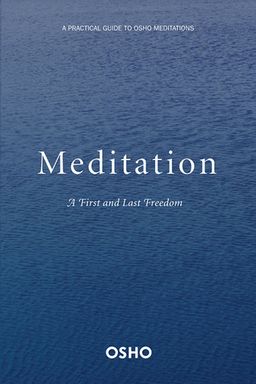
Have you ever wondered if true freedom comes not from political revolutions or social movements but from your own inner state of awareness? In Meditation: The First and Last Freedom, Osho argues that meditation is not merely a technique for relaxation—it is the deepest science of human transformation. He contends that meditation is both the first step and the final destination toward discovering who we really are. It does not depend on belief in gods or doctrines but on direct experience; you can be an atheist or agnostic and still meditate, because meditation is rooted in existential truth, not religion.
Osho’s central claim is bold yet simple: when thought pauses, you glimpse the eternal within. Meditation is not sitting cross-legged in isolation—it is learning to witness every moment, whether washing dishes, walking, or listening. By turning awareness inward, we shift from identifying with our thoughts and emotions to becoming the watcher, the witness, the quiet center of the cyclone. Here we discover a space untouched by turmoil or belief—a pure consciousness that is always free.
From Superstition to Science
Osho redefines meditation as a science rather than a superstition. He insists that the process has nothing to do with faith in God, soul, or heaven. Like a scientist unafraid of experimentation, you must test these truths yourself. Anyone—believer, doubter, or skeptic—can witness what happens when thought halts: the body and mind separate, revealing the infinite abyss that lies between. You emerge realizing that you, as consciousness, cannot die though the body may perish. This is not a creed but an experience that dissolves fear and dependence.
Meditation for the Modern Mind
The world Osho addresses is tense, restless, and over-stimulated. Modern people feel too busy, too anxious, too skeptical for traditional meditation, which seems slow and monastic. In response, Osho designed Active Meditations—dynamic, cathartic processes like Dynamic and Kundalini meditation—where you release pent-up energy through breath, dance, and movement until relaxation and stillness arise naturally. For the jet-age psyche weighed down by stress, these practices offer immediate breakthroughs: after effort comes stillness, after madness peace. Meditation becomes not a ritual but a spontaneous rhythm woven into daily life.
Freedom Through Awareness
At its core, Osho’s philosophy centers on awareness—what he calls witnessing. Every action, done with awareness, becomes meditation. Walking, eating, listening—if you remain alert, life itself turns sacred. Rather than fighting darkness or ego, you switch on the light of observation. Once you stop trying to improve yourself or conform to others’ expectations, self-acceptance opens the door to healing. Meditation gives this freedom—the only freedom that cannot be taken away—because it pulls you out of conditioning into direct consciousness.
The Journey and Its Promise
Across its many sections, Osho’s book guides readers through the nature of meditation, the flowering of love and silence, the physiological science behind techniques, and obstacles such as ego or mind tricks. Each chapter maps a stage of inner evolution—from chaos to centeredness, from doing to non-doing, from identification to pure witnessing. Ultimately, meditation leads to the fourth state beyond waking, dreaming, and sleep—the turiya consciousness of awareness itself.
You discover that bliss, compassion, intelligence, and creativity are not goals to seek but natural expressions of a silent center. By entering that center—the first and last freedom—you live spontaneously, joyfully, unattached yet deeply connected. This is Osho’s radical message: transformation requires no shoulds, no beliefs, and no escape from life. Meditation is both the experiment and the result, the seed and the flower. When awareness blossoms, you realize there was never any bondage—only forgetfulness of your own limitless sky.