
Idea 1
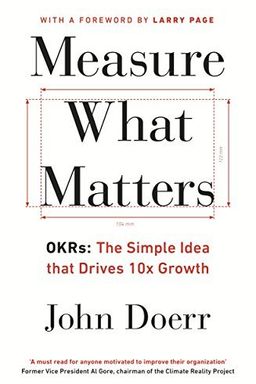
Measure What Matters: The Power of OKRs
What if you could make every goal at work crystal clear, align your entire team around it, and actually track progress in real time? That’s the question John Doerr tackles in Measure What Matters. Drawing from his experience with legendary companies like Intel and Google, Doerr argues that success ultimately depends not on the brilliance of your idea but on disciplined, measurable execution. His answer is deceptively simple: OKRs—Objectives and Key Results—a goal-setting system that unleashes focus, alignment, accountability, and ambition within teams.
Doerr’s thesis is that “ideas are easy; execution is everything.” Through stories of Andy Grove’s Intel, Larry Page’s Google, Bill Gates’s philanthropy, and even Bono’s activism, he shows how OKRs become the operating system for achievement. OKRs transform how we think about goals—from vague aspirations to specific, measurable outcomes—and encourage people to stretch beyond what seems possible. They structure how leadership works, how alignment is created, and how progress is measured and celebrated.
From Chaotic Goals to Clarity and Discipline
The story begins in the halls of Intel during the 1970s. Andy Grove, Intel’s brilliant CEO, developed a results-driven management approach built on one simple principle: focus on what counts. Peter Drucker had earlier proposed “management by objectives,” suggesting that organizations thrive when they set clear goals tied to measurable performance. Grove took Drucker’s philosophy and made it practical—he added “key results” so that progress wasn’t left to subjective opinions. The formulation was concise: an Objective is what we want to achieve; the Key Results define how we know we’re getting there.
When Doerr encountered Grove’s system as a young engineer at Intel, he saw more than a management tool—he saw a way to make complex organizations move in the same direction. Years later, he carried this system as a gift to a fledgling startup called Google. Larry Page and Sergey Brin, already obsessed with data and transparency, adopted OKRs enthusiastically, making them a cornerstone of Google’s culture. The results were extraordinary: the company scaled from a small garage team to a multibillion-dollar empire while keeping its teams aligned and focused. OKRs, Doerr insists, were critical in Google’s journey from chaos to coherence.
The Four Superpowers of OKRs
Doerr frames the book around four “superpowers” that define OKRs: Focus and Commit, Align and Connect, Track for Accountability, and Stretch for Amazing. Together, these abilities help an organization identify what matters most, synchronize efforts, measure progress honestly, and push boundaries. When people and teams use OKRs properly, they eliminate confusion, prioritize effectively, and stay motivated by visible progress. OKRs produce a rhythm of continuous learning—each quarter ending with reflection, adjustment, and renewed commitment.
Consider Google as the archetype of this discipline. Larry Page would personally review OKRs with engineers, asking uncomfortable questions like, “Why can’t this be twice as fast?” This culture of measurable accountability, Doerr argues, transformed aspiration into execution. Employees across levels knew not just what company goals were but how their own tasks contributed to them. That visibility created buy-in and motivation more powerful than incentives alone.
Beyond Business: OKRs for Philanthropy, Startups, and Social Change
Doerr expands the use of OKRs beyond Silicon Valley. In the Bill & Melinda Gates Foundation, key results like “reduce malaria deaths by 90%” gave abstract humanitarian ideals concrete routes to progress. At Bono’s ONE Campaign, OKRs made passion measurable: the organization could quantify advocacy success and accountability while shifting its culture to work collaboratively with African partners. Similarly, startups like Zume Pizza used OKRs to train their growing teams in discipline and teamwork, while the YouTube leadership team used them to chase “stretch goals” like achieving one billion hours of daily watch time.
By examining these diverse settings, Doerr shows that OKRs don’t just belong in corporate boardrooms—they work wherever people need to translate mission into measurable progress. OKRs fuse vision with execution. Whether it’s feeding a village or launching a new browser, the principle is the same: if you can’t measure what matters, you can’t manage it.
Why OKRs Matter in Today’s World
Modern work moves fast. Teams are global, hybrid, and constantly shifting. Traditional goal systems—annual reviews, vague benchmarks—can’t keep up. Doerr argues that OKRs offer the adaptability and clarity today’s economy demands. They replace top-down bureaucracy with transparency and collaboration. In a world where employee engagement is dangerously low (as Gallup frequently reports), OKRs create motivation through shared purpose and visible progress.
“Ideas are easy; execution is everything.” —John Doerr
Throughout Measure What Matters, Doerr fuses storytelling with practical frameworks. He gives you templates to write your own OKRs and guidance on how to grade them, align them across teams, and use them as conversation starters rather than management weapons. The message is both profound and simple: measurable goals built on trust and transparency can bridge the gap between dreaming and doing. In a noisy world overflowing with ideas, OKRs teach you how to make the things that matter most actually happen.