
Idea 1
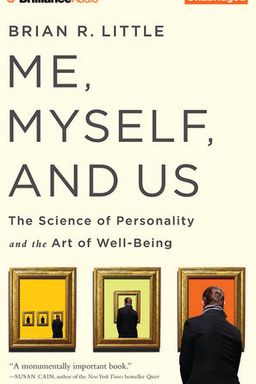
The Science of Personality and the Art of Well-Being
Who are you, really—and how do you become the person you most want to be? In Me, Myself, and Us, psychologist Brian R. Little invites you on a guided tour of the modern science of personality to answer timeless questions about identity, character, and happiness. Blending rigorous psychology with witty storytelling, Little argues that personality isn't fixed: it's a dynamic interplay between who we biologically are, the cultures that shape us, and the projects that give our lives meaning.
At its heart, Little’s claim is revolutionary in its balance—he contends that we have stable traits that shape our tendencies but also remarkable flexibility to act beyond those traits when our values and passions demand it. Drawing from decades of research and his own teaching at Harvard, Cambridge, and Carleton, Little maps how personality science changes the way we understand well-being: not as a static happiness to be attained but as an art of living that intertwines our biological dispositions, social environments, and deeply personal pursuits.
Understanding the Layers of Personality
Little organizes personality into three unfolding natures: our biogenic nature (genetic and physiological dispositions like introversion), our sociogenic nature (the norms and expectations of our culture and upbringing), and our idiogenic nature (the personal projects and values that define our individuality). These three forces converge to shape “who we think we are” and “who we try to be.” This trilogy of traits, culture, and commitments forms the foundation of personality science.
Through patient observation and humor—from the introverted professor hiding in a restroom after a lecture to the disagreeable executive finding solace in hockey—Little shows that we constantly shift among these layers depending on context and choice. Understanding this interplay, he suggests, is how we cultivate both authenticity and adaptability—the two pillars of well-being.
The Courage to Act Out of Character
Central to Little’s argument is the notion of free traits, behaviors we adopt voluntarily that don't match our natural tendencies but serve our deeper commitments. You might be an introvert who acts like an extravert to teach well or a tough-minded skeptic who behaves kindly to care for a loved one. These free traits—what he calls “acting out of character”—are where personality becomes art. We stretch beyond what we are for what we care about, often at a personal cost. This stretch, and the balance it requires, defines the human capacity for growth.
This idea expands personality science beyond trait psychology. While classic thinkers like William James claimed our character “sets like plaster,” Little believes we are “half-plastered”: partly shaped by biology but still remarkably capable of transformation through projects and purpose. In this view, personality isn’t fate; it’s agency expressed over time.
From Traits to Projects: The Architecture of a Life
Little’s research on Personal Projects Analysis reframes life not around static traits but around ongoing pursuits. These personal projects—“lose weight,” “write a book,” “be a better parent”—reveal how personality expresses itself through doing, not just being. Your happiness, he shows, depends less on the kind of person you are and more on the nature of the projects you pursue: are they meaningful, manageable, connected to others, and emotionally uplifting?
By studying how people phrase, structure, and evaluate their projects, Little illuminates the mechanics of motivation and the art of well-being. Successful projects merge meaning with efficacy; they balance realism with positive illusions; they link personal identity (“being me”) with action in context (“doing what matters”). When those align, our lives feel coherent and fulfilling.
Personality in Place and Time
From bustling cities to quiet gardens—or even digital landscapes like Facebook—Little extends personality science to environments. He contrasts Alexanderville (community-loving, harmony-seeking) with Milgramopolis (overloaded, frenetic) to show how cities and cultures nurture or strain different personalities. Whether in physical neighborhoods or online networks, well-being grows when environments fit our dispositions and values. His notion of “restorative niches” emphasizes this point: just as introverts need quiet corners to recover, every personality needs spaces that allow it to recharge.
The Well-Being of Pursuit
Little’s subtitle—The Science of Personality and the Art of Well-Being—is key. The “science” lies in empirical research: personality traits predict health, creativity, and longevity. The “art” lies in how we pursue projects and reframes when life demands change. Ultimately, well-being isn’t a destination or a permanent state; it’s an ongoing negotiation between stability and flexibility, control and hope. Little concludes, beautifully, that the most adaptive stance toward life is not certainty or perfection—but hope itself, the willingness to keep pressing our buttons while making sure they’re really hooked up.
Central Message
You are not fixed by your genes or your circumstances. You are shaped by your projects—by the things you choose to care about and pursue. If personality is the science of who you are, well-being is the art of cultivating that science wisely. Together, they form a life that is both meaningful and resilient.