
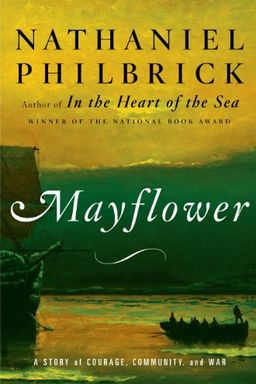
Mayflower cover

Mayflower

by Nathaniel Philbrick

Mayflower by Nathaniel Philbrick paints a vivid picture of the 1620 voyage that laid the groundwork for a nation. Experience the Pilgrims'' journey of faith, survival, and the complex relationships with native peoples that led to both cooperation and conflict, profoundly influencing American history.

Faith, Covenant, and the Birth of a People

At the heart of this book lies a question: how does faith turn into politics? You enter the story where belief is action—where the English Separatists of Leiden transform a theological conviction into a social blueprint that will become the foundation for New England. These men and women do not simply flee persecution; they carry a covenantal ideal across the sea, believing that their communal discipline will manifest God’s purpose.

The Pilgrims’ starting point is covenant theology. For William Bradford, John Robinson, and William Brewster, the congregation is a moral and spiritual unit responsible directly before God. Predestination defines status, but virtuous labor and self-control define witness. In Leiden, this produces tight organization: they worship apart, regulate conduct strictly, and see their fellowship as both spiritual and civic duty. That dual identity—religious body and political brotherhood—becomes the DNA of Plymouth Colony.

Exile and Practical Fear

Living in Holland gives them religious freedom but erodes their Englishness. Their children speak Dutch; economic hardships multiply; and war looms across Europe. Bradford and Robinson conclude that only emigration to America can preserve both faith and nationality. Richard Hakluyt’s writings reinforce the imagination of planting a reformed English church abroad. As they prepare to cross the Atlantic, this covenantal purpose fuses survival, reform, and identity into one project.

From Chaos to Compact

The voyage itself turns disorder into creative invention. When the Speedwell springs leaks and is abandoned, the Leideners crowd into the Mayflower with merchants and adventurers—the "Strangers"—who share no common faith. With factions rising and mutiny threatened, they draft the Mayflower Compact: a civil covenant that binds diverse peoples into a body politic under just laws. Signed by 41 men, it moves covenant theology into civic practice—linking religious self-discipline with political consent. In effect, faith becomes constitutional design.

Testing by Suffering

Once ashore, winter transforms conviction into endurance. Between December 1620 and March 1621, disease kills nearly half, including Bradford’s wife. Burial is secret to hide weakness. Yet the survivors turn care, mercy, and shared labor into a social theology: suffering as trial and purification. Miles Standish builds palisades; William Brewster leads prayer; and mutual service converts calamity into cohesion.

Diplomacy and Adaptation

Survival depends on negotiation with Massasoit’s Pokanokets. The 1621 treaty—mutual protections and return of fugitives—creates the first pragmatic alliance between English and Native nations. Squanto’s knowledge teaches the Pilgrims agriculture adapted to American soil (corn mounds with fish fertilizer, beans, and squash). The Pilgrims’ openness to learn contrasts sharply with Jamestown’s arrogance. Here, faith meets flexibility: religion defines community, but pragmatism ensures survival.

From Testimony to Legacy

This founding moment plants enduring seeds. Economic struggle soon pushes commercialization and land division; military needs yield fortifications and hierarchy; and diplomacy evolves into dependency. But you can trace the through-line—belief converted into system, covenant born of theology reshaping politics. Bradford’s Of Plymouth Plantation captures it best: that they knew they were pilgrims, and their journey gave meaning to endurance. In the centuries that follow, that consciousness grows into myth—the Puritan roots of American identity.


Conflict, Order, and Early Survival

You see Plymouth’s formative years as an experiment in governance and social engineering under relentless threat. The Pilgrims’ initial alliance with Massasoit stabilizes the colony, but scarcity tests their structures. Their first winter wipes out half the settlers; Bradford’s calm, Brewster’s faith, and Standish’s martial resolve preserve cohesion. To secure permanence, they turn to organization: palisades, militia companies, and communal labor bind identity to endurance.

Civic Religion and Practical Governance

Faith and law merge. The Mayflower Compact formalizes consent; Carver’s election as governor displays pragmatic unity across factions. Town meetings emerge, and punishments enforce discipline—Bradford seizing cricket balls from men playing during Christmas signals moral vigilance. You begin to see the fusion of spiritual and civil authority as survival’s tool, not ideology alone.

Privatized Innovation

In 1623, desperate after poor communal harvests, the Pilgrims divide land into private plots. Productivity soars as families cultivate for themselves. The change reflects adaptability over dogma: private property becomes moral labor’s reward. Economically it marks a pivot from communal religious economy to emerging capitalist ethos—proof that pragmatism drives success as much as prayer.

Social and Defensive Architecture

Fortifications mirror belief. An eight-foot palisade encloses Plymouth, converting covenant into visible protection. Houses line a central street, proximity enforcing mutual watchfulness. On Fort Hill rises the gun platform—symbol of divine and defensive vigilance. You can think of the settlement itself as a moral geometry: obedience inscribed in architecture.

Faith as Political Muscle

Bradford’s leadership shows theology as organizational strength. He interprets suffering as providential discipline and uses communal hardship to renew civic unity. (Compare this spiritual sociology to later frontier leaders who merge ethics and governance.) Early Plymouth thus becomes a laboratory where conscience, covenant, and craft produce a viable society amid collapse.


Trade, Land, and Moral Contradiction

From survival arises commerce. By the mid-1620s Plymouth’s fragile economy binds it to the Merchant Adventurers in London—Thomas Weston’s inconsistent support, Robert Cushman’s patents, and mounting debt reshape politics. Trade in furs, clapboard, and sassafras temporarily sustains them, but beaver decline and poor returns force new strategies. You see the birth of colonial capitalism under pressure.

Debt and Dependency

Loans to fund the voyage create obligations the colonists can barely meet. Ships such as the Fortune and others return modest cargoes. By 1626 the Merchant Adventurers dissolve and a few Plymouth leaders take over the debt, forming internal elites—Bradford, Allerton, and Standish—whose private responsibility gives them disproportionate power. Fiscal survival thus births hierarchy.

The Fur and Wampum Economy

Isaack de Rasiere introduces wampum as exchange medium; trading posts stretch northward along rivers to Maine. Howland and Alden operate remote settlements, exchanging English goods for beaver. But when trade wanes, land becomes currency. You watch an evolution: commerce generates diplomacy, and diplomacy enables dispossession.

Buying Land, Losing Justice

Roger Williams warns that Native lands must be purchased, yet Plymouth courts monopolize transactions—buying territory from Massasoit and others at unfair prices, often reselling for profit. (Note: this reflects a pattern of colonial legal manipulation—title replacing community tenure.) Land purchases, while framed as civility, mark moral erosion. Every sale deepens inequality and dependence between English and Native partners.

The Long Arc of Dispossession

Economic logic replaces covenantal ethics. Debt breeds exploitation: peaceful treaties mutate into instruments for land transfer. You begin to see the seed of later conflict—wealth accumulation rewriting the alliance born from survival. In Plymouth’s balance sheet, security costs justice.


War, Leadership, and Metacom’s Revenge

Three generations after the Mayflower, covenant fractures into war. The rise of Metacom (Philip) reveals the residue of unrepentant land theft, manipulated treaties, and the slow suffocation of Wampanoag autonomy. His father Massasoit’s alliance had protected Plymouth; his brother Wamsutta’s death during English interrogation in 1662 turns trust into grievance. What begins as a series of disputes explodes into the colony’s worst crisis.

Legal Humiliation

The murder of the Praying Indian John Sassamon in 1675 becomes the spark. English courts execute three Wampanoags after a dubious trial, asserting authority over people who were never English subjects. Philip sees humiliation rather than law; New England sees justice. That clash of legal worlds makes reconciliation impossible.

Escalation into Total War

Attacks at Swansea and other villages trigger massacres; militia retaliation turns brutal. Massachusetts and Plymouth deploy men under Josiah Winslow and Benjamin Church. Church begins inventing mixed tactics: small mobile units blending English firearms and Native stealth. His evolution into frontier fighter—quiet scouting, decentralized command—marks the turning point from European rigidity to American adaptation.

The Great Swamp Fight

In December 1675, a thousand English soldiers assault a Narragansett fort in a frozen swamp, killing hundreds and burning wigwams. It is both triumph and tragedy: tactical victory born of moral failure. English officers die, frostbite kills the wounded, and the act itself annihilates neutral allies. The incident reveals how fear converts faith’s discipline into vengeance.

Philip’s Death and Ambiguous Peace

By mid-1676, alliances fracture, Mohawk attacks destroy Philip’s camp, and Canonchet’s death ends Narragansett hope. Church’s small band captures Annawon and eventually corners Philip; the shot fired by Alderman, a Pocasset Indian, ends the rebellion. The war’s horror consumes one-third of the region’s Native population and cripples English finances. Covenant yields to conquest.


Mercy, Captivity, and Cultural Reflection

Amid war’s devastation, human narratives emerge—none more influential than Mary Rowlandson’s captivity story. Captured at Lancaster in February 1676, she endures marches through snow and starvation, interprets every moment through divine providence, and records it in a book that becomes colonial America’s first bestseller. Her testimony bridges experience and ideology: suffering made evidence of grace.

Captivity as Currency

Among Nipmucks and Wampanoags, captives are political assets. Rowlandson’s ransom is negotiated by Praying Indians like Tom Doublet and Peter Conway—proof that diplomacy threads through tragedy. Philip and Quinnapin bargain for coats, liquor, and corn; commerce and war intertwine. Through these exchanges, you see how humanity persists in conflict’s shadow.

Faith and Agency

Rowlandson prays, sews, and negotiates; she survives through spiritual resolve and adaptability. Her narrative balances Puritan fatalism with human observation—recording both cruelty and kindness. When Weetamoo shelters and feeds her, compassion crosses cultural lines. The text becomes moral allegory and ethnographic witness at once.

Parallel Suffering: Praying Indians

Christianized Natives suffer equal injustices. The Massachusetts government interned hundreds on Deer Island—many die of cold and starvation—while their survivors serve English armies as scouts. Job Kattenanit and James risk their lives as spies, proving loyalty despite persecution. With them, theology and prejudice collide: conversion did not guarantee respect.

Moral and Emotional Aftermath

Rowlandson’s account renews Puritan resolve but amplifies fear. Her story shapes memory: captivity as proof of divine testing, Indians as instruments of judgment. Through her lens, the personal becomes political mythology. You finish this part understanding that empathy and ideology coexisted uneasily—but both survived to define New England’s conscience.


Aftermath, Memory, and the Creation of Origins

When the smoke clears, numbers tell the cost. By 1676 most southern New England tribes have lost between sixty and eighty percent of their people through death, famine, and exile. Colonists face debt that lasts generations. Plymouth’s economic collapse leads to absorption into Massachusetts by 1692, ending its original autonomy. The Puritan experiment—founded on covenant—becomes politically dependent.

Demographic and Economic Shock

About 2,000 Natives die in battle, 3,000 of disease, and 1,000 are sold into slavery; survivors flee north. Plymouth loses nearly 8 percent of adult men; towns lie burned, treasury empty. Trade collapses, land value concentrates in Boston investors. The region’s recovery spans a century. This economic aftershock closes the loop from religious ideal to pragmatic subordination.

Mythmaking and Commemoration

Memory rebuilds meaning. Bradford’s Of Plymouth Plantation, rediscovered and canonized, sanctifies the Pilgrim story; Benjamin Church’s Entertaining Passages turns brutal frontier warfare into legend. Plymouth Rock becomes symbol, Forefathers’ Day institutionalizes reverence. National identity absorbs moral trauma as divine origin.

Alternative Memory and Resistance

Later writers like William Apess reframe the narrative: Philip as hero, dispossession as injustice. Native oral traditions keep tragedies alive, reclaiming Thanksgiving as mourning. Their voices remind you that every founding myth hides multiple truths, and that the Pilgrims’ covenant contained seeds of conflict as well as community.

Enduring Lesson

The book closes where it began—with faith transformed into politics and then into memory. You recognize in Plymouth’s saga both miracle and moral compromise: a disciplined people who survived by covenant, adapted through pragmatism, conquered by necessity, and commemorated by myth. Their legacy teaches that every beginning carries its own caution—that ideals can inspire a nation but also justify its contradictions.

Dig Deeper

Get personalized prompts to apply these lessons to your life and deepen your understanding.

Go Deeper

Get the Full Experience

Download Insight Books for AI-powered reflections, quizzes, and more.