
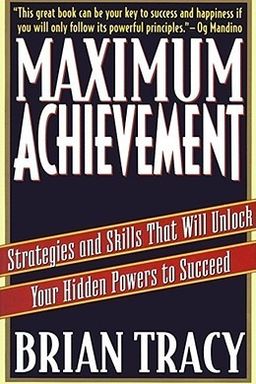
Maximum Achievement cover

Maximum Achievement

by Brian Tracy

Maximum Achievement is your step-by-step guide to unleashing your hidden powers and achieving success. Brian Tracy offers practical exercises to boost self-esteem, enhance performance, and set strategic goals for personal and professional control.

Reprogramming the Mind for Total Success

How can you deliberately design a life of fulfillment, wealth, health and peace instead of leaving it to chance? Brian Tracy’s philosophy centers on one radical assertion: you become what you think about most of the time. The mind, he argues, is both the cause and the cure of every human outcome. Success is not luck—it’s the inevitable result of aligning your thoughts, emotions and actions with universal mental laws.

Tracy builds an integrated system where psychology and practicality meet. He teaches that your self-concept—the sum of your beliefs about who you are—is your inner “master program.” Everything you achieve, tolerate or avoid flows from it. To reprogram this mental software, you must align three intelligence systems: the conscious mind (your selector), the subconscious mind (your processor) and the superconscious mind (your creative source). Each responds predictably to input, emotion and repetition.

The Master Idea: You Can Recode Your Self-Concept

Your self-concept is the filter that determines what you attempt and how much you persist. Tracy divides it into three layers: self-ideal (the person you want to become), self-image (how you see yourself now) and self-esteem (how much you like yourself). To grow rapidly, you must close the gap between self-ideal and self-image while enhancing self-esteem through achievements, affirmations and self‑liking. The phrase “I like myself” is repeated because self-approval is the emotional key that unlocks competence and resilience.

Natural Laws That Govern Mental Mastery

Tracy identifies seven universal laws of the mind—like gravity for thought—that explain why similar patterns keep recurring until you change the cause. The Law of Control ties happiness to a sense of agency. The Law of Cause and Effect states that every result has a precise antecedent cause—your repeated actions and attitudes. The Laws of Belief and Expectation show that you literally generate outcomes according to what you inwardly expect and believe. Laws of Attraction, Correspondence and Mental Equivalency reveal that your outer circumstances echo your inner imagery: what you dwell on expands.

You’re always broadcasting mental signals that attract results in harmony with your dominant vibration of thought. Therefore, to transform outcomes you must substitute better mental equivalents: positive self-images, powerful expectations, and focused goals charged with emotion.

Harnessing the Subconscious and Superconscious

Your conscious mind programs, but your deeper minds perform. Tracy visualizes the conscious as a small golf ball resting on a basketball—the massive subconscious beneath it. By repeated suggestion, visualization, relaxation and emotional reinforcement, you can feed precise commands that become automatic behaviors. Relaxation accelerates this conditioning (as shown by pioneers like Emile Coué and Georgi Lozanov). But beyond even the subconscious lies the superconscious: the source of intuition, inspiration and genius. When you clarify a goal, saturate your mind with data, then release tension and trust, the superconscious responds with insight—often in dreams, showers, or flashes of intuition. Examples range from Archimedes’ “Eureka” to Tracy’s own spontaneous insights during speeches.

The Discipline of Goals, Habits and Responsibility

Once thinking is reordered, results require motion. Goal setting acts as the focusing lens that turns scattered energy into precision laser. Tracy’s twelve-step goal formula—desire, belief, clarity, deadlines, written plans and persistent action—sharpens performance. Success then hardens into habit through the laws of habit and practice: repeat new patterns until they become easier than old ones. Because emotion fuels behavior, reinforce desired habits with joy, not guilt.

Everything begins with one “master decision”: take complete responsibility. The instant you stop blaming circumstances, you regain control and therefore freedom. Responsibility collapses stress and converts reactive complaint into constructive action. It is the linchpin of mental maturity.

Emotional Mastery, Relationships, and Love

Negative emotion, not lack of opportunity, causes most failure. Anger, guilt and resentment poison the nervous system and block creativity. Through forgiveness—of parents, others, and self—you disengage from the past. The Law of Substitution lets you replace destructive feelings with affirmations like “I am responsible.” Stress, too, dissolves when you act rather than worry.

At the social level, success depends on relationship mastery. Tracy’s Law of Indirect Effort says: treat others as valuable to gain cooperation. Listening, appreciation, acknowledgement and empathy expand your influence. These same principles govern families and parenting: unconditional love, specific praise, and thoughtful communication forge strong self-esteem in children.

The Journey to Love and Fulfillment

The book closes by linking achievement to love—the ultimate creative force. Self-love generates confidence and compassion; love of others builds connection; universal love harmonizes you with life itself. Asking “What is the most loving, honest and wise course now?” becomes a daily compass. As you act lovingly, you attract success, peace, and vitality.

Tracy’s overall message is empirical spirituality: thought, emotion and action obey precise laws. When you master those inner laws—by clarity, repetition, forgiveness and love—you master results. Success then shifts from luck to science, and happiness from wish to practice.

Across its chapters, the system builds upward: define your self-concept, align with mental laws, program the subconscious, set goals, form habits, take responsibility, forgive, love and serve. Each stage reinforces the next until personal mastery becomes not only possible but predictable.


The Power of Self-Concept

Brian Tracy treats the self-concept as your internal master program—the deepest determinant of behavior and performance. It is a bundle of beliefs, images and emotions about who you are. You perform in harmony with this internal script, never permanently rising above or falling below your own self-image. Alter the script, and results inevitably follow.

Three Parts of the Self

Your self-ideal defines the person you want to be—your mental target. The self-image is how you currently see yourself in daily action, while self-esteem reflects how much you like and trust yourself. Lasting growth requires nurturing all three simultaneously: clarify the ideal, visualize yourself closer to it, and build esteem through daily achievements and affirmations.

Tracy summarizes performance with a compact formula: (Inborn Aptitude + Acquired Ability) × Attitude = Performance. Attitude multiplies everything else. Even ordinary marksman skill, when powered by belief and enthusiasm, outperforms genius under pessimism.

How It Forms and How to Rewrite It

Your early environment writes the first version of your self-concept. Parents, teachers and peers transmit permissions and prohibitions—often through subtle emotional signals such as withheld affection. Many adults live inside programs written by childhood criticism. Tracy illustrates this with the laborer who broke his family’s “we’ve always been laborers” belief, retrained into sales, and multiplied his income after replacing inherited labels.

Fortunately, what was learned can be unlearned. The same mechanisms that created the old program—repetition, emotion and suggestion—can reprogram new patterns. Visualization, affirmations and emotionally charged goals create new neural “grooves.” Within three weeks, consistent repetition begins to replace fear with confidence.

From Limiting to Liberating Beliefs

Two common negative programs dominate: inhibitive (“I can’t”) and compulsive (“I must”). Both originate in childhood attempts to earn acceptance. The cure is conscious contradiction through affirmations like “I like myself” and “I can do it.” Tracy distinguishes this healthy self-liking from arrogance—it is self-trust, not superiority.

“You are where you are because of what you believe yourself to be.” Alter that belief and reality recalibrates itself around your new image.

Through constant internal rehearsal—speaking kindly to yourself, visualizing success, acting as if confident—you rewire your master program. The process is mechanical but the results feel miraculous: new confidence, better relationships, and rapid external improvement.


Universal Laws of the Mind

Tracy presents seven governing principles—mental laws that determine success as predictably as physics controls flight. By understanding and cooperating with these laws, you can engineer positive outcomes rather than rely on chance.

The Law of Control

You feel good to the degree you feel in control of your life. Internal locus creates serenity; external locus produces stress. Regain control by taking responsibility for your thoughts and reactions—walking away from situations that erode autonomy.

Law of Cause and Effect

Every result springs from a specific cause. Trace failures to their behavioral roots, adjust the causes, and effects will change. This law underpins practical success: repeat the selling behaviors that yield closed deals, not wishful thinking.

Belief, Expectation and Attraction

You do not see reality directly—you see through your beliefs. Strong belief converts possibilities into certainties. Expectations act externally: treat people as competent and they rise, as Robert Rosenthal’s Pygmalion study proved. The Law of Attraction extends this principle to opportunities—you magnetize experiences consistent with your dominant thoughts.

Correspondence and Mental Equivalency

The world mirrors your inner state: “As within, so without.” Construct a rich inner picture and outer conditions match it. The Law of Mental Equivalency demands emotional intensity—ideas must be charged with feeling to materialize. Construct detailed mental blueprints and act consistently until they solidify into form.

When you combine belief, expectation and vivid thought with persistent action, you set off a chain reaction of self-fulfilling events. Mental laws are impartial—they work for success or failure depending on your input.

The key is deliberate use: monitor beliefs, set empowering expectations, visualize desired outcomes daily, and replace hopeless thoughts with images of achievement. Over time, your external reality synchronizes with your internal programming.


Programming the Subconscious Mind

The subconscious is your internal factory—silent, tireless, and literal. It does not judge commands; it executes whatever your conscious mind accepts as true. Tracy teaches that most people let accidental inputs shape their subconscious. You can reverse this by feeding it deliberate instruction through affirmations, visualization and emotion.

Three Laws of Subconscious Work

The Law of Subconscious Activity states that any idea you emotionally accept is acted upon automatically. The Law of Concentration ensures what you dwell on expands. And the Law of Substitution offers the fastest control mechanism: since only one thought can occupy consciousness, deliberately replace negatives with positives.

Visualization strengthens these laws. Tracy emphasizes four dimensions—frequency, vividness, intensity and duration. Daily, emotionally charged images teach your subconscious new patterns (e.g., the Toastmasters who visualize speeches repeatedly until confidence replaces fear).

Tools for Reprogramming

Write goals in the present tense; review them morning and night. Speak them aloud while visualizing success. Record affirmations with soothing background music to bypass the conscious critic. Relax while doing so: under the Law of Relaxation, mental effort sabotages results; calm expectancy accelerates them.

Techniques from pioneers like Emile Coué (“Every day, in every way, I’m getting better and better”) and Georgi Lozanov’s accelerated learning demonstrate the speed of conditioned suggestion when the mind is relaxed. Tracy’s “End-of-Movie” method encapsulates this: vividly imagine having already achieved your goal, feel the satisfaction, release the thought, and let your subconscious fill in the steps.

Treat mental programming as daily hygiene. In minutes each morning, visualize achievements, affirm confidence, and feed your mind with uplifting input. Over weeks, invisible change becomes unmistakable results—the subconscious converts mental film into lived experience.


Goal Setting and Continuous Action

Tracy calls goal setting the master skill of success. It converts vague wishes into directives for your subconscious and superconscious to act upon. Without goals, you drift; with them, you engage purposefully with reality.

The 12-Step Goal Method

His systematic process has twelve essential stages: decide what you want intensely, believe it's possible, write it down, clarify your reasons, assess start point, set deadlines, list obstacles, identify information and people you need, design a plan, visualize success, and act persistently. Each step aligns the mental laws previously discussed. Written goals especially activate the subconscious—they transform desires into tangible commitments.

In one dramatic example, a couple applied the method to marry at Robert Schuller’s Crystal Cathedral and honeymoon on the Love Boat. Despite scant funds, disciplined focus and expectation produced serendipitous commissions and scheduling miracles. The moral: clarity plus persistence organizes invisible help.

Maintaining Momentum

Momentum compounds like interest. Follow Newton’s logic—once moving, continuation is easier than restart. Daily micro-actions (“Do something every day that moves you forward”) create unstoppable force. Where fear kneecaps progress, smaller believable goals rebuild self-trust and expand ambition over time.

Finding Your Major Purpose

Tracy offers seven self-interview questions—about values, mortality, dreams, and impossible wishes—to unearth your overriding purpose. Once chosen, align goals and schedules to it. Congruence between values and goals produces tranquility; conflict breeds stress.

Written, specific, time-bound goals trigger a self‑governing success mechanism. Take one step daily and momentum guarantees arrival.

Goal setting gives direction to mental energy, transforming confusion into calculation. It’s how ordinary people achieve extraordinary outcomes through organized persistence.


Habits, Emotion and the Comfort Zone

Habits automate nearly all behavior—roughly 95% of what you do daily. Because repetition structures the brain, change means building new patterns until they overwrite the old. Tracy combines Newtonian physics with psychology: objects (and people) in motion remain in motion unless acted upon by opposing habit.

The Laws of Habit and Practice

The Law of Habit holds that repeated responses become automatic. The Law of Practice adds that each repetition makes the new action easier. The fusion teaches hope: any attitude or skill can be developed intentionally through persistent rehearsal. Start small—lose five pounds, make one sales call—then escalate difficulty as confidence builds.

Emotion as the Fuel

Thoughts alone rarely sustain behavior; emotion powers persistence. Two primary motivators dominate human life: desire and fear. Most people live in avoidance of fear rather than pursuit of desire. To break stagnation, strengthen desire with vivid reasons why you want the change, and use substitution to redirect fear toward constructive action.

Expanding the Comfort Zone

Comfort zones maintain equilibrium but halt growth. Tracy warns of psychosclerosis—hardening of attitudes. The cure: deliberate discomfort. Each time you stretch into the unfamiliar—public speaking, negotiation, exercise—you enlarge what feels normal. Eventually, higher performance becomes automatic.

Attach emotion to new habits, practice them until effortless, and embrace temporary discomfort—this triad ensures durable transformation.

Master your habits and emotions, and freedom replaces fear. You cease oscillating between guilt and procrastination and move steadily toward chosen goals.


Responsibility, Forgiveness, and Emotional Freedom

The single greatest leap toward adulthood, Tracy insists, is the decision to take complete responsibility for your life. Responsibility equals control, and control equals freedom. The opposite—blame—locks you in helplessness.

From Victim to Master

Accepting responsibility means acknowledging that your thoughts, not circumstances, create your emotions and outcomes. Saying “I am responsible” reframes anger into agency. This single affirmation disrupts negativity in seconds. Tracy recounts discovering this shift at age twenty, when he stopped blaming employers for his failures and began setting goals.

Defusing Negative Emotions

Anger, guilt, jealousy and resentment derive from four triggers: justification, identification, lack of consideration and blaming. Each can be broken by the Law of Substitution—replacing destructive thoughts with constructive ones. Remember: the conscious mind holds one thought at a time; crowd it with positives and poison dissipates.

The Power of Forgiveness

Forgiveness is not sentimental; it is pragmatic. The Law of Forgiveness states you are healthy to the degree you can forgive and forget offenses. Holding grudges keeps negative chemistry alive. The recommended three-part process: forgive parents, forgive everyone else, and forgive yourself. Writing and mailing an honest forgiveness letter, as in the businessman story, often produces immediate relief and restored energy.

Forgiveness is an act of enlightened self-interest—you do it to free yourself, not to absolve others.

The combination of responsibility and forgiveness transforms emotional life. You stop reacting and start creating. Inner calm returns as love replaces resentment, allowing the higher mind to operate freely.


Peace of Mind and Stress Mastery

Peace of mind stands as Tracy’s ultimate success indicator. Without inner calm, wealth or power lose meaning. Stress, he explains, is not imposed—it is a chosen interpretation. Once you claim responsibility for how you respond, you regain psychological immunity.

Sources of Stress

Seven main sources recur: worry, loss of purpose, unfinished business, fear of failure, fear of rejection, denial and anger. Each reflects misdirected thought energy. Worry wastes imagination on negatives that seldom occur; denial magnifies them by avoidance; anger physiologically poisons the body through sustained adrenaline.

Practical Stress Tools

The four-step Worry Buster turns anxiety into problem-solving: define the worry, state the worst case, accept it if necessary, and act to make it less bad. Action dissolves fear. Completing lingering tasks also restores focus and energy by removing “open loops.”

Anger must be discharged physically and constructively—hit a bag, run, shout—so its chemistry clears without harming others. Finally, confront rather than evade unpleasant facts; pay small emotional prices early instead of crisis prices later.

Peace is not passive. It is persistent engagement with reality combined with emotional control.

By substituting worry with purposeful action and resentment with acceptance, you maintain serenity amid task and tension. Peace becomes your operating baseline rather than a vacation from turmoil.


Relationships, Parenting, and Social Success

Eighty-five percent of life success, Tracy asserts, stems from how well you work with people. Social intelligence amplifies all other skills. His Law of Indirect Effort reveals that you win respect, love and cooperation indirectly—by giving them first.

Practical Relationship Behaviors

Make others feel important. Use acceptance, appreciation, approval, admiration and attention. Smile genuinely, thank frequently, and give specific praise (“I liked how you handled that meeting”). Listen actively: face the person, pause before responding, ask open questions, and paraphrase feelings. As Dale Carnegie’s story illustrates, talking less and listening more makes you unforgettable.

Love and Partnerships

Successful couples share core values and commitment. “Burning bridges” behind the decision to stay deepens trust. Rekindle affection by acting the loving behaviors you practiced when courting. Self-concept compatibility matters—high‑esteem partners reinforce each other.

Parenting by Love and Example

Children adopt self-concept models from parents, not lectures. Unconditional love, consistent praise and respectful communication forge secure adults. Eliminate destructive criticism; correct behavior through encouragement and clear expectations. Spend unbroken time daily with children, apologize when wrong, and make them feel heard. “Children learn what they live” becomes a practical rulebook.

Love expressed as respect, attention and consistency is the most powerful educational method ever discovered.

Whether leading teams or families, giving others dignity and belief multiplies influence. As you raise esteem around you, your own rises in return—a compounding cycle of goodwill and success.


Love as the Ultimate Mastery

At the summit of Tracy’s model stands love—the binding energy of all personal mastery. Whereas other sections teach mechanism, this final principle teaches motive. Love is both the goal and the means of alignment with all mental laws.

Three Dimensions of Love

He distinguishes among Eros (self-love), Philia (love of others) and Charis (universal goodwill). Self-love is foundational: you cannot give what you don’t possess. Affirm “I like myself” daily—not as narcissism but affirmation of worth. Outward love follows naturally via compassion, appreciation and service.

Love and Mental Law

When loving energy drives beliefs and expectations, all other laws amplify. The Law of Correspondence insures that an inner atmosphere of love mirrors as harmonious conditions externally. Love dissolves fear—the fundamental negative emotion—and activates forgiveness, creativity and intuition simultaneously.

Love as Daily Practice

Ask continually: “What is the most loving, honest and wise thing I can do right now?” Answer through behavior: listen, praise, bless even adversaries. Use substitution—respond to irritation with a blessing. The act of love alters biology, reduces stress, and magnetizes support.

Love transforms moral principle into operational strategy—it reinforces every mental law while ensuring peace and fulfillment.

Through repeated loving acts—kind speech, forgiveness, gratitude—you complete Tracy’s circle: your master program now runs on unconditional goodwill. External success then becomes the reflection of inner harmony, the true state he calls self‑mastery.

Dig Deeper

Get personalized prompts to apply these lessons to your life and deepen your understanding.

Go Deeper

Get the Full Experience

Download Insight Books for AI-powered reflections, quizzes, and more.