
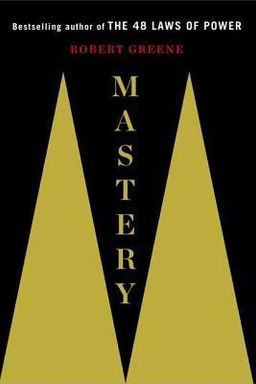
Mastery cover

Mastery

by Robert Greene

In ''Mastery,'' Robert Greene distills the essence of achieving excellence by emulating the steps of historical and modern masters. Drawing from interviews and studies, Greene presents actionable strategies for discovering your calling, learning under mentors, and cultivating innovative thinking. This book is a guide to transforming potential into mastery, regardless of your starting point.

The Evolutionary Path to Mastery

What separates those who create timeless innovations from those who remain competent but ordinary? In Mastery, Robert Greene argues that mastery is not a gift reserved for the few but a biological potential within everyone. It is a return to the deepest human nature—our species’ capacity for learning through immersion, imitation, and long practice. Greene views mastery as the highest form of intelligence: a fusion of rational analysis and spontaneous intuition that arises after years of deliberate engagement with reality. This book outlines how you can awaken that latent power through a structured progression of transformation.

Across history—Darwin charting natural life aboard the Beagle, Leonardo dissecting cadavers, or Einstein visualizing light beams in his mind’s eye—Greene finds a repeating pattern. Masters pass through three phases: Apprenticeship, Creative-Active experimentation, and finally, the organic intelligence of Mastery. He merges biography, neuroscience, psychology, and ancient craft models to show that the brain itself is designed for this process. Mastery is not luck or innate genius—it is earned plasticity.

From Instinct to Discipline

Greene begins with the observation that childhood curiosity—what he calls the “Original Mind”—is naturally expansive, intuitive, and flexible. But as adults, social demands narrow attention into conformity, and we lose that openness. To recover creative power, you first need to connect with what Greene calls your Life’s Task: the work that corresponds to your inner seed, the unique inclination glimpsed early in life. That task acts as the emotional engine of your long journey; without it, persistence collapses under frustration.

Masters from Einstein to Curie follow this pulse. Einstein’s boyhood fascination with a compass or Curie’s childhood awe at lab instruments became guiding beacons decades later. Your first step, then, is rediscovery—listening to those original fascinations and aligning them with career choices that leverage individuality instead of suppressing it.

The Three-Stage Path

Once the Life’s Task is found, Greene maps a three-phase path of development. First, the Apprenticeship: a long, patient submission to reality and skill. Modeled after the medieval craft guilds and Darwinesque field study, this stage emphasizes deep observation, repetition, and hands-on testing. You learn the rules, internalize minute details, and accumulate tacit knowledge until actions become reflexive. It is not glamorous work—it is ritualistic tedium that rewires neural circuits for precision.

Second comes the Creative-Active phase, where fluency turns to creativity. Now you push boundaries, combine domains, and manufacture productive tension. Greene uses Mozart, Edison, and Ramachandran to show how originality evolves from mastery of basics, not defiance of them. You embrace uncertainty (Keats’s “Negative Capability”), alternate focus with incubation, and encourage serendipity—the accidents that reward prepared minds.

Finally comes Mastery itself: the emergence of “fingertip feel.” Greene describes this as fluid intuition—a seamless fusion of analytical thought and embodied instinct. Leonardo’s hand, Faraday’s experiments, or Bobby Fischer’s pattern-sensing chess mind illustrate this state. Here, the instrument or domain becomes an extension of your nervous system. The Master perceives patterns invisibly; decisions occur at the speed of insight, not deliberation.

Supporting Pillars: Mentorship, Social Intelligence, and Time

Across all phases, several consistent supports appear. A Mentor accelerates learning through guided feedback—Faraday’s apprenticeship to Davy or Jung’s relationship with Freud illustrate the catalytic exchange between experience and youthful intensity. Yet, as Greene warns, mentorship must end in metaphorical separation (“al maestro cuchillada”)—cutting the master to step into autonomy.

Equally crucial is Social Intelligence. Without understanding people—their envy, politics, and self-interest—you dissipate energy in drama. Franklin’s London experience showed how misreading motives breeds failure; discernment preserves your creative focus. And throughout everything, there is time. Greene stresses that mastery is a re-education of our relationship to time itself. The brain matures through slow accumulation, and shortcuts rob us of depth. Seven to ten years of deep work recreate the patient, hunter-gatherer attention our species evolved for.

The Dimensional Mind and the Future of Creativity

The culmination of Mastery is what Greene calls the Dimensional Mind—a mind that integrates disciplined knowledge with the open curiosity of childhood. Mozart’s reimagining of opera in Vienna, combining rigorous skill and inner play, exemplifies this end state. The Dimensional Mind transforms knowledge into living form—it shapes new realities rather than reacting to old ones.

“Mastery is the ability to see reality more clearly, to make rapid creative decisions based on deeply internalized pattern recognition.” – Robert Greene

Across its narrative, Mastery is both a manual and an anthropology. It shows that the capacity for deep skill, intuition, and creativity is our evolutionary calling. Your task is to align your life around that process—to select the authentic problem that stirs you, apprentice yourself to reality, endure the long climb, and emerge with an intelligence that feels instinctive because it is earned. In Greene’s vision, this is the modern path to personal power and the creative renewal of civilization itself.


Discovering Your Life’s Task

Your path to mastery begins before you ever pick up a tool: it starts with rediscovering who you are. Greene calls this inner compass your Life’s Task—the activity that aligns your natural inclinations, early fascinations, and deepest psychological drives. This is not a romantic “passion” but a biological fit between temperament and task. When you find it, the long years of effort ahead become sustainable; when you ignore it, burnout or mediocrity follows.

Return to Origins

To find your Life’s Task, Greene urges you to re-examine your childhood fascinations. As children, you expressed preferences unfiltered by money or approval: Einstein’s wonder at a compass needle, Marie Curie’s fascination with her father’s lab devices, or Ingmar Bergman’s obsession with a projector beam. These are pre-verbal clues to your innate inclinations. Reconnect with those moments by noticing what still quietly draws your fascination today.

Occupy the Right Niche

Once recognized, that seed must find ecological footing—a niche where your individuality is an asset. Some reach mastery by narrowing into anomalies (V. S. Ramachandran’s study of phantom limbs); others by combining fields (Yoky Matsuoka’s robotics and neuroscience hybrid). Either way, you turn idiosyncrasy into advantage by structuring your environment to favor your mode of thought.

Reject False Paths

Many lose their Life’s Task by pursuing careers dictated by approval. Mozart’s early dependence on his father and the Salzburg court trapped him in external validation until rebellion freed his authentic voice. Likewise, you may need to challenge parents, institutions, or comfort zones to restore autonomy. Greene emphasizes that such rebellion must be controlled—act strategically, not emotionally—and grounded in genuine conviction about your direction.

Use Setbacks as Redirections

Setbacks are often coded messages steering you toward authenticity. Boxer Freddie Roach’s forced retirement led him to become a world-class trainer; Buckminster Fuller’s suicidal despair preceded his creative rebirth. Each rediscovered meaning by pivoting toward the same inner call expressed differently. In Greene’s view, your Life’s Task evolves, but its seed is constant. Treat each disruption not as betrayal but as a compass recalibration toward deeper purpose.


The Apprenticeship: Training the Mind and Hands

Once you locate your Life’s Task, you enter what Greene calls the Apprenticeship: the most rigorous school you’ll ever attend. It isn’t academic—it’s experiential, humbling, and indispensable. This is where you transform curiosity into competence through years of observation, practice, and testing. The payoff is not immediate mastery but the raw neural framework upon which mastery is built.

Phase One: Deep Observation

Each new field begins with silence. Your job is not to talk or impress but to absorb. Charles Darwin’s early voyage on the HMS Beagle exemplifies this: the young naturalist spent months cataloguing, watching, and learning before theorizing. Greene recommends adopting a “mute your colors” rule—observe subtle social and technical codes before participating. By mapping how systems really work, you train attention and respect for process.

Phase Two: Skill Acquisition

Repetition is the crucible of transformation. Like medieval apprentices spending seven years honing craft, you break tasks into micro-skills and repeat until competence becomes muscle memory. Modern neuroscience validates this ritual: initial conscious control gives way to subconscious fluency as cortical maps strengthen. Tedious practice is therefore sacred; it automates lower processes so higher creativity can later ignite. Greene praises those who delay gratification—Benjamin Franklin, Daniel Everett, or Zora Neale Hurston—for prioritizing environments rich in feedback over quick rewards.

Phase Three: Experimentation

After internalizing tools, you must test your independence. Push ideas into public space: publish, prototype, or present. Darwin’s early geological hypotheses and Leonardo’s gadgetry both illustrate how experimentation closes the apprenticeship loop. Mistakes are not shame—they’re stress tests for readiness. This phase also signals the border to the Creative-Active stage where imagination and expertise converge.

“Practice until the frontal cortex falls silent. Then you get the space to observe, innovate, and create.” – Robert Greene

Greene’s counsel is simple but radical in a culture addicted to shortcuts: value delay. Every minute of real practice compounds into intuitive advantage. Apprenticeship is not a pause before your career—it is the career’s true foundation, the time when discipline becomes destiny.


The Mentor and the Social Mind

As you navigate your apprenticeship, Greene stresses that individual effort thrives within a network of relationships. Mentors and social intelligence multiply your growth by providing both strategic guidance and political protection. They translate observation into wisdom and keep ambition from derailing through emotional missteps.

The Mentor Dynamic

Mentorship is an alchemy between generations: experience igniting potential. Michael Faraday’s relationship with Humphry Davy shows how humility and dedication can turn proximity into transformation. Mentors compress years of errors into weeks of insight. Greene cautions, however, that no mentor should become a permanent parent figure. You must eventually internalize their methods, then break away—Jung’s departure from Freud or Glenn Gould’s adaptation of Guerrero’s piano techniques demonstrate the artistic necessity of symbolic rebellion.

Social Intelligence

Technical skill alone can be undone by social blindness. Greene identifies the Naïve Perspective—the tendency to project good intentions onto others. This illusion breeds disappointment and political missteps. Benjamin Franklin learned to replace moralizing with observation; he read motives as data. Masters cultivate emotional distance to preserve energy for creation. Greene’s seven “Deadly Realities”—envy, conformism, rigidity, and others—describe recurring human patterns. Recognizing them turns toxic offices into manageable ecosystems rather than battlefields.

Tactical Applications

  • Speak through your work: Let results answer gossip as Semmelweis did in medicine.
  • Craft appropriate personas: Control perception like artist Teresita Fernández to channel attention productively.
  • Suffer fools gladly: Goethe’s calm toward irritants conserved mental bandwidth for art.

Greene’s point: social mastery protects cognitive mastery. Seeing people clearly, using mentors strategically, and detaching gracefully are political arts inseparable from creativity itself.


Creative-Active Mastery

After years of drill and observation, the next leap is the Creative‑Active phase—when technique becomes language and knowledge transforms into innovation. Here you reenter the playfulness of your childhood mind, yet with expert control. Greene calls this the birthing grounds of originality: structured freedom.

Techniques of Creative Thought

You cultivate creativity by alternating between discipline and release. Strategies include:

  • Negative Capability: Keats’s formula for holding uncertainty—used by Mozart, Shakespeare, and Darwin to tolerate ambiguity until new patterns emerge.
  • Serendipity: Keep multiple streams of input active, as Pasteur or Edison did, so that accidents feed intuition.
  • The Current: Cycle between analysis and fieldwork—the Darwinian rhythm between observation and speculation.
  • Altering Perspective: Like Henry Ford, flip conventional assumptions; look for what’s missing, not just what’s visible.
  • Primal Intelligence: Use hands, models, or diagrams to externalize thought—Einstein’s visual metaphors and the Wright brothers’ tinkering show how tactile cognition outruns verbal reasoning.

The Role of the Creative Task

Every creative explosion centers on a problem that obsesses the practitioner. Edison’s obsession with the electric lamp or Coltrane’s with sonic purity exemplify how emotion fuses with intellect. Greene’s Primary Law of creativity: personal intensity translates into originality. Your chosen problem must stretch but not crush you—ambitious enough to demand growth, concrete enough to test daily.

Managing Tension and Breakthrough

Creative breakthroughs follow a predictable arc: initial excitement, struggle, saturation, break, and insight. Einstein’s long grappling with relativity, Wagner’s dream-born chords, or Galois’s deathbed algebra reveal how tension precedes revelation. You can induce incubation by working until exhaustion, then walking, sleeping, or shifting tasks. The mind continues processing subconsciously. Structured tension thus becomes an ally, not an enemy.

At this stage, creativity is no longer erratic inspiration—it’s a design. You create the conditions (task, practices, rhythms) that make novelty inevitable.


Intuition and the Dimensional Mind

As repetition crystallizes and experiments accumulate, a mental transformation occurs: knowledge becomes perception. Greene names this state Masterly Intuition or the Dimensional Mind. It integrates analytical reasoning with embodied memory until insight appears as instinct. This is the summit of mastery—and the reawakening of the Original Mind on a higher plane.

Neural and Evolutionary Roots

Greene anchors intuition in biology. Evolution favored rapid pattern detection; through long practice, humans can refine this instinct into artistic and scientific cognition. Mirror neurons and dense mnemonic networks explain how repeated exposure—like Jane Goodall’s years among chimpanzees or Bobby Fischer’s relentless games—builds predictive sense. Mastery redeploys ancient instincts to modern complexity.

The Fingertip Feel

When knowledge becomes reflex, your mind frees bandwidth to perceive wholes instead of parts. Leonardo could sculpt anatomy without cross-checking diagrams; Cesar Rodriguez’s pilot reflexes replaced panic with instinctive control. Greene calls this the “fingertip feel”—not metaphysical intuition but embodied computation. The threshold may demand 20,000 hours of qualitatively rich engagement, not mere endurance but vivid practice with feedback.

Building the Dimensional Mind

To maintain creativity beyond mastery, you must retain childlike openness. Greene’s Dimensional Mind balances disciplined knowledge with curiosity. Mozart achieved it when he fused encyclopedic technique with playful rebellion in Vienna. You can emulate this by alternating intense focus with relaxation, exploring analogies, and deliberately re-engaging imagination through play or cross‑disciplinary study. The Masters’ minds are three‑dimensional—they perceive patterns, gaps, and dynamics simultaneously.

The fingertip feel is not mystical; it is the economy of mastery—automatic proficiency lifting perception to higher orders. When your instrument feels like part of your body, you have merged thinking and doing into one seamless act.

Masterly intuition is the ultimate reward for patience. It embodies Greene’s thesis that true intelligence is sensory, emotional, and systemic. In this state, you no longer learn from reality—you collaborate with it.

Dig Deeper

Get personalized prompts to apply these lessons to your life and deepen your understanding.

Go Deeper

Get the Full Experience

Download Insight Books for AI-powered reflections, quizzes, and more.