
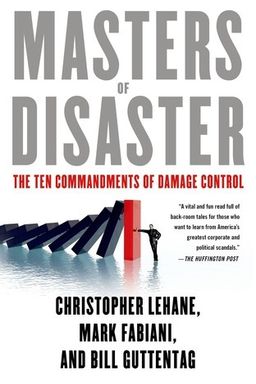
Masters of Disaster cover

Masters of Disaster

by Christopher Lehane, Mark Fabiani and Bill Guttentag

Masters of Disaster explores the art of damage control in the information age. With insights from top disaster managers, it unveils strategic commandments to help politicians, celebrities, and companies avert scandals and maintain their reputations amidst crises.

Thriving in an Age of Constant Crisis

Can you recall a moment when a sudden problem—at work, online, or in your personal life—felt like it was spinning out of control? In Masters of Disaster: The Ten Commandments of Damage Control, Christopher Lehane, Mark Fabiani, and Bill Guttentag argue that in the modern information age, crises are not anomalies—they’re inevitable realities. The authors contend that the new social and media landscape demands every business leader, public figure, and ordinary citizen become their own “master of disaster.”

This book is both a philosophy and a field guide to managing crises swiftly and strategically. Lehane and Fabiani—known for their trench work on the Clinton White House’s scandal defense teams—believe that crises no longer wait for morning headlines; they unfold across instantaneous digital news cycles. Whether you’re a CEO facing backlash, a teacher confronting scandal, or a regular social media user caught in controversy, your survival depends on mastering the art of damage control.

The New Normal: Crisis as a State of Nature

According to the authors, the digital era has created a perfect storm of crisis conditions. They identify five massive shifts responsible for this ongoing turbulence: proliferation of information outlets, the breakneck speed of communication, the erosion of public trust, selective information consumption, and the emergence of a community-driven media ecosystem. These changes mean every misstep—from a bad tweet to a faulty product—can explode into a full-blown reputational wildfire.

For example, when any smartphone owner can act as a journalist and social media posts can go viral within minutes, even local incidents can trigger global attention. Lehane points out that you are now on a level playing field with Fortune 500 firms—anyone can exploit a mistake, whether it’s a rival CEO or a disgruntled customer. Just as the authors show with the Obama “bitter clingers” and Romney “47%” remarks, there are no longer private moments in the public sphere.

The Formula for Survival

The book builds its lessons around three survival principles—Do No Harm, Discipline, and Credibility. These principles serve as the DNA of every crisis response, whether you’re dealing with an oil spill or a bad Yelp review. Doing no harm means resisting the urge to spin, lie, or blame others—actions that amplify damage. Discipline involves preparation and restrained action, and credibility is all about establishing honesty through transparent communication.

From this foundation, the authors then present the practical framework—the Ten Commandments of Damage Control. These ten rules form the operational toolkit for surviving crises in both public and private contexts. They range from core tenets such as Full Disclosure, Speak to Your Core Audience, and Don’t Feed the Fire to defensive and offensive strategies like No Swiftboating and They Dissemble, You Destroy. Each commandment comes with case studies—from Tiger Woods’s unraveling scandal to Kobe Bryant’s comeback, from corporate missteps by BP and Toyota to political recoveries like Bill Clinton’s and Gavin Newsom’s.

Beyond Spin: The Mission is Trust

Ultimately, Lehane and Fabiani insist that the real mission of damage control is not just communication—it’s trust restoration. They remind readers that crisis management is the art of surviving scrutiny without losing integrity. As they vividly write: “Crisis is like a knife fight in a telephone booth.” To win, you can’t just dodge blows; you must fight strategically—owning mistakes, staying transparent, and executing your plan with unwavering discipline.

In a world where the next viral scandal could be one click away, Masters of Disaster offers a blueprint for resilience. You’ll learn why spin kills credibility, how speed can destroy truth, and how transparency helps rebuild reputation. By the end, you won’t just understand how to manage crises—you’ll know how to master them. This book matters today because crisis isn’t something to fear anymore; it’s something every one of us must learn to navigate, survive, and emerge stronger from.


Do No Harm: Stop Digging Your Own Hole

Lehane and Fabiani begin their survival philosophy with the timeless warning: when you’re in a hole, stop digging. In times of crisis, the instinct to defend yourself usually makes the problem worse. The first principle—Do No Harm—is the damage-control equivalent of the Hippocratic Oath: avoid actions that exacerbate your wound.

Don’t Chase the Story

As the authors show through Anthony Weiner’s infamous scandal, the impulse to respond immediately can be fatal. Weiner’s frantic denials about hacked tweets only fueled gossip cycles. Lehane calls this “chasing the story,” an attempt to win the hour instead of the war. Rushing to respond without verified facts means releasing information that will soon collapse under scrutiny. You cannot outpace the 24/7 spin cycle; the only route to credibility is to slow down and ensure your narrative is true.

Don’t Spin Yourself into a Trap

Spin once was a survival tool; now it’s a death trap. BP’s catastrophic failure in managing the Gulf oil spill proved this vividly. When CEO Tony Hayward downplayed the eco-impact, his optimism appeared delusional. As underwater cameras streamed oil leaks in real time, his reassurances became PR fuel for outrage. The authors note that complex communication systems—from tweets to YouTube—amplify untruths faster than facts. Spinning to win a day’s headline may cost years of reputation.

Don’t Blame Others—Lead Through Accountability

Passing the buck only deepens mistrust. Whether it's a fired employee or a rogue contractor, blaming others when your audience expects accountability will destroy your brand. The authors showcase contrasting cases: Coke’s quick admission and correction after the New Coke fiasco versus James Murdoch’s finger-pointing during News Corporation’s phone-hacking scandal. Coke turned lemons into lemonade; Murdoch’s deflection turned apology into accusation. Leadership, Lehane writes, is about owning even what isn’t directly yours because responsibility rebuilds trust faster than excuses.

Do No Harm asks a simple but brutal question: are your actions reducing the flames—or throwing fuel on them? This principle isn’t about silence—it's about strategic restraint. If you can resist panic, hold the shovel, and start climbing instead of digging, you’ve already begun restoring trust.


Discipline: Keeping Cool When the Storm Hits

When crises erupt, emotions cloud judgment. Lehane urges leaders to emulate Michael Corleone’s mantra from The Godfather: “It’s not personal, Sonny. It’s strictly business.” Discipline—the second principle—is mental toughness and strategic focus under extreme pressure.

Preparation is Power

Discipline starts with preparation. Whether you’re the CEO of a tech firm or the owner of a bed-and-breakfast, anticipating likely crises gives you control before chaos erupts. Lehane praises Rachael Solem’s Irving House Inn, which survived a bedbug scare because she had rehearsed protocols for years: swift inspection, transparent communication, and public reassurance. Compared to larger hotels caught unprepared, Solem’s disciplined preparation preserved her reputation.

Mental Toughness and Clarity

Even the most well-prepared crisis brings fog. The Clinton White House’s response to suddenly “found” billing records shows how calm clarity limits harm. Instead of speculating or spinning, staff simply released the records and admitted what they knew and didn’t know. This refusal to panic kept speculation from becoming scandal. Discipline means minimizing chaos by controlling your mental state first.

Think Long Term—Rehabilitation Is a Marathon

Redemption takes time. From Michael Milken’s post-conviction philanthropy to Eliot Spitzer’s carefully staged comeback, Lehane demonstrates that whether rebuilding a company or a personal life, recovery demands patience and direction. The public will forgive errors but not impatience. Every post-crisis statement must signal commitment to reform, not desperation to rebrand. Discipline transforms survival into revival.

By marrying preparation, mental toughness, and long-term thinking, you can transform crisis chaos into credibility. Discipline assures your audiences that you are in charge—even when the world isn’t.


Credibility: The Currency of Trust

The third survival principle—Credibility—is what truly buys redemption. Lehane calls accurate information the “coin of the realm.” Without it, even the cleverest communication plan collapses.

Accuracy Before Everything

Johnson & Johnson’s Tylenol crisis stands as the gold standard. When cyanide-laced pills killed consumers, J&J didn’t spin or evade. It told the public exactly what it knew, what it didn’t know, and what it was doing to fix the problem—recalling all products and redesigning packaging. Transparency transformed tragedy into triumph. This case epitomizes how accurate information earns credibility even in disaster.

Manage Expectations

Credibility also hinges on expectation management. Promise less and deliver more. Lehane cites Mayor Tom Bradley’s appointment of Warren Christopher to review police brutality after the Rodney King incident. By choosing an impeccable and independent investigator, Bradley exceeded expectations and established honest leadership. In contrast, leaders who overpromise and underdeliver—like BP in its early oil-spill updates—lose trust faster than facts can catch up.

The Pivot Point: From Past to Future

A successful apology or reform can serve as a “pivot point”—a turning moment that draws a bright line from failure to recovery. Whether it was JFK’s responsibility for the Bay of Pigs, Jeff Bezos admitting Amazon’s Kindle data error, or Alex Rodriguez’s televised steroid confession, each pivot rebuilt trust through vulnerability and action. Lehane advises seizing this moment with clarity and sincerity: a decisive apology followed by tangible fixes.

Credibility is not words—it’s consistency. When you demonstrate that accuracy guides your decisions and humility shapes your response, you don’t just survive scrutiny; you strengthen your public equity for the long term.


Full Disclosure: Tell the Whole Story, Fast

“He who discloses first, wins.” The first commandment of damage control, Full Disclosure, tackles the hardest human tendency—fear of exposure. Lehane argues that the drip-drip of withheld truths hurts far more than a swift, complete confession.

Learning from Tiger Woods’s Silence

Tiger Woods’s refusal to immediately admit infidelity turned a private mistake into a public meltdown. By delaying full disclosure, he invited months of speculation, ridicule, and cascading corporate exits. Had he confessed immediately and framed his conduct within remorse and accountability, his scandal might have been brief rather than epic. By contrast, Kobe Bryant’s quick acknowledgment of extramarital sex but assertion of consent allowed him to control his story and return to glory.

The Shield and the Sword

Lehane frames full disclosure as both defense and offense. Disclosure protects by preventing long burns of rumor (the shield), and strikes by converting honesty into credibility (the sword). The release of bad information, packaged with ownership and corrective action, disarms critics. Senator John McCain’s open admission of poor judgment in the Keating Five scandal, coupled with championing campaign finance reform, turned guilt into leverage.

One Bite at the Apple

Lehane warns that full disclosure works only once. Italian prime minister Silvio Berlusconi’s repeated apologies for sexual misconduct lost all sincerity. Audiences forgive once—but they won’t forgive serial repentance. Full disclosure demands completeness, timing, and truth: not partial admission but full accountability.

When you make the choice to lead with transparency, you seize both moral and strategic ground. The truth is inevitable—your advantage lies in controlling when, how, and in what context it arrives.


Speak to Your Core Audience: Hit the Bull’s-Eye

Knowing whom you’re talking to—and delivering exactly what they need to hear—is the second commandment. Lehane insists that crises are won or lost based on identifying your core audience and relentlessly focusing on their trust.

Penn State’s Miscommunication Disaster

The Penn State sexual abuse scandal revealed what happens when leaders forget their true audience. As abuse revelations surfaced, President Graham Spanier and Coach Joe Paterno failed to address their governing Board—the only group with authority over their future. By ignoring their most crucial audience and issuing tone-deaf statements defending indicted staff, both men lost credibility overnight.

Mastering Concierge Communication

Lehane describes speaking to your audience as providing “five-star concierge service.” That means responsiveness, clarity, professionalism, and consistent tone. When New Vision Television filed for bankruptcy restructuring, executives personally met with employees and clients, launched a dedicated Q&A site, and tweeted updates. The result? Confidence in leadership and near-zero reputational loss.

No Pandering Allowed

Speaking authentically isn’t the same as flattering. When Costa Cruises tried to deflect blame for a shipwreck by scapegoating its captain, the public saw manipulation, not accountability. True audience engagement begins with understanding their perspective—not exploiting it. As Lehane quips, “Don’t put lipstick on the pig.”

In crisis communication, your target isn’t the noise of the crowd but the calm of conviction. When you hit the bull’s-eye—delivering truth directly to decision-makers—you shift from chaos to control.


Details Matter: Precision Builds Credibility

Winston Churchill once observed that wars are won by details. Lehane agrees: “The smallest discrepancy becomes the largest inconsistency.” Commandment Four—Details Matter—shows how mastering specifics transforms chaos into confidence.

The Price of Vagueness

Meg Whitman’s gubernatorial campaign imploded not because of scandal, but because of sloppy details. Her vague answers about her voting history, workplace conduct, and undocumented housekeeper gave journalists endless contradictions to exploit. Each inconsistency magnified distrust. Lehane emphasizes that the public doesn’t demand perfection—they demand coherence.

Deploy Good Facts to Beat Bad Facts

When negative stories circulate, data trumps rhetoric. The National Hockey League’s response to a season lockout demonstrated how factual transparency wins skepticism. The league released audited financials proving systemic revenue imbalance, and even skeptics accepted their logic. Details became armor. Lehane calls this “meeting the burden of proof”—providing verifiable evidence before speculation fills the gap.

You Are Not in a Confessional

The authors caution against over-disclosure that overexposes. Idaho Senator Larry Craig’s unsolicited denial of involvement in a scandal no one had accused him of exemplifies this mistake. Share details strategically, not impulsively. Every public statement must have purpose—release only what fortifies credibility.

Details are precision diplomacy: confirm your facts, anticipate scrutiny, and never contradict yourself. Those who master the minutiae secure authority; those who improvise under pressure crumble.


Respond with Overwhelming Force: Control the Narrative

Commandment Seven—Respond with Overwhelming Force—asks you to control the narrative before the rumor controls you. Lehane argues that half measures invite confusion. In crisis, one consistent bottom-line message repeated relentlessly is your best weapon.

Bear Stearns and the Consequence of Hesitation

The downfall of Bear Stearns shows what happens when leaders hesitate. As financial rumors spread in 2008, executives issued mixed signals—denying problems one day and admitting liquidity issues the next. Investors fled, and confidence vanished. If the company had communicated one consistent message backed by verified data, Lehane argues, panic might have been contained. In a crisis, perception outruns reality.

Sing Off the Same Sheet of Music

Unity within an organization amplifies credibility. The Bay Bridge construction team’s response to weld safety allegations exemplifies coordinated communication. Every spokesperson—from engineers to executives—repeated the phrase “We are cooperating fully; the welds are good welds.” That chorus of consistency drowned out rumor. Lehane calls this “choir defense”—when everyone sings the same refrain, dissonance disappears.

Avoid Message Handcuffs

Not all repetition is good. Tone-deaf messaging—like BP’s CEO lamenting “I want my life back”—alienates audiences. Strong messages require empathy and alignment, not defiance. Lehane advises leaders to test every message for credibility and compassion before amplification.

Overwhelming force doesn’t mean shouting louder; it means speaking clearer, earlier, and with discipline. When your organization shares one bottom line that resonates, rumor becomes irrelevant.

Dig Deeper

Get personalized prompts to apply these lessons to your life and deepen your understanding.

Go Deeper

Get the Full Experience

Download Insight Books for AI-powered reflections, quizzes, and more.