
Idea 1
Rugged Flexibility: Thriving Through Change
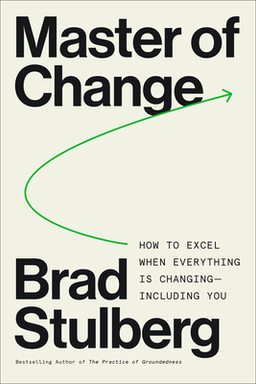
What if everything you thought you knew about stability was wrong? In Master of Change, Brad Stulberg argues that the pursuit of permanence—a central story modern society tells us—is at odds with the true nature of life. Instead of resisting disruption, Stulberg invites us to build what he calls rugged flexibility—the ability to stay strong at your core while adapting like water to constant transformation.
He contends that we are conditioned to see change as an anomaly, a problem to solve, a storm to endure until 'things get back to normal.' Yet, both science and ancient wisdom say otherwise: change is not the exception; it’s the rule. To live well, we must stop clinging to the illusion of stability and instead learn how to navigate life’s ongoing cycle of order, disorder, and reorder.
Across disciplines—from biology and neuroscience to philosophy and psychology—Stulberg shows that thriving systems don’t resist change; they transform with it. This book offers a comprehensive model for how to achieve such transformation, weaving together fresh scientific insights with timeless teachings from Stoicism, Buddhism, and Taoism. His core message: with the right mindset, identity, and actions, change need not be feared—it can be mastered.
Life Is Not a Straight Line
At the heart of Stulberg’s argument lies a simple but revolutionary shift in perspective. For more than a century, modern science leaned on a model called homeostasis, the idea that living systems seek to maintain equilibrium by resisting change. But this model—developed by 19th-century physiologist Claude Bernard and popularized by Walter Cannon—misrepresents how complex systems actually evolve. In reality, Stulberg explains, life operates through allostasis: achieving stability through change, not by avoiding it. Healthy systems—whether individuals, ecosystems, or organizations—operate in cycles of order → disorder → reorder. Growth doesn’t mean returning to where we started; it means finding stability at a new place entirely.
In this model, disorder isn’t a threat but a necessary stage of transformation. It’s when we grow, innovate, and evolve—if we know how to stay grounded in the process. Stulberg calls this skill rugged flexibility: being simultaneously tough and adaptable, disciplined yet open. “To be rugged,” he writes, “is to be strong and durable. To be flexible is to bend without breaking. Together, they form the quality you need to thrive.”
From Control to Conversation
According to Stulberg, embracing this framework means shifting from trying to control change to entering into conversation with it. Life ceases to be something that happens to you and becomes something that you are in dialogue with. Resistance depletes you; responsiveness energizes you. The key is to develop three overlapping domains of rugged flexibility: mindset, identity, and action.
- Mindset: Developing a perspective that accepts impermanence and expects difficulty instead of fearing it.
- Identity: Building a self that is cohesive but fluid—stable enough to feel like ‘you,’ yet flexible enough to grow.
- Actions: Learning to respond, not react, during moments of change, and to turn adversity into meaning and momentum.
These three aspects work together: mindset shapes identity, identity drives actions, and actions reinforce mindset. When integrated, they form a coherent framework for sustainable excellence—doing good and feeling good over the long haul.
A Path, Not a Road
Stulberg closes his introduction with a vivid metaphor. A road, he writes, is linear and rigid—it has a set destination, cutting straight through the landscape. When conditions shift, roads crack. A path, on the other hand, winds with its environment; it reveals itself step by step. On a path, you’re not “knocked off course” because the course itself evolves. The lesson is clear: treat your life as a path, not a road. If you cling to the illusion of fixed order, you’ll crumble when chaos arrives. But if you embrace change as part of the terrain, you’ll endure and even flourish.
To guide readers along this path, Stulberg divides the book into three parts: cultivating a rugged and flexible mindset, building a rugged and flexible identity, and performing rugged and flexible actions. Each section offers stories, science, and tools for mastering change, from the micro (daily frustrations, injuries, career shifts) to the macro (collective upheavals, aging, mortality).
“Life is an ongoing and oscillating series of ebbs and flows.”
—Brad Stulberg, Master of Change
This insight reframes reality itself: flux is not an emergency; it’s the essence of being alive. Master of Change is as much a psychological manual as a philosophical meditation—a call to evolve your relationship with impermanence so that you can live, work, love, and lead with purpose even when nothing stays the same.
Across the following key ideas, we’ll unpack Stulberg’s core techniques—from opening to life’s flow and expecting it to be hard, to redefining identity and taking wise action. His framework doesn’t eliminate uncertainty—it transforms how you meet it, turning chaos into a lifelong teacher rather than a foe.