
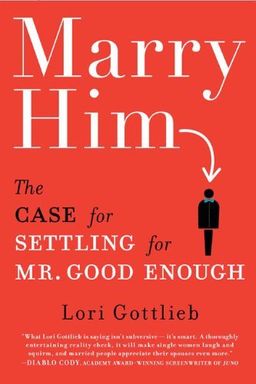
Marry Him cover

Marry Him

by Lori Gottlieb

Marry Him is a witty exploration of modern dating, challenging the pursuit of perfection by highlighting the value of ''good enough.'' Through humorous anecdotes and expert insights, Lori Gottlieb encourages readers to focus on meaningful qualities for lasting love.

The Case for Choosing Real over Ideal

What if your endless search for the perfect partner was the very thing keeping you from finding love? In Marry Him: The Case for Settling for Mr. Good Enough, writer and psychotherapist Lori Gottlieb challenges modern singles—especially women—to rethink the unrealistic standards that have made dating and relationships nearly impossible. Through personal stories, interviews with experts, and candid reflection, Gottlieb argues that our romanticized pursuit of perfection, fed by movies, social expectations, and post-feminist ideals of empowerment, has led many otherwise intelligent, desirable women to remain single and dissatisfied.

Gottlieb contends that women who have internalized the belief that they deserve only the best often confuse “not settling” with “never compromising.” This mindset creates unattainable standards in dating—lists full of superficial preferences that have little to do with long-term relationship happiness. The book’s central idea is simple but uncomfortable: to find lasting love, you need to choose the real over the ideal. You have to stop chasing fantasy and learn how to value qualities that truly make marriage work—kindness, character, shared values, and emotional reliability—over temporary charm or dazzling chemistry.

Why Modern Dating Is Failing Us

The book opens with the humorous parable of the “Husband Store,” where each floor offers increasingly perfect men—until the top floor reveals no men at all. It’s a metaphor for how women tend to overlook good partners while climbing toward impossible perfection. Gottlieb then recounts her own painful experiences with dating in her late 30s and 40s, realizing that her high standards—height, humor, career success—had eliminated potentially wonderful men. At 39, she had a child on her own and later wrote an article about wishing she had settled earlier for someone good enough rather than waiting for Prince Charming. Her honesty frames the book not as a manifesto for mediocrity but as an urgent wake-up call about how we pursue love in a culture of excessive choice.

The Culture of Choice and Perfection

Our generation, Gottlieb says, has been raised on the illusion that “you can have it all.” That illusion—stemming from feminist independence, self-help optimism, and romantic comedies—has translated poorly into the dating realm. Women aren’t just looking for partners; they are auditioning for soulmates who meet every requirement. This has led to what behavioral economists call maximizing—seeking the absolute best in every category instead of satisficing, which means accepting something that meets high standards but not all of them (Barry Schwartz’s The Paradox of Choice uses similar logic). Maximizers, Gottlieb shows, spend years looking for a better eight when they already have their perfect seven sitting right in front of them.

Why the Ideal Man Rarely Marries You

Through conversations with dating coach Evan Marc Katz and psychologist Michael Broder, Gottlieb uncovers why certain women chase alpha males—confident, driven, and attractive men—yet later complain that those same men never commit. Alpha males, she explains, often marry women with whom they feel comfortable and supported, not those who compete with them for dominance. Ambitious women frequently seek “better versions” of themselves, creating power struggles instead of harmony. The result: they end up single while the alpha males marry the nurse, kindergarten teacher, or laid-back professional who complements rather than challenges their personality.

Realistic Love vs. Fairytale Love

Gottlieb uses countless anecdotes—friends who broke up over bad shoes or wrong movie preferences, clients who dismissed kind men because they “didn’t feel a spark”—to illustrate how distorted our concept of romance has become. These women are reliving the patterns set by pop culture heroines like Carrie Bradshaw, confusing entitlement with empowerment. What they call “having high standards” is often emotional immaturity—the belief that love should be all about instant chemistry, constant fascination, and never having to compromise. Real love, Gottlieb insists, looks different. It’s not the dizzying fireworks of a rom-com; it’s the steady comfort of a partner who shows up, cares for your child’s fever, and stays through life’s mundane moments. Happily ever after isn’t about perfection—it’s about partnership.

Learning the New Definition of ‘Settling’

To “settle,” Gottlieb proposes, should not mean giving up joy or attraction—it should mean letting go of rigid fantasies about what happiness should look like. You may not get the six-foot, Ivy League, world-traveling, emotionally profound poet who also likes dogs and jazz. But you might get a kind, flawed, devoted spouse who loves you deeply and shares your core values. Those are the qualities that build long-term contentment, according to the marital researchers, economists, rabbis, and ordinary married couples Gottlieb interviews. Their collective wisdom reinforces the book’s message: marriage success depends far more on character compatibility than on instant passion or prestige.

Why These Ideas Matter

Ultimately, Marry Him is about maturity—about replacing the impulsive checklist of youth with the grounded perspective of adulthood. It matters because millions of singles are stuck in a self-defeating loop, holding out for a fantasy whose expiration date is reality itself. Gottlieb’s call to action isn’t cynical; it’s compassionate realism. Her argument empowers you not to settle for less love—but to settle into more happiness by valuing what love really is: friendship, kindness, growth, and shared life. In a dating world obsessed with perfection, she invites you to choose someone good enough—because good enough, once you’ve seen the alternative, turns out to be pretty great.


The Myth of the Perfect Partner

Gottlieb dismantles one of contemporary dating’s most toxic illusions: the belief that somewhere out there exists a flawless soulmate who will intuitively complete you and check every box on your list. This fantasy—reinforced by media, feminist ideals of self-actualization, and commercialized romance—creates a generation of lonely perfectionists. She shows how we design extravagant mental shopping lists filled with superficial criteria (height, career, sense of style, hairline) that have almost no bearing on marital happiness.

The Husband Store Parable

In the book’s iconic opening joke—the “Husband Store”—women climb floors offering progressively better men, only to reach the top where there are none left at all. This satire captures the futility of endless improvement-seeking. The more options we believe exist, the less content we become. Gottlieb interprets modern dating as an overwhelming marketplace, echoing Dan Ariely’s behavioral economics point that “more choice leads to paralysis.”

Pseudo High Standards

Relationship coach Susan Page introduces the concept of “pseudo high standards,” where people reject partners not because they violate their deep values, but because they don’t match arbitrary ideals. One woman dumps an affectionate boyfriend because he dresses badly; another passes on a compassionate teacher because his job seems too mild. Page urges singles to distinguish essential needs (kindness, communication) from cosmetic preferences (height, career title). If someone meets 80 percent of what you value, Page asks, since when is 80 percent “settling”?

Beauty in Imperfection

Page compares dating to Japanese pottery—where imperfections in a glaze are admired as part of the art. You might envision a pot emerging perfect from a kiln, but sometimes the unpredictable fire creates something even more beautiful. Her metaphor reminds you that love is about discovery, not control. Instead of clinging to expectations, you can ask a more liberating question: “What is this, and is it beautiful?”

By letting go of lists and perfection, you make space for surprise and appreciation. As Gottlieb learns in her own dating journey, breaking up with the list—not the guy—may be the wisest decision of all.


Changing the Chemistry Obsession

One of Gottlieb’s most radical insights is that instant chemistry—the butterflies, the electrifying spark—is not the foundation of lasting love. Through expert interviews and her experiences with dating coach Evan Marc Katz, she shows that people often mistake adrenaline for compatibility. That rush is thrilling, but short-lived, often masking incompatible goals or poor communication.

The Science Behind the Spark

Rutgers anthropologist Helen Fisher explains that romantic obsession activates the same dopamine-rich reward centers as addiction. The euphoric drive makes you irrational, overlooking red flags while clinging to a fantasy. Fisher’s research shows that initial “in-love” chemistry tends to fade after 18 months to three years, replaced by calmer companionship. Couples who stay together transform lust into trust. Chemistry changes form—it doesn’t disappear.

When Chemistry Misleads

Dating coach Evan Marc Katz warns that women often chase men who inspire the strongest immediate attraction—only to end up rejected, ignored, or heartbroken. He asks clients to look for a “chemistry-to-compatibility ratio” of a 6 or 7 in excitement and a 9 in shared values. The couples who endure, Evan says, aren't the ones with fireworks; they’re the ones who enjoy steady warmth. Gottlieb herself experiences this transformation with a man she calls “Sheldon2.” He doesn’t wow her with charisma, but he’s kind, curious, and reliable—a “mellow” connection that turns into real affection over time.

Biology and Expectation

Psychologist Martie Haselton contributes another twist: attraction fluctuates hormonally. Women biologically crave different kinds of men depending on the time in their cycle—dominant “alpha” types during fertile phases, nurturing partners during others. The key, she stresses, is not to base lifelong choices on temporary impulses. Chemistry changes; character endures.

Once you stop treating butterflies as destiny, you can focus on what Gottlieb calls “emotionally mature love”—comfort, compatibility, and everyday intimacy. Sparks fade. Friendship stays lit.


The Economics of Love and Time

In one of the book’s most unconventional sections, Gottlieb compares dating to business and economics. Consulting experts like sociologist Paul Amato and former marriage therapist John Curtis, she shows that marriage success often depends on pragmatic, not romantic, factors—communication, teamwork, and shared goals. She even treats dating as an economic market where supply, demand, and depreciation shape opportunity.

The Business Plan for Marriage

Curtis encourages couples to approach relationships like joint ventures: define roles, discuss finances, and establish shared long-term objectives. Marriage, he says, isn’t just “love”—it’s management. Those who regard marriage as teamwork fare better than those who expect perpetual emotional intensity. (Stephanie Coontz, in Marriage: A History, similarly notes that earlier generations married for partnership, not soul mating.)

Supply and Demand in the Dating Market

As women age, Gottlieb bluntly notes, the statistical pool of available men shrinks. Census data and economist Mark Gimein’s “Bachelor Auction” analogy reveal that confident women often wait too long to “bid,” assuming their value is permanent. Meanwhile, the early bidders—less picky women—marry the best men first. Those who delay may be left with fewer options. The fairness may be debatable, but biology and demographics don’t lie.

The Hidden Costs of Holding Out

Through witty calculations, Gottlieb tallies the “sunk costs” of extended singlehood—money spent on dating apps, clothes, waxing, and therapy, plus emotional exhaustion. By contrast, she portrays marriage as offering stability, companionship, economic protection, and daily kindness. From a cost-benefit perspective, waiting endlessly for Prince Charming can be more expensive—financially and emotionally—than choosing a good enough man now.

Love may not be a spreadsheet, but counting the real costs of perfection helps you understand its price. When Gottlieb says “settling isn’t selling”—she means it literally and figuratively. Waiting for more can sometimes cost you everything.


Rewriting Feminist Empowerment

Perhaps the book’s most controversial theme is its critique of post-feminist dating ideology. Gottlieb, herself a liberal feminist, confesses that feminism “fucked up her love life”—not because equality is wrong, but because independence became distorted into entitlement. Many women, she argues, equate empowerment with never compromising, waiting for the ideal partner, and believing that true happiness must come entirely from oneself. The result? Emotional disconnection disguised as self-sufficiency.

Empowered or Isolated?

Gottlieb recounts decades of cultural messaging urging women to “have it all,” yet many end up single, exhausted, and unable to reconcile high expectations with biological reality. Feminism promised freedom, but in romance it often delivered paralysis. Successful career women like Julia from chapter one reject kind, ordinary men like Greg for being “uninspiring,” only to realize years later that they miss Greg’s compassion and steadiness while chasing ambitious charmers who never commit.

The Entitlement Trap

Psychologists like Michael Broder observe that entitlement has replaced reciprocity in modern dating. Many women view love through a “me-me-me” lens—seeking adoration instead of partnership. Gottlieb highlights scenes from Sex and the City where heroines proudly declare, “I love myself more,” mistaking selfishness for strength. Empowerment, she suggests, should mean resilience and cooperation, not domination or constant self-protection.

Redefining Strength

Real strength, Gottlieb argues, means vulnerability—the courage to let someone love you, flaws and all. Rather than waiting for a mythical “better,” you build something solid with a partner willing to grow together. Paradoxically, compromise becomes the most empowering act because it transforms fantasy into reality.

In dismantling false empowerment, Gottlieb doesn’t dismiss feminism; she redeems it. True equality in love isn’t about never needing anyone—it’s about choosing interdependence consciously, with humility and heart.


The Good Enough Marriage

To close her argument, Gottlieb looks beyond dating to the marriages themselves. With researcher Paul Amato’s twenty-year studies, she finds that many couples who divorce aren’t unhappy—they’re just “not ecstatic.” They end decent marriages chasing excitement, only to end up lonelier or less satisfied in second unions. The lesson: perfection is not sustainable, but good enough often is.

Understanding the 'Good Enough'

Amato’s concept of the “good enough marriage” describes relationships that hover around a 7 on a happiness scale. They aren’t drama-filled nor transcendent, yet they provide stability, kindness, and companionship—the ingredients of enduring joy. Gottlieb argues that if dating expectations mirrored these values, fewer people would throw away great partners over minor flaws.

Children and Stability

The ripple effects extend to children. Amato’s follow-up studies show that kids of dissolving “good enough” marriages fare worse than those from high-conflict marriages, who feel relief when parents split. For stable-but-unfulfilled couples, divorce blindsides kids, destroying their sense of security. Happiness, Gottlieb concludes, isn’t about constant growth—it’s about learning to accept recurring days of ordinary love.

Real Love, Real Life

Citing rabbi David Wolpe’s wisdom, Gottlieb reminds readers that marriage is about the shared life you build—its history, your friends, your children—rather than the thrill of early attraction. “You’re not married to the person,” Wolpe says. “You’re married to the marriage.” Once you shift focus from spark to sincerity, good enough becomes more than enough.

In the end, Marry Him closes not with cynicism but hope. True love, it turns out, isn’t about the ideal—it’s about devotion in the trenches. That, Gottlieb reminds us, is how good enough becomes great.

Dig Deeper

Get personalized prompts to apply these lessons to your life and deepen your understanding.

Go Deeper

Get the Full Experience

Download Insight Books for AI-powered reflections, quizzes, and more.