
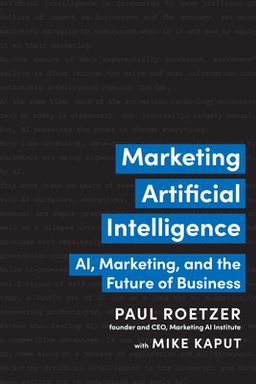
Marketing Artificial Intelligence cover

Marketing Artificial Intelligence

by Paul Roetzer & Mike Kaput

Unveil the future of marketing with ''Marketing Artificial Intelligence.'' This guide explores how AI reshapes strategies, enhances creativity, and revolutionizes audience engagement. Navigate the digital landscape with insights that make AI your marketing ally.

Marketing Artificial Intelligence: The New Frontier of Smart Marketing

What happens when your marketing starts thinking for itself? In Marketing Artificial Intelligence, Paul Roetzer and Mike Kaput argue that we’re entering an era where marketing intelligence is no longer purely human. Artificial intelligence (AI)—the science of making machines smart—will transform every marketing function, from advertising and analytics to sales and customer service. The authors contend that today’s marketers stand at the threshold of an AI-driven revolution, one as significant as the dawn of the internet itself. To thrive, you don’t need to become a data scientist; you need to understand how to make marketing smarter by combining the best of human creativity with machine-driven prediction and automation.

At its core, the book defines AI in simple, actionable terms. Rather than a sci-fi fantasy about sentient robots, AI is described as a set of technologies—machine learning, deep learning, natural language processing (NLP), and computer vision—that help machines interpret and act on data. These tools can do what marketers already do—namely, analyze, predict, and create—but at a superhuman scale and speed. When marketers apply AI to their everyday work, they can automate repetitive tasks, forecast outcomes with precision, and personalize customer experiences in ways previously impossible.

The Case for Smarter Marketing

Traditional marketing has always been data-driven, but the volume and complexity of data today far exceed human processing capacity. Consumers spend their days generating enormous digital footprints through search queries, emails, purchases, and social interactions. As Roetzer and Kaput note, marketers are drowning in data while still relying on outdated manual systems to make sense of it. In their words, much of today’s marketing automation is really “manual automation”—a collection of rules coded by humans that do not learn or improve with experience. AI changes that equation by enabling technologies that learn from data, get smarter over time, and actively enhance human decisions.

To illustrate, the authors point to everyday examples: Amazon predicting your next purchase; Gmail finishing your sentences; Tesla using Autopilot to navigate traffic; and Netflix tailoring your viewing suggestions. Each instance of AI reflects a combination of massive data, machine learning, and algorithms that learn with each interaction. Marketers, the authors stress, should view these consumer experiences as a preview of what’s possible within their own organizations. The same power that helps Netflix guess your next binge can help your team predict customer churn, recommend optimal content, and personalize campaigns for every segment on your email list.

From Fear to Opportunity

A recurring theme in the book is that AI won’t replace marketers; it will replace tasks. Many professionals fear automation will destroy creative jobs, yet Roetzer and Kaput insist that marketers who embrace AI early will not only safeguard their roles but supercharge them. The machines will handle the data-heavy, repetitive work—analyses, predictions, and optimizations—while you’ll focus on empathy, storytelling, and strategy: the irreplaceably human elements of marketing. AI serves as a power multiplier, freeing marketers to spend less time toggling between dashboards and more time bringing imagination and emotional intelligence into their campaigns.

Still, there’s an urgency to act. Just as companies that ignored the internet lagged behind in the 2000s, those ignoring AI now risk permanent disadvantage. The authors describe “next-gen marketers” as professionals who evolve with technology, balancing curiosity with action. These marketers experiment with AI tools, pilot small projects, and learn how to scale insights responsibly. (Similar arguments appear in Andrew Ng’s AI Transformation Playbook, which advocates learning by doing to gain momentum.) Marketing leaders that master AI’s possibilities early can unlock massive competitive advantages—better predictions, faster decisions, and more meaningful engagement at scale.

Making AI Actionable

Roetzer and Kaput built the Marketing AI Institute specifically to make these technologies accessible. They transform abstract concepts into practical frameworks such as the Marketer-to-Machine Scale, which helps you evaluate how much of a process can and should be automated. They also offer tools like the AI Score for Marketers, allowing teams to identify high-value use cases to pilot. In the book’s structure, major chapters correspond to application areas—advertising, analytics, content, email, SEO, sales, and customer service—each demonstrating concrete benefits from case studies. For instance, Clorox’s pandemic chatbot improved customer satisfaction when shelves were empty; Monday.com grew organic traffic fifteenfold by using AI to optimize SEO; and Okta increased lead conversions with AI-powered qualification tools. These aren’t theoretical examples; they’re blueprints for transformation.

Beyond tactics, the book urges marketers to think about ethics and empathy in equal measure. Technology amplifies everything—including bias, manipulation, and misinformation. The authors emphasize responsible use: personalization without invasion, automation without dehumanization. The goal isn’t just smarter marketing; it’s more human marketing, where machines empower professionals to listen, learn, and connect better with their audiences. Brands like Adobe and Google, they note, have already codified AI ethics to guide innovation responsibly. Embracing this mindset protects not only your company’s reputation but also public trust in marketing itself.

Why This Matters Now

AI isn’t a distant future—it’s already embedded in your work, even if you don’t see it. Every email suggestion, ad impression, and analytics dashboard you use likely contains AI components. As machine learning becomes cheaper and more accessible, those organizations that learn to pilot, test, and scale AI intelligently will separate themselves from those still struggling with spreadsheets. The book’s message is empowering: you don’t need to rebuild your marketing from scratch, just make it smarter. Recognize where intelligent automation can save time, personalize experiences, and reveal insights that humans alone can’t uncover.

In short, Marketing Artificial Intelligence invites you to reimagine your work. It shows that combining human creativity with machine precision creates a partnership far more powerful than either alone. As technology accelerates at ten times today’s pace, marketers who learn to speak the language of machines—without losing their humanity—will define the next era of business. The book is both a roadmap and a rallying cry: now is the moment to evolve from marketer to machine-enhanced innovator, to lead the transformation rather than follow it.


Understanding How AI Works in Marketing

Roetzer and Kaput begin by demystifying artificial intelligence. They borrow DeepMind CEO Demis Hassabis’s definition of AI as “the science of making machines smart,” then adapt it for their field: marketing AI is “the science of making marketing smart.” This clear framing instantly dispels the myth that AI requires a PhD in data science. Instead, it’s a set of technologies that can observe, learn, and act on data to improve outcomes over time.

Core Components of AI

The authors explain that artificial intelligence is an umbrella term encompassing several subfields. The most critical for marketers are:

  • Machine learning (ML): Algorithms that enable software to learn patterns from data and improve predictions over time without explicit programming.
  • Deep learning: A more advanced subset that mimics the human brain’s neural structure, enabling computers to recognize images, understand speech, and generate language.
  • Natural language processing and generation: The ability to read, understand, and write human language.
  • Computer vision: The power to interpret visual data like photos and video.

Together, these technologies enable machines to take on data-driven tasks typically handled by humans—analyzing performance, optimizing campaigns, or even writing content. The key advantage? Machines get faster and smarter as they process more data, which the authors call “intelligent automation.”

From Algorithms to Intelligent Automation

Traditional marketing software uses simple algorithms—human-coded rules like “if X, then Y.” AI systems, by contrast, generate their own rules based on observed performance. This difference allows AI tools to personalize marketing at scale. For example, Amazon’s recommendation engine doesn’t rely on human intuition about products; it uses complex algorithms that predict what you’ll buy based on millions of other shoppers’ patterns. Likewise, Google’s Gmail Smart Compose uses language prediction models to finish your sentences. These are examples of “machines learning by doing.”

Roetzer and Kaput also introduce predictive capabilities as the heart of marketing AI. Predicting which leads will convert, what content will perform, and how budgets should shift based on results are tasks tailor-made for AI. The authors highlight that every marketing decision—whether designing a subject line or pricing an ad—is a prediction. AI allows marketers to ground those predictions in evidence rather than instinct.

The Human Side of Machine Learning

While discussing how AI learns, the authors emphasize the human responsibility behind the technology. Machines don’t truly “understand” or possess emotion—they process zeros and ones. That means the quality of your data profoundly affects AI’s performance. If your datasets are biased, incomplete, or inaccurate, the system’s outputs will mirror those biases. This becomes crucial when dealing with sensitive areas like advertising targeting, hiring, or personalized recommendations. (This echoes concerns raised by scholars like Timnit Gebru and Shoshana Zuboff on algorithmic bias and surveillance capitalism.)

In sum, to harness AI in marketing, you must understand how it learns and what information it’s learning from. Your data isn’t just numbers—it’s the DNA of your predictions. When machines and marketers learn together, both improve, creating a continuous feedback loop that drives smarter strategies and stronger results.


The Three Pillars of AI: Language, Vision, and Prediction

To make AI accessible, Roetzer and Kaput divide its applications into three broad categories: language, vision, and prediction. Every practical AI use case in marketing falls under one or more of these domains. Understanding them helps marketers imagine how to apply AI in their daily work.

Language: Understanding and Generating Words

Language AI processes and generates human communication. Natural language processing (NLP) lets machines read text or transcribe speech, while natural language generation (NLG) allows them to write and respond. Examples include voice assistants like Alexa and Siri or GPT-3-based tools that draft marketing copy. At PR 20/20, Roetzer launched “Project Copyscale” to test automated content creation. Early attempts fell short of true intelligence—they required strict templates and structured data—but tools like GPT-3 later revolutionized content generation, enabling coherent, humanlike writing at scale.

Yet, with this power comes risk. Automated content can perpetuate bias or misinformation if unchecked. Brands must review and edit machine output to ensure accuracy and ethical alignment. The lesson: AI can write with you, not for you.

Vision: Seeing through Data

Computer vision gives machines the ability to interpret images and video. Applications include emotion detection, facial recognition, and image tagging. For marketers, it means being able to track where logos appear across social media or automatically categorize product photos. Talkwalker, for instance, uses vision AI to identify brand placements in user-generated images—saving thousands of hours in manual tagging. Meanwhile, creative examples like the Salvador Dalí deepfake exhibit—where visitors spoke with a digital facsimile of the artist—show how vision AI can inspire new forms of immersive storytelling.

Prediction: Forecasting the Future

Prediction sits at the heart of all marketing AI. Machines analyze past data to forecast future outcomes—what campaigns will succeed, which customers will churn, what time to send emails. The authors reference Prediction Machines by Agrawal, Gans, and Goldfarb, emphasizing that as prediction becomes cheaper, decisions become smarter and faster. For example, Netflix predicting what you’ll watch next is just an evolved form of statistical learning—it’s anticipating your behavior.

Together, language, vision, and prediction form the trifecta of intelligent automation. They convert raw data into understanding, insight, and foresight—allowing modern marketers to communicate, create, and compete in profoundly new ways.


Becoming the Next-Gen Marketer

The core of the book’s argument is that the future belongs to “next-gen marketers.” You don’t become one by age or title, but by mindset. Next-gen marketers embrace change, learn continuously, and work seamlessly with machines. They see AI as an ally, not a threat.

The Shift from Manual to Intelligent Marketing

Roetzer and Kaput note that many marketing teams today are stuck in what they call “Level 0” of automation—doing everything manually even when tools exist. Their Marketer-to-Machine (M2M) Scale outlines progress from Level 0 (all human) to Level 4 (fully machine-driven). Each step increases intelligent automation. The goal isn’t to replace humans but to determine the balance between human and machine in every process.

For instance, drafting an email newsletter may currently require manual writing, formatting, and scheduling. An M2M Level 1 tool might suggest subject lines. Level 2 could auto-personalize content. Level 3 might manage segmentation and timing autonomously. Level 4, though still futuristic, would craft, optimize, and deploy entire campaigns with minimal oversight. Understanding the scale helps you buy and implement smarter tech without falling for hype.

Use Cases, Not Complexity

Next-gen marketers begin with small, high-value use cases—tasks that are data-driven, repetitive, and predictive—before scaling AI across their organizations. Roetzer’s AI Score for Marketers tool helps identify where automation will create the most value. The idea mirrors Andrew Ng’s advice from the broader AI field: start with pilot projects likely to succeed quickly, using them to build momentum, credibility, and executive buy-in.

Human Skills Still Lead

Equally important, the authors stress developing the qualities that machines can’t replicate—empathy, creativity, and strategic vision. Modern tools can recommend which ad to run, but only humans can understand the emotional truth behind brand storytelling. They cite Kai-Fu Lee’s AI Superpowers, which argues that future economies will value compassion and connection above raw computation. Being human is now your competitive advantage.

To stay relevant, educate yourself and your team. Attend conferences like MAICON (Marketing AI Conference), take online courses, and engage in professional communities. The Marketing AI Institute itself models how continuous learning transforms an industry—offering programs like AI Academy for Marketers to bridge the knowledge gap.

Ultimately, becoming next-gen means reimagining your role: you’re no longer just a marketer using tools; you’re a strategist designing a symbiotic relationship between human creativity and machine intelligence. In this new age, curiosity and adaptability matter as much as technical know-how.


AI Across the Marketing Spectrum

One strength of Roetzer and Kaput’s book is how concretely it shows AI’s reach across marketing disciplines. Each major function—advertising, analytics, content, sales, SEO, and more—has its own transformation story, demonstrating that AI is not hypothetical but revolutionary right now.

Advertising and Analytics

AI already powers the digital advertising ecosystem through real-time bidding and programmatic platforms. The RedBalloon case study shows how Naomi Simson replaced agencies with Albert, an AI system that tested thousands of ad variations daily, achieving up to 1,100% return on ad spend. On the analytics front, AI tools like Crayon and Google Analytics use machine learning to reveal insights from millions of data points instantly—something human analysts could never match.

Content, SEO, and Social Media

BuzzFeed’s “Good Advice Cupcake” and Monday.com’s 1,570% traffic growth demonstrate AI’s role in creative optimization. Tools like MarketMuse and Jasper use NLP to generate and refine content; others like Lately and Talkwalker use computer vision and language analysis to predict which social posts will resonate. These examples prove that machine-assisted creativity doesn’t diminish originality—it enhances it.

Sales, Email, and Customer Experience

In sales, AI-powered assistants such as Drift and Exceed automate lead qualification. Okta’s partnership with Drift resulted in a 30% pipeline increase. Tools like rasa.io personalize newsletters for every subscriber, while Clorox’s pandemic chatbot showed how AI can turn crisis response into customer engagement, achieving 63% satisfaction. These examples echo McKinsey’s estimate that AI could contribute up to $15 trillion to the global economy, with marketing and sales accounting for up to $6 trillion.

Across all disciplines, AI is both a microscope and a telescope: it helps you see hidden patterns and spot future opportunities. The marketers who understand how to wield it will create exponential growth where others see incremental gains.


Scaling AI Strategically

After experimentation comes expansion. Scaling AI requires systematic thinking, leadership support, and ethical grounding. Roetzer and Kaput’s framework—built around data, talent, and strategy—shows how to move from isolated pilots to enterprise-wide adoption.

Ten Steps to Scale

The authors outline ten key steps, including thinking strategically, defining business goals, and training your team. They insist that data is the lifeblood of AI; without clean, structured information, even the best tools fail. Accenture’s research backs this claim: 72% of successful AI adopters prioritize a core data foundation. Roetzer emphasizes becoming an informed buyer—understanding the difference between real machine learning and overhyped marketing buzzwords—and selecting technologies aligned with measurable outcomes.

Leadership and Learning

Executive sponsorship drives transformation. The authors urge marketers to communicate AI in business terms—ROI, efficiency, revenue growth—rather than jargon. They also highlight the importance of “mutual learning” between humans and machines, referencing MIT and BCG’s studies: companies that continuously learn with AI are 70% more likely to achieve significant benefits. Education at scale—through partnerships with institutions like the University of Florida’s AI initiative—is essential for building future-ready teams.

Human-Centered Ethics

Scaling AI isn’t only operational—it’s moral. As brands collect vast consumer data, maintaining trust becomes crucial. The authors frame responsible AI using seven dimensions, from accountability and fairness to sustainability and human oversight. Adobe’s ethics board and Google’s AI principles serve as model examples of institutional integrity. Building similar frameworks ensures that automation amplifies empathy, not exploitation.

In essence, scaling AI is about balancing power with purpose: using technology to deliver personal, ethical, and measurable business value while protecting the humanity at the heart of marketing.


Becoming More Human Through AI

Perhaps the book’s most counterintuitive message is that AI can make us more human. Roetzer and Kaput close with stories and reflections that reframe artificial intelligence as a tool for empathy, not detachment. The infamous Apple Card scandal illustrates the dangers of unexamined bias—an algorithm giving women lower credit limits than men, even when incomes were similar. The issue wasn’t the math; it was the lack of human oversight and understanding.

From Bias to Responsibility

The authors warn that AI is only as ethical as its inputs and its programmers’ intentions. To counter this, companies must create explicit ethics policies addressing bias, transparency, and privacy. Initiatives such as AI4ALL, Women in AI, and Stanford’s Human-Centered AI Institute pioneer inclusivity and accountability. Marketers should treat data not as raw material but as human stories—collected and used with respect. By designing for fairness, you make your brand stronger and society safer.

The Human Plus Machine Mindset

Roetzer and Kaput argue for embracing the concept of “human plus machine.” Inspired by Kai-Fu Lee’s AI Superpowers, they explain that true progress merges computational intelligence with emotional intelligence. Machines can see, hear, and predict; humans can love, empathize, and imagine. The interplay between the two—like Lee’s own revelation after surviving cancer—reveals that meaning, not metrics, drives value.

Applied to marketing, this mindset means using automation to listen better, not speak louder; to personalize genuinely, not surveil aggressively. It means freeing creative teams from repetitive reporting so they can build culture, community, and care into every campaign. The best brands, the authors predict, will measure success not by clicks or conversions but by relationships sustained over time.

Ultimately, to be human in the age of machines is to choose empathy over efficiency, transparency over manipulation, and purpose over profit. The future of marketing is not artificially intelligent—it’s authentically human.

Dig Deeper

Get personalized prompts to apply these lessons to your life and deepen your understanding.

Go Deeper

Get the Full Experience

Download Insight Books for AI-powered reflections, quizzes, and more.