
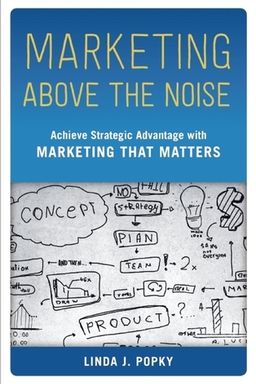
Marketing Above the Noise cover

Marketing Above the Noise

by Linda J Popky

In ''Marketing Above the Noise,'' Linda J Popky offers a guide to navigating the chaotic marketing landscape. By emphasizing timeless strategies over trendy tactics, she empowers marketers to build strong brands, engage customers meaningfully, and leverage data for strategic advantage.

Standing Out in the Marketing Interview

Have you ever walked out of a marketing interview wondering if you truly stood out—or if you blended into a sea of capable yet forgettable candidates? In Rise Above the Noise: How to Stand Out in the Marketing Interview, Lewis C. Lin argues that acing a marketing interview has far less to do with charm or luck and far more to do with demonstrating strategic, structured marketing thinking in action. The interview is not simply a test of what you know—it’s a live campaign in which you are the product.

Lin positions his book as both a playbook and a training simulator for marketing-minded job seekers. He contends that what separates top candidates from the rest is their ability to think like seasoned marketers: to analyze audiences, communicate brand value clearly, and create compelling stories under pressure. In the same way that great marketing campaigns capture attention amid crowded marketplaces, great interviewees must cut through noise and make messages unforgettable.

From Branding Theory to Interview Practice

The structure of the book mirrors the logic of effective marketing strategy. It begins with understanding what interviewers are truly assessing—a mix of marketing aptitude, planning ability, communication clarity, composure, and a satisfying conclusion—dimensions Lin grades rigorously in example answers from real interviews. He shows how seasoned marketers, like seasoned interviewees, must make choices under limited time and incomplete information. You’re expected to craft coherent recommendations with creative insight while walking your interviewer through a logical process that feels effortless yet strategic.

Throughout its seventeen chapters, the book proceeds like an end-to-end syllabus for a marketing career: from developing a positioning statement and executing STP and 4P frameworks, to mastering pricing, responding to declining sales, launching products, handling PR disasters, and analyzing ROI. But what makes Lin’s approach stand out is that he treats the interview not as an academic case study—but as real-world marketing strategy. Every chapter explains not only what the interviewer wants, but also how to think aloud like a marketer building or rescuing a brand in real time.

Why “Rising Above the Noise” Matters

In a competitive market where dozens—or hundreds—of qualified marketers apply for each role, Lin urges candidates to think in marketing terms: competition, differentiation, and user experience. Your competitors? Other applicants. Your brand message? The blend of logic, creativity, and authenticity that you communicate in each response. Your audience? A human hiring manager balancing intellect and emotion in a high-stakes decision.

Lin’s philosophy is deeply rooted in this paradox: companies recruit marketers to build unique brands, yet few candidates actually market themselves uniquely. Most rely on recycled frameworks and vague answers. His book breaks that cycle by transforming each category of marketing interview question—case studies, analytical puzzles, behavioral prompts, and even off-the-wall personal questions—into opportunities to prove both competence and curiosity.

A Hybrid Between Strategy Manual and Story Collection

Lin doesn’t simply instruct; he demonstrates. Every chapter features annotated sample dialogues between candidate and interviewer, complete with grading rubrics. These mini case studies reveal what mediocre answers sound like and what outstanding ones do differently. A weak candidate might dodge a question; a strong one acknowledges ambiguity, asks targeted follow-ups, and structures a response using a framework like the Big Picture (Goals → STP → 4Ps) or the Pricing Meter. The difference isn’t jargon—it’s confidence and clarity.

As you move through the book, you can see how Lin’s playbook merges core marketing concepts with interview psychology. Each chapter layers skill upon skill: positioning becomes the foundation; segmentation and targeting refine focus; pricing introduces analytical flair; and behavioral storytelling, supported by Lin’s own DIGS Method™ (Dramatize, Indicate, Go through, Summarize), ensures emotional connection. The mix of rigor and relatability makes this manual both a marketer’s refresher course and a behavioral coach in one.

What You’ll Learn Across the Journey

By the time you finish, you’ll have learned how to:

  • Craft crisp and memorable product positioning statements that communicate unique value
  • Develop structured marketing plans using goals, segmentation, targeting, and the 4Ps
  • Handle pricing and market-entry cases with both quantitative logic and strategic empathy
  • Diagnose declining sales, defend brands against aggressive competitors, and develop creative campaigns
  • Master behavioral and offbeat questions by blending storytelling with brand positioning of self

Lin closes by returning marketing principles to their natural subject: you. The final chapter—“Rising Above the Noise”—guides candidates through personal branding, awareness strategies, and creative outreach, all designed to differentiate you long before you ever set foot in an interview room. It’s a reminder that the ultimate marketing product isn’t a cereal box, a smartphone, or an app—it’s the story you choose to tell about yourself and how well that story resonates with those you seek to serve.


Decoding the Marketing Interview

Lewis Lin begins with a fundamental premise: to perform well, you first need to know what the playing field looks like. The marketing interview, he notes, is a simulation of real marketing judgment. Interviewers craft case and behavioral questions not to stump candidates but to evaluate their ability to interpret information, prioritize insights, and communicate under pressure.

What Interviewers Really Want

In marketing, there’s rarely a single “correct” answer—only compelling reasoning. Hiring managers don’t want parrots repeating textbook frameworks; they want strategic thinkers who can connect ideas. Lin distills the five main dimensions interviewers evaluate: Marketing Aptitude, Plan, Communication Skills, Composure, and Satisfying Conclusion. These mirror the expectations of a real marketer pitching new campaigns or leading cross-functional teams.

For instance, Marketing Aptitude measures not only your vocabulary of concepts like segmentation or pricing elasticity but also your ability to apply them judiciously. A weak candidate lists frameworks mechanically; a strong one tailors them to context—as a brand manager would when analyzing a real brief from Procter & Gamble or Starbucks.

Case Versus Behavioral Questions

According to Lin, marketing interviews tend to blend two question types. Case questions present you with a hypothetical challenge—like declining sales, launching a new product, or countering a competitor. They test structured thinking and poise. Behavioral questions dig into your past experiences to predict how you’ll handle similar situations. Companies such as P&G, Kellogg, and SC Johnson often rely on behavioral formats because they correlate past actions with future success. Others, like tech firms, favor hybrid or case-style interviews.

The Ideal Marketing Candidate

From Lin’s analysis of P&G’s brand manager job description, ideal marketers exhibit six intertwined competencies: strategic vision, advertising judgment, media fluency, project leadership, consumer insight, and quantitative analysis. But above all, they must act like cross-functional CEOs—capable of influencing without authority and communicating across creative, analytical, and operational domains. This combination of empathy and rigor, Lin emphasizes, is what the best marketing interviews seek to surface.

“Think like a marketer under pressure—not a student taking an exam.”

Lin frames the marketing interview as a moment of synthesis—a test of structured improvisation that reveals how you think, not what you’ve memorized.

By reframing the interview as a collaborative problem-solving exercise rather than an interrogation, you begin to showcase what companies really hire for: clarity, empathy, creativity, and the ability to drive brand growth through disciplined communication.


Crafting an Unforgettable Positioning Statement

For Lin, few marketing interview questions reveal true skill as clearly as this: “How would you position our product?” It’s a test of your strategic instincts and linguistic precision. Great positioning answers, like great campaigns, distill a brand’s entire story into a single, memorable sentence.

The Formula That Works

Lin leans on Geoffrey Moore’s classic template from Crossing the Chasm:

For [target user] who [needs or wants], the [product name] is a [category] that provides [benefit]. Unlike [competitor], the [product name] [unique difference].

But Lin warns candidates to avoid robotic recitation. Interviewers listen for intuition, not templates. The most successful candidates hybridize professional rigor with slogan-level wit. Think: “For first-time computer buyers like students and grandparents, the Samsung Chromebook is as sexy as the MacBook Air—but costs 80% less.” That line, Lin notes, has rhythm, specificity, and brand storytelling rolled into one.

Focus on One Benefit

One of Lin’s central lessons echoes the wisdom of advertising legend David Ogilvy: one brand, one promise. Multiplying benefits leads to diluted perception. Volvo stands for safety. FedEx for overnight reliability. Miller Lite for “Great Taste…Less Filling.” As Lin shows through historical examples (Pepsi vs. Coca-Cola, Emery Air Freight vs. FedEx), trying to dominate multiple benefit categories only confuses consumers. In interviews, candidates who mention too many benefits make the same mistake: their answers lose focus.

Balance Creativity and Credibility

Interviewers value originality, but they also seek believability. A slogan-like answer earns extra credit only if it’s consistent with customer truth. When Lin grades positioning answers as “excellent,” those candidates demonstrate empathy for customer motives and competitive reality. They don’t make vague statements like “the best quality at the best price”; they craft differentiated narratives backed by logic. This mirrors real-world marketing: ideas must inspire but also align with data. (Similarly, Al Ries and Jack Trout’s Positioning: The Battle for Your Mind makes this balance the essence of long-term brand leadership.)

So the next time you’re asked for a positioning statement, think beyond formula. Ask yourself: Who exactly am I speaking to? What emotional or functional benefit do they care about most? How can I say it simply enough to fit on a product package—and strong enough to fit in their memory?


The Big Picture Framework for Marketing Plans

When interviewers ask, “You have $1 million to spend—what’s your marketing plan?” most candidates panic. Lin transforms this dreaded question into an opportunity by teaching the Big Picture Framework. Derived from Professor Christie Nordhielm at the University of Michigan, the framework captures how marketers move from strategy to execution logically and creatively.

Step One: Goals

Every good marketing plan begins with clarity of purpose. Is the objective revenue growth, market share, or brand awareness? Lin urges you to make goals specific, measurable, and time-bound—for example, “Increase U.S. market share of sugar-free energy drinks by 3% among 25–34-year-olds in the next 12 months.” Vagueness signals fear of failure; specificity signals accountability.

Step Two: STP—Segmentation, Targeting, Positioning

The heart of strategy. Lin walks through demographic, behavioral, attitudinal, and aspirational segmentation. He encourages aspiring marketers to favor aspirational segments: customers defined by what they strive to be, not what they already are. Brands like Chanel or Old Spice thrive by appealing to identity and aspiration. In targeting, you focus resources on the clusters where your benefit resonates most. Then you articulate positioning statements built on that segment’s desires and needs—tying back to earlier lessons.

Step Three: The 4Ps—Product, Place, Promotion, Price

With strategy in place, Lin brings you into tactical mode. Product design, packaging, and innovation are addressed through his CIRCLES Method™ (Comprehend, Identify, Report, Cut, List, Evaluate, Summarize). For instance, he demonstrates how Procter & Gamble might have invented Tide Pods by noticing that messy measuring frustrates customers. The cycle prompts structured creativity—something hiring managers love to see in interviews.

Distribution (Place) choices depend on customer behavior and product complexity. Promotion covers both classic media and digital tactics—from consumer sweepstakes to Cadbury’s social campaigns. Lin insists candidates link every promotional proposal to goals and metrics like reach, frequency, or conversion rate, showing quantitative grounding. Lastly, price receives its own deep treatment later, framed as one of the marketer’s most powerful levers of strategy and psychology.

Together, Goals + STP + 4Ps form what Lin calls “the marketer’s operating system.” In interviews, explaining your ideas through this logic elevates you from candidate to consultant—turning messy brainstorming into a persuasive, professional dialogue.


Mastering Pricing and Analytical Thinking

Pricing, Lin argues, is more than math—it’s storytelling with numbers. In interviews, quantitative questions reveal whether you can connect financial intuition to customer psychology. He divides pricing challenges into two types: changing price of an existing product and setting price for a new product.

Pricing Existing Products

Lin introduces the simple but powerful Pricing Worksheet: list old and new prices, costs, unit volumes, and gross profits. Then compare totals before and after a price change. Candidates must adjust for potential competitor reactions or elasticity effects. When analyzing whether to raise the price of Hidden Valley Ranch or Pringles, Lin’s examples show candidates performing sensitivity analyses and anticipating responses—a mindset borrowed from game theory (“the prisoner’s dilemma” in the Delta vs. United case).

Pricing New Products

For new offerings, the unknown variable is demand, not cost. Lin’s Pricing Meter visualizes the balance among three numbers: cost to produce (floor), competitor pricing (market), and customer willingness to pay (ceiling). The goal is to price between floor and ceiling, ideally just below perceived value to maximize adoption. This framework mirrors value-based pricing philosophy used by companies like Apple or Southwest Airlines—businesses that price not just by cost, but by the experience and perception they create.

Beyond the Numbers

Lin emphasizes presentation: talk through your assumptions, list your variables, and validate conclusions with qualitative judgment. In good interviews, the math matters less than the logic—it’s not about “getting the answer” but demonstrating how a marketer blends analysis and storytelling. This skill also translates to later sections on ROI calculations and estimation cases, where Lin provides worksheets and industry-standard metrics (CTR, conversion rate, CPC) that mirror the analytics vernacular of modern marketing teams.

If positioning reveals your art, pricing demonstrates your science. And in an environment where marketers must justify every dollar, Lin’s rigorous yet intuitive pricing toolkit proves indispensable.


Handling Declining Sales and Market Challenges

Declining sales questions are staples of brand management interviews because they reveal diagnostic thinking. Lin teaches a deceptively simple formula: Sales = Price × Quantity. When numbers drop, the cause lies in one (or both) of these factors—from consumer demand shifts to competitive interventions.

Diagnose Before You Prescribe

Lin coaches candidates to play detective. Ask whether consumer preferences, competitor moves, or channel changes are at play. For example, when Kingsford Charcoal faced declining sales as Americans adopted gas grills, an excellent candidate reframed the problem: charcoal grilling still had an advantage—taste. By repositioning Kingsford as the choice for “foodies” who care about flavor, the candidate kept both realism and creativity intact.

Similarly, in the Kit Kat case, Lin shows how the root cause wasn’t product performance but distribution conflict: Costco replaced Kit Kat endcaps with its own private label. The solution wasn’t more advertising, but renegotiating shelf space or co-manufacturing private-label alternatives. Smart candidates, Lin notes, know that fixing symptoms (e.g., ads) without addressing causes (e.g., placement) is like “turning up the volume on a broken radio.”

Distinguish Between Category and Share Issues

A useful layer is to determine whether your brand’s entire category is shrinking (as in charcoal) or simply your brand’s slice within a healthy category (like Colgate losing share to Burt’s Bees). In the latter, Lin advises considering market entrants, new customer preferences (organics, sustainability), or competing benefits like Crest’s whitening innovation. The decision point often becomes whether to build, buy, or partner into new segments—aligning with CEO-level strategy questions later in the book.

Across all scenarios, Lin’s mantra is simple: diagnose with logic, propose with empathy, and conclude with confidence. In every declining sales story, it is the clear, structured thinking—not the laundry list of tactics—that convinces interviewers you can lead a business through turbulence.


Telling Your Story with the DIGS Method™

For behavioral interviews, Lin introduces the DIGS Method™—a masterclass in narrative intelligence. Unlike the formulaic STAR method (Situation, Task, Action, Result), DIGS invites you to tell stories that feel cinematic and emotionally authentic while still structured.

D – Dramatize the Situation

Set the scene with stakes and emotion. Context turns routine tasks into gripping challenges. Instead of “we launched a campaign,” say, “We had one week to save a $10 million account that was threatening to defect.” The dramatization instantly positions you as protagonist and clarifies why the moment mattered.

I – Indicate the Alternatives

Show that you made conscious choices. Presenting multiple options—and your reasoning—demonstrates critical thinking. In behavioral storytelling, alternatives create drama and contrast; they prove that your success wasn’t accidental but the result of judgment under uncertainty.

G – Go Through What You Did

Now immerse the listener in action: what you said, who you influenced, what resistance you overcame. Realistic sensory details convey leadership presence. As Lin notes, “drop the interviewer on the front lines with you.” That authenticity makes them visualize you in their company.

S – Summarize the Impact

Close the loop by quantifying or qualifying results. Cite metrics (“lifted sales by 10%”) or testimonials (“our VP called it the smoothest launch in five years”). Even if numbers are approximate, specificity sells credibility—just as brands use metrics to prove campaign ROI.

Through detailed examples—such as a VP calmly addressing internal criticism or a public affairs manager guiding a controversial gun-policy announcement—Lin shows how DIGS transforms performance reviews into persuasive human stories. It’s storytelling not as embellishment, but as strategy: a way to brand yourself with empathy, logic, and poise.


Building and Marketing Your Personal Brand

Lin ends where all marketing begins: branding. The final chapter, “Rising Above the Noise,” reframes your career as a product launch. To stand out, you must design, promote, and nurture your personal brand using the very same steps outlined for products.

Develop Your Positioning

Just as a brand defines what it stands for, you must articulate what you want to be known for. Is it storytelling ability, data-driven growth, or leadership under pressure? Align your brand promise with the employer’s needs—if a company prizes digital agility, emphasize analytics and social strategy rather than traditional advertising laurels.

Generate Awareness and Interest

Lin argues that blindly submitting resumes through corporate portals is the least efficient funnel of all. Instead, use trusted introductions, personalized outreach, and small “campaigns” like sending relevant research or creative ideas to target employers. Think of each gesture as a touchpoint: you’re gradually nurturing brand awareness and interest before the formal interview ever begins.

Offer a Free Trial

One of Lin’s most actionable tips: do the job before you’re hired. Design a mock campaign, conduct competitive analysis, or present consumer insights. Leaving tangible work with the interviewer changes the conversation from speculation (“Can you do this?”) to demonstration (“You already did”). In today’s market, this proactive proof of value can be more persuasive than any resume bullet.

Don’t Forget the Follow-Through

Finally, he reminds readers that classic marketing principles still apply to relationships: reinforcement builds retention. Send heartfelt thank-you notes—because consistency of brand tone and courtesy matters. Recruiters remember professionalism long after creative gimmicks fade.

By blending authentic self-marketing with disciplined execution, Lin’s conclusion expands the book’s metaphor: the most successful marketers are those who treat their careers like evolving brands. They listen to feedback, test new messages, and continuously refresh their value proposition—always finding new ways to rise above the noise.

Dig Deeper

Get personalized prompts to apply these lessons to your life and deepen your understanding.

Go Deeper

Get the Full Experience

Download Insight Books for AI-powered reflections, quizzes, and more.