
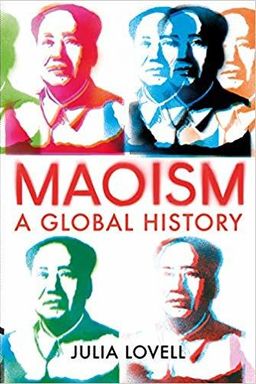
Maoism cover

Maoism

by Julia Lovell

Julia Lovell''s ''Maoism: A Global History'' explores the far-reaching impact of Maoist ideology, from its inception in China to its influence on global revolutions. This comprehensive analysis reveals how Maoism''s adaptable principles have shaped political landscapes and inspired movements worldwide, offering a compelling narrative of its enduring legacy.

Maoism as Global Strategy and Myth

Why did Maoism capture imaginations from rural Asia to urban Paris? This book argues that Maoism was not a single doctrine but a flexible toolkit—an evolving system of ideological, military and rhetorical strategies that transformed Chinese Communism into a global brand of revolution. Mao Zedong fused guerrilla warfare, peasant politics, and continuous ideological struggle into a method for seizing and holding power. His ideas travelled widely, energizing liberation movements, shaping state practices, and creating both political devotion and catastrophic violence.

From Revolution to Export

At its core, Maoism reverses classical Marxism by placing the peasantry, not the industrial proletariat, at the center of revolution. Power, Mao declared, ‘comes out of the barrel of a gun,’ and protracted guerrilla warfare from the countryside was its method. The intertwining of political and military tactics—building base areas, fighting flexible battles, and rooting the army in the masses—created a recipe that could be replicated in other terrains. Unlike the rigid bureaucratic model of Soviet Communism, Maoism emphasized adaptability, voluntarism, and faith in mass mobilization. That combination made it exportable.

Mao’s 'mass line' promised receptivity to popular will: gather the people’s scattered ideas, refine them through Party wisdom, and return them improved. In practice this meant cycles of participation and control—mobilization followed by rectification, enthusiasm followed by self-criticism. Foreign revolutionaries found this participatory rhetoric flexible enough to localize yet rigorous enough to command obedience.

Discipline and Thought Reform

The Yan’an Rectification Campaign (1942–43) transformed Mao’s ideas into a machinery of thought control. Intensive study, confession, self-criticism, and public struggle sessions became tools for ideological purification. Writers like Wang Shiwei, who questioned Party privilege, learned that dissent led to death. What emerged was a political technology that made loyalty appear voluntary. These rituals of confession and correction would later echo across the world—from the Japanese United Red Army’s internal purges to American Cold War fears of 'brainwashing.'

Western anxiety about Chinese 'thought reform' shaped real policies. Publications by Edward Hunter popularized the term 'brainwashing' during the Korean War, convincing U.S. leaders that Communist methods could rewrite human consciousness. The result was the CIA’s MK‑Ultra program—experiments with LSD, hypnosis and sensory deprivation. Ironically, Western fear of Maoist psychology reproduced the very authoritarianism it feared.

Building a Global Image

Much of Maoism’s reach came through storytelling. Edgar Snow’s Red Star Over China (1937) painted Mao as a heroic, poetic peasant-statesman. Snow’s crafted interviews made Mao palatable to Western audiences and mythologized the Red Army’s Long March. The book turned Yan’an into a symbol of egalitarian purity. Reproduced in multiple languages, it carried Maoism’s message into Malaya, Peru, and beyond, giving future insurgents both ideological example and narrative model. (Note: Snow’s work was part-journalism, part-PR, yet that is precisely what made it globally powerful.)

The Age of High Maoism

By the 1960s Maoism reached its zenith. The Sino-Soviet Split turned China into an alternative revolutionary pole: while Moscow preached cautious coexistence, Beijing urged perpetual struggle. Mao’s Great Leap Forward, though catastrophic domestically, embodied this voluntarism—faith that human will could surpass material limits. The Cultural Revolution reasserted that belief through chaos, mobilizing youth to 'bombard the headquarters.' Abroad, Lin Biao’s essays proclaimed Mao Zedong Thought as the spiritual weapon for liberation across the Third World. Posters, songs and Little Red Books turned revolution into culture, exporting imagery as well as ideology.

From Influence to Catastrophe

Yet the global journey of Maoism reveals profound contradictions. In Indonesia (1965) Maoist rhetoric of audacity intersected with local volatility and Cold War intrigue, triggering massacres of hundreds of thousands. In Vietnam and Cambodia, alliances curdled into wars and genocides: Beijing’s support for the Khmer Rouge enabled atrocity, while Sino-Vietnamese rivalry erupted in open conflict. In Africa, Maoism funded railways and guerrilla schools; in the West, it inspired both cultural rebellion and political extremism. The Nepali and Indian Maoists later carried that banner into new contexts—blending ideology, insurgency, and disillusion. Across continents, the pattern repeated: idealism fused with discipline, mass fervor with control, hope with terror. Maoism’s legacy remains a lesson in how revolutionary myth can travel faster and farther than its moral compass.


Discipline and the Politics of Thought

Mao understood revolution as much a mental process as a material struggle. To consolidate power, he devised methods that fused pedagogy, confession, and terror into what historians call 'thought reform.' The Yan’an Rectification Campaign (1942–43) institutionalized these methods. Thousands of cadres underwent 'self-criticism' in small circles, confessing ideological deviance, rewriting their life stories, and denouncing others. Surveillance and persuasion merged, creating a self-disciplining subject loyal to the Party—and to Mao himself.

The Mechanism of Control

Rectification combined intimate and public rituals. Kang Sheng’s secret police systematized confessions through both study sessions and 'struggle meetings,' turning belief into performativity. The method exported easily: Perguerrilla movements in Peru, Japan, and elsewhere transplanted these confessional structures. The paradox was that Maoism’s language of mass empowerment relied on humiliation and conformity to sustain emotional control.

From China to Cold War Panic

In the West, reports from prisoner-of-war camps during the Korean War transformed these practices into the specter of 'brainwashing.' Edward Hunter’s reports claimed that Chinese instructors had invented 'menticide'—the murder of the mind. Although later psychologists concluded that coercive persuasion, not total mind reprogramming, explained the behavior, American policymakers acted as if communists possessed a superweapon. The CIA’s MK‑Ultra program, directed by Sidney Gottlieb, spent millions testing chemical and psychological control. The supposed discovery of Maoist thought reform thus produced its mirror image inside the United States—proof that rival empires learn from each other’s fears.

Enduring lesson

Total ideological control begins with voluntary confession: Rectification blurred persuasion and coercion so thoroughly that individuals internalized surveillance as self-reform.

Thought reform therefore stands as Maoism’s psychological signature. It illustrates how revolutions police belief as fiercely as borders and how Cold War powers, both East and West, converted fear of the other’s methods into dark experiments of their own.


Maoism's Export and the Third World

In the decolonizing world of the 1950s and 60s, Maoism promised moral leadership against imperialism. China portrayed itself as poor but principled—a partner to newly independent nations. This ideological export mixed material aid, training, and spectacle. Zhou Enlai’s tours across Africa introduced the Eight Principles of Assistance: equality, respect for sovereignty, and shared hardships. In practice, China trained soldiers and engineers, built infrastructures like the Tan‑Zam railway, and sent medical teams and teachers who claimed to 'live like locals.' The outreach won friends and UN votes but also revealed contradictions between generosity and propaganda.

Aid, Charm and Propaganda

Chinese diplomacy wrapped aid in performance. Radio Peking broadcasts flooded African airwaves; portraits of Mao and millions of Little Red Books were distributed from Mali to Zanzibar. Leaders such as Julius Nyerere and Abdulrahman Babu admired China’s model of self-reliance. Yet tensions soon appeared: accidents on construction projects, racial misunderstandings and ideological arrogance undermined goodwill. In Zanzibar, a beating of an African student provoked protests, showing that cultural hierarchy persisted beneath claims of equality.

Exporting Guerrilla Practice

Chinese training extended beyond aid. Between the 1960s and 1980s, the PRC trained more than twenty thousand African and Asian fighters. From Nanjing to Ghana’s secret camps, recruits studied sabotage and political education. The objective was to replicate the 'People’s War' that encircled cities from the countryside. Nelson Mandela, ZANU cadres in Zimbabwe, and others learned Maoist doctrines adapted to their terrains. But outcomes were inconsistent: some movements achieved independence; others collapsed into authoritarianism or chaos. Even successful alumni, like Zimbabwe’s Mugabe, adopted centralized, repressive state models mirroring aspects of Mao’s own rule.

Dual reality

For many developing countries, China’s aid symbolized solidarity, yet each project also served Beijing’s diplomatic aims—recognition, prestige, and ideological influence.

The Maoist mission in the Third World left a conflicted legacy: it built roads, railways and hope, but exported political rigidity and leader cults. Its history prefigures China’s modern global presence—a blend of altruism, competition, and calculated influence.


Failures and Ruins: From Indonesia to Cambodia

When Maoist rhetoric collided with fragile states and Cold War interventions, consequences were catastrophic. In Indonesia (1965), President Sukarno’s balancing act between the army and the Communist Party (PKI) unraveled after the 'September 30th Movement.' Within weeks, General Suharto’s forces, aided by Western intelligence, massacred up to a million suspected leftists. Mao’s slogans about courage and leapfrogging history resonated in PKI discourse, but without military capability or political coherence, the party’s zeal turned suicidal. (Note: The CIA and MI6 encouraged suppression to stem Communist expansion.)

Indochina’s Tragic Laboratory

In Vietnam and Cambodia, Maoism’s influence mixed with anti-colonial struggles and regional rivalry. Chinese training and billions in aid helped Vietnam defeat France and America, but relations deteriorated when Vietnam leaned toward the USSR. In Cambodia, Pol Pot took Maoist notions of class purification to genocidal extremes. Endorsed by Beijing with funds and praise, the Khmer Rouge abolished money, emptied cities, and killed roughly a quarter of their population. Vietnam’s intervention to end the genocide in 1978 precipitated China’s punitive invasion of Vietnam in 1979—a tragic cycle of ideological kinship turned fratricide.

A Warning on Ideological Hubris

These episodes show how revolutionary universals failed before local complexity. Maoism’s promise of peasant empowerment became a cover for elite authoritarianism, and its notion of permanent revolution fostered paranoia and purges. Each case revealed a recurring pattern: a small intellectual elite invoking the rural poor as justification while wielding terror in their name.

Main takeaway

Global Maoism's bloodiest episodes resulted from mixing ideological certainty with weak institutions and Cold War meddling—political fantasy meeting geopolitical reality.

The lessons of Indonesia, Vietnam, and Cambodia stand as warnings: when ideology overrides empathy and local understanding, revolutionary idealism mutates into catastrophe.


Maoism's Afterlives in India, Peru and Nepal

Long after Mao’s death, his revolutionary grammar inspired new wars in very different places. In Peru, Abimael Guzmán’s Shining Path recast Maoism as apocalyptic crusade; in India, Charu Mazumdar’s Naxalite movement declared parliamentary democracy a bourgeois trap; in Nepal, educated Brahmin elites led a decade-long Maoist insurgency that toppled a monarchy but struggled to rule.

Peru: Ideology as Cult

Guzmán, a philosophy professor trained in Marxist theory and enamored of Mao’s voluntarism, transformed academic radicalism into terror. Under his leadership, Shining Path combined strict discipline, public executions, and rural intimidation, producing 69,000 deaths. Guzmán’s 'strategic offensive' ignored Peru’s complex society and turned ideology into moral absolutism. The peasantry—nominally revolutionary subjects—suffered most. (Note: Peru's Truth and Reconciliation Commission later recognized both state and insurgent crimes.)

India: A Long Guerrilla War

Indian Maoism, rooted in resentment against caste oppression and rural inequality, erupted in Naxalbari (1967). Charu Mazumdar and later the People’s War Group carried Mao’s doctrine into forests and tribal areas. They built armed zones in Andhra Pradesh and Chhattisgarh, using violence both as resistance and control. State counterinsurgency—particularly the Salwa Judum militia—committed equal or greater abuses, fueling a cycle of brutality. The movement persists, blending legitimate grievance with rigid ideology.

Nepal: From Books to Power

In Nepal, Maoism arrived through translation and universities before it reached the hills. Leaders like Prachanda and Baburam Bhattarai read Mao and Xiang literature before raising rifles. The 1996 insurgency began with a manifesto of forty demands and ended a decade later with the monarchy’s fall. Women and lower castes gained unprecedented roles—female fighters like Kamala became ministers—but coercion and forced recruitment also scarred communities. The subsequent peace process (2006–2011) integrated only a fraction of Maoist fighters, many left disillusioned while elites joined government. Corruption and political fragmentation followed, mirroring past revolutionary disappointments.

Shared pattern

Across Peru, India, and Nepal, Maoism’s translation produced social awakening yet repeated its core paradox: violent egalitarianism led by elites and sustained through coercion.

These post‑Mao wars reveal how revolutionary faith, when detached from historical empathy, breeds cycles of rebellion and regret. Mao’s ghost lived on, both as liberation myth and as a manual for authoritarian resurrection.


Neo-Maoism and China's Revival

Inside China, Mao’s image never disappeared—it was repurposed. Under Xi Jinping, the Communist Party revives selected Maoist elements to reinforce discipline and authority without unleashing the chaos of the Cultural Revolution. This controlled resurrection intertwines nostalgia, nationalism, and political engineering.

Symbolism and Control

Xi’s administration employs Maoist language—the 'mass line,' 'rectification,' and 'self-criticism'—in campaigns that tighten party oversight. Anti-corruption drives recall earlier purges but are calibrated to consolidate central power. Visits to Mao’s shrines, bans on 'historical nihilism,' and the inclusion of 'Xi Jinping Thought' in the constitution affirm continuity with revolutionary legitimacy. Yet this revival occurs within a hyper‑capitalist society, creating an ideological hybrid: socialist purity invoked to manage capitalist expansion.

Public Culture and Neo-Maoists

Grassroots neo-Maoists—from the Utopia website to Bo Xilai’s 'Sing Red, Strike Black' experiment in Chongqing—celebrated defiant nostalgia for equality and moral order. Bo’s spectacular rise and fall demonstrated the Party’s ambivalence: it admires Maoist cultural energy but fears its populist volatility. Online left-nationalists continue to invoke Mao’s legacy to criticize inequality and Westernization, yet most remain within nationalist rather than revolutionary bounds.

Selective continuity

Modern China uses Maoist imagery to legitimize centralized rule while discarding the radical egalitarianism that once animated it.

Xi’s neo‑Maoist turn thus completes the circle: the language of permanent revolution retooled to secure permanent authority. Mao’s face still gazes over Tiananmen, but now as emblem of order, not upheaval.


The Contradictory Legacy

Maoism endures because it captures two enduring human desires: collective empowerment and moral certainty. Yet its history exposes how those desires turn oppressive when harnessed to central control. Across continents, movements invoking Mao blended emancipation and coercion, solidarity and hierarchy. In Africa, Asia, and Latin America it offered a language for dignity and defiance; in practice it often reproduced new elites and new inequalities.

Ideals and Outcomes

Where Maoism aligned with genuine popular grievance, it could dismantle colonial arrogance and open political space. Where it ignored local realities, it produced devastation. The doctrine’s portability made it seductive; its rigidity made it perilous. The moral of Maoism’s long journey is neither simple rejection nor blind praise—it is a reminder that ideals detached from empathy and pluralism mutate into violence.

Final reflection

Maoism’s strength was faith in mass agency; its tragedy was the belief that purity could be imposed by force.

Today, traces of Maoism remain in China’s governance style, in India’s forests, in African infrastructure, and in Western cultural memory. Understanding its contradictions—idealism versus control, revolution versus order, solidarity versus fear—teaches you how political ideas travel, transform, and sometimes betray their origins. Maoism survived not as doctrine, but as warning and mirror of modern power itself.

Dig Deeper

Get personalized prompts to apply these lessons to your life and deepen your understanding.

Go Deeper

Get the Full Experience

Download Insight Books for AI-powered reflections, quizzes, and more.