
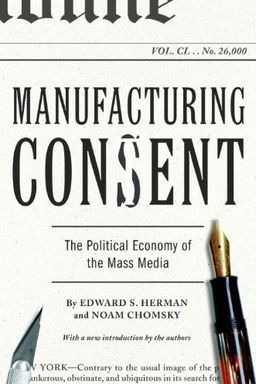
Manufacturing Consent cover

Manufacturing Consent

by Edward S Herman and Noam Chomsky

Manufacturing Consent critically examines the role of mass media in shaping public opinion. Through a detailed propaganda model, it reveals how media filters information to favor elite interests, challenging the perception of a free press and exposing the power dynamics that maintain social inequality.

Media Power and the Propaganda Model

What determines the news you read each morning? In Manufacturing Consent, Edward Herman and Noam Chomsky argue that mass media in market democracies serve not as neutral informers but as ideological institutions that reinforce elite power. Their core claim is structural, not conspiratorial: systemic business, ownership, and state pressures shape how information is filtered, framed, and circulated. You can understand this framework through their Propaganda Model — a set of five structural filters that explain why certain facts, victims, and narratives dominate mainstream coverage while others disappear.

At the center of the book lies a practical insight: news is not simply chosen, it is produced through institutional routines that reward conformity. Herman and Chomsky show how journalism functions predictably under conditions of ownership concentration, advertising dependence, official sourcing, systematic flak, and reigning ideology. In combination, these filters define the boundaries of acceptable discourse and make dissent costly or invisible.

The Five Filters: Structure Over Intent

The first filter—ownership and profit orientation—anchors the model. Media are large corporations, often parts of diversified conglomerates like Disney, Time Warner, and Viacom. Their profit motives create natural caution: stories that threaten advertisers, board partners, or investor confidence rarely reach prominence. The second filter—advertising—reinforces this bias by turning the audience into the product sold to marketers. Advertisers prefer affluent, consumption‑oriented demographics, which narrows editorial tone and content around marketplace values. Radical or labor press traditions vanished as they lost access to ad funding (Curran & Seaton’s findings illustrate this transformation).

The third filter—sourcing—explains why official voices dominate the news. Deadlines and budget pressures drive reporters toward pre‑packaged information from governments, corporations, and PR agencies. The Pentagon or State Department offer instant copy, while grassroots or dissident groups lack comparable resources. This creates symbiotic dependence: official institutions supply stories; journalists supply credibility. The fourth filter—flak—acts as punishment. When coverage deviates, you often see organized pressure campaigns, lawsuits, or advertiser withdrawals. Groups like Accuracy in Media and Freedom House routinely produce such flak, ensuring editorial compliance through preemptive self‑censorship.

The fifth filter—dominant ideology—provides cohesion. Anti‑communism functioned as the Cold War’s ideological boundary; later replaced by market fundamentalism and national‑security patriotism. Within these norms, critical voices appear radical or unpatriotic. The filters, working together, explain why media echo official premises reflexively: they constrain not by direct command but by structural incentive.

Empirical Demonstrations

Herman and Chomsky’s method is empirical. They quantify reporting patterns: whose deaths count as tragedy, whose elections generate praise, whose atrocities qualify as genocide. Comparing coverage of Polish priest Jerzy Popieluszko’s murder (in a communist state) with the killings of Archbishop Romero and U.S. churchwomen in U.S.‑aligned El Salvador, they reveal a staggering asymmetry in attention and moral tone. The differential in column inches and editorials demonstrates how foreign‑policy alignment predicts compassion. “Worthy victims” in enemy states are humanized; “unworthy victims” in client regimes are obscured or blamed for instability.

They also test the model on elections. In Nicaragua (1984), extensive coverage condemned Sandinista processes as coercive despite positive observer reports from LASA; in El Salvador and Guatemala (client states), press narratives celebrated “demonstrations of democracy” despite pervasive terror and mandatory voting. Even raw topic counts in the New York Times confirm alignment with U.S. interests—freedom‑of‑press themes surface when criticizing adversaries but vanish for allies.

Historical and Contemporary Applications

Case studies extend from Indochina to Iraq. Coverage of U.S. chemical warfare (Agent Orange) and Cambodian bombing faded quickly, while unverified claims like “Yellow Rain” received extensive amplification. The later Iraq‑WMD episode reprises the same pattern: repetition of official assertions by Judith Miller and Michael Gordon in the Times validated Cheney’s war rhetoric. Corporate media again became “reliable members of the war‑making team,” illustrating the model’s durability.

Iran coverage after 2003 showed identical mechanisms—mistranslations (“wiped off the map”) circulated thousands of times, while NPT context and nuclear hypocrisy were ignored. Part 3’s quantitative data (spikes in mentions, loaded words like “defiant”) expose how narrative inflation serves strategic policy aims.

Purpose and Remedies

In closing chapters, the authors restate the model’s societal purpose: media defend the economic, social, and political interests of privileged groups dominating state and economy. The process is automatic—driven by market constraints, access dependency, and internalized professional norms. But they also suggest countermeasures: support public broadcasting, grassroots media cooperatives, and community channels that broaden debate (examples include Pacifica Radio or Radio Zinzine). They urge citizen vigilance—asking “who benefits?” each time narratives align with power.

(Note: Unlike conspiracy theories, the propaganda model describes systemic behavior. Its predictive value lies in structure, not motive. You measure it by patterns—topic emphasis, source types, framing asymmetries—observable across decades.)

In sum, Herman and Chomsky teach you to read news as institutional output, not spontaneous discovery. When state and corporate interests converge, media filter reality to manufacture consent. Recognizing those filters revives your capacity for independent judgment—the book’s enduring practical aim.


Ownership and Corporate Control

The first filter—ownership—is the foundation of the propaganda model. Herman and Chomsky trace how U.S. media evolved from locally owned papers to consolidated transnational conglomerates. By the 1990s, a handful—including Disney, AOL Time Warner, Viacom, News Corp, and General Electric—controlled nearly all major outlets. Such concentration converts editorial independence into corporate risk management: investigative journalism becomes expensive; entertainment and cross‑promotion are safer for shareholders.

Commercial Logic and Editorial Effects

Big firms need predictable returns. So newsroom priorities shift toward broadly appealing, advertiser‑safe products. You see it when network news devotes more airtime to lifestyle features and less to investigative series about industrial pollution or foreign interventions. Deregulation and cross‑ownership amplify this trend—removing barriers that once kept information sources diverse. Herman and Chomsky cite Bagdikian’s evidence showing how even one firm under $1 billion in assets was exceptional; scale itself discourages dissenting content.

Synergy and Self‑Censorship

Cross‑media synergy means stories must not harm sister companies or advertisers. Disney’s political coverage cannot endanger theme‑park relations; Time Warner balances news with entertainment promotion. This convergence narrows ideology to managerial common sense: efficiency, growth, stability. When power is concentrated, the result is structural conservatism—bias toward existing hierarchies, not overt command. The book stresses that even aggressive reporting rarely exceeds boundaries defined by owners’ interests.

Takeaway

Ownership concentration limits pluralism. The larger the corporation, the greater the pressure to protect the conglomerate ecosystem—and the smaller the space for challenging stories.

To read critically, you must link recurring framing choices—like muted coverage of client‑state atrocities—to who owns the media and who gains from stability. Economic structure creates ideological continuity across outlets, explaining why “news fit to print” often means news fit for investors.


Advertising as Invisible Influence

Advertising, the second filter, reshapes journalism from within. Since ads subsidize nearly all mainstream news, media producers align content with the preferences of advertisers and the audiences advertisers value most. Herman and Chomsky show how this logic marginalizes working‑class or radical perspectives and creates continuous commercial discipline on editorial choices.

Economic Subsidy and Audience Shaping

Historically, advertising allowed some newspapers to underprice competitors and dominate circulation. Radical or labor papers—lacking ad revenue—died. Modern equivalents persist: networks curate “quality audiences” for consumer goods. The newsroom’s mission becomes selling affluent demographics rather than informing citizens. Grant Tinker’s remark at NBC—“Programming follows advertiser support”—captures this culture perfectly.

Normative Reference and Content Filtering

Advertisers act as subtle censors. Programs investigating corporate misconduct or systemic inequality invite risk; sponsors withdraw or preemptively veto. When Gulf+Western pulled funding from WNET’s Hungry for Profit, the station sanitized content—a clear case of ad influence reshaping editorial integrity. The pattern encourages entertainment and soft news, discouraging structural critique of capitalism.

Lesson

Follow the ad dollars. When you notice conspicuous silence around industries or policies, it often correlates with advertiser sensitivity or audience targeting constraints.

The advertising filter teaches you to question not only what stories run but what kinds of stories fit the format. Markets reward distraction—“content” that preserves consumption—over hard truth. Recognizing that underlying transaction clarifies why systemic journalism remains rare in commercial media.


Sourcing, Experts, and Institutional Symbiosis

The third filter—sourcing—explains the daily mechanics of institutional bias. Reporters depend on official channels for credibility and volume. Governments and corporations exploit that need by supplying steady streams of ready-to-use material, ensuring the news agenda mirrors official priorities.

How Dependence Forms

Deadlines drive journalists toward predictable sources: briefings, press conferences, photo ops. The Pentagon and White House operate vast communication offices; grassroots groups cannot compete. Herman and Chomsky quantify this imbalance and show how it yields symbiotic relations—journalists “plug in” to official feed systems that define reality for public consumption.

Manufactured Expertise

Public relations and think tanks magnify sourcing bias. Foundations fund policy experts whose commentary aligns with corporate aims—CSIS, Heritage, AEI, and others appear frequently as “independent” voices while channeling ideological consensus. The authors trace this to the Powell Memo strategy, which built a durable network of business-friendly intellectuals. Media cite them as neutral analysts even when funding is partisan.

Practical Check

When new “experts” flooding airwaves support a policy line, investigate their funding and institutional ties. Apparent objectivity often masks organized source manufacture.

Routine sourcing thus turns journalism into relay. Official suppliers manage not only facts but credibility itself. Recognizing that dependence reveals why controversial context—like U.S. covert funding or archival data undermining narratives—rarely gets attention.


Flak and Ideological Enforcement

The fourth filter, flak, is organized backlash. It operates as deterrent discipline on journalists and outlets that venture beyond orthodoxy. Herman and Chomsky compile examples—from lawsuits to boycotts—showing how media critics funded by powerful interests manufacture reputational and financial pain for transgressors.

Institutionalized Pressure

Groups like Accuracy in Media, the Media Institute, and Freedom House specialize in policing coverage. Libel suits against CBS (Westmoreland case) demonstrate how legal mechanisms reinforce caution. Editors internalize expectations and self-censor preemptively. Even without explicit threats, memory of prior flak constrains risk-taking stories that challenge the military, corporations, or foreign-policy consensus.

Ideology as Unifying Glue

Flak merges with the fifth filter—ideology. In Cold War years, anti‑communism served as gatekeeper; today market faith and national security fill that role. These frameworks mark the boundaries of “reasonable” debate. Journalists who cross those lines risk ostracism or career damage. The process is systemic, not conspiratorial—the price of transgression is too high for most professionals.

Core Insight

Flak creates feedback: past punishments teach future restraint. Ideology defines the safe zone, and flak enforces it.

When you see concerted denunciations of “biased” reporting, ask whether the criticism arises from genuine fact-checking or organized political enforcement. The distinction marks where public discourse ends and propaganda begins.


Victims, Elections, and Narrative Bias

Herman and Chomsky’s comparative case studies reveal how filters manifest in content: which victims and elections matter. “Worthy” victims—those harmed by adversaries—get human interest and outrage. “Unworthy” victims—those harmed by allies—receive scant coverage or explanation.

Differential Humanity

Popieluszko’s murder in Poland generated editorials and front-page empathy; dozens of murdered clergy in El Salvador and Guatemala—U.S. client states—were treated as routine or contextual casualties. The New York Times devoted more space in one month to Poland than to Latin America’s long ordeal. This asymmetry quantifies ideological priorities concealed in moral language.

Demonstration Elections

Elections repeat the same pattern. In U.S.-backed El Salvador, Guatemala, or Grenada, sham procedures were praised as democratic achievements. In Nicaragua (1984), robust oversight and free participation were dismissed as “stage-managed.” Independent observers like LASA found fairness; major media ignored them. Topic audits show how coverage in client states emphasized turnout and enthusiasm, while adversaries faced scrutiny on press freedom and secrecy.

Learning to Decode

Check double standards. When identical facts—violence, censorship—produce opposite conclusions, you’re observing systemic bias, not journalist accident.

Foreign coverage thus functions as moral theater: outrage and legitimacy flow along alliance lines. The consistency across victims and ballots reveals ideology embedded in news routines.


War Coverage and Manufactured Crises

Several chapters show media serving as amplifiers of elite war narratives—from Indochina to Iraq. Each crisis illustrates timing, repetition, and omission as tools for consent manufacture.

Indochina to Cambodia

During Vietnam, the press accepted the premise of defending freedom, marginalizing U.S. chemical warfare (Agent Orange) and extensive bombing. Later attention to Khmer Rouge atrocities—though vital—operated selectively, allowing retrospective justification of Western intervention. William Shawcross’s “silence” thesis wrongly blamed the Western left for ignoring Cambodia, while U.S. media ignored their own earlier silence about bombing. This inversion shows how outrage depends on political usefulness.

Nicaragua’s MIG Diversion

During Nicaragua’s 1984 election, a sudden “MIG arrival” story dominated headlines—later disproven but effective in burying election results that contradicted U.S. claims. Timing made the false narrative persuasive: crisis replaced coverage. LASA noted results were literally buried under alarmist reports—a textbook propaganda success.

Iraq and Iran: Modern Replications

In Iraq (2002–03), Judith Miller’s WMD reporting recycled official leaks from figures like Ahmed Chalabi. Cheney then cited those reports as validation, closing the feedback loop. Later, the press reframed invasion as democracy promotion, still avoiding discussion of early fabrications. Iran coverage repeated this pattern via mistranslations and fear rhetoric (“defiant,” “nuclear threat”) while omitting U.S.–Israeli nuclear hypocrisy.

Key Pattern

Crises emerge when government narrative needs reinforcement. The media’s dependency on official sourcing ensures amplification over verification.

From Tonkin to Tehran, manufactured urgency steers attention away from evidence. Recognizing timing and motive prevents repetition of past consent operations.


The Bulgarian Connection and Narrative Construction

The book’s appendix on the Papal assassination plot shows propaganda mechanics on a smaller scale. After Mehmet Ali Agca shot Pope John Paul II (1981), a narrative tying the crime to Soviet and Bulgarian agents—the Sterling‑Henze‑Kalb (SHK) model—spread through Reader’s Digest and NBC. Despite scarce evidence, it dominated Western coverage for years.

Creating a Useful Story

Claire Sterling and Paul Henze’s claims suited Cold War interests. The “Bulgarian Connection” linked the Vatican attack to the KGB, reinforcing anti‑communist sentiment. U.S. outlets repeated these assertions as plausible despite contradictions and forgeries later traced to Italian intelligence (SISMI) and P‑2 networks. Alternative evidence—Agca’s coaching and pressure—received little attention.

Media Framing and Omission

John Tagliabue’s New York Times wrap‑up, “Verdict on Papal Plot, But No Answer,” epitomizes framed reporting. The acquittal for lack of proof became “no answer.” Coaching hypotheses were labeled “sinister,” defense evidence ignored, and state manipulation dismissed as irrelevant. Such framing preserves ideological comfort even when facts collapse.

Insight

When a preferred narrative aligns with strategic ideology, absence of evidence seldom kills the story—it merely fades behind “unsatisfying mysteries.”

The Bulgarian episode demonstrates that propaganda need not suppress information outright; it reconfigures ambiguity to sustain desired suspicion. You read certainty without proof—a template echoed in later WMD and terrorism coverage.


Purpose, Limits, and Citizen Response

In final chapters, Herman and Chomsky synthesize the model’s meaning and propose responses. Media’s societal purpose, they argue, is not enlightenment but reproduction of elite consensus. The system functions because market structures reward conformity and punish structural critique.

Internalized Values

Journalists seldom act maliciously; they internalize institutional norms. Patriotism, time pressure, and defamation risk push coverage toward safe interpretation. Occasional investigative bursts—Watergate, Pentagon Papers—occur only when elite consensus allows critique circumscribed to procedural, not systemic, harm. Hence scandals replace structural examination.

Reform and Resistance

The authors envision alternatives: non‑commercial radio and TV, community channels, participatory media production. By democratizing access, citizens can expand discourse beyond elite frameworks. Examples like Pacifica Radio and cooperative stations show that public accountability can counteract market filters.

Final Thought

Understanding structural filters reclaims discretion: instead of rejecting media entirely, you can interpret its patterns critically and rebuild plural information spaces.

The propaganda model thus serves both diagnosis and instruction. It teaches you to read systemic signals—ownership links, sourcing dependences, ideological frames—and to cultivate media literacy powerful enough to pierce organized consent.

Dig Deeper

Get personalized prompts to apply these lessons to your life and deepen your understanding.

Go Deeper

Get the Full Experience

Download Insight Books for AI-powered reflections, quizzes, and more.