
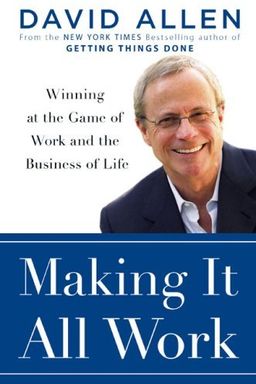
Making It All Work cover

Making It All Work

by David Allen

Discover how to align your daily tasks with your life''s big goals in David Allen''s ''Making It All Work.'' This guide builds on the principles of ''Getting Things Done,'' offering practical strategies for capturing ideas, managing distractions, and organizing tasks to achieve meaningful productivity.

Making It All Work: Control, Perspective, and Flow

What does it take to stay clear, calm, and creative amid constant demands? In Making It All Work, David Allen argues that success in modern life depends on balancing two interdependent capacities: control and perspective. If you can consistently manage both—keeping your commitments clear while staying aligned to meaningful goals—you achieve what he calls a 'mind like water': the ability to respond appropriately to whatever appears without stress or reactivity.

Allen’s central premise is that personal productivity is not about doing more, but about handling what has your attention so you can focus on the right things. To do that, he provides a coherent map built on the Getting Things Done (GTD) method—a set of habits that integrate capturing, clarifying, organizing, reflecting, and engaging with work. Making It All Work expands GTD from a tactical system to a philosophy of balanced living.

Control and Perspective: The Two Dimensions of Effectiveness

Allen visualizes your state of being on a matrix with control on one axis and perspective on the other. When both are high, you feel centered and effective—'Captain and Commander.' When both are low, you act reactively in 'Victim or Responder' mode. High control but low perspective produces 'Micromanagers' who overfocus on mechanics; high perspective but low control generates 'Visionaries' prone to chaos. The goal is to shift continually toward Captain and Commander mode by adjusting whichever side is weak: more capture for control, or more reflection for perspective.

Allen’s practical advice: start where the pain is. If you feel scattered, regain control by capturing everything that has your attention. If you feel mechanical or uninspired, zoom out for perspective through horizon reviews. Balance, not perfection, restores flow.

The Three Models That Organize Doing, Thinking, and Choosing

To operationalize both control and perspective, Allen teaches three complementary models. First, the Workflow Model (Collect, Process, Organize, Review, Do) manages the horizontal flow of work—how to handle every incoming input or idea. Second, the Natural Planning Model guides vertical thinking for projects using five intuitive steps: purpose, vision, brainstorming, organizing, and next actions. Third, the Horizons of Focus structure helps you choose priorities across six altitudes—from daily next actions (runway) to purpose and principles (50,000 feet).

Together, the three models form a complete operating system for life and work: workflow gives you control, planning gives shape, and horizons give direction. Each is simple alone, but combined they enable complex self-management without burnout. (Note: The same conceptual symmetry appears in Stephen Covey’s 'habits' model, but Allen’s strength is tactical granularity.)

The Flow of the Book and Its Practical Objective

Making It All Work is structured as a roadmap. The early chapters describe why the GTD system exploded globally and reveal the psychological logic behind it: your brain is great at generating ideas but poor at remembering commitments. Later sections walk you through the processes that deliver both control and perspective—capture, clarify, organize, reflect, and engage—each one connected to specific habits, tools, and real-world examples from executives, writers, and teams.

Allen reminds you the book is not an oracle but a toolbox. You don’t have to implement all parts at once. Begin with capturing everything on your mind, clarify what those things mean, and organize them where they belong. Then, through regular reflection, you’ll build trust in your system and confidence in your choices. Over time, you’ll spend most of your days in meaningful engagement rather than firefighting.

Core proposition

Power equals concentration. Concentration arises from eliminating distraction. Distraction stems from mismanaged commitments. Manage commitments better, and your mind regains its focusing power.

Why GTD Resonates Worldwide

Allen’s system became global because it addresses a universal modern problem: potential-meaning overload. We no longer suffer information overload—we suffer from too many ambiguous inputs that could mean something and too many roles demanding action. GTD gives a reliable way to interpret those inputs and park them in trusted places. It’s platform-neutral, tool-agnostic, and simple enough that you can start on paper. Tech culture adopted it eagerly because of its rule-based elegance and immediate friction reduction—what Allen calls the elimination of drag.

Trust and Responsibility

Allen closes by invoking an old proverb: 'Trust in a larger order, but tie your camel.' In practice this means you can believe in intuition and purpose, but you must also build reliable systems to support them. GTD replaces vague worry with specific behavior. When you adopt it, you discover that peace of mind is not the absence of work—it’s the product of total, trustworthy self-management. That, ultimately, is how you make it all work.


Capturing and Clarifying Commitments

The first step toward regaining control is to get everything out of your head. Allen calls this capturing or clearing—recording what has your attention in an external, trusted place. Your mind is brilliant for having ideas but terrible at holding them. If you internalize that truth, you’ll stop treating your head as a reminder system and begin using it for thinking instead of remembering.

The Mind Sweep and Capture Tools

To capture comprehensively, perform a mind sweep: walk through your physical and mental space and jot down every incomplete item—calls, projects, concerns, errands, or dreams—one per slip of paper or note. Allen recounts clients like a sitcom writer who found this exercise life-changing because it freed creative bandwidth. Use whatever capture tools work for you—pen and paper, wallet pads, voice memos, whiteboards, or digital lists. The only rule: if it pops into your head, put it into a trusted bucket immediately.

Group or team capturing multiplies clarity. When families or teams download what has their attention collectively, hidden assumptions surface and alignment improves. A shared in-basket becomes shared mental RAM.

Clarifying: From Raw Input to Meaningful Steps

Capture only empties your mental inbox. Clarifying is where you decide what each input means. The key question is: Is it actionable? If yes, determine the desired outcome (what completion looks like) and the next physical action required. These two questions—'What’s the outcome?' and 'What’s the next action?'—transform vagueness into progress. If no action is required, the item becomes trash, reference, or someday/maybe material.

Consider a note that just says “Mom.” Until you clarify that it means “Plan Mom’s sixtieth birthday,” your brain keeps reopening the loop. Once you define the outcome and next step—perhaps “Research restaurants or call Roberta”—the anxiety disappears because the meaning is parked in the right place.

Allen’s golden rule

If something is still on your mind, you haven’t finished your thinking about it. Clarify it enough to decide its next action or destination, then your mind can let it go.

Practiced together, capture and clarify sweep your mental closets clean. You stop feeling victimized by input and start making informed decisions about meaning and action.


Organizing Meaning and Managing Context

Once you’ve clarified meaning, the next challenge is organizing your commitments so that what matters is accessible when you need it. Allen defines being organized not as being neat, but as placing things where they belong according to their meaning. If something sits where you expect to find it when relevant, you’re organized; if not, you aren’t.

Simple Categories That Map Reality

Begin with clear buckets: projects (ongoing outcomes), next actions (physical steps), waiting-for items (delegated tasks), reference (non-actionable information), and trash. Use a calendar as the 'hard landscape' — only for time-bound commitments. Many people overcomplicate with tags and priorities because they don’t trust their review process. Keep it simple; the system will stay resilient.

Context-Based Action Lists

Actions multiply quickly, so you group them by context—the environment or tools required. Typical contexts include Calls, Computer, Office, Home, Errands, Read/Review, and Agendas. When you’re in an airport, you check the Calls list; when at your computer, you check Computer actions. This prevents being reminded of things you cannot do in that moment and increases productive spontaneity.

Customize contexts to fit your life: a sailor might keep “At Sailboat,” a CFO might have “Brain-Dead Tasks” for low-energy moments. The structure is personal but must reflect conditions of doing, not abstract categories.

Support, Reference, and Filing Systems

Support materials relate directly to projects and stay nearby. Reference material is background information needing no action. Keep these separate so active commitments don’t disappear in archives. Follow Allen’s one-minute rule for filing: if it takes longer than a minute, you’ll avoid it. Use a friction-free A–Z filing system with clean labels and annual purges to keep trust high. (Note: this simple rule mirrors Marie Kondo’s philosophy—ease creates habit.)

In short, organizational clarity ensures that decision-making happens once, not repeatedly. Once you put things where they belong, you reclaim energy for doing rather than remembering where things live.


Projects and Natural Planning

A project, in Allen’s model, is any outcome requiring more than one action but completable within a year. Most people have thirty to a hundred such projects spanning work and life. Maintaining a single Projects list—one line per outcome—ensures you can scan your commitments easily. The list must connect to clearly defined next actions; if any project lacks a next step, it stalls.

The Natural Planning Model

To avoid paralysis, use Allen’s Natural Planning Model: Purpose and Principles → Vision of Outcome → Brainstorm → Organize → Next Actions. This structure mirrors how people intuitively plan unconsciously (think of how you plan a vacation). Explicitly using it accelerates clarity and momentum.

  • Start with Purpose—why this project matters—and clarify guiding standards.
  • Visualize success vividly; sensory detail strengthens motivation.
  • Brainstorm freely to generate ideas without judgment.
  • Organize strands into structure: sequences, priorities, categories.
  • Determine the next physical action to create movement.

The Gracie’s Gardens Example

Allen illustrates this with Ron Taylor’s fictional 'Gracie’s Gardens.' Ron’s projects include launching a wholesale division and hiring a sales head. Each project produces specific next actions—'Draft wholesale plan,' 'Email Sandy re: bookkeepers'—and a weekly review keeps them moving. Simple structure replaces overwhelm.

The Natural Planning Model also scales upward: vacation planning, app design, or company mergers follow the same logic at different magnitudes. (Parenthetical note: this alignment with natural cognition explains GTD’s enduring appeal—it works the way your brain already wants to work.)

Projects represent the middle horizon—where aspirations touch daily tasks. Keeping your list current and applying natural planning ensures you always know what progress looks like next.


Incubation and Reflection

Not everything deserves immediate action. Allen distinguishes between commitments to act and creative possibilities to revisit later. His incubation tools—Someday/Maybe lists and Tickler reminders—let you park ideas guilt-free while preserving potential. They create mental space without sacrificing creative flexibility.

Someday/Maybe and Ticklers

Use a Someday/Maybe list for nonurgent ideas you want to reconsider regularly—travel, hobbies, speculative projects. Use a Tickler file or calendar trigger for items you want to revisit on a specific date. Managing these two forms distinctly prevents list bloat and forgotten commitments.

When you trust these incubation tools, you stop mentally hoarding and become more present. Review Someday/Maybe lists weekly or monthly so they remain alive. As Allen notes, incubation is 'intentional postponement'—not procrastination but strategic timing.

Reflection and the Weekly Review

Reflection is the engine that keeps your system trusted. Allen reframes 'review' as 'reflection' to stress its cognitive value: updating your data and renewing perspective. The Weekly Review—one to two hours weekly—is your maintenance ritual. It has three parts: Get Clear (empty all in-baskets), Get Current (update lists and projects), and Get Creative (generate ideas and fresh vision).

Reflection’s payoff

Consistent reflection yields two rewards: an updated map of commitments and greater confidence in moment-to-moment choices.

When your system is reviewed and trusted, intuitive decision-making becomes more reliable; your unconscious knows your world is handled. The Weekly Review thus transforms a pile of lists into an integrated life management compass.

Think of incubation and reflection as the mind’s breath cycle: inhale possibilities, exhale clarity. These practices sustain calm control even in turbulence.


Horizons, Priorities, and Purpose

Allen’s ultimate system stretches from minute-to-minute actions to life purpose. The six Horizons of Focus articulate these layers: 0 feet (next actions), 10,000 (projects), 20,000 (areas of focus), 30,000 (goals), 40,000 (vision), 50,000 (purpose and principles). By regularly shifting altitude, you align daily activity with the life you intend to create.

Prioritizing in Real Time

Moment-to-moment choices depend on three limiting factors: context, time available, and energy. First, you can only do what fits your environment. Second, time windows define suitable tasks. Third, energy levels dictate what quality of work you can perform. This triad—context, time, energy—helps you pick actions that fit reality while honoring higher goals.

Allen notes that we operate in three modes: predefined work (from our lists), ad hoc work (responding to surprises), and processing incoming items. Knowing which mode you’re in brings awareness and control. Overreactive work destroys flow; reviewing inputs restores it.

Vision, Purpose, and Principles

Above goals lie vision (long-term desired futures), purpose (the 'why'), and principles (non-negotiable values). Allen encourages organizations and individuals to define these to serve as decision filters. For example, in the fictional 'Gracie’s Gardens' case, the purpose ('provide outstanding garden materials') and principles (customer care, environmental stewardship) guided strategic choices and daily behavior alike.

You don’t have to articulate purpose prematurely. Let real experience refine it over time. But once clarified, higher horizons become your compass for every decision below them—ensuring that productivity feeds meaning, not just motion.

Dig Deeper

Get personalized prompts to apply these lessons to your life and deepen your understanding.

Go Deeper

Get the Full Experience

Download Insight Books for AI-powered reflections, quizzes, and more.