
Idea 1
Turning Ideas into Reality
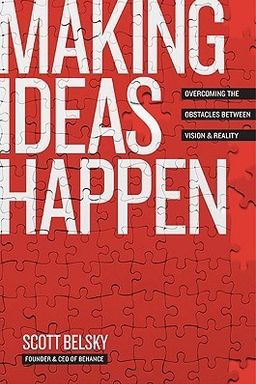
How many brilliant ideas have you had that never left your notebook or your mind? In Making Ideas Happen, Scott Belsky contends that creativity alone isn’t what drives progress — it’s execution. Great ideas are plentiful, but only a fraction ever materialize because most of us fail at the messy middle: turning inspiration into action. As Belsky puts it, genius is not the idea itself but the ability to organize, motivate, and persevere until something exists in the world.
Drawing on years of research with hundreds of creative professionals, entrepreneurs, and organizations (from Apple and IDEO to Zappos and Google), Belsky presents a blueprint for transforming inspiration into implementation. The book introduces a practical equation—Creativity × Organization = Impact—and a central methodology called the Action Method, which breaks every project into three components: Action Steps, Backburner Items, and References. His aim is to help you work with a bias toward action rather than living in the perpetual fog of ideation.
Why Brilliant Ideas Die
Belsky begins with a hard truth: most ideas die not because they’re bad, but because creators fail to execute. Internal tendencies like disorganization, idea addiction, or fear of failure combine with external obstacles — limited time, lack of structure, and an absence of accountability. The result is what he calls the project plateau, a painful middle stage where enthusiasm fades and only disciplined action keeps ideas alive. For creatives like screenwriter Chad or philosopher Risa (two real examples in the book), success came only when they adopted structure and engaged community — two habits that feel unnatural but are essential for progress.
From Inspiration to Execution
The book is organized around three forces that determine whether ideas happen: Organization and Execution (how you manage projects and energy), the Forces of Community (how you leverage relationships for feedback and accountability), and Leadership Capability (how you motivate yourself and others over the long haul). Each section dismantles the myth that creativity and discipline are opposites. Instead, Belsky argues they form a symbiotic relationship between inspiration and structure — in his words, “constraint breeds strength.” This theme echoes Igor Stravinsky’s belief that limiting your options deepens creative mastery.
The Action Method and Beyond
At the heart of the system is the Action Method, a simple but revolutionary framework designed to keep creators moving forward. Each project, Belsky explains, contains three types of content: concrete Action Steps (specific tasks that move an idea ahead), non-actionable References (information to store), and Backburner Items (future possibilities). By managing these three separately — whether on a notepad or in an app — you train yourself to live in motion. The message: execution is not glamorous, but it’s the only path from potential to impact.
Ideas Need Communities
Belsky then turns to what he calls “the forces of community.” Ideas do not flourish in isolation. Engaging others — mentors, peers, collaborators — provides feedback, accountability, and opportunities for momentum. A creative circle or network (like his own Behance community) can turn ideas into shared missions. He emphasizes that transparency and feedback loops strengthen commitment, echoing Chris Anderson’s philosophy at Wired that ideas spread best when shared openly. In short, your ability to ship depends on your willingness to collaborate.
Leading Yourself and Others
The final piece of the puzzle is leadership — first of others, but primarily of yourself. Making ideas happen requires self-awareness, mental loyalty, and persistence through uncertainty. Belsky explores how effective leaders balance structure with autonomy, foster team chemistry, and manage their own psychology amid ambiguity. He dissects real-world practices, from IDEO’s prototyping culture to Zappos’ emphasis on happiness, demonstrating that leadership in creative work is less about authority and more about enabling progress. “The most valuable leaders,” he writes, “talk last, listen first, and share ownership.”
By the end of the book, you realize that making ideas happen is both a discipline and a moral calling — a responsibility to bring value into the world. Creativity matters, but impact requires perseverance, organization, and community. Belsky’s message can be summarized simply: ideas don’t happen by accident — they happen by design.