
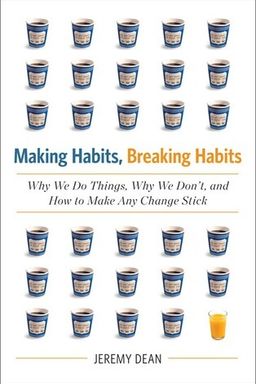
Making Habits, Breaking Habits cover

Making Habits, Breaking Habits

by Jeremy Dean

Making Habits, Breaking Habits by Jeremy Dean delves into the science of habit formation and transformation. Discover practical strategies for fostering positive changes and overcoming detrimental habits, leading to a healthier, more fulfilling life. Through insightful analysis, the book provides tools to cultivate enduring change in everyday routines.

The Hidden Power of Habit and How It Shapes Your Life

How much of your day do you actually control? From brushing your teeth to scrolling your phone, eating lunch, and deciding on a route home, most of what feels like conscious choice is actually autopilot behavior. In Making Habits, Breaking Habits, psychologist Jeremy Dean argues that habits are the silent engineers of our daily lives—patterns that operate beneath conscious awareness yet dictate our behavior far more than rational choice ever does. They are efficient, but they also make life rigid. Dean contends that understanding the science of habits—how they form, persist, change, and even hijack our emotions—is essential if you want to shape your behavior in meaningful ways.

Dean draws on hundreds of psychological studies to uncover what habits truly are: automatic routines formed by repetition and reinforced by environment and emotion. He shows that they aren’t just trivial actions, but complex mental and emotional scripts that govern how we eat, work, love, and think. Habits free up mental energy for higher-level thinking, but they can also trap us in unproductive or unhealthy cycles. Understanding how habits are born—and what determines their death—is the first step toward real change.

What Habits Really Are

Habits, Dean explains, are behaviors repeated so often in stable contexts that they become automatic. They allow us to act without exhausting our limited mental resources on repetitive tasks. The irony is that while habits give us freedom from indecision, they can enslave us by removing conscious choice. Research by Wendy Wood and others shows that roughly half of our waking hours are spent performing habitual actions. This means your daily life is mostly driven by learned associations between specific environments and specific behaviors—grabbing coffee on your commute, checking social media when bored, or watching television after dinner.

Context, Emotion, and the Unconscious

Dean emphasizes the importance of context. Habits are inseparable from the environments in which they occur. A behavior embedded in one setting is hard to perform somewhere new because cues disappear. This is why moving house disrupts routines—you can’t find the kettle, your autopilot collapses. Similarly, emotions are involved but gradually fade through repetition. As Nico Frijda’s “laws of emotion” suggest, repeated experiences dampen emotional response. This makes habits emotionally neutral, efficient but dull. Habit, Dean writes, is “curiously emotionless behavior.”

The Myth of 21 Days

One of Dean’s opening arguments punctures a popular myth: that a new habit forms in 21 days. Based on Maxwell Maltz’s 1960 book Psycho-Cybernetics, this notion has fueled self-help culture for decades. Real psychological data, however, tell a different story. A University College London study found that on average, habits take 66 days to form—and that complex behaviors like exercise can take up to 254 days. Most habits emerge through gradual repetition, not magical two-week conversions. Dean shows this distinction matters because unrealistic expectations lead to failure and self-blame, not persistence.

The Battle Between Intention and Habit

We assume our intentions shape our habits—decide to exercise, and you will. But Dean reveals that strong habits often overpower intention. Through studies on fast-food consumption, TV watching, and recycling, he illustrates that intentions predict behavior only when habits are weak. When they are strong—performed weekly or daily—they dominate, leaving us confident but wrong about our control. The illusion that we’re in charge, he warns, can keep us locked in automatic behavior even while believing we’re acting freely (similar findings appear in The Power of Habit by Charles Duhigg).

Making and Breaking Habits

Dean’s central mission is practical: showing what it takes to create or dissolve habits. He explains that repetition within stable contexts builds automaticity; to change, you must either disrupt the context or replace the behavior. Mindful awareness, environmental design, and concrete planning—especially “implementation intentions,” or specific if–then plans—can help conscious choice compete with autopilot. Instead of suppressing a bad habit, you replace it with a new, better one triggered by the same cues.

Beyond Everyday Habits: Creativity and Happiness

In later chapters, Dean extends the psychology of habits into creativity and happiness. He argues that expertise creates mental habits that stifle innovation and that breaking these requires randomness, constraint, or fresh perspective—a “mental reshuffling” that allows insight. Likewise, happiness itself depends on habit, but positive routines risk becoming stale through emotional habituation. The cure? Mindful variation. Like Epicurus or modern positive psychologists, Dean concludes that a fulfilling life is built not on endless novelty but on conscious awareness of routine. When we learn to make peace with our patterns—and modify them deliberately—we turn habit from tyrant into ally.


The Anatomy of Habit Formation

Jeremy Dean begins by exploring how habits are born and what makes them tick. They are the products of repetition, automaticity, and context—patterns that evolve through unconscious learning rather than deliberate decision. The formation of a habit is much slower and more individualized than popular advice suggests. Through detailed experiments, he shows that creating new habits relies on an intricate interplay between intention, circumstance, and emotion.

The Myth of Quick Change

The legendary 21-day habit rule comes from Dr. Maxwell Maltz’s observation that his patients adapted to cosmetic surgery or amputation within three weeks. Dean dismantles the idea that all habits follow this rigid timeline. Drawing on University College London research involving 96 people tracking daily behaviors over three months, he reveals that some habits—like drinking water after breakfast—form in 20 days, while others—like doing daily sit-ups—can take 84 days or more. On average, 66 days marks the true threshold for automation.

Automaticity—Acting Without Thinking

Dean borrows the term automaticity to describe the psychological state where we act with minimal conscious thought. Habits, he explains, aren’t deliberate—they are mental shortcuts that save cognitive energy. Consider driving: at first, every control demands focus; with repetition, it becomes effortless. This mental shift is both liberating and limiting. The more familiar a behavior becomes, the less emotional engagement it provokes. As the emotion researcher Nico Frijda noted, repeated experience dulls both pain and pleasure, leaving habitual behavior emotionally neutral yet deeply ingrained.

The Role of Context and Cueing

Context cues—physical environments, time, and social settings—trigger habitual actions. Dean uses Pavlov’s dogs as the prototype: associative learning that applies equally to us. Entering your car cues driving, your desk cues email checking, and a coffee shop cues buying a muffin. When these cues disappear, habits sputter. He cites research showing that students moving to new universities easily change routines because their familiar cues vanish—an example of “habit discontinuity.” Similarly, moving house, changing jobs, or entering new social circles can temporarily free you from autopilot behavior, offering rare windows for change.

Decision Fatigue and the Need for Automation

A striking benefit of habit is its ability to combat decision fatigue. Each decision drains mental energy; automation preserves it. Dean explains why waking up, driving, or brushing teeth shouldn’t require deliberation—they are low-stakes, repetitive actions that habits optimize. Yet, the relief from constant choice has a cost: when automatic behavior dominates emotional awareness, we lose touch with what we feel or want. The first step to any change, Dean insists, is noticing what we actually do when we think we’re just “living.” Awareness—through mindfulness or monitoring—is the gateway from automatic action back to conscious control.


The Unconscious Autopilot

In one of Dean’s most revealing sections, he invites you to confront your unconscious. Most of what you think you’re deciding is, in fact, predetermined by invisible mechanisms beneath conscious awareness. Through stories and experiments, he demonstrates that people often act first and explain later, inventing rational reasons for behavior that was automatic all along.

Choice Blindness

A study by Swedish psychologists asked participants to select which face they found more attractive from pairs of photos. In a clever sleight-of-hand, researchers swapped the chosen card for its opposite and asked participants to justify their choice. Most didn’t notice the swap and confidently explained why the unchosen face was supposedly appealing. This ‘choice blindness’ reveals how the unconscious can dictate preference while consciousness fabricates meaning afterward.

The Limits of Self-Knowledge

Dean builds on Timothy Wilson’s research showing that we have shallow access to our own minds. We like to believe introspection reveals truth, but it often distorts it. People misjudge their self-esteem, personality, and even basic motivations. He recounts studies where people preferred identical nylon stockings based solely on placement on a rack, yet denied any influence of position. Even when told their bias, they rejected the idea. Conscious reasoning, he concludes, operates as a defensive layer—a narrative shield protecting our sense of rationality from the irrational engines underneath.

Brains on Autopilot

The biological anchor of habit lies in the frontal lobes and basal ganglia. When the frontal lobes—the brain’s monitoring centers—are damaged, habitual behaviors run wild. Dean recounts François Lhermitte’s patients with “utilization behavior”: if shown a comb, they automatically comb their hair, even after being told not to. Others, afflicted with “alien hand syndrome,” watched their own hands perform unwanted actions. These cases dramatize the hidden force of the unconscious—habit is behavior detached from intention.

The Paradox of Introspection

Thinking too much about your motives can make them less accurate. Dean recounts experiments where participants asked to rationalize their choices later regretted them more, and those who analyzed their feelings before buying art reported less satisfaction. Introspection, ironically, can cloud insight rather than clarify it. The lesson: don’t dig deeper into the unconscious—it’s opaque. Instead, observe your habits externally. Becoming aware of what you do—without judgment—is far more revealing than speculating why you do it. Awareness, not analysis, is the antidote to the autopilot.


When Habits Hijack Goals

Dean asks a provocative question: if habits serve our goals, why do they so often sabotage them? The answer lies in how behaviors become detached from their original motives. Over time, the association between context and action strengthens while the link to our intention weakens. This mismatch—what Dean calls the ‘habit–goal disconnect’—explains why we can vow to change yet behave the same way.

When the Environment Overrides Intention

In experiments by John Bargh, participants subliminally exposed to words about old age walked slower afterward. They didn’t decide to move gently—it was unconscious activation of a stereotype. Similarly, Asian American students primed with words related to Asian identity performed better on math tests. Attitudes and behavior can be activated automatically by subtle cues in the environment. Dean calls this “direct cueing”: when context triggers action without conscious evaluation. It’s why moving house can suddenly break or reshape habits—the cues are gone, and so is the automatic script.

Motivated but Misguided

Dean describes “motivated cueing,” when our unconscious associates the wrong habit with a desired emotional outcome. Alcohol is a prime example. Students drink not primarily for intoxication but for social connection. Over time, the habit of drinking fuses with the feeling of belonging until one cannot exist without the other. Contextual cues—bars, music, laughter—activate the drinking reflex, independent of intention. Like Dean himself flipping a bathroom light during a power outage, we perform actions that no longer achieve their goals but have become automatic responses to old cues.

Breaking the Chain

Habits that hijack goals cannot be reasoned away; they must be replaced. The remedy is altering the environment so cues lose their power or reassigning them to new behaviors. Dean explains how substituting one habitual response with another—like chewing gum instead of smoking—interrupts the old loop. By reshaping cues rather than resisting them, we align action with purpose. The victory of intention over habit lies not in willpower but in design: crafting situations that favor your conscious goals over your conditioned ones.


Escaping the Daily Grind

Even when habits protect us, they often imprison us in repetition. In this section, Dean examines how daily routines can both anchor and anesthetize our lives. While habits bring comfort, predictability, and efficiency, they can also dull emotional engagement, weaken creativity, and narrow social and professional horizons.

Routine as Safety

Dean opens with a story from George Cockcroft’s novel The Dice Man. Its protagonist fights boredom by letting dice decide his actions—a rebellion against predictability. Ordinary life, Dean suggests, doesn’t require such chaos, but it thrives on routine’s paradox. Research shows that rituals—like family meals or bedtime habits—create belonging and emotional security. Familiar patterns, from sitting in the same lecture seat to cooking the same dinner, reduce stress because they make the world predictable.

When Safety Becomes Stagnation

The downside is rigidity. People report feeling detached from their own habits, performing them with little pride or ownership. Dean calls it behavioral numbness—a sense that life happens to us rather than being lived by us. This is reinforced by how similar routines form collective habits. At work, research shows organizations evolve through repeated routines: stable yet resistant to innovation. Dean cites a study of early bicycle manufacturers—companies survived best when they balanced old habits with new practices. Too little change led to decay; too much caused chaos.

Habits in Social and Commercial Life

Social habits, too, dictate who we befriend. Studies show we bond less over shared attitudes than over shared activities—those who “play together stay together.” This unconscious pattern explains why friendships persist even when personalities differ. Commercially, Dean points out how loyalty programs exploit these same mechanisms. Marketers analyze repeat purchasing behavior to predict preferences, discovering that strong shopping habits overpower satisfaction—most brand switching happens among satisfied customers who simply fell into new routines. Habits, not rational evaluation, drive consumer loyalty.

Breaking Monotony Without Breaking Structure

To escape the grind, Dean advises awareness, not radical upheaval. Like bicycle firms retaining old methods while experimenting, we should identify which habits support our goals and which limit us. Monitor repeating patterns, note their contexts, then change one variable—a time, a place, a companion. Routine supports growth only when it evolves. The secret to thriving in structure is not rolling dice but consciously redesigning the map of repetition.


The Psychology of Change: Making and Breaking Habits

Dean’s most practical chapters dive into how you build, replace, and sustain habits. Change isn’t about sheer willpower but intelligent planning. He introduces two powerful tools grounded in psychological research: implementation intentions and mental contrasting. Together, they help translate intention into action.

Implementation Intentions: The Power of If–Then Planning

Ordinary resolutions like “I’ll eat healthier” fail because they’re vague. The more precise you are, the more automatic the response becomes. Implementation intentions link a cue to an action: “If it’s lunch, I will eat fruit.” Each repetition strengthens the mental bridge until it feels instinctive. Across 94 studies, people using if–then plans were more successful at everything from exercising to sticking to diets. The trick, Dean explains, is choosing clear triggers and simple actions—events work better than clock times, and starting small builds momentum.

Mental Contrasting: Facing Fantasy With Reality

Invented by psychologist Gabriele Oettingen, mental contrasting forces you to imagine success but confront obstacles immediately after. By juxtaposing wish and reality, your brain distinguishes achievable goals from illusions. Research shows this technique increases motivation when expectations are high—because you’re emotionally prepared for the challenges. Dean turns this method into the WOOP exercise: Wish, Outcome, Obstacle, Plan—define what you want, why you want it, what stands in your way, and how you’ll respond.

Breaking Old Habits: Replacement, Not Suppression

Trying not to perform a bad habit backfires; suppression increases mental salience. Studies show that people who avoid thinking about indulgent behaviors—dieters suppressing chocolate cravings—think about them more. Dean advocates replacement: diverting the behavior toward an alternative with the same trigger. Smokers chew gum; procrastinators work in new settings; snackers eat fruit. Replacement turns inhibition into redirection, transforming failure into progress.

Self-Control Is Finite—Plan Around It

Willpower, according to Roy Baumeister’s ego depletion theory, behaves like a muscle. Exerting self-control—resisting temptation or forcing discipline—reduces energy for later decisions. Dean’s solution: pre-commitment and environmental design. By restricting future temptation (leaving your phone in another room, locking the biscuits away), you protect yourself when motivation wanes. Successful change, he concludes, depends less on inner strength and more on cultivating outer structure—turning effort into habit until self-control becomes unnecessary.


Healthy, Creative, and Happy Habits

Beyond everyday behavior, Dean explores how habits determine long-term well-being, from physical health to creativity and happiness. Here, he connects habit psychology to self-regulation, innovation, and emotional resilience.

Health and the Habit Trap

Eating, exercising, and smoking are deeply habitual, shaped by cues, social reinforcement, and automatic consumption. Governments often fail to change these behaviors because they target intentions, not contexts. Data show dieting success depends on modest, repeatable routines—consistent breakfast, small environmental tweaks, and gradual replacement of one unhealthy action with another healthy one. Similarly, exercise habits stick when they’re linked to stable daily cues (morning workouts) and reinforced through self-monitoring tools like pedometers.

Daily Genius: Creativity and Habit

Dean argues that expertise itself becomes a mental habit that can block innovation. The solution? Constraints, randomness, and perspective shifts. Studies show people solve problems more creatively when freed from their usual tools—like using a pair of pliers as a pendulum to connect two strings. Similarly, psychological distance in time or space (imagining a problem a year or thousands of miles away) increases abstract thinking and insight. Creative flexibility arises from alternating between defocused wandering and sharp concentration. In short, creativity flourishes when we break cognitive routines while maintaining structural persistence—what Dean calls “a mindful play between order and chaos.”

The Habit of Happiness

Using studies on gratitude, savoring, and mind-wandering, Dean outlines how habits shape emotional life. Happiness, like creativity, depends on awareness. Gratitude practice increases optimism, but mechanical repetition erodes joy. Because human emotion habituates faster to positive experiences, variety preserves pleasure. Likewise, mindfulness prevents the emotional detachment that routine causes. People who stay present feel happier than those whose minds wander—even when background circumstances are unchanged. Dean’s essential message echoes Epicurus: happiness isn’t conditional on wealth or novelty but awareness of ordinary pleasures. When conscious variation meets unconscious rhythm, habitual life becomes fulfilling rather than flat.

Turning Routine Into Mastery

The book concludes with a paradox: habit is both the problem and the solution. Success, whether physical, creative, or emotional, comes from learning which habits to keep automated and which to perform mindfully. Routine habits stabilize accomplishment; mindful deviations renew meaning. True mastery is not escaping repetition but transforming it—making your automatic behaviors conscious enough to evolve. Life’s best habits, Dean suggests, are flexible structures: steady enough to guide you, alive enough to surprise you.

Dig Deeper

Get personalized prompts to apply these lessons to your life and deepen your understanding.

Go Deeper

Get the Full Experience

Download Insight Books for AI-powered reflections, quizzes, and more.