
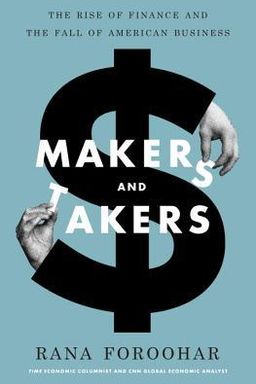
Makers and Takers cover

Makers and Takers

by Rana Foroohar

Makers and Takers by Rana Foroohar investigates the profound impact of financial deregulation and corporate greed on the American economy, illustrating how these forces led to the 2008 financial crisis. The book calls for urgent reform by examining historical parallels and revealing the interconnectedness of politics and finance.

The Financialized World

You live in a world where finance no longer serves the economy—it runs it. This book argues that financialization, the process by which financial motives and institutions dominate economic and social life, has transformed how companies operate, how households save, and how nations make policy. Finance has become not a means to create value, but an end in itself, reshaping incentives from Wall Street to Main Street.

The rise and reach of financialization

Financialization means that more profits, activity, and political power concentrate in the financial sector even as its direct contribution to jobs and innovation remains small. Research from the IMF, BIS, OECD, and economists such as Adair Turner and Raghuram Rajan show that beyond a certain size, finance stops boosting productivity and instead inflates consumption, asset prices, and inequality. When finance represented roughly 7% of U.S. GDP but collected up to 25% of corporate profits at its peak, the imbalance became clear: firms now gain more by moving money than by making things.

How it shows up in companies and daily life

You can see financialization through corporate behavior—record cash piles combined with aggressive borrowing, massive stock buybacks instead of reinvestment, and a shrinking share of loans flowing to small businesses. Everyday effects include stagnant wages, rising essential costs, and a retirement system tethered to volatile markets. When fund managers prioritize quarterly returns, even your 401(k) helps reinforce short-termism. Policymakers have gradually shifted responsibility to markets, encouraged deregulation, and allowed financial culture to shape economic priorities—what scholars call cognitive capture.

A political and cultural transformation

This transformation is not just technical—it reflects a cultural victory of market logic. Business schools, corporate boards, and regulators absorbed the language of efficiency and shareholder value, sidelining ideas of long-term investment and social responsibility. The rollback of Glass-Steagall in the 1990s and the explosion of derivatives trading marked finance’s ascent to political dominance. Citigroup’s creation (Weill’s empire merging Travelers and Citicorp) became emblematic of how financial conglomerates integrated every money-making function—insurance, lending, trading—under one roof.

Why it matters and what might change

Financialization affects you because it changes how value is created, who captures it, and what risks are shared. When returns come from speculation, economies lose resilience: debt builds faster than productivity, and losses are socialized while gains remain private. The book calls for a rebalancing—tax systems that stop rewarding leverage, corporate rules that curb buybacks, and public investments that rebuild productive capacity. Most importantly, it calls for a cultural reset: finance should support innovation and well-being, not dictate them.

Key idea

When the highest reward flows to circulating money rather than building real things, the economy loses its moral compass. Reclaiming finance as a servant—not master—of economic life is the book’s ultimate message.


Shareholder Value Culture

The doctrine of maximizing shareholder value has become the lodestar of modern management—but it also underpins financialization’s excesses. Born from Milton Friedman’s essays, agency theory (Jensen & Meckling), and MBA management models, it redefined corporations as vehicles for investor returns rather than communities of workers, innovators, and customers.

How it reshaped corporate behavior

By linking executive pay to stock options and earnings-per-share targets, the system hardwired short-term incentives. Buybacks became a favored weapon: they lift EPS and share prices even when sales stagnate. Activist funds like Icahn, Loeb, and Ackman perfected this mechanism by pressuring management for quick payouts. Apple’s 2013 borrow-to-buyback maneuver—despite holding over $145 billion in cash—embodied how even successful innovators respond to market-engineering pressure.

Who wins and who loses

The beneficiaries are concentrated at the top: executives paid in stock, hedge funds flipping positions, and institutions chasing quarterly benchmarks. The losers are diffuse: employees with stagnant pay, consumers missing product innovation, and communities facing fewer long-term investments. When institutional investors manage pension money for teachers or public workers but act as short-term activists, they inadvertently help finance extract value from its own clients.

Reversing the cycle

Longer vesting periods, disclosure rules for buybacks, and fiduciary duties for fund managers could dampen short-termism. The book argues that restoring stewardship—exemplified by investors like John Bogle or David Swensen—would build durable firms. In countries where workers participate in boards, such as Germany, investment horizons lengthen and inequality narrows. The contrast underscores a truth: incentives shape destiny.


From Banks to Behemoths

The banking system’s journey from conservative intermediary to global conglomerate explains much of modern financial power. Starting with the erosion of Depression-era safeguards like Glass-Steagall, banks used deregulation and lobbying to expand into trading, insurance, asset management, and commodities. Citigroup’s evolution under Sandy Weill stands as the book’s central case study.

Deregulation and complexity

The 1998 Travelers-Citicorp merger pushed legal boundaries, later blessed by Congress through Gramm-Leach-Bliley. Complexity became profitability—opaque balance sheets created room for risk-taking in derivatives and global debt markets. Regulators, often outgunned or culturally captured, admitted they couldn’t map exposures in real time. Gary Gensler likened bank structures to black boxes that even CEOs couldn’t fully comprehend.

Too big to fail—and to regulate

Once these giants dominated, they became 'too big to fail,' requiring taxpayer rescues when crises hit. The Dodd-Frank Act aimed to curb risk but left loopholes intact. Derivatives markets remained complex and partially unregulated. From Pecora’s 1930s hearings to 2008’s bailouts, history shows a pattern: reform follows crisis, but capture undermines sustainability.

What must change

Breaking up megabanks or ring-fencing retail deposits from trading desks would restore simplicity and resilience. Thomas Hoenig and Anat Admati argue higher equity buffers make banks safer without choking credit. (Note: this echoes Adair Turner’s call to treat finance as public infrastructure—essential but risky.) The message is practical: complexity hides fragility, and fragility multiplies cost.


Managers, Metrics, and the MBA Mindset

Financialization isn’t just structure—it’s mindset. After World War II, business education shifted toward analytics and shareholder value, elevating 'professional managers' over creators. The book traces this lineage from Frederick Taylor’s scientific management to Robert McNamara’s Whiz Kids and the modern MBA-driven corporation.

The culture of control

Taylor’s time-and-motion studies birthed managerialism: control work through measurement. McNamara’s team at Ford pushed this to an extreme—profit-center accounting, cost control, and metrics trumped engineering judgment. The Edsel debacle and Pinto safety failures show what happens when accounting replaces craftsmanship.

The MBA revolution

Business schools importing Chicago School economics taught efficient market theory and agency models. Managers learned to optimize shareholder returns rather than build enduring firms. Students migrated to finance for prestige, draining talent from production industries. This intellectual drift explains why innovation waned while financial engineering soared.

The path forward

Reforms in business education now explore behavioral economics and ethics. Authors like Andrew Lo propose adaptive markets frameworks that incorporate human judgment, not just models. The book argues for cultivating 'makers' again—leaders grounded in products, not spreadsheets. You feel the payoff when companies design for durability, not quarterly reports.


Speculation and Commodities

Commodities—food, fuel, metals—once mirrored supply and demand. Now they behave like financial securities. This section examines how investment banks and funds turned raw materials into speculative assets, altering global prices and risks.

The institutional invasion

After the early 2000s, institutional investors poured billions into commodity index funds, touting diversification. A Yale study (funded by AIG) legitimized commodities as an 'asset class.' From 2003 to 2008, institutional positions ballooned from $13 billion to $260 billion. Hedge funds and pension managers thus began treating food and fuel as bets, not necessities.

The aluminum example

Goldman Sachs’s Metro warehouses illustrated how financial actors can control both physical supply and derivatives. Delivery times ballooned, premiums spiked, and manufacturers paid billions in extra costs. Regulators struggled because laws allowed banks to own 'complementary' commodity businesses. Senate and CFTC probes exposed conflicts yet found it hard to prove intent.

Global consequences

Speculation amplified volatility in oil and food markets. The World Food Programme linked 2008 price spikes to investor flows. When derivative volumes dwarfed physical trade (over $600 trillion in notional contracts by 2015), markets served traders more than producers. The book urges stricter transparency, separation between physical and financial positions, and accountability for social impact.


Housing and the Rise of Private Equity

The housing recovery after 2008 revealed another frontier of financialization: private equity turned homes into rent streams. Firms like Blackstone bought tens of thousands of foreclosed properties through Invitation Homes, creating a new landlord class whose business is rent extraction, not community building.

Institutional landlords

Blackstone’s 46,000-home portfolio generated nearly $2 billion in income in 2014. Other firms followed, backed by mortgage financing from major banks. Public policy accelerated the shift—HUD and Fannie Mae sold pools of foreclosed homes to investors instead of local buyers. In some areas prices stabilized, but renters faced high fees, poor maintenance, and reduced access to ownership.

Securitizing rents

Private equity began bundling rental income into securities, creating a new risk channel akin to pre-crisis mortgage bonds. Rent-backed instruments could reach trillion-dollar scale, embedding housing affordability into Wall Street’s speculative matrix. Without transparency, tenant welfare becomes invisible.

Policy lessons

To rebalance, the book calls for community-buying rights, disclosure of institutional holdings, and leverage through the Community Reinvestment Act to discourage extractive financing. Understanding private equity’s incentives—quick returns over social health—helps explain why financial markets now dictate where and how you live.


Tax Games and Incentives

Corporate tax systems are central to financialization, rewarding leverage and profit shifting over real investment. The book explores how tax inversions, offshore shelters, and biased deductions drive companies to behave like financial engineers.

Inversions and the offshore empire

Pfizer’s proposed takeover of AstraZeneca and later Allergan exemplified how firms merge to relocate headquarters to low-tax jurisdictions. Techniques like the 'double Irish' route royalties to tax havens. Apple held vast profits abroad to avoid U.S. taxes. Collectively U.S. multinationals parked over $2 trillion offshore, reducing domestic reinvestment.

Debt favoritism

The code allows interest deductibility but not similar equity benefits, encouraging leveraged buyouts, debt-driven payouts, and inflated asset prices. Mortgage interest subsidies produce similar distortions for households. Fixing these incentives—equalizing debt and equity treatment—could slow speculative behavior and restore productive investment.

Reform roadmap

Taxing profits where economic activity occurs, closing offshore loopholes, and rewarding long-term holdings would foster corporate citizenship. Without such realignment, companies continue to gain from profit arbitrage instead of innovation.


Regulatory Capture and Political Power

Financial power extends beyond markets—it permeates politics. Lobbying, campaign financing, and the revolving door between regulators and industry weaken oversight. Citigroup’s influence over a 2014 budget rider that diluted Dodd-Frank exemplifies how rules are rewritten from within.

Lobbying and influence mechanics

In the 2013–14 cycle, finance spent roughly $1.4 billion lobbying Washington. Studies found 93% of Volcker Rule commentary came from industry actors. The result: complex carve-outs allowing risky behavior to persist. Regulators, many former finance executives, often internalize industry viewpoints—a form of 'cognitive capture.'

The justice gap

After 2008, few top executives faced prosecution. Judge Jed Rakoff criticized the 'too big to jail' principle, arguing it undermines rule of law. Fines became routine costs of doing business. Carmen Segarra’s recordings at the New York Fed revealed how deference replaces scrutiny at the top.

Restoring public accountability

The book urges transparency for lobbying contacts, limits on post-regulatory employment, and broader citizen participation in rulemaking. (Luigi Zingales reminds: 'Without public support, financiers need political protection to operate.') Ultimately, democracy must reclaim rulemaking from industry capture.


Five Reforms to Rebalance Finance

The book concludes with concrete reforms that could restore finance’s social function. These are not utopian—they are actionable shifts in rules, norms, and priorities designed to make financial systems serve production, not speculation.

Simplify and increase transparency

Simpler regulation prevents loopholes. Moving derivatives to public clearinghouses and empowering the Office of Financial Research to investigate crises independently would reduce opacity. Complexity benefits insiders; clarity protects the public.

Reduce leverage and favor equity

Require higher equity capital in banks so owners—not taxpayers—bear risks. Admati, Hellwig, and Hoenig show better-capitalized banks lend more consistently. Tax credits for equity financing could counter the debt bias.

Rebuild corporate purpose

Move beyond shareholder primacy to stakeholder governance. Encourage long-term investors, restrict opportunistic buybacks, and integrate workers on boards. These steps create inclusive accountability.

Launch a new growth model

Public investment—in infrastructure, R&D, education, green innovation—is the foundation for sustainable growth. Mariana Mazzucato’s work shows the state can seed technological revolutions. Finance must amplify that capacity, not undermine it.

Final principle

Reform finance with the Hippocratic ideal: first, do no harm. Losses must stay private; gains must serve society.

Dig Deeper

Get personalized prompts to apply these lessons to your life and deepen your understanding.

Go Deeper

Get the Full Experience

Download Insight Books for AI-powered reflections, quizzes, and more.