
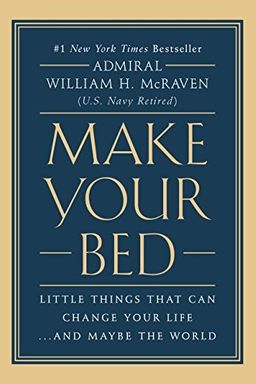
Make your Bed cover

Make your Bed

by William H McRaven

Make Your Bed distills invaluable lessons from Admiral McRaven''s Navy SEAL experiences into practical advice. Learn how small actions can lead to big changes, and discover the importance of resilience, teamwork, and perseverance in overcoming life''s challenges.

Small Actions, Big Change: The Power of Simple Discipline

What if changing the world started not with grand gestures, but with the simple act of making your bed each morning? In Make Your Bed, Admiral William H. McRaven argues that life's most profound transformations begin with small, consistent acts of discipline and courage. Drawing from his decades-long career as a U.S. Navy SEAL, McRaven contends that building a better world—or a better life—comes down to mastering fundamentals: accountability, teamwork, resilience, courage, and hope.

McRaven first introduced these ideas during his famous 2014 commencement address at the University of Texas at Austin, where he distilled ten lessons from SEAL training into a straightforward blueprint for personal leadership. These lessons struck a global chord because they boiled down elite military principles into universal life wisdom. The result is a compact yet powerful guide on how ordinary people can cultivate extraordinary strength through daily habits and courageous choices.

From SEAL Training to Everyday Life

McRaven draws vivid parallels between the grueling six months of SEAL training in Coronado, California, and the challenges we all face—setbacks, failures, doubts, and moral tests. SEAL candidates endure sleepless nights, freezing oceans, and relentless inspections designed to break them down. But these hardships also forge unshakable discipline. From rolling in the sand to becoming a “sugar cookie,” or surviving “Hell Week,” McRaven learned lessons about life’s unfairness, the importance of teamwork, and the courage to continue when every cell screams to quit.

Like other military-inspired leadership works—such as Jocko Willink’s Extreme Ownership—McRaven’s message transcends uniformed service. While his credentials grant him authority, his tone is measured, humble, and deeply personal. Each principle is backed with gripping anecdotes: swimming through shark-infested waters, rescuing hostages in Iraq, or meeting young soldiers who embodied resilience in heartbreaking conditions.

Why These Lessons Matter

In a world of instant gratification and self-centered ambition, Make Your Bed reintroduces timeless disciplines—like consistency, humility, courage, and service—that help you stay grounded amid chaos. The ten lessons form a moral code for action:

  • Start your day with a simple success
  • Find strength in others
  • Judge people by effort, not appearance
  • Accept life’s unfairness and keep moving forward
  • Turn failure into fuel for strength
  • Dare to take risks
  • Face down fear and intimidation
  • Be at your best when life is darkest
  • Give others hope
  • Never, ever quit

Each one begins with a personal story from SEAL training or McRaven’s command experience, then expands into a universal truth applicable to business, education, parenting, or simply surviving hardship. His approach isn’t abstract—it is built on grit and observation, told through tales of heroism and humility.

A Code for Resilient Living

At its heart, the book promotes a way of living that emphasizes character over comfort. Making your bed is symbolic: it’s about order in chaos, pride in effort, and a sense of momentum. The same goes for facing “sharks,” or bullies; surviving “Circuses,” or repeated failure; and refusing to ring the bell, the ritual act of quitting SEAL training.

McRaven’s message resonates because it rejects excuses. It reminds you that fairness, luck, and ease are illusions. What truly changes your life is the combination of small victories, self-discipline, and courage to act even when no one is watching. It’s an empowering antidote to the idea that change requires status, power, or privilege. Every person, McRaven insists, can start where they are—with something as simple as a neatly made bed—and transform their world.

Across these ten lessons, McRaven offers a survival guide for moral and emotional endurance. Together, they form a philosophy of leadership through service, courage, and persistence. In the chapters ahead, you’ll see how these lessons play out—from counting on your “boat crew” to finding hope in the mud, from daring greatly to standing tall in failure—and how each small act of resilience forms the foundation for greatness.


Start Your Day with a Task Completed

McRaven begins with what seems like a trivial habit—making your bed. But this single act, he insists, sets the tone for success. In SEAL training, beds were inspected with militaristic precision: sheets tucked tight, corners square, pillow perfectly centered. A bounce test with a quarter wasn’t a gimmick—it represented an instructor’s expectation for excellence, even in the smallest details.

The Power of Small Wins

Making your bed is about claiming your first victory. You start the day not in chaos, but with accomplishment. This tiny success triggers momentum; your brain stacks those wins throughout the day. It’s the same psychological principle that Charles Duhigg describes in The Power of Habit—keystone habits cascade into larger patterns of discipline and motivation.

McRaven links this to leadership: if you can’t do the small things right, you’ll never handle the big ones. During combat deployments, he found solace in order amid disorder—rolling up his sleeping bag or straightening his cot in war zones. When life spun out of control, that familiar act was proof that he still had agency.

Order in Chaos

In the aftermath of the September 11 attacks, confined to a hospital bed after a parachute injury, McRaven’s first act of recovery was to make that bed. It symbolized reclaiming purpose. This message resonates beyond the military: students, parents, or professionals can ground themselves in structure when life becomes unpredictable.

“If you want to change the world, start by making your bed.”

The metaphor is both practical and philosophical. Starting with order builds confidence, reinforces pride, and—when days go badly—provides comfort in one thing that went right. McRaven’s message is simple but profound: success begins not with talent or opportunity, but with small acts of discipline repeated daily.


You Can’t Go It Alone

The second lesson emerges from the “boat crews” of SEAL training, where seven men carry and row a ten-foot rubber raft through surf and sand. Each person has to dig in equally, or the crew capsizes. It’s an unforgettable metaphor for life: wherever you’re headed, you need people to help you paddle.

SEALs learn interdependence early. When one member is injured or exhausted, others carry the load. McRaven recounts moments when his teammates fed him, paddled harder, or sacrificed rest as he recovered from illness. Later, when he nearly died in a parachute accident that shattered his pelvis, his wife Georgeann’s care and Admiral Eric Olson’s faith in him literally saved his career.

The Myth of the Lone Hero

Modern culture glorifies rugged individualism, but McRaven dismantles that illusion. Even the strongest SEALs, the best athletes, or the most accomplished leaders rely on others for survival and success. Leadership, he suggests, isn’t about independence; it’s about interdependence—the shared responsibility to row in rhythm.

Think of your own “boat crew”: your family, friends, colleagues, or mentors. Real success comes when everyone digs into the surf together. When one person weakens, others pull harder, trusting that you’ll do the same when their turn comes.

Building Your Support System

McRaven encourages readers to cultivate relationships built on mutual respect and resilience. No one achieves greatness in isolation—not in warfare, business, or personal growth. Building teams, showing gratitude, and leaning on others when you need them are not signs of weakness but of wisdom.

As he puts it, “You can’t paddle the boat alone.” Whether your battle is against fatigue, failure, or fear, success comes when you sync your strokes with others—committed to the same destination, bonded by shared struggle.


Measure Success by the Size of Your Heart

In Chapter Three, McRaven champions one of his most human insights: it’s not your background, size, or credentials that matter—it’s the heart you bring to the fight. In SEAL training, the smallest men in the class, dubbed “the Munchkin Crew,” routinely outperformed their taller peers in races and swims. Their teamwork, humor, and grit made them unstoppable.

Grit Over Genetics

The “Munchkins” prove that toughness isn’t physical—it’s mental and emotional. McRaven also recalls meeting Tom Norris, a small, quiet man who, at first glance, seemed unfit for SEAL life. That same man turned out to be a Medal of Honor recipient who had rescued downed pilots in Vietnam through sheer courage and endurance. Norris’s story dismantled every stereotype McRaven held about what a hero should look like.

In life, as in SEAL training, talent and privilege fade in the face of persistence. True measure is found in determination, humility, and the refusal to surrender. Angela Duckworth’s research on grit echoes the same truth: passion and perseverance outweigh raw ability.

A World Beyond Labels

McRaven’s story reminds us that great teams—and societies—are built on inclusion, not prejudice. The ocean doesn’t care about your race, wealth, or pedigree. What matters is the will to swim harder against the current. It’s a powerful call for meritocracy of effort rather than privilege.

“If you want to change the world, measure people by the size of their heart—not their flippers.”

This lesson reframes judgment in every sphere—schools, workplaces, and communities. When you look for heart instead of status, you unlock hidden reservoirs of courage and creativity in yourself and others.


Life’s Not Fair—Drive On!

McRaven experienced firsthand how life’s unfairness can either crush or forge you. In SEAL training, even when students perfected every detail, instructors would still find errors. Those who failed inspections rolled in the sand and became “sugar cookies”—spending the entire day cold, wet, and miserable for no reason other than bad luck. The takeaway? Sometimes your best effort won’t be enough, and that’s okay.

The Reality of Unfairness

The “sugar cookie” ritual was meant to teach emotional resilience. Some trainees quit, unable to bear that unfairness. Those who accepted it learned how to control their responses to things they couldn’t control. As McRaven puts it: “Life isn’t fair, and the sooner you learn that, the better off you’ll be.”

He compares this lesson to real tragedies—like SEAL friend Moki Martin, paralyzed in a cycling accident. Moki never once asked “Why me?” Instead, he adapted, painting, parenting, and inspiring others with his perseverance. His story demonstrates how to live fully despite adversity, much like Viktor Frankl’s attitude in Man’s Search for Meaning.

Resilience Without Bitterness

McRaven urges you to reject victimhood. The world may not reward your efforts equally, but giving in to self-pity only ensures defeat. Resilience means making peace with the unfair and choosing forward motion. Heroes and ordinary people alike are defined not by what happens to them, but by how they respond.

This mindset helps you preserve dignity, progress, and perspective—even when soaked like a “sugar cookie.” As McRaven demonstrates, success requires focusing not on fairness, but on fortitude.


Failure Can Make You Stronger

SEAL training’s infamous “Circus” is a perfect metaphor for life’s trials. The Circus was a dreaded, two-hour punishment session of exhausting calisthenics assigned to those who failed in the day’s challenges. Fatigue increased the odds of failing again, creating a vicious cycle. But McRaven discovered that over time, those who endured the most Circuses grew stronger, faster, and more resilient.

Building Strength Through Suffering

McRaven and his swim buddy, Marc Thomas, were regulars at the Circus for their slow swim times. Instead of quitting, they embraced it. By graduation, they broke records. The pain had transformed into power. McRaven later applied this lesson when he was fired from a SEAL command position early in his career. Surviving humiliation and rebuilding his reputation forced him to mature as a leader.

Failure, he learned, is not a condemnation but a curriculum. The pain of mistakes teaches humility and toughness—values echoed by psychologists like Carol Dweck, who emphasizes “growth mindset” in Mindset.

Embracing the Circus in Your Life

Today’s “Circus” might be rejection, illness, or disappointment. You can let it break you, or you can let it strengthen you. By enduring those workouts of the soul, you prepare yourself for future battles. Each failure builds endurance for the storms ahead.

McRaven’s message: don’t be afraid of The Circus. Step into it, sweat through it, and come out stronger. Life’s extra “calisthenics” are how you toughen the mind and heart.


You Must Dare Greatly

Fear is the companion of progress. McRaven’s sixth lesson encourages you to take risks—to “slide down the obstacle headfirst.” In SEAL training, the fastest trainees dared to ride a treacherous rope slide headfirst off a thirty-foot tower. It looked reckless but rewarded boldness backed by skill. Playing it safe guaranteed mediocrity.

Calculated Courage

Daring greatly doesn’t mean acting recklessly; it means embracing uncertainty with preparation and resolve. In Iraq, McRaven authorized a dangerous daylight raid to rescue hostages from a terrorist compound. It was high risk but strategically necessary—and it saved lives. The courage to act decisively defines effective leadership.

This principle echoes Theodore Roosevelt’s “Man in the Arena” and Brené Brown’s concept of “vulnerability as courage.” Playing it safe is far riskier than stepping forward intelligently.

“Who Dares Wins”

Borrowing the motto of Britain’s Special Air Service, McRaven insists that victory belongs to those willing to face danger, ridicule, and failure. Personal growth, innovation, and leadership all require you to trust your training and dare greatly.

“Life is a struggle, but those who live in fear of failure will never achieve their potential.”

Whether leaping into business ventures, personal challenges, or emotional risks, your greatness lies in headfirst slides—the moments when caution yields to courage.


Stand Up to the Bullies

The seventh lesson draws on one of SEAL training’s most primal fears: swimming in shark-infested waters. Trainees are taught never to back down—if a shark circles, punch it in the snout. In other words, face your fears head-on, because bullies—like sharks—feed on hesitation.

Courage in the Face of Fear

McRaven shows that courage is not the absence of fear but mastery over it. He applies this metaphor to moral courage as well. When Iraqi leaders were still terrified of Saddam Hussein after his capture, McRaven realized that tyrants maintain power only through others’ fear. By isolating Saddam, he dismantled his psychological hold. The same principle applies to workplace bullies or toxic relationships—they lose power the moment you stop being afraid.

Moral and Physical Bravery

Standing up to injustice, intimidation, or abuse requires the same courage as swimming through dark waters. But, as McRaven notes, courage resides within everyone. It’s found in students standing up to peer pressure, employees speaking truth to power, and citizens opposing tyranny. Courage enlarges your world, while fear shrinks it.

“If you want to change the world,” McRaven writes, “don’t back down from the sharks.” Courage is contagious—and it’s the first step toward a better world.


Be Your Best in Darkest Moments

McRaven’s eighth principle emerges from the most perilous part of SEAL diving exercises: navigating under ships in total darkness. This is when panic threatens, when even a trained diver can lose orientation. SEALs learn that in those moments, you must rely on your training and composure—you must be your very best when the situation seems most hopeless.

This lesson resonates with anyone facing loss, grief, or despair. McRaven connects it to military funerals in Afghanistan, where soldiers demonstrated extraordinary dignity and strength in honoring fallen comrades. “In the darkest moments,” he writes, “we come together and rise to our highest potential.”

Character in Crisis

Moments of crisis reveal who you truly are. McRaven witnessed families of fallen heroes standing tall in unimaginable pain, choosing grace over defeat. Like stoic philosophers (Marcus Aurelius, for example), he emphasizes composure over chaos and duty over despair. Darkness doesn’t build character—it reveals it.

So when you’re submerged under life’s weight, be calm, disciplined, and deliberate. The light may be gone, but your best self must still shine.


Give People Hope

In the mudflats of SEAL training—the lowest, coldest part of Hell Week—McRaven discovered the transformational power of hope. When his class shivered through the night, ready to quit, one trainee began to sing. The single voice broke the despair, slowly joined by dozens until every man sang together. The song didn’t warm their bodies, but it warmed their spirits. They made it through because one man dared to give others hope.

The Leadership of Hope

For McRaven, real leadership is less about strategy than about inspiration. Hope sustains teams under pressure. He saw it again at Dover Air Force Base, where Marine General John Kelly comforted families who lost loved ones in combat—including his own son. Kelly transformed grief into grace, embodying how one person’s strength can lift others from despair.

Why Hope Changes Everything

Hope, McRaven writes, is “the most powerful force in the universe.” It enables endurance when logic says give up. It fuels movements, marriages, and missions. Leaders like Lincoln, Mandela, and Malala all gave their people hope—and changed the world. You can do the same, even in small ways: by choosing optimism, by encouraging others when things seem lost.

When you’re “up to your neck in mud,” start singing. Because hope multiplies; it’s the bravest contagion of all.


Never, Ever Quit

The final lesson is the cornerstone of all the others: persistence. In SEAL training, quitting was literal—ring the brass bell three times, and you were done. Hundreds failed, but those who didn’t ring the bell proved that endurance matters more than comfort. McRaven summarizes it simply: never, ever quit.

The Cost of Quitting

Quitting feels like relief, but it permanently removes the chance to succeed. McRaven warns that easy exits become lifelong regrets. He recounts meeting a young Army Ranger, Adam Bates, who lost both legs to a mine in Afghanistan. Despite his injuries, Bates signed to McRaven: “I will be OK.” A year later, Bates stood tall on prosthetics at his unit’s ceremony—living proof that perseverance transcends circumstance.

This aligns with Angela Duckworth’s concept of grit and Viktor Frankl’s belief that meaning sustains survival. Pain is inevitable; surrender is optional.

Endurance as a Way of Life

Each of McRaven’s ten lessons begins and ends here: persistence wins. Whether you face cold oceans, professional setbacks, or emotional pain, success belongs to those who keep paddling. His advice closes both his famous speech and the book itself: start with small wins, rely on others, be brave, stay hopeful—and never quit.

“Never, ever ring the bell.”

Life will tempt you to stop, but greatness belongs to those who persist through fear, failure, and fatigue. The difference between ordinary and extraordinary often comes down to the simplest choice: keep going.

Dig Deeper

Get personalized prompts to apply these lessons to your life and deepen your understanding.

Go Deeper

Get the Full Experience

Download Insight Books for AI-powered reflections, quizzes, and more.