
Idea 1
Making No Small Plans: Dreaming Boldly, Building Together
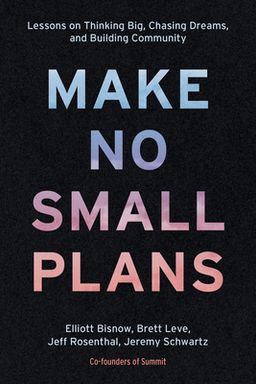
Have you ever had a wild idea—a vision so big that people said you were crazy for even thinking it? In Make No Small Plans, Summit founders Elliott Bisnow, Brett Leve, Jeff Rosenthal, and Jeremy Schwartz argue that those audacious dreams are exactly what the world needs. They contend that greatness—and change—come not from cautious, incremental plans, but from boldness, collaboration, and relentless belief in possibility. Yet making big dreams work requires more than vision; it takes community, trust, and the courage to fail forward.
This book is both a memoir and a manifesto—a chronicle of four friends who turned a snowball of curiosity into a global community of entrepreneurs, doers, and dreamers. Starting with no money, no network, and no roadmap, they built Summit Series, an organization that hosted events with figures like Richard Branson, Bill Clinton, and Beyoncé-level cultural change-makers. From a ski trip in Utah to purchasing the largest ski resort in North America, Make No Small Plans shows what happens when naïveté meets purpose.
From Dreamers to Builders
At its core, the book narrates a move from youthful chaos—half-baked ideas, cold calls, rejections—to disciplined dreaming grounded in trust and values. The Summit story mirrors the genesis of many start-ups born from what Peter Thiel called a ‘zero-to-one’ leap—a jump into the unknown when logic says you should wait. Elliott Bisnow’s first failed ski summit, where no one said yes, taught him a key truth: rejection often signals that the idea isn’t wrong, just not big enough. (This echoes Steve Jobs’s view that the biggest risk isn’t failure—it’s thinking small.)
Through countless missteps—like sending a $3,000 event invite that angered their network, or inviting speakers they couldn’t afford—they discovered that audacity without humility burns bridges. The turning point came when they replaced self-promotion with trust-building, realizing that culture “steamrolls strategy.” The lesson? People don’t buy ideas—they buy into values. By doubling down on kindness, connection, and giving rather than taking, Summit became a magnet for innovators across disciplines.
The Power of Community
Throughout the book, one principle repeats like a mantra: “You can go fast alone, but far together.” The authors show how each partner’s contrasting strengths—Elliott’s relentless vision, Brett’s salesmanship, Jeff’s creative sensitivity, Jeremy’s technical prowess—fused into an engine of complementary genius. Their relationships stand as a case study in how diverse talents amplify outcomes, much like Ray Dalio’s “idea meritocracy” in Principles. Every success—from the first White House event connecting entrepreneurs with the Obama administration to chartering a 14-story cruise ship—stemmed from shared purpose over individual ego.
The Summit gatherings were more than conferences; they were carefully designed “containers for serendipity.” By inviting musicians, scientists, athletes, and artists into the same room, they blurred the boundaries between business and creativity, profit and purpose. This interdisciplinary alchemy echoes TED’s influence but adds a distinctly human warmth: barefoot hospitality, communal dining, and soulful conversation. Their philosophy: when you connect good people, good things happen naturally.
From Temporary Events to a Lasting Home
But what do you do when a movement outgrows its format? For Summit, the answer came in one outrageous decision: buy a mountain. The founders’ quest for a permanent home led to Powder Mountain, a 10,000-acre ski resort in Utah they vowed to turn into a living experiment in community. It was madness—a $40 million challenge for a team that barely had $1 million in the bank. Yet that audacity embodied the book’s thesis: big plans summon the allies, knowledge, and miracles required to realize them. Through sleepless nights, dozens of setbacks, and even losing contracts seven times, they proved that momentum, trust, and transparency could move mountains—literally.
Why It Matters Now
In an era defined by burnout, uncertainty, and isolation, Make No Small Plans is both antidote and roadmap. It invites you to rethink leadership—from control to co-creation, from competition to collaboration. It reminds us that success isn’t about exits or valuations but about values and vision. Whether you’re founding a company, starting a movement, or reinventing your life, the same lesson applies: be bold enough to start before you’re ready, and humble enough to learn as you go.
“The world doesn’t change one person at a time. It changes as networks of relationships form among people who share a common cause and vision of what’s possible.” – Margaret Wheatley (quoted in the book’s epigraph)
Summit’s journey—from a few friends in a grandmother’s condo to a global platform for creative capitalism—shows that dreaming big is not recklessness; it’s responsibility. The bigger your plan, the more good you can do. That’s why this book’s core call to arms isn’t simply entrepreneurial—it’s existential: make no small plans, because the world doesn’t have time for them.