
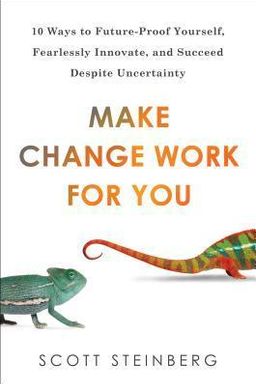
Make Change Work for You cover

Make Change Work for You

by Scott Steinberg

Make Change Work for You explores how to embrace change as an opportunity for growth. By examining successful companies and entrepreneurs, it provides actionable strategies to adapt and thrive in uncertain times, whether you''re an employee, leader, or CEO.

Turning Fear into Fuel for Change

Have you ever noticed how quickly life can shift from calm waters to chaos, leaving you anxious about what comes next? In Make Change Work for You: 10 Ways to Future-Proof Yourself, Fearlessly Innovate, and Succeed Despite Uncertainty, Scott Steinberg argues that the ability to adapt is the single greatest advantage you can cultivate in today’s unpredictable world. He contends that change isn’t a threat—it’s an opportunity. The challenge lies not in the changes themselves but in our emotional response to them—namely, fear, anxiety, and self-doubt.

Drawing from hundreds of interviews with executives, entrepreneurs, and professionals, Steinberg outlines a framework for turning fear into focus, courage, and innovation. He insists that you don’t need to be fearless to thrive—you just need to act courageously in spite of fear. Through his FEAR Model—Focus, Engage, Assess, React—he provides a systematic approach to mastering uncertainty and using it as fuel for progress.

Change Is the New Operating Reality

From technological disruption to economic volatility, Steinberg begins by reminding us that we now live in an age where industries are transformed overnight. Businesses like Blockbuster, Kodak, and Yahoo! fell not because they lacked talent but because they failed to evolve. Similarly, individuals who cling to what worked yesterday risk irrelevance tomorrow. The modern world, he writes, is a test of agility: those who can pivot and reinvent themselves will not only survive but dominate.

(As futurist Peter Diamandis also notes in Bold and Abundance, the exponential rate of technological change means that “stability” is now an illusion—adaptability is the real career insurance.)

Fear as Feedback, Not Foes

At the heart of Steinberg’s philosophy is a simple yet profound idea: your fears are actually signals trying to teach you something. Fear of failure, embarrassment, or change is not a defect; it’s data. It tells you where you feel unprepared, where growth is waiting, and where opportunity hides behind discomfort. By listening to those signals instead of avoiding them, you gain insight into what really matters and where you need to focus your efforts.

He distinguishes between seven primary fears—failure, embarrassment, loss of control, rejection, confrontation, isolation, and uncertainty. Each one holds a paradox: left unmanaged, they paralyze; interpreted correctly, they empower. The difference lies in how you choose to respond.

From Fear to Action: The FEAR Model

To make these ideas practical, Steinberg introduces the FEAR Model—an action-oriented system for turning uncertainty into progress:

  • Focus: Identify the precise challenge and analyze it from multiple angles.
  • Engage: Take deliberate action; don’t let paralysis set in.
  • Assess: Evaluate the results and feedback from your choices.
  • React: Refine and adapt based on what you’ve learned, iterating toward improvement.

He illustrates this through stories like Master Lock’s reinvention of its product strategy and W.L. Gore’s (creator of GORE-TEX) pivot into the music industry with Elixir Strings—examples of using feedback, reframing risk, and acting decisively in times of uncertainty.

Courage as a Habit, Not a Trait

Steinberg dismantles the myth that courage is innate. Drawing on research by positive psychologists like Robert Biswas-Diener and Monica Worline, he argues that courage is a muscle that strengthens with use. Courageous people still feel fear—they’ve just learned to act anyway. Every time you tackle an uncomfortable challenge, you expand your comfort zone. Over time, what once seemed impossible becomes routine.

He gives examples like OK Go’s Damian Kulash, who turned constant uncertainty in the music industry into creative reinvention, and business executives who embrace experimentation as their default state. Courage, Steinberg says, is built through small, repeated acts of bravery, not grand heroics.

Why This Matters Now

Why does all this matter? Because in a world where jobs vanish, industries evolve, and technology changes overnight, the only thing you truly control is your willingness to adapt. Emotional intelligence—especially the ability to manage fear—has become the new competitive advantage. As psychologist Angela Duckworth’s research on grit supports, long-term success depends not on genius but on perseverance in the face of discomfort.

Steinberg’s promise is empowering: once you learn to reinterpret fear, it transforms from an obstacle into your greatest ally. You begin to see uncertainty not as chaos but as a playground of possibilities. The rest of the book shows how to cultivate courage systematically, turn fear into innovation, experiment confidently, and stay relevant—no matter how fast the world changes.


Mastering the Seven Fears That Hold You Back

Steinberg opens the discussion of fear by mapping its seven most common forms, particularly in the workplace. Each of these fears interlocks, forming a web that can quietly strangle innovation unless we learn to break free. Yet, when properly understood, each fear also signals a crucial developmental opportunity.

1. Fear of Failure

Failure is the most universal and potent fear. Steinberg reminds us of Nike’s iconic ad featuring Michael Jordan confessing to thousands of missed shots and losses. It's not failure that defines you—it’s your ability to learn and continue. The author insists that every failure is tuition: tuition in a learning process that brings you closer to mastery.

2. Fear of Embarrassment

Marketing executive Mark Quinn’s story demonstrates this vividly. His edgy “Virgin Mattress” campaign offended conservative colleagues, almost costing his job. Yet by reworking the idea instead of abandoning it, Quinn not only kept his career but revolutionized how his company communicated. Courage in the face of embarrassment often leads to authentic reinvention.

3. Fear of Losing Control

This fear often arises when circumstances don’t align with our expectations. Entrepreneur Kyle Smitley saw her clothing startup stall until she relinquished control and experimented with direct outreach to bloggers. When she shifted her approach, success followed. Steinberg’s lesson: don’t cling to outdated strategies—adapt and redirect the energy that control once commanded.

4. Fear of Rejection

Rejection, Steinberg argues, is rarely personal—it’s statistical. You’re bound to hear “no” more than “yes.” His own story about cold-calling game companies as a teenager to work for free shows how persistence turns rejection into connection. Every “no” is simply one step closer to “yes.”

5. Fear of Confrontation

Many fear conflict, mistaking it for hostility. Yet crucial conversations are where innovation starts. The author highlights Unilever’s creative campaign for Ragú, born from a tough confrontation between ad executive Gerry Graf and executives hesitant to risk controversy. Their brave choice led to viral success—proof that friction often sparks brilliance.

6. Fear of Isolation

At FedEx, innovation leader Michelle Proctor learned that employees only innovated when they felt connected. Her solution was to create a “safe space” for risk-taking. The more we fear being ostracized, the more we cling to conformity; the antidote is community and collaboration.

7. Fear of Change and Uncertainty

Valve Software provides a master class here. The company has no formal managers—employees self-organize around projects. The result? A powerful culture of freedom and continual innovation. This flexibility transforms fear of uncertainty into creative play. For Steinberg, adaptability is courage in motion.

Together, these seven fears form a checklist of growth edges. Identify which one dominates your life, and you’ll discover the next challenge that can strengthen your confidence, creativity, and courage.


Building Courage as a Daily Practice

Central to Steinberg’s message is that courage isn’t the absence of fear—it’s constructive action in the presence of it. Borrowing insights from psychologist Robert Biswas-Diener (author of The Courage Quotient), he reveals that bravery can be learned through repeated exposure, feedback, and adaptation—like training a muscle through incremental challenges.

The Science of Courage

Studies show that courage correlates with awareness and adaptability, not fearlessness. In psychological terms, courage is a balance between measured awareness of risk and willingness to act. Executives often exhibit more courage than even soldiers or firefighters—not because they face less fear, but because they decide faster and act amid ambiguity every day.

Courage Is Contagious

Monica Worline’s research on workplace courage reveals a social multiplier effect: when leaders model bravery, employees follow suit. For example, when managers at tech firms actively encourage challenges to their authority, creativity rebounds. Courage spreads like wildfire when rewarded and acknowledged.

Training Your Courage Muscle

The U.S. Army’s Master Resilience School offers a real-world blueprint. Soldiers train not to eliminate fear but to harness it through simulations and reflection. Similarly, Steinberg argues that professionals can cultivate “courage conditioning” by voluntarily stepping into situations that stretch comfort zones—speaking up in meetings, pitching bold ideas, or taking calculated career pivots.

Practical Courage in Business and Life

Courageous individuals, Steinberg says, proactively shape circumstances instead of waiting for them to change. Whether you’re asking for a promotion, launching a company, or confronting a toxic process at work, the goal is not to guarantee perfect outcomes but to strengthen the capacity for decisive action. Courage, like trust, compounds through consistency.


Transforming Anxiety and Paranoia into Awareness

Anxiety and paranoia often get a bad rap, but Steinberg reframes them as evolutionary assets. These emotions heighten awareness, alert us to change, and can drive vigilance in business and personal growth. Instead of suppressing anxiety, the trick is to channel it constructively.

From Panic to Preparedness

Tony Hawk’s example illustrates the power of productive anxiety. Before performing groundbreaking tricks, Hawk spends years meticulously preparing. His nerves keep him sharp, not scared. Similarly, organizations that accept a “healthy paranoia,” like Intel under Andy Grove’s leadership, stay prepared for competitive threats and disruptions.

Intelligent Paranoia

Business history proves that those “paranoid” enough to anticipate shifts—like Procter & Gamble in the diaper wars or Starbucks partnering with rivals to reduce risk—ultimately stay ahead. Grove’s warning that “only the paranoid survive” becomes a mantra for innovation rather than fear.

Creating Tripwires for Awareness

Steinberg advises developing “tripwires”—early-warning systems that detect small anomalies before they become crises. In your career, this might mean tracking trends or soliciting regular feedback before satisfaction drops. For companies, it means monitoring sales, engagement, or reputation signals rather than waiting for collapse.

Seen this way, anxiety and paranoia become sensors guiding strategy, alerting you to evolve before stagnation strikes. They’re built-in radar for survival, not symptoms to eliminate.


Fail Fast, Learn Faster

Steinberg’s fourth rule, “Transform Failure into Success,” revolves around redefining failure as feedback. Every stumble reveals the boundaries of current capabilities and the next iteration needed for success. Leaders like Kimberly-Clark’s Darwin Smith proved that perseverance through failure transforms entire enterprises.

Failure as Innovation’s Currency

When Smith risked selling Kimberly-Clark’s legacy paper mills to focus on consumer brands, short-term losses seemed catastrophic. Yet, by enduring discomfort, the company later dominated with Kleenex and Huggies. This courage to fail forward is echoed in entrepreneurs like TrainSignal’s Scott Skinger, who bet his business on streaming despite zero revenue months. The payoff: exponential growth.

The Emotional Cost of Growth

Fear of failure carries emotional pain—shame, isolation, frustration. Steinberg insists you can’t avoid that pain; you can only normalize it. The willingness to stay with discomfort longer than competitors is a mark of resilience. (This parallels Angela Duckworth’s emphasis on grit as sustained commitment to long-term goals.)

Turning Pain into Power

The “lean startup” mindset, as coined by Eric Ries, mirrors Steinberg’s philosophy: build, measure, learn, repeat. Each iteration, whether a failed prototype or a misfired pitch, is raw data for future success. The goal isn’t perfection—it’s progress. The quicker your feedback loop, the faster your evolution.

In short, Steinberg’s reframing is liberating: failing is inevitable, but staying down is optional. Every failure is simply unfinished learning.


The Improviser’s Edge

Improvisation—Rule 5—is the discipline of adapting plans on the fly. Steinberg likens it to jazz or live performance: success depends on flexibility, not fixed notes. He draws on examples from Grooveshark, Harvard Business School, AMC Networks, and more to show that improvisation is vital for surviving disruption.

Improvisation in Action

When CEO Sam Tarantino’s music streaming company Grooveshark faced lawsuits and bans, his team improvised with browser-based workarounds that saved the business. Harvard’s FIELD program trains MBAs with the same principle: respond dynamically, learn by doing, adjust quickly.

Becoming a “T-Shaped” Leader

Steinberg endorses Fast Company’s idea of the “T-shaped” professional—broad general knowledge across disciplines combined with deep expertise in one. Improvisers must pull from varied toolkits, combining design thinking, finance, creativity, and intuition to solve complex problems.

Embrace Continuous Change

Improvisation thrives amid chaos, but it demands emotional agility and patience. Don’t fear unpredictability; surf it. By planning minimally yet preparing deeply, you build insight to pivot at any moment. As Steinberg says, “Never be without a plan—and never rely on one.”


Experiment Constantly

Adapting from improvisation, Steinberg moves to deliberate experimentation. Stagnation, he argues, is voluntary; progress requires constant testing. From 3M engineers tinkering on Post-it notes to Campbell’s hackathon, innovation comes not from theory but trial.

Life as a Prototype

Think of your career as a start-up: prototype, launch, iterate. Whether it’s Airbnb founders realizing photography quality mattered or Anita Crofts at the University of Washington designing her own role, experimentation turns curiosity into career reinvention. Failure rates may be high, but each test yields priceless insight.

The Mindset of Iteration

Steinberg celebrates “permanent beta,” a mindset from LinkedIn’s Reid Hoffman meaning you’re always evolving. You are never finished—only upgrading. Organizations like SolarCity and Ben & Jerry’s succeed precisely because they embrace learning over ego.

The message: tinker relentlessly, both in projects and personal growth. In a volatile world, curiosity is protection, and experimentation is resilience in action.


Picking Battles and Playing the Odds

Steinberg’s later chapters merge strategy with psychology: knowing which risks to take and when. Borrowing from game theory, he suggests that modern success is statistical. Winning means stacking probabilities—playing many hands wisely rather than betting everything on one move.

Selective Aggression

Poker champion Phil Gordon calls it “selective aggression.” You test small bets often, retreat quickly from weak hands, and go all-in only when the odds favor you. Merck’s Sanjoy Ray shows this by assigning key innovation roles to passionate, not necessarily most qualified, employees—smart bets based on engagement potential, not titles.

Risky Is the New Safe

As Indra Nooyi of PepsiCo told Fast Company, “You have to create your own tailwinds.” Playing safe is now the riskiest move. Whether pitching an idea like Microsoft’s J Allard did to Bill Gates or pivoting careers like Andrew Stinger, calculated daring expands opportunity.

Work and Life as Probability Games

Every decision carries odds. The trick is to keep rolling until probabilities work in your favor. Courageous players never stop betting—they just learn to bet smarter. As Steinberg concludes, success is no longer about avoiding losses but accumulating strategic wins that compound over time.


Staying Relevant in a World That Won’t Sit Still

The book closes with a rallying cry: ongoing relevancy is the new definition of success. Like muscles unused, skills and perspectives atrophy fast. Staying relevant means relentless self-renewal—continuing education, recalibration, and experimentation.

Reinvention as Routine

Companies like L&T General Insurance in India proved that rethinking delivery systems—using mobile technology instead of traditional brokers—opens entire new markets. Individually, consistency in upgrading skills, building networks, and scanning trends prevents obsolescence.

The Generation Flux Advantage

Fast Company’s term “Generation Flux” captures Steinberg’s idea perfectly: success is not about age, but adaptability. Continuous learners who develop cross-functional fluency and creative risk tolerance will always outrun the competition.

Steinberg’s closing lesson is deeply optimistic: In a world of uncertainty, relevance is renewable. You just have to keep becoming. As he puts it, “The moment you stop moving forward, you start moving backward.”

Dig Deeper

Get personalized prompts to apply these lessons to your life and deepen your understanding.

Go Deeper

Get the Full Experience

Download Insight Books for AI-powered reflections, quizzes, and more.