
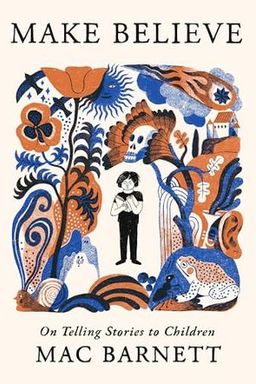
Make Believe cover

Make Believe

by Mac Barnett

The children’s book author considers the impact of children’s literature and how it provides a lens into the lives of children.

Make-believe that tells the truth

When was the last time you pretended—really pretended—and felt your pretend world tell you something true about the real one? In Make Believe, Mac Barnett leans into that magic: the odd but reliable way stories, jokes, and capers can smuggle big truths inside small, funny moments. Barnett contends that make-believe isn’t the opposite of truth; it’s a different road to reach it. By inviting you to follow a kid into spycraft, palaces, and even a brush with the KGB, he shows how pretending helps you test courage, ethics, and identity—safely, playfully, and memorably.

The book frames make-believe as a powerful tool for kids and grown-ups: a structure for practicing bravery, decoding adult rules, and making sense of complicated history. Through the Mac B., Kid Spy setup (a child narrator recruited into international intrigue), you see how humor, tight plotting, and a confiding voice turn “just a story” into a lab for real-life skills. The chapter guideposts—The Call, Spy Plane, The Tower, Her Majesty, Art Heist, Captured, KGB HQ, Jean Crime—signal a classic caper scaffold that doubles as a curriculum for thinking: you learn to notice clues, plan, improvise, and reflect.

Make-believe as a method, not an escape

Barnett treats make-believe as method. When a kid narrator becomes a spy, the game comes with rules: evidence matters, secrets have costs, and choices shape outcomes. You’re not fleeing reality; you’re rehearsing it. This aligns with developmental research on pretend play (see Alison Gopnik’s work) showing that imagination strengthens causal reasoning and empathy. Barnett brings that science to life by letting a child try on adult-scale problems in kid-sized scenes. “Spy Plane” isn’t an air-power lesson; it’s a controlled experiment in fear, awe, and responsibility.

Comedy as a truth-delivery system

Jokes aren’t detours here; they’re vehicles. Wordplay (a chapter like “Jean Crime” winks at both a name and a noun), visual gags, and running bits keep pages turning while reinforcing key ideas: pay attention to language, notice patterns, expect reversals. Humor builds trust between narrator and reader. When a kid confides—often with shrugging honesty about fear or a botched plan—you recognize yourself. That recognition makes later moral choices land harder. You laugh first; then you think.

A caper’s clock teaches thinking in steps

The outline reads like a heist film for young readers: a call to action, reconnaissance, a boldly simple plan, a cleverly complicated problem, failure, regrouping, and a rendezvous that reframes everything. That rhythm—threat, plan, obstacle, pivot—trains you to break challenges into parts. It’s Ocean’s Eleven remixed for a playground, where the prize isn’t jewels so much as competence. Each beat offers a mental move you can reuse in real life: make a plan; expect your plan to meet reality; revise with better data.

Why it matters now

Kids confront a world of oversized topics—history, politics, surveillance, authority—long before they have adult power. Make Believe gives them a safe, funny space to examine those forces. A queen on the phone, a flight to a secret HQ, rain in the dark: these images are theater sets for practicing judgment. And for adults reading along, Barnett models how to talk about truth in an age of noise: be specific, be kind, and don’t be boring. The result is a shared language for courage and curiosity.

In the pages ahead, you’ll see how Barnett uses a “kid gets the call” premise to empower readers, how real history becomes a playground without losing gravity, how the heist blueprint teaches planning and iteration, why jokes are memory machines, and how spying-as-pretend clarifies the ethics of truth-telling. You’ll come away with strategies you can use immediately—whether you’re seven, seventeen, or a parent who loves reading out loud.

Key Idea

Make-believe isn’t about escaping the world; it’s about rehearsing how to live in it—with wit, nerve, and heart.


A kid gets the call

Barnett opens with an irresistible inciting incident: a regular kid receives a very irregular phone call. In chapters like “The Call,” “Queenly Power,” and “Her Majesty,” the child narrator, Mac, is tapped for a mission by a head of state. It’s absurd and perfectly serious at once. You feel what Mac feels: the shock of being chosen, the tingle of responsibility, and the awkward logistics of saying yes to something so big you can hardly name it.

From chosen to choosing

Being chosen is fun, but Barnett doesn’t stop there. The story quickly shifts from passive selection to active decision-making. By “Spy Plane” and “The Tower,” Mac must interpret instructions, ask better questions, and take first steps into a world where adults hold power and secrets. It’s a brilliant narrative trick: you, the reader, feel invited into a club and then, almost immediately, feel the weight of membership. The thrill becomes agency.

Competence without condescension

Many children’s adventures hand kids a destiny; Barnett hands Mac a dossier. The tone says, “You can do this,” without pretending tasks are easy. Directions are specific; stakes are clear; grown-ups aren’t caricatures, even when they’re funny. That combination respects kids’ intelligence. (Compare to Roald Dahl’s Matilda, where brilliance fights cruelty; here, capability meets complexity and must negotiate it.)

Courage as a series of small acts

Big courage is made of tiny choices: picking up the phone, getting on a plane, walking into an unfamiliar tower. Barnett frames bravery as practiced increments. For a young reader, this maps directly onto life—raising your hand in class, telling a friend the truth, trying out for the team. The mission gives you a metaphor you can carry into Tuesday afternoon.

The comedy of awe

Mac’s reactions to majesty—protocol, palaces, the odd pageantry of “King and Queen Stuff”—are tinged with awe and undercut by sly jokes. You get giggles without losing respect for the setting. This balance teaches a quietly radical lesson: you can honor institutions and still keep your wits about you. Laughter becomes a grounded stance, not disrespect.

By the end of this opening movement, you’ve watched a kid enter a grown-up game and start to play it well. The “kid gets the call” trope isn’t about exceptionalism; it’s about invitation. You don’t need a crown to give permission—you can choose yourself, one brave act at a time.


History you can laugh at

When a story drops a kid into “KGB HQ,” it’s doing more than raising the stakes; it’s introducing history as a character. Barnett treats big, thorny topics—Cold War spymasters, national symbols, museums, and towers—with a light touch that still respects the facts. You meet the idea of the KGB as a force to outwit, not a lecture to endure. In “The Tower,” real places become settings you can feel under your feet; in “Art Heist,” culture becomes a plot device you can root for and puzzle through.

Playful frames, serious edges

A joke cracks open the door; a detail keeps it honest. That’s Barnett’s move. He’ll land a pun (as in the chapter title “Jean Crime,” nudging you to listen closely to language) and then slip in a precise, anchoring fact: a place name, a protocol, a hint of political tension. The effect is permission to engage. You get to giggle and learn, which is exactly how sticky learning happens. (Think Horrible Histories, but with a warmer, confiding narrator.)

De-scaring the scary

History can be frightening in the abstract; in a scene, it’s navigable. A shadowy agency becomes a lobby you can walk into, a guard you can evade, a room with a map and pins. The massive shrinks to the manageable. That’s not minimizing harm or danger; it’s right-sizing it for a reader who’s still figuring out the world. When “Rain in the Dark” falls, the mood shifts, but you’ve been prepared by humor and competence to handle it.

Context through caper

Because the story rides on a caper engine, historical context slips in sideways. You learn what a headquarters implies (hierarchy, secrecy), why towers matter (power, history), why art needs protection (value, identity). The lesson isn’t coded in bold; it’s embedded in stakes. The richer your sense of setting, the more the mission matters, and the more you absorb along the way.

Respect without reverence

Barnett respects institutions enough to joke about them. That’s a healthy stance for young readers. It models citizenship as curious, informed, and lightly skeptical. By letting a kid ask why a rule exists—or how a museum guards its treasures—he trains the muscle of civic thinking. (Compare to Kate DiCamillo’s approach in Because of Winn-Dixie, where kindness opens social systems; here, curiosity unlocks historical systems.)

If you’ve ever wished history class felt more like a page-turner, this is the bridge: facts with a pulse, jokes with a backbone. You finish the chapter and realize you’ve added a few real-world files to your mental spy kit.


The heist blueprint for thinking

Look closely at chapters like “A Threat,” “Oh and Also,” “My Secret Plan,” “Art Heist,” “Captured,” and “Rendezvous,” and you’ll see a blueprint for solving problems. Barnett borrows the caper’s reliable clock—stake, scope, scheme, snag, scramble, success—and turns it into a thinking routine readers can reuse anywhere. The story motors forward, but the structure teaches you how to move when the unknown shows up.

1) Name the stakes (A Threat)

First, something matters. A theft, a warning, a ticking clock. By specifying exactly what’s at risk—an artwork, a secret, a symbol—Barnett makes focus feel natural. You can’t plan without a clear “why,” and kids feel that in their gut. In your life, this maps to defining the assignment before touching the keyboard or lacing up your shoes.

2) Scope and constraints (Oh and Also)

The funniest chapter title might be the most instructional. “Oh and Also” signals the surprise constraints every plan meets: you have less time, fewer tools, more eyes watching. Instead of treating constraints as complaints, Barnett treats them as design specs. That reframes frustration as creativity fuel.

3) Draft the plan (My Secret Plan)

Caper plans are deliciously tidy—on paper. Barnett often gives you a diagrammatic sense of steps, then lets reality test them. This makes iteration feel normal, not shameful. It’s a subtle growth-mindset lesson: good thinkers expect to revise.

4) Execute and adapt (Art Heist)

Action sequences are where readers feel smart. You’re inside the plan, recognizing beats you anticipated, and then—whoops—something flips. A guard returns early, a door sticks, a new clue appears. You learn to pivot. The reader’s reward isn’t just plot satisfaction; it’s the mental click of flexible thinking.

5) Survive the snag (Captured)

Failure isn’t a narrative problem; it’s the point. When Mac is caught or cornered, you ride through fear to composure. The lesson: you can be brave and scared at the same time. Barnett makes these lows short but real, modeling how to breathe, observe, and look for one small move that opens the next.

6) Re-group and resolve (Rendezvous)

Great capers end with graceful reconnection: allies meet, clues recombine, and the story reveals the pattern that was hiding. For readers, it’s epistemology in sneakers—how we know what we know. The final rendezvous isn’t just about swapping loot; it’s about comparing notes and updating beliefs.

If you’ve ever wanted a kid-friendly way to teach planning, iteration, and grit, this is it. The caper makes cognition feel like adventure, and the adventure makes cognition unforgettable. (For a comparable structure in middle grade, see Trenton Lee Stewart’s The Mysterious Benedict Society.)


Jokes that teach and stick

Barnett’s comedy isn’t decoration; it’s the engine oil that keeps cognition humming. Wordplay, visual gags, callback humor, and tonal whiplash (from regal to ridiculous) all serve learning. A chapter title like “Jean Crime” is a pun you feel in your ears; it invites you to become a pattern hunter who notices double meanings. By making you laugh, the book makes your brain alert—exactly when it wants to tuck in a key idea or clue.

Wordplay as attention training

Puns and homophones reward careful listening. When a joke flips on a single syllable, kids learn to track language at the granularity of sound. That’s literacy training disguised as silliness. Think of it as strength work for decoding and inference—skills every reader needs in school and life.

Visual humor as comprehension scaffolding

Illustrations (often with diagram vibes, labels, or cutaway views) shoulder part of the narrative load. A ridiculous disguise, a labeled gadget, or an expressive reaction shot means a developing reader doesn’t have to hold everything in working memory at once. This frees cognitive space to track plot and absorb background facts. The laugh buys you bandwidth.

Callbacks and running bits

Recurring jokes create a web of recall. When a gag returns in a new context, it clicks two memories together: “I’ve seen this before, but now it means more.” That’s how expertise is built—by recognizing structures across scenes. The comedy is doing double duty as a spaced-repetition system for story beats and big ideas.

Tone that earns trust

Because the narrator laughs at himself as often as at the world, the book avoids the trap of mean humor. The tone is brave, not brittle. That warmth keeps risk scenes readable and hard topics graspable. You trust a narrator who can giggle and still tell you the truth.

The practical takeaway for you: if you want a lesson to land—at home, in class, or in your own writing—tie it to a laugh. Humor is Velcro for memory. (Educator Doug Lemov notes similar effects in Teach Like a Champion: engagement amplifies retention; Barnett shows you the literary version of that principle.)


Honest lies and spy ethics

Spies lie. Kids learn quickly that secrets can be both necessary and dangerous. Barnett doesn’t dodge the tension; he turns it into an ethics lesson a child can actually use. Across beats like “Captured,” “Rain in the Dark,” and the eerie fun of “KGB HQ,” Mac faces choices about what to say, what to hide, and when to change his mind. The book’s moral north star is clear: make-believe may bend facts inside the story, but it doesn’t bend your responsibility to people.

The difference between pretend and deceit

Barnett draws a bright line: pretending is a shared game with consent; deceit is taking advantage. When Mac uses a disguise or a cover story to get past a guard, you’re inside a contest where both sides accept the rules of the chase. When a choice would harm a friend or betray trust, the narrative slows down and asks you to feel that weight.

Loyalty triangles

The story sets up a classic triangle: loyalty to self (your safety and integrity), to loved ones (friends, family), and to a larger cause (the mission, the Queen, the public good). Dilemmas arise when these pull in different directions. Barnett offers an accessible heuristic: tell the truth to people; mislead obstacles. If someone’s dignity is at stake, the book nudges you toward honesty; if a locked door is at stake, misdirection is part of the game.

Courage without cruelty

Even at its tensest, the narrative avoids valorizing humiliation or harm. Victory looks like wit, not domination. That models a kind of courage kids can carry into school: stand up, speak up, but don’t step on people to win. (E.B. White’s Charlotte’s Web teaches kindness as strategy; Barnett extends that into the realm of risk and secrecy.)

Admitting when you’re wrong

A smart spy updates beliefs. “Rendezvous” scenes often include confessions—“I thought X, but clue Y means Z.” This showcases intellectual humility as a strength. For readers, it normalizes the sentence, “I was wrong,” and attaches it to competence, not embarrassment.

If you want a simple family rule from a spy book: keep people safe, keep promises where you can, and when a secret starts to hurt someone, it’s time to tell the truth. Make-believe can be a game; your word still matters in the real world.

Dig Deeper

Get personalized prompts to apply these lessons to your life and deepen your understanding.

Go Deeper

Get the Full Experience

Download Insight Books for AI-powered reflections, quizzes, and more.