
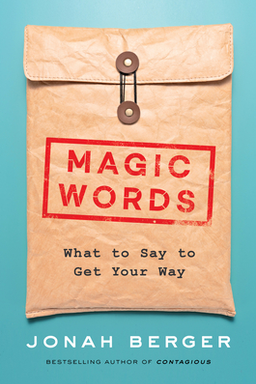
Magic Words cover

Magic Words

by Jonah Berger

Magic Words reveals the secret language techniques that can help you achieve your goals, from nailing interviews to resolving conflicts. Learn scientifically proven strategies to use language effectively, transforming your personal and professional interactions with compelling and persuasive communication.

The Hidden Science behind the Power of Words

How can a single word change your life? From a toddler’s first “please” to a politician’s carefully chosen “because,” words carry invisible power that shapes the way others see us, respond to us, and even how we perceive ourselves. In Magic Words, Wharton professor Jonah Berger reveals that language isn’t merely a tool for communication—it’s a form of influence encoded with psychological and social science. The secret isn’t having more things to say, but learning how to say them in exactly the right way.

Berger argues that the difference between effectiveness and failure in persuasion, selling, teaching, or leading often comes down to specific linguistic choices—tiny words that activate deep mechanisms of identity, confidence, emotion, and connection. He contends that words literally create worlds: they trigger identity and agency, transmit confidence, ask the questions that move conversations forward, make ideas tangible through concreteness, and evoke emotional resonance that sustains attention. Just as magic spells in ancient tales had the power to reshape reality, the right language today can persuade customers, motivate teams, strengthen relationships, and even reveal hidden truths about human behavior.

Why Words Matter More Than We Think

Most people speak around 16,000 words a day, yet rarely consider their impact. Berger’s opening story—his young son Jasper discovering that “peas” (his early version of “please”) could make adults act—sets the foundation: language drives action. Through examples like the 1970s “Copy Machine” experiment, where adding the word “because” made strangers 50% more likely to say yes, Berger shows the measurable force of single-word changes. The lesson: words don’t just convey thoughts; they generate behaviors. They spark cooperation, empathy, persuasion, and even shape corporate success through subtle linguistic indicators.

The Six Types of Magic Words

To make this immense power practical, Berger distills the science into six linguistic categories—the six types of magic words that transform communication:

  • Activate Identity and Agency – words that make people act by connecting actions to who they are.
  • Convey Confidence – speech patterns that signal certainty and authority.
  • Ask the Right Questions – questions structured to build rapport, elicit honesty, and foster collaboration.
  • Leverage Concreteness – language that paints vivid pictures instead of vague abstracts to make people feel heard.
  • Employ Emotion – storytelling and emotional engineering that engage listeners deeply and sustain attention.
  • Harness Similarity (and Difference) – how linguistic overlap and divergence shape connection, creativity, and influence.

Berger later adds a seventh lens, shifting from performance to perception—What Language Reveals—showing how analyzing words uncovers truths about writers, societies, and implicit biases.

Why This Matters in Everyday Life

Whether you’re pitching an idea, calming a nervous friend, or leading a team meeting, every sentence reveals more than you realize. The right phrasing can move people from passive to active (“Can you help?” vs. “Can you be a helper?”), or transform reluctance into empowerment (“I can’t eat cake” vs. “I don’t eat cake”). Leaders who eliminate hedges (“I think,” “maybe”), shift verb tenses to the present (“is great” instead of “was”), and use concreteness (“gray T-shirt” rather than “top”) appear more confident and trustworthy. And emotional language—balanced between highs and lows—keeps audiences captivated, from Guy Raz’s podcast storytelling to movie scripts that ride emotional roller coasters.

Language as a Social Mirror

Yet Berger isn’t just teaching rhetoric; he’s decoding how words mirror thought and culture. In later chapters, big data and natural language processing reveal how linguistic patterns predict voting behavior, financial trustworthiness, and social bias. Language, he argues, leaves fingerprints of identity—our age, personality, political leanings, and even unconscious prejudice show through the words we choose.

The Promise of Intentional Speech

Instead of treating great communicators as born with a “way with words,” Berger reframes skillful communication as learnable science. Through small, evidence-backed shifts, you can create outsized impact: motivate behavior, deepen relationships, and reveal truth. His message is democratic—whether you’re a writer or speaker, the power of words is available to anyone willing to wield it with precision and care. Ultimately, Berger’s book teaches that language isn’t magic because it’s mystical; it’s magic because it transforms intentions into actions at scale. By mastering these six linguistic sciences, you become not just a better communicator—but a more influential human being.


Activate Identity and Agency

Berger opens his framework with the most fundamental spell: connecting language to identity. He demonstrates how subtle word choices—turning verbs into nouns, swapping “can’t” for “don’t,” or framing refusals with empowerment—activate people’s sense of self and agency. Once an action becomes part of who you are, you’re far more likely to perform or avoid it.

Turning Actions into Identities

At Stanford’s Bing Nursery School, researchers found that when children were asked to “be a helper” instead of simply “help,” their willingness to tidy toys jumped by nearly a third. Why? Because “helper” implies belonging—a positive identity rather than a temporary action. This linguistic alchemy scales beyond preschool. In elections, asking people to “be a voter” lifted turnout by 15%. Framing ethical behavior as self-definition (“don’t be a cheater”) halved dishonesty compared to the command “don’t cheat.” Across contexts, nouns signal permanence; verbs imply fleeting choice. As Berger puts it, we act to confirm who we believe we are.

Changing “Can’t” to “Don’t”

The word “can’t” suggests external restriction—something is preventing you. “Don’t,” by contrast, signals autonomy and preference. When dieting participants replaced “I can’t eat chocolate cake” with “I don’t eat chocolate cake,” their self-control doubled. The shift from constraint to choice empowered them to resist temptation. This distinction applies to any goal: “I don’t check my email late at night” asserts ownership, whereas “I can’t” implies weakness. You can use “can’t” strategically to decline requests when an external reason helps soften refusal—but when your aim is to strengthen resolve, “don’t” wins.

Replace “Should” with “Could”

To spark creativity, Berger encourages reframing decisions from moral obligation (“what should I do?”) to possibility (“what could I do?”). Harvard researchers found that the simple word “could” tripled the originality of moral problem solving because it triggered divergent thinking and imagination. In creativity terms, “should” narrows options and reinforces judgment; “could” frees ideation. Try asking colleagues “What could we build next quarter?” instead of “What should we build?”—the former invites fresh insight.

Talk to Yourself (the Right Way)

Before a high-stakes presentation or stressful moment, Berger recommends using distant self-talk—addressing yourself by name (“Jane, you’ve done this before”)—to reduce anxiety and boost performance. University of Michigan experiments showed that speakers talking to themselves in third person performed better and felt calmer than those using “I.” This outsider perspective unlocks objectivity, allowing you to coach yourself like a friend would.

Picking Your Pronouns

Pronouns reveal agency and blame. Using “you” can personalize communication on social media, increasing engagement by making readers feel addressed. But in customer support contexts, “you” may imply fault (“you can’t get the printer to work”). Knowing when to drop the pronoun or shift from “you” to neutral phrasing prevents conflict and boosts perceived empathy. Likewise, using “I” clarifies personal opinions and takes responsibility, while removing it can make statements feel objective. Practiced intentionally, pronoun choice shapes control and harmony in daily interactions.

Language that activates identity and agency doesn’t just describe reality—it rewrites how people see themselves within it. If you want to inspire action, empower choice, and build confidence, stop telling people what to do. Show them who they can be.


Convey Confidence

Confidence isn’t only internal—it’s linguistic. Berger’s second category decodes how speech patterns signal certainty, authority, and credibility. Drawing on courtroom studies, presidential speeches, and real-world communications audits, he proves that phrases expressing conviction can be just as persuasive as facts.

Lose the Hedges

Hedges like “maybe,” “I think,” or “it seems” soften statements but erode faith in the speaker. When advisers expressed certainty (“definitely,” “clearly”), people perceived them as wiser—even if they were equally wrong. Using these definite phrases projects competence. It’s why Donald Trump’s blunt “believe me” style, despite flaws, feels persuasive; certainty signals leadership. Berger’s lab research confirms that removing hedges increases compliance and trust.

Cut the Hesitations

Filler words—“um,” “uh,” “you know”—crush authority. In one case study, a sales executive improved conversion rates by 30% after eliminating these verbal tics from presentations. Pauses, Berger notes, are more powerful than fillers: they give space without diluting confidence. Practice replacing hesitation with deliberate silence; audiences interpret pauses as poise, not panic.

Turn Pasts into Presents

Our verb tense reveals conviction. Saying “This restaurant has great food” sounds current and enduring, while “had great food” feels temporary and subjective. Across Amazon reviews and business communications, present tense boosted engagement and persuasion by implying timeless truth. In leadership terms, present-tense language positions you as a source of ongoing credibility, not merely relaying past opinion.

Know When to Express Doubt

Ironically, Berger finds that showing uncertainty can strengthen credibility in polarized conversations. When people admitted partial doubt about a controversial issue, their listeners became more open-minded. Expressing willingness to learn softens resistance—essential for emotionally charged debates or scientific communication (similar to Adam Grant’s arguments in Think Again about intellectual humility). Doubt, when strategic, builds trust and reduces defensiveness.

Berger’s confidence equation:

Certainty signals expertise → Brevity signals power → Occasional doubt signals authenticity.

When words consistently balance conviction with humility, credibility becomes contagious. Speaking with power isn’t about dominating others—it’s about guiding them to trust that your clarity is earned.


Ask the Right Questions

Questions, Berger explains, are the conversational equivalent of catalysts—they can unlock connection, information, and influence if asked skillfully. Rather than fearing questions as signs of weakness, he reframes them as tools for intelligence and empathy.

The Science of Asking for Advice

Contrary to popular belief, asking for advice makes you appear smarter, not dumber. A Wharton-Harvard study found that people who sought advice after tackling brain teasers were seen as more competent because the request flattered the giver’s intelligence. In professional life, “What’s your view on this approach?” invites cooperation while boosting your perceived skill.

Follow Up to Show You Care

From speed dating to client meetings, follow-up questions create bonds. When you respond to “I love hiking” with “Where do you like to go?” instead of changing topics, you signal genuine attentiveness. Follow-up questions tripled the likelihood of second dates in studies, showing that responsiveness beats charm. Ask, listen, then build on what you hear.

Deflect Difficult Questions

In sensitive moments—salary negotiations, interviews, or sales settings—direct honesty can hurt, and refusal can offend. Berger suggests deflection: respond with a relevant question. If asked “What was your last salary?”, redirect with “Could you share the range for this role?” This strategy reframes the power dynamic, signaling engagement rather than evasion. Negotiation experiments showed that deflectors achieved better outcomes and were rated more likable than refusals or lies.

Avoid (Positive) Assumptions

When eliciting truth, phrasing matters. Asking “The iPod doesn’t have any problems, does it?” led sellers to hide defects. Asking “What problems does it have?” doubled truthfulness. Negative-assumption questions imply awareness, discouraging deception. Want candid feedback or honest data? Start from the possibility that issues exist; people feel safer admitting them.

Start Safe, Then Build

The Fast Friends method by Arthur and Elaine Aron illustrates how escalating questions foster closeness. Begin with easy ones (“Who would you want as a dinner guest?”), then deepen (“What would you most regret not telling someone if you died tonight?”). Over thirty-six questions, strangers became emotionally connected within forty-five minutes. Progressive vulnerability builds trust in any context—from team bonding to romantic connection.

In short, asking better questions transforms interactions. Whether listening, negotiating, or trying to connect, curiosity isn’t weakness; it’s strategic empathy—an act of attention that creates influence.


Leverage Concreteness

Abstract language hides meaning; concrete words reveal it. Berger’s fourth principle shows how specificity makes communication feel real, increasing clarity, trust, and even sales. From airlines to start-ups, concrete phrasing translates intentions into understanding.

Show That You’re Listening

When Berger studied hundreds of customer service calls, the most satisfied customers weren’t those who simply got solutions—they were those who felt heard. Agents who said “I’ll look for that gray T-shirt” instead of “I’ll look for that” boosted satisfaction and post-sale spending by 30%. Concrete language signals attention and empathy. It proves you understood specifics rather than performing politeness.

The Curse of Knowledge

Experts often overestimate understanding, using jargon invisible to outsiders. This “curse of knowledge” leads leaders, teachers, and entrepreneurs to speak abstractly, losing audiences. The antidote: anchor ideas in tangible imagery. Replace “digital transformation” with “letting customers shop online as well as in-store.” Vivid, sensory detail reduces confusion and increases persuasion.

When Abstract Is Better

Sometimes, though, abstraction wins. In venture capital, start-up pitches using visionary language (“a global solution for transportation access”) attracted more funding than literal descriptions (“an app to hail taxis”). Abstract phrasing signals scale, leadership, and long-term potential. Use concreteness for clarity; use abstraction when projecting future vision. Focus on how to make something happen for concreteness, and why it matters for abstraction.

Berger’s rule of balance:

Be concrete when building understanding; be abstract when inspiring belief.

Concreteness lets people see your words with their minds’ eyes. Whether in teaching, selling, or customer care, people don’t just want to be told—they want to be shown. Specific language proves listening, builds clarity, and turns thought into trust.


Employ Emotion

Stories move people not through data, but through emotion. Berger’s fifth linguistic magic proves that emotional language shapes attention, enjoyment, and persuasion across everything—from podcasting to storytelling, marketing, and relationships.

The Beauty of Imperfection

The “pratfall effect” shows that competent people who admit flaws become more likable. Guy Raz’s interviews shine because he asks entrepreneurs not only about triumphs but mistakes—like the failures of Famous Dave’s founder. Admitting vulnerability humanizes success and builds empathy. In interviews or leadership, authenticity fuels connection.

Build a Roller Coaster

Kurt Vonnegut once said good stories have graphable shapes: ups and downs, tension and release. Berger’s analysis of thousands of films confirms that emotional fluctuation—moving between highs and lows—creates engagement. Movies like Star Wars and Cinderella succeed because emotions oscillate; smooth positivity bores audiences. The thrill comes from contrast.

Mix Up Moments

Volatility—the alternation of emotion—keeps experiences fresh. Just as commercials interrupt adaptation during TV shows, moments of setback make joy more potent. Berger shows that uncertain ups and downs make stories and communication stickier, capturing attention even in everyday presentations.

Match Emotion to Context

Emotion helps or hurts depending on context. In hedonic domains (movies, music, vacations), emotional words like “amazing” and “beautiful” drive persuasion. In utilitarian contexts (software, job applications), cooler adjectives like “flawless” or “efficient” work better. People buy pleasure with feeling; they buy functionality with proof.

Activate Uncertainty

To hold attention, don’t just evoke emotion—evoke uncertain emotion. Anxiety, curiosity, surprise pull people forward, while certainty ends curiosity. Readers are 30% more likely to finish articles that provoke suspense. Berger’s conclusion: interest lives in the unresolved. When people wonder what happens next, they stay tuned.

Emotion is persuasion’s engine; authenticity and volatility are its fuel. Whether you’re pitching, writing, or storytelling, dare to feel—and to let others feel with you.


Harness Similarity and Difference

The sixth category transcends individual words, exploring how linguistic similarity and variation shape connection and success. Berger’s analysis—from beer enthusiasts to boardrooms to Billboard charts—reveals that being alike helps you belong, but being different helps you stand out.

Signal Similarity

In organizations, language synchrony predicts promotions. Studies of 10 million emails found employees linguistically aligned with peers were three times more likely to be promoted and four times less likely to be fired. Matching colleagues’ verbal rhythm signals cultural fit. Similarity builds trust, rapport, and shared identity—powerful currency in professional success.

Drive Difference

But creativity thrives on divergence. Analyzing song lyrics, Berger and Grant Packard found that atypical tracks—those mixing genres or themes—were more likely to hit charts. Lil Nas X’s “Old Town Road,” a country-rap blend, dominated because it was unlike anything else. Difference excites curiosity, sparks novelty, and makes experiences memorable. In conformist cultures, innovation begins through linguistic nonconformity.

Plot the Right Progression

Speed and pattern matter in storytelling and communication. Fast-moving plots—books and films that quickly traverse diverse ideas—engage audiences, while over-complexity can confuse informational pieces. Start slow to establish clarity, then accelerate to maintain interest. Berger’s research confirms that successful narratives blend familiarity first, novelty later—a rhythm echoing effective persuasion itself.

Ultimately, similarity builds bridges; difference builds monuments. The balance between fitting in and standing out defines how ideas spread and how voices shine.


What Language Reveals

In his final chapters, Berger shifts focus from influence to insight—how language reveals personality, behavior, and society itself. Words, he shows, are forensic clues capable of predicting authorship, honesty, even future actions.

Language as Fingerprint

The centuries-old mystery of Shakespeare’s lost play Double Falsehood was solved not by reading, but by computational linguistics. Algorithms compared pronouns, prepositions, and emotional words across playwrights’ works, identifying Shakespeare’s and Fletcher’s signature styles. Berger celebrates this as proof that words encode personality—a linguistic DNA unique to every writer.

Predicting Behavior

Language even forecasts financial reliability. In peer-to-peer lending platforms, borrowers who wrote “I’m hardworking” and invoked “God” were eight times more likely to default than those who used analytical phrasing like “interest” or “payment.” Text alone predicted repayment almost as well as credit scores. The message: even when we try to persuade, our unconscious truth leaks through the words we choose.

Revealing Bias in Society

Analyzing 250,000 song lyrics over fifty years, Berger’s collaborators found hidden sexism: women described more by warmth (“beautiful,” “sweet”) and men by competence (“strong,” “smart”). Biases persist across children’s books, media, and even police speech. Body-camera analysis revealed that officers used less respectful, more informal language toward Black motorists—subtle linguistic discrimination undermining trust. Language unveils prejudice as precisely as data uncovers trend.

Words as Windows to the Mind

In Berger’s framework, understanding language means decoding humanity. The same principles that empower persuasion also expose truth. Our syntax—what we emphasize, omit, or hedge—reflects thought patterns, moral values, and emotional states. By listening closely, we don’t just become more effective communicators; we become more insightful citizens of the world.

In its closing reflection, Magic Words returns from analysis to empathy: words are not merely instruments of power—they’re instruments of understanding. When you master their magic, you gain not dominance but depth, reading both yourself and others through the language of life.

Dig Deeper

Get personalized prompts to apply these lessons to your life and deepen your understanding.

Go Deeper

Get the Full Experience

Download Insight Books for AI-powered reflections, quizzes, and more.