
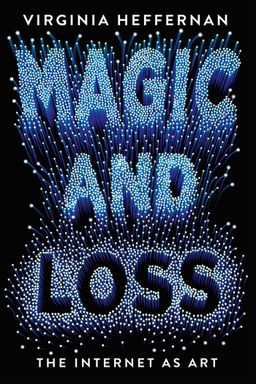
Magic and Loss cover

Magic and Loss

by Virginia Heffernan

Magic and Loss delves into the internet''s dual role as an enchanting force and a source of social challenges. Explore how it reshapes art, communication, and culture while addressing the trade-offs of living in a hyper-connected world.

The Internet as Human Civilization’s Masterpiece

Have you ever felt torn between the enchantment of digital life and the nostalgia for what came before? In Magic and Loss, Virginia Heffernan argues that the Internet is not just a technological innovation or a business platform—it’s humanity’s greatest artistic creation. She contends that the Web should be approached not as a utility or a marketplace but as a new aesthetic universe, a collective masterpiece comparable to the pyramids, the symphony, and the novel.

Heffernan’s central claim is striking: the Internet is a vast, collaborative work of realist art—a form that both seduces us with magic and wounds us with loss. As our daily life becomes increasingly pixelated, she urges us to read the digital world the way we read literature or music: as an aesthetic experience laden with cultural values, beauty, and emotion.

Magic and Loss: The Dual Nature of the Digital Age

From the opening pages, Heffernan frames the Internet as a paradox. It delivers "magic"—the frictionless abstraction of our physical world into pure ideas—and, equally, "loss"—the disappearance of tactile, embodied experiences like letters, vinyl records, and face-to-face conversation. She compares opening an iPad or posting on Instagram to ancient rituals of communion with invisible forces. At the same time, she mourns the quiet extinction of analog pleasures—the smell of books, the deliberateness of handwriting, even the silence of being offline.

These two forces, the ecstatic and the elegiac, shape the book’s emotional rhythm. The Internet, she insists, feels both transcendent and hollow. We have built a civilization of code that rivals the Sistine Chapel—and yet yearn for a lost world of matter and slowness.

From Technology to Art

Heffernan invites readers to reinterpret the Internet as a cultural artifact, not just a network or a business system. She compares its emergence to other historical revolutions in art: just as theater, poetry, and cinema transformed ways of seeing, the Web has altered how we create and experience meaning. Its basic elements—design, text, photography, video, and music—comprise a new aesthetic canon. In this digital realm, every tweet is a haiku, every Instagram a miniature painting, every YouTube clip an experimental film.

Instead of lamenting the coarseness of online culture, she asks us to see its originality: the vernacular beauty of memes, the lyricism of hashtags, the poignancy of status updates. For Heffernan, the democratization of art through digital participation transforms criticism itself. Anyone posting online contributes to an evolving performance of identity and imagination—what she calls a global MMORPG (massively multiplayer online role-playing game) of culture.

The Personal and the Historical

Heffernan’s preface begins with a moment of revelation: a 2006 YouTube video of the guitarist Funtwo performing an electrifying rendition of Pachelbel’s Canon. Watching this amateur video, she realizes she’s witnessing something monumental—the birth of a new mode of art. It’s homemade, viral, participatory, and radiant in its imperfections. This scene becomes her emblem of digital culture’s allure: the mix of artistry and intimacy, the shift from polished spectacle to shared creation.

Her own life story intertwines with the rise of the Web. Once anchored in books and graduate seminars, she gradually abandons magazines and print for viral videos and forum debates. The revelation is not merely behavioral but philosophical. The Internet doesn’t just change how we consume—it redefines what knowledge, fame, and ethics mean. Its language of speed and interactivity replaces the moral debates and close reading of the twentieth century. Between analog and digital, she insists, lies not a difference in degree but in kind.

Why It Matters

Heffernan’s re-enchantment of the Internet comes with urgency. If we fail to see digital life as culture, not code, we risk misunderstanding the civilization we inhabit. Artists and critics must read the Web’s sprawling archives the way Sontag read photography or Kael read cinema: as an aesthetic of speed, connectivity, and collective imagination. Each meme, each Tumblr feed, each podcast is a brushstroke in this vast portrait of humanity’s longing for transcendence through technology.

“The Internet,” writes Heffernan, “is our masterpiece—the great work of human civilization, challenging the novel, the highway, and the printing press.”

Ultimately, Magic and Loss invites you to stand in awe of the strange beauty of digital life without denying its ghosts. It says: the spiritual and aesthetic project of our time is understanding this dual reality. The glow of screens is our cathedral light; the silence behind them, our mourning hymn.


Design and the Soul of Digital Space

Digital design, Heffernan explains, is far more than visual decoration—it’s the architecture of our mental world. Her opening chapter explores how the aesthetics of app design and the chaotic sprawl of the Web shape the way you think, feel, and move. She contrasts sleek, intuitive apps like Hundreds and Monument Valley with the noisy disorder of the commercial Web, describing this divide as the difference between elegance and sprawl.

Chaos vs. Clarity

Cruising through YouTube and Amazon, Heffernan feels like modernism never happened. Ads roar across the page, colors clash, and attention shatters. The Web, she writes, “is late-stage Atlantic City.” This disorder isn’t accidental; it’s systemic. Commercial sites are built to distract and provoke, to keep you clicking. Every flashing video or “Buy Now” button is part of an interactive economy where your attention becomes currency. “You think you’re reading,” she observes, “but in fact you’re being read.”

She likens the experience to living in a crowded city—hucksters shouting from every corner—whereas apps provide refuge: calm, curated spaces of elegant minimalist design. The rise of app culture becomes a kind of digital white flight from the noisy metropolis of the Web into suburban enclaves of curated simplicity like Apple’s App Store.

Symbols Over Words

Heffernan traces the history of design back to the origins of computer iconography—from the phosphor-green screens of her childhood to the smiley icon of the early Macintosh. These symbols, replacing dense manuals and text-based programming, made computers visually intuitive. In doing so, they also transformed human cognition. Coders, many dyslexic or visually oriented, preferred symbolic, pictographic languages to text-heavy command lines (as Cathy N. Davidson later explained in Now You See It). “Icons are miracles,” designer Jon Hicks said—they compress language, transcend translation, and express information faster than writing ever could.

From this shift emerges a universal pictorial literacy—the emoji, the app icon, the hyperlink arrow. Reading online becomes less about deciphering sentences than navigating a symbolic maze. In this world, literacy is reclaimed as design literacy, and the written word loses primacy to the visual cue.

The Moral Dimension of Design

Design, she argues, is ethical. Ugly design manipulates and confuses; beautiful design clarifies and uplifts. The corporate pursuit of user “engagement” often corrupts this principle, rewarding addiction over comprehension. Against that, Heffernan celebrates game designers who respect the user’s subconscious flow—apps that teach patience, rhythm, and spatial harmony. In Hundreds, holding a red circle until it totals 100 becomes a meditation on concentration and restraint, a parable of mindfulness amid the chaos of notifications.

“Digital design,” Heffernan writes, “doesn’t just map mental space—it caresses the subconscious.”

Through design, the Internet teaches us new moral and aesthetic habits—speed balanced by stillness, attention modulated by distraction. When you next open your phone, Heffernan suggests, you aren’t just browsing. You’re inhabiting a philosophy rendered in pixels.


The Language Revolution: Text and Hyperlexia

In one of the book’s most fascinating arguments, Heffernan calls digital life a “civilization of text.” We are hyperlexic, she says—reading without end, devouring more words than any generation in history. But this flood of symbols also changes the nature of reading itself. What once meant contemplation now means speed and saturation. Our obsession with reading—the constant scanning of emails, posts, and tweets—is both a triumph of literacy and a form of addiction.

From Books to Screens

Heffernan describes how her life shifted from consuming novels to reading digital text at breakneck speed. The Kindle gave her refuge—slower, more solitary—but she noticed that even it couldn’t remain untouched by the hyperlexic impulse. Reading on the Web, she says, feels like “drinking from a fire hose,” echoing Grateful Dead lyricist John Perry Barlow’s metaphor from the early days of cyberspace. Information gushes beyond comprehension. We read not to understand but simply to keep up.

Paradoxically, this explosion of textual engagement comes with a collective sense of inadequacy. The more we read, the more we feel uneducated. “We have,” she writes, “come up with an impossible task for ourselves: to match Google’s omniscience.”

Poetry and Twitter

If you think Twitter killed poetry, Heffernan insists you’re wrong. It revived it. Tweets, with their 140-character constraint, are modern epigrams—aphoristic, musical, occasionally profound. She places them in a lineage reaching back to Pascal’s Pensées and Confucius’s maxims. “A tweet,” she says, “is as short as a sigh, and just as human.”

Digital brevity, instead of signaling decline, becomes a new literary form. Online, language mutates into slogans, hashtags, and abbreviations that compress meaning with wit and velocity. Reading becomes lurking—observing conversation as information flow rather than discourse.

Mindfulness Amid the Flood

Against this torrent, Heffernan explores tools like Spritz, a speed-reading app that flashes words one at a time. While critics dismissed it as “snake oil,” she saw in it both magic and menace. Speed intensifies pleasure but erases white space—the pauses that make language sacred. “Speed-reading,” she writes, “denies the idea of the page. It denies the notion of rest.” The digital age, then, is not an end to reading but a reinvention, redefining literacy as the ability to surf rather than sink.

“We’re never not reading,” Heffernan warns. “Hyperlexia—the plague of our time—is both enlightenment and obsession.”

In a culture that never stops consuming words, Heffernan invites you to pause, to rediscover solitude in the act of reading—and to see each line of digital text as an echo of ancient poetry now written in code.


Visual Language and Digital Photography

Heffernan turns next to the rise of visual literacy—the shift from written language to images. The death of the BlackBerry and the reign of the iPhone mark, she says, a cultural turning point: from words to pictures. Modern civilization, she argues, “communicates mostly in images, graphics, and video.” Like Renaissance painters confronting the printing press, we’re learning to see anew.

From Symbol to Image

The iPhone’s camera becomes, in Heffernan’s hands, both an aesthetic and philosophical instrument. Apple engineers bragged that it was “the most popular camera in the world,” a claim that captured the new ethos of self-documentation. Photography, once the domain of professionals, now expresses everyday theology—the belief that experience finds meaning only when captured and shared. High dynamic range, halo lighting, and filters don’t reproduce reality; they sanctify it.

Heffernan calls this phenomenon “animistic photography.” The world glows. Objects radiate spirit. She traces this aesthetic through apps like Instagram and predecessors like Flickr, which pioneered the hyperreal, filtered image. Icelandic photographer Rebekka Guðleifsdóttir and the artist Merkley exemplify how digital manipulation turned photography into dreamscape art, replacing documentary realism with emotional surrealism.

The Family as Multimedia Project

Digital photography, she notes, transformed family life itself. Children now grow up as image subjects; their existence is validated through snapshots, albums, and Instagram posts. A newborn’s first photo circulates online before leaving the hospital. “Where farmers bred for field hands,” she writes, “we breed to produce digital photos.” Parenting becomes production, a ritual of visual creation that expresses both love and consumption.

Reality to Hyperreality

Heffernan’s analysis mirrors Baudrillard’s concept of hyperreality: photography no longer imitates reality—it supplants it. Our filters and edits simulate memory itself, turning daily life into cinematic illusion. “Life,” Instagram whispers, “is beautiful, and it goes by fast.” For Heffernan, visuality becomes the language of compassion—learning to look at the world with aesthetic appreciation rather than cynicism.

“Now that stylized images have become the answer to ‘How are you?’ we can avoid the ruts of linguistic expression in favor of a forgiving, playful style of looking.”

In her hands, a selfie is not narcissism—it’s modern portraiture. To learn this visual language, Heffernan argues, is to learn empathy in a world that now communicates through light.


Video as Universal Language

Heffernan calls online video “the universal language of the twenty-first century.” Tracing its genealogy from the first YouTube upload—Jawed Karim’s Me at the Zoo—she argues that video defines our digital realism. It doesn’t just record history; it becomes history. Like prose and photography before it, video combines evidence with emotion, building an art form that captures human life in motion and myth.

The Birth of YouTube

YouTube’s founders—Karim, Chen, and Hurley—reimagined media as exchange, not broadcast. The first amateur clip changed everything by replacing polished spectacle with participation. To Heffernan, Me at the Zoo is the Internet’s equivalent of cave painting: trivial, poetic, and epoch-defining. Every comment, remix, and parody that followed turned the viewer into a maker.

Video, she emphasizes, democratized representation. “YouTube wasn’t entertainment. It was civilization.” The platform’s communal frenzy echoes ancient trading pits and agorae—places where stories constitute currency.

Art and Amateurism

The magic of YouTube lies in its imperfections. Homemade videos, messy and tender, have aesthetic power precisely because they break artistic hierarchy. The Funtwo guitar video, Beyoncé’s raw music clips, and viral documentaries like Manhattan Bridge Piers all reflect a new cosmic honesty: art without polish, truth without pretense. This amateurism, Heffernan argues, resurrects sincerity as beauty.

The Ethics of Attention

Video also carries moral weight. The viral footage of Neda Agha-Soltan’s death during Iranian protests epitomizes digital martyrdom—a global witnessing made possible by the camera phone. Yet Heffernan notes the eerie ephemerality of online empathy: once the hashtag fades, collective memory vanishes. Digital vision both enlightens and numbs. “We are eyewitnesses,” she writes, “and it’s over.”

“Online video,” she concludes, “is the first art form to make the world visible and invisible at once—real and unreal in the same frame.”

Video, then, is not just storytelling; it’s sacrament. Each upload replays our collective ache for meaning—our refusal, even now, to look away.


Digital Music and the Echo of Humanity

Heffernan’s chapter on music captures the emotional core of Magic and Loss. She examines how the MP3, the iPod, and streaming transformed not only listening but feeling. Digital music, she argues, embodies the Internet’s dual nature perfectly—it is pure magic, converting sound into light, and pure loss, stripping away texture, imperfection, and presence.

Magic: The Birth of the iPod

When Steve Jobs released the iPod, he turned listening into transcendence. He imagined music as a spiritual technology—a way to commune with beauty through perfect compression. “It will bring a little joy,” he said after 9/11, offering sonic solace to a troubled world. Yet Heffernan notes that digital music’s sleek perfection betrayed its metaphysical absence. “It wasn’t music,” she writes, “it was the painting of music—a Zeuxis illusion.”

Loss: The Missing Body

MP3s, praised for fidelity, are fundamentally lossy—they discard subtle vibrations and echoes, the human imperfections that make sound alive. Listening becomes spectral, disembodied. The body vanishes; the soul flickers. “We peck at painted grapes,” she says, recalling Pliny’s tale of illusion over reality. The earbuds seal us in isolation, offering comfort but silencing communal listening. Intimacy moves from concert halls to private headspace.

Analog Nostalgia and Digital Redemption

Still, Heffernan finds grace in technology’s evolution. Live music, vinyl, and analog telephony return as antidotes to the sterility of digitization. In the tactile inconsistencies of a record’s hiss or a friend’s phone voice, she hears resurrection—the note of mortality that digital perfection tries to erase. Quoting Proust, she reminds us: “Music offsets death.”

“Digitization makes sound eternal,” she writes, “but immortality without decay is silence.”

Through music, the Internet shows its essence: the longing to preserve what’s mortal. Magic transforms; loss humanizes. The digital symphony is, at heart, an elegy for our own voices still ringing in the static.


Faith, Technology, and the Cloud Beyond Death

In her closing meditation, Heffernan weaves theology and technology into one luminous thread. When she spilled water on her laptop, she realized nothing was truly gone—her data lived on in the Cloud. This moment crystallized her insight: the Internet now embodies humanity’s ancient obsession with immortality. Like heaven, the digital ether promises that consciousness can outlive the body.

The Digital Afterlife

Heffernan connects Google’s Calico project—an attempt to “hack death”—to William James’s concept of the “mother-sea” of consciousness. The Cloud becomes our modern divine substrate, absorbing every image, thought, and voice into eternal preservation. “Consciousness survives bodily death,” she writes; not metaphysically, but through servers and light.

Faith Without Dogma

Drawing on her devout yet curious past—from Methodist childhood to Episcopalian and Jewish adulthood—Heffernan finds comfort not in doctrine but pragmatism. Following philosophers like Wittgenstein and Rorty, she embraces belief as a useful form of grace: “It’s a gift if you can do it.” Technology, she suggests, gives us that grace by showing the miraculous in ordinary function—the way Wi-Fi connects us, or how code preserves memory.

Amazing Grace in Pixels

Her encounter with physicist Frank Wilczek on Twitter bridges science and faith. Citing Niels Bohr’s horseshoe motto—“They say it works even if you don’t believe in it”—Heffernan finds spiritual truth in digital pragmatism. The Internet doesn’t require your belief to work; its miracles persist regardless. Like gospel music echoing through YouTube, it fuses technology and transcendence.

“Magic and loss,” she concludes, “have always coexisted in aesthetic experience. Maybe they are aesthetic experience.”

In her final vision, the Internet becomes both cathedral and mausoleum—a space where humanity preserves its fleeting light. Every tweet, photo, or song is a prayer against oblivion. It works, even if you don’t believe in it.

Dig Deeper

Get personalized prompts to apply these lessons to your life and deepen your understanding.

Go Deeper

Get the Full Experience

Download Insight Books for AI-powered reflections, quizzes, and more.