
Idea 1
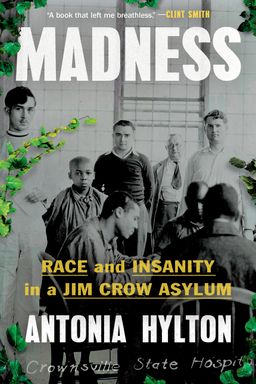
Madness, Race, and the Crownsville System
How do you tell the truth about a place built to help and to harm? In Madness, Antonia Hylton argues that Crownsville—the Maryland Hospital for the Negro Insane—was never a neutral medical site. It was a racially engineered solution to social anxieties about Black freedom that fused psychiatry with segregation, labor extraction, and carceral control. Hylton contends that to understand Crownsville’s history—and the afterlives of that history in today’s mental-health and criminal-legal systems—you must see how race shaped every layer of institutional life: who was admitted, how they were treated, what work they did, how they were remembered, and why the record of their lives often disappeared.
In these pages, you trace a century-long arc. You start with a Jim Crow origin story: a state builds an asylum for Black Marylanders on cheap, rural land and then uses the people inside to construct and maintain the campus. You move through midcentury, when therapeutic language justifies coercive treatments, and “industrial therapy” becomes a euphemism for unpaid labor. You see racial terror and legal power collide with psychiatry—lynching on the Eastern Shore, judges committing civil-rights protesters to Crownsville—and recognize a broader ecosystem of control.
What you learn about institutions
You learn that buildings and budgets tell a story. Crownsville prioritized beds and farms over therapy rooms and training, with appalling crowding and few clinicians. Public outcry (like Howard Norton’s 1949 “Maryland’s Shame”) prompted investments that added more beds rather than more care. Underfunding wasn’t an accident; it was policy. Leaders like Kenneth B. Jones bluntly asked why Crownsville’s per-patient spending lagged white hospitals by half. The answer was segregation’s arithmetic: separate meant lesser.
You also meet people who complicate the narrative. Superintendents such as Jacob Morgenstern pushed desegregation and hired Black professionals; psychologists like Vernon Sparks created training pipelines. Black nurses and aides—Gertrude Belt, Faye Belt, Delores Hawkins—built humane spaces inside an inhumane design. Their daily improvisations, from moving patients out of “the cage” to talking someone down from a roof, are the book’s moral center.
How power shaped treatment
Midcentury psychiatry was both innovative and brutal. At Crownsville, hydrotherapy, insulin comas, Metrazol, electroshock, and lobotomy were practiced under conditions of limited consent. Elsie Lacks—Henrietta Lacks’s daughter—almost certainly underwent pneumoencephalography, a procedure that left scars and suffering, before dying at the hospital in 1955. Staff memories suggest that shock sometimes functioned as discipline, not cure, and Black aides were conscripted as enforcers within a hierarchy they did not control. Research partnerships dangled prestige while masking unequal risk.
Race also shaped diagnosis and detention. During the Civil Rights era, schizophrenia shifted culturally from a diagnosis of withdrawal to one of hostility (as Jonathan Metzl documents). Judges leveraged hospitals for containment, exemplified by the Elkton Three: civil-rights activists Juanita and Wally Nelson and Eroseanna “Rose,” whose sit-in at a Route 40 diner ended in a judge’s commitment order to Crownsville. Superintendent Charles Ward found them sane; the point had already been made—psychiatry could be a tool to police dissent.
Archives, grief, and afterlives
Hylton writes amid archival absence. Patient master cards are sparse; detailed files vanished—destroyed, lost, or contaminated. That silence forces you toward oral history: Janice Hayes-Williams reconstructs cemeteries and identities; volunteers like Sonia King and archivists like Paul Lurz preserve names, autopsies, and photographs; former staff offer ethically complicated testimony. The cemetery itself—numbered graves, unclaimed bodies sent to medical schools—makes erasure tangible and demands ritual repair.
Deinstitutionalization promised better alternatives and delivered far less. Medications and policy reforms shuttered asylums without building robust community care. Crownsville closed in 2004; prisons swelled as hospitals emptied. Conditional release regimes demanded stability many did not have, turning freedom into supervision. The book’s final movement insists that memory is part of justice: Janice’s Say My Name ceremony, county-level preservation, and proposed memorials counter a century of silence.
Core claim
Crownsville shows you how a society medicalizes difference, racializes diagnosis, extracts labor as “therapy,” and then buries the evidence—unless communities insist on remembrance and repair.
The book leaves you with a usable past. If you work in policy, it warns against closing institutions without funding care. If you practice medicine, it reminds you that consent, coercion, and culture are inseparable. If you’re a descendant or neighbor, it invites you to demand names, records, and rituals that dignify the dead. Madness is institutional history braided with intimacy—Pauli Murray’s father William H. Murray, the author’s family encounters with police and psychosis, the soft-spoken heroism of Black staff—that turns abstraction into a call to act. (Note: Read alongside Rebecca Skloot’s The Immortal Life of Henrietta Lacks or Anne E. Parsons’s From Asylum to Prison for complementary perspectives.)