
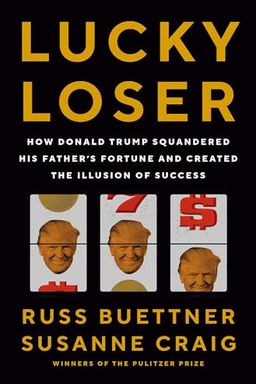
Lucky Loser cover

Lucky Loser

by Russ Buettner And Susanne Craig

The New York Times and Pulitzer Prize-winning reporters detail the fortunes and failures behind Donald Trump’s wealth.

From Subsidy to Spectacle

How can you tell when a fortune rests on operational skill versus on public money, pliant oversight, and media alchemy? In this book, the authors argue that the Trump enterprise—first father, then son—specializes in converting public programs, family wealth, litigation, and television spectacle into private gain. The core claim is simple but unsettling: when you mix generous government policy, weak enforcement, and a publicity-first mindset, you can build the appearance of greatness long before the fundamentals justify it.

You start with Fred C. Trump, who masters New Deal–era housing tools (especially FHA’s Section 608) to scale from small houses to vast apartment complexes. You then watch a father–son transfer: trusts, leases, cozy appraisals, and cash infusions that let Donald act like an independent mogul while family capital absorbs the downside. Next, you learn the son’s playbook: announce, inflate, and litigate—use bold claims, tabloid charisma, and combative lawyers to bend politics and partners. Finally, you see the mask and the reckoning: The Apprentice turns image into a cash machine; overleveraged projects, dubious tax maneuvers, and political conflicts reveal what spectacle hid.

The seed: public programs as private pipelines

Fred Trump’s rise is not a fairy tale of entrepreneurial heroism but a case study in exploiting policy design. Section 608 mortgages, pegged to developer-supplied costs with lax verification, become an ATM. At Shore Haven and Beach Haven, he standardizes construction, squeezes costs, and pockets the spread between FHA-insured mortgages and actual expenses—all under the permissive eye of Clyde L. Powell. Senate Capehart hearings later expose “windfall profits,” yet the fortune is already baked in. (Note: this mirrors patterns David Cay Johnston documents about public subsidies becoming private rents.)

The engine: enabling, trusts, and quiet cash

Fred doesn’t just bequeath money; he builds a runway. Ninety-nine-year ground leases place income in children’s hands; annual gifts maximize thresholds; rent flows to family trusts; and later, vehicles like All County Building Supply and Apartment Management Associates funnel markups to heirs. When Donald needs liquidity, Fred writes checks or, in a pinch, buys $3.35 million in casino chips to plug a bond payment. The message to you: family capital can turn audacity into survivability—at a cost in governance and moral hazard.

The playbook: announce, inflate, litigate

Donald perfects a loop: make a grand claim, force media validation, then treat pushback as proof of your strength. Pseudonyms like “John Baron,” scaffolding banners, and gossip-column placements amplify his aura. When regulators or critics intrude, he escalates—Roy Cohn countersues the Justice Department in a 1973 fair-housing case rather than accept a quiet consent decree, multiplying headlines and attention. In markets, he dabbles in greenmail (Holiday, Bally, United), juicing perception while skirting disclosure lines (a $750,000 Hart-Scott-Rodino settlement follows).

The money: leverage, guarantees, and tax shields

Lines of credit from Chase banker Conrad Stephenson, Bear Stearns margin accounts, and junk bonds at punishing rates (13.75% for the Castle; ~14% for the Taj) fuel rapid expansion. Personal guarantees make Donald the key risk-bearer—except that family and lenders repeatedly cushion blows. Tax returns later show massive losses ($263.7 million in core-business losses in 1990), erasing taxable income even as the persona screams “billionaire.” You see the truth of leverage: it creates flash, then exposes fragility.

The test cases: overreach as habit

The USFL saga compresses “Trump Logic”: assert, psychologize, dismiss. He pushes a fall schedule, sues the NFL, and wins $1—symbolic drama, real-world destruction. Casinos repeat the pattern: dismiss Harrah’s research, finance the Castle with junk, open the Taj with operational gaps, and saddle properties with interest they can’t carry. The West Side rail yards and “Television City” promise world’s-tallest glory, but approvals stall and carrying costs (about $18 million a year) devour cash.

The mask and the reckoning

Mark Burnett’s The Apprentice turns Trump into a meticulously edited archetype of competence. Product integrations yield millions per episode; licensing gushes ($103.2 million from 2004–2010). Trump University and seminar plays monetize the halo—until lawsuits and a $25 million settlement expose thin substance. In Chicago, a “credit tsunami” plea tries to dodge a $40 million guarantee; a $678 million 2008 loss deduction shields taxable income. Politics then multiplies contradictions: the Old Post Office lease proceeds; Mar-a-Lago fees soar; patronage bookings pour in; and conflicts of interest harden into scandal.

Key idea

This is a portrait of an American business model: public subsidy at the base, family wealth as ballast, publicity as multiplier, leverage as accelerant, and lawfare as shield—culminating in a political brand that monetizes attention even as legal and financial exposures mount.

For you, the book is a due-diligence manual in disguise. Ask where capital really comes from; separate headlines from cash flow; map who bears risk; and treat celebrity like volatile collateral. The story warns that when image outruns operations, gravity arrives—often via auditors, bond covenants, and courts.


Fred’s Public-Private Machine

The book opens by showing you how Fred C. Trump transformed federal housing policy into private capital. Understanding his model matters, because it becomes the scaffolding for Donald’s rise: government-insured mortgages, political lubrication, and meticulous cost discipline generate cash flows that later finance trusts, gifts, and quiet rescues.

How Section 608 minted fortunes

After 1934, the FHA normalized long-term mortgages; Section 608 later allowed developers to borrow against self-reported costs on low-interest, government-insured terms. Fred recognized the incentive: if you control the input (costs) and keep oversight at bay, insured debt exceeds true outlay. At Shore Haven and Beach Haven, he industrializes construction—standard floorplans, assembly-line trades, bulk buying—then captures the spread between inflated mortgage proceeds and disciplined costs. Clyde L. Powell’s permissive FHA shop greenlights deals; developers withdraw “excess” funds that should never have existed.

Scale, politics, and weak enforcement

Fred’s genius isn’t architectural flare; it’s operational scale and political navigation. He coordinates entire blocks, keeps wages and materials tight, and cultivates borough patrons like John Cashmore. The 1954 Capehart hearings expose Powell’s gambling and favoritism and call the windfalls “outrageous,” but by then, FHA-backed projects have seeded a durable portfolio. (Note: the pattern—public risk, private gain under weak controls—recurs in later eras of public-private partnerships.)

Trusts, leases, and disguised gifts

Fred converts operating triumphs into intergenerational wealth. He uses 99-year ground leases so his children become landlords on paper while his companies run the buildings. He pipelines rent to each child (about $13,928 annually at the time) and gives $6,000 Christmas checks to hit the gift-tax cap. He later leans on lowball appraisals (Robert Von Ancken) to discount assets for transfers into GRATs, lowering taxable values. When the IRS later audits, the core transfer stands—the children control claims on decades of cash flows.

Cash without calling it cash

The family builds conduits to distribute money offstage. All County Building Supply and Apartment Management Associates sit between vendors and Fred’s properties, adding markups that become income for heirs (including Donald). The markup also shows up in rent-regulated filings, justifying increases to tenants. When Donald needs a patch, Fred improvises: in 1990 he buys $3.35 million of chips at the Castle’s cage and walks out—an infusion masquerading as gaming. In another episode, he writes off a $15 million loan to Donald after Trump Palace falters, reporting a loss while quietly keeping his son afloat.

Enabling Donald and shaping risk

Fred co-signs or guarantees early deals (the Grand Hyatt cash contribution alongside Jay Pritzker, introductions to bankers), assigns friendly appraisers, and uses political contacts to soften threats. He also chooses his heir: Donald gets runway and deference; Freddy and the daughters get less voice. That favoritism institutionalizes a culture where one child’s appetite for spectacle sets the family’s risk profile (compare to best-practice family governance that separates ownership from day-to-day control and creates independent oversight).

Key idea

Fred’s model fuses public subsidy with private extraction, then converts the proceeds into tax-efficient, control-preserving trusts. That mechanism, more than Donald’s swagger, is the family’s true “secret sauce.”

For you, the lesson is twofold. First, interrogate how policy designs—cost-plus subsidies, insured lending—create perverse incentives without strong audits and post-construction clawbacks. Second, in family enterprises, diagnose whether transfers and governance protect the business or simply underwrite a preferred heir’s risks. Fred’s strategy preserved wealth brilliantly; it also created the moral hazard that defined Donald’s career.


Announce, Inflate, Litigate

Donald Trump’s distinctive edge isn’t superior operations; it’s psychological offense. The book maps a repeatable loop—announce, inflate, litigate—that lets him borrow credibility from headlines and convert it into leverage with banks, partners, and politicians. You can treat this as a toolkit: media theater to expand the negotiating set, lawfare to delay or intimidate, and selective disclosures to frame the narrative.

Announcements as leverage

Trump learns that if you say it big, reporters will print it, and counterparties will take calls. He unfurls TRUMP banners over Grand Central scaffolding; he touts 26,000 units at the West Side Yards; he declares multibillion-dollar net worth to Forbes. The effect: fear of missing out among banks and officials, which helps secure incentives (like the Commodore/Grand Hyatt abatement) and partners (Hyatt, the Pritzkers) before the fundamentals lock. (Parenthetical note: this anticipates contemporary “vision-as-collateral” tactics in tech, though without tech’s network effects.)

The media ecosystem as amplifier

Tabloids, society columns, and later cable outlets reward color over spreadsheets. Pseudonyms like “John Baron” seed favorable stories; glossy profiles echo scale claims without documents. The result is a perception of inevitability: a man so famous he must be competent. That perception later underwrites licensing waves, seminar audiences, and political crowds. But this is brittle capital—withdrawn quickly when scandal hits (as NBC, Macy’s, Serta, PVH did in 2015).

Litigation as stage and shield

Rather than defuse conflicts quietly, Trump often escalates. In the 1973 fair-housing suit, Bunny Lindenbaum advises a consent decree; Trump hires Roy Cohn, countersues, and runs press conferences. In business, he sues or threatens to flip the table: antitrust theatrics against the NFL in the USFL case, countersuits in Atlantic City partner fights, and disclosure games in stock plays. Regulators fine him for Hart-Scott-Rodino failures ($750,000) and shareholder-related settlements ($2.25 million with Bally), illustrating the costs of operating at disclosure’s edge.

Greenmail and takeover theater

With Ace Greenberg at Bear Stearns, Trump opens margin accounts and buys sizable stakes in Holiday, Bally, and United, hinting at takeovers. Stocks jump; he exits with short-term gains (he reports $25.4 million of such gains in 1987). Companies strain balance sheets to deter him, and magazines inflate his image as a financial wizard. But these are episodic profits, not operating strength—and they attract legal and reputational scrutiny.

Key idea

Publicity is a form of capital and litigation is a form of bargaining—but both incur hidden liabilities: fact-checking later, regulator attention, and partners who remember.

If you manage deals, borrow the signal, not the substance. Announcements can frame options and attract talent; they cannot replace signed tenants, cash flows, or clean compliance. And use law as a scalpel, not a cudgel; the book shows how theatrics sometimes bought Trump time but also hardened opposition and triggered deeper investigations.


Leverage’s Glittering Trap

The difference between appearing rich and being solvent is usually leverage. The book details how Donald Trump, enabled by family backstops and pliant financiers, stacked loans, junk bonds, and personal guarantees to build quickly—then nearly lost everything when interest and cycles turned. You learn to read balance sheets for the traps: high fixed charges, contingent guarantees, and tax losses that mask cash stress.

The tools that sped the rise

Early projects draw on Fred’s direct cash and guarantees (e.g., the Grand Hyatt’s deal alongside Jay Pritzker) and on bank friends like Chase’s Conrad Stephenson, who extends personal lines. Bear Stearns provides both bond placement and margin-fueled trading platforms. Junk bonds finance the Castle at 13.75% (about $40 million in annual interest) and the Taj near 14%. These rates are rocket fuel on the way up—and napalm when revenues miss.

When the cycle turns

By June 1990, Trump owes about $3.4 billion to banks and bondholders and misses a $73 million interest bill. Lenders impose triage: suspend payments, advance a $65 million lifeline for interest, and cap personal spending at $450,000 a month. He must hire professional finance staff and accept oversight. The optics of opulence meet lenders’ spreadsheets—and the spreadsheets win. Tax transcripts later reveal staggering business losses (negative $68.7 million in 1986; $263.7 million in 1990) that erase taxable income even as the public persona persists.

Chicago: covenants, force majeure, and tax alchemy

The Chicago tower concentrates the dynamics. Fortress lends $130 million at double-digit rates with a rich exit fee (~$49 million); Deutsche finances $640 million for construction and requires a $40 million personal guarantee plus buyer vetting. When 2008 hits and sales stall, Trump invokes a “credit tsunami” as force majeure to dodge repayment, shocking Deutsche and provoking suit. He simultaneously declares the project “worthless” for tax, claiming a $678 million loss in 2008 (and later another $168 million through partnership moves), shielding income from television and endorsements. Years of audit follow.

New lifelines and fragile cash flows

Jared Kushner introduces Rosemary Vrablic at Deutsche’s private-banking arm, which extends a $99 million loan personally guaranteed by Trump. Covenants require minimum net worth ($2.5 billion) and liquidity ($50 million), and annual reporting reveals a dependence on media and licensing income (about $52.2 million in a six-month snapshot). Strip out TV, and core real-estate operations run negative—an inversion of the public myth.

Key idea

Leverage is a timing bet. If your receipts are cyclical or approval-dependent, high fixed interest converts delays into existential threats, and paper losses can hide but not heal cash deficits.

For you, the practice points are blunt. Stress-test debt service at conservative revenues; avoid personal guarantees on speculative assets; and don’t treat tax losses as strategy—they are accounting reflections of economic pain that lenders will price into your next loan. Most of all, separate brand value from cash flow; the book shows how Trump’s name raised money and then needed television to keep the lights on.


Case Studies in Overreach

Ambition scales organizations when married to discipline. Without discipline, it multiplies losses. The book walks you through three arenas—sports, casinos, and mega-development—where Donald Trump’s bravado outpaced market math and coalition-building, producing costly lessons for anyone managing risk.

USFL: provocation without a plan

After buying the New Jersey Generals, Trump pushes the United States Football League to abandon its spring niche and challenge the NFL in fall. He frames TV networks as eager and the NFL as afraid, dismissing McKinsey’s Sharon Patrick and sober owners like John Bassett and Tad Taube. He bankrolls star signings (Gary Barbaro, Brian Sipe, Doug Flutie) and makes himself the league’s face in an antitrust suit argued by Roy Cohn. The jury calls the NFL a monopoly but awards the USFL $1 (trebled to $3)—a symbolic “victory” that arrives too late to save a league bled dry by salaries and legal fees.

Atlantic City: debt over operations

At Trump Plaza, a partnership with Harrah’s offers operational expertise; Trump instead browbeats managers, resists a parking garage, and opens a competing property, the Castle, financed by $351.8 million in 13.75% bonds. The Taj Mahal becomes the apotheosis of overreach: grand openings mask incomplete systems; regulators halt operations over slot-cash reconciliation failures; and analysts like Marvin Roffman warn the property needs over $1 million a day just to service debt—numbers Atlantic City can’t deliver. A 1989 helicopter crash kills top executives Steve Hyde and Mark Etess, exposing a thin bench just when triage is needed.

West Side Yards: vision before permission

On Manhattan’s West Side, Trump escalates others’ plans into “Television City,” with a 150-story tower by Helmut Jahn and dreams of anchoring NBC. Advisors warn about FAA height limits, community blowback, and the diseconomics of ultra-tall cores. Trump banks on spectacle and momentum instead of tenants and approvals, and time becomes a predator: at least $18 million a year in taxes and interest bleed the project while politics and neighbors resist. Ultimately, capital partners like Daewoo and Henry Cheng (New World) step in, supplying cash but taking control—Trump keeps the brand, loses the driver’s seat.

Pattern recognition for you

Across these cases, the sequence is inverted: announce maximal scale, seek fame, and then scramble for financing, tenants, and approvals. Partnerships form as rescue operations, not as planned complements. Debt service turns a slow permitting calendar into a liquidity crisis, and lawsuits substitute for coalition work. The lesson is structural: in regulated, capital-intensive fields, process mastery—zoning, community engagement, stress-tested budgets—beats theater.

Key idea

Publicity can assemble a crowd; it cannot assemble cash flows, systems, or approvals. When those lag, interest compounds the penalty.

If you lead ambitious projects, reverse the sequence. First secure permission and anchor demand, then scale design, then announce. And when partnering, respect the operator’s craft—Harrah’s research and systems were more valuable than a marquee name. The book shows that ignoring such basics makes brand a liability, not an asset.


Turning Image Into Cash

The most profitable business Donald Trump ever built may have been himself—as a TV character. The Apprentice didn’t just burnish a tarnished balance sheet; it produced a licensing and integration engine that out-earned many of his properties while requiring little operational competence. But the book also shows the trap: when your product is your persona, controversy is a revenue risk.

TV alchemy: Burnett’s “dramality”

Producer Mark Burnett builds a cinematic universe inside Trump Tower: a Harvard-library boardroom, a loft, and a three-minute “Meet the Billionaire” reel that recasts years of losses as a brain-powered comeback. The format fuses story with sponsor integration: single-episode arcs for Crest, Domino’s, Burger King—long-form ads disguised as business tests. Integration fees climb to $2–3 million per top episode by season two; Trump gets half of profits and separate appearance fees.

Integration economics and side deals

A single Crest episode drives 4.7 million web hits, validating Burnett’s model. As money swells, frictions grow: Trump demands extra pay for brief promos, pursues personal sponsorships, and occasionally signs side deals (lectures, books) that dodge producers’ splits. Still, ratings and his face keep sponsors on board—proving that reputation can be monetized even when partners grumble.

Licensing spread—and dilution risk

The show unlocks a spree: suits, colognes, bottled water, board games, and dozens of announced real-estate licensing projects (roughly forty never materialize). Because licensing pays upfront for the name, Trump often cashes in whether projects deliver or not—an elegant cash model with hidden decay. Overextension erodes brand meaning (compare to restrained luxury houses that guard scarcity and quality).

Education-as-brand: Trump University and seminars

Riding TV credibility, Trump University and live seminars sell tiers of “insider” instruction. Operators like Mike and Irene Milin deploy high-pressure upsells; instructors such as James Harris and Stephen Gilpin (an Apprentice hopeful) lack elite credentials. Consumers are urged to “max out” cards for elite packages; quality lags marketing; complaints swell. Trump reportedly extracts about $5 million; years later, a $25 million settlement closes class and state suits. ACN and Ideal Health (rebranded Trump Network) pay him millions for endorsements that reps use as social proof—another revenue stream with reputational tail risk.

Fragility revealed

When Trump’s 2015 campaign launch includes inflammatory rhetoric, NBC severs ties and major partners (Macy’s, Serta, PVH, PGA) exit. Licensing income slides from $51 million (2011) to $2.9 million (2018). The same medium that minted cash now magnifies political blowback. In parallel, banks’ internal memos on the Chicago tower show reliance on TV/licensing cash to meet covenants—evidence that the media engine wasn’t just gravy; it was structural.

Key idea

Media can convert reputation into recurring revenue and bargaining power, but it also concentrates risk: one reputational shock can turn off multiple faucets at once.

For you, the playbook is usable—and cautionary. If you license your name, demand quality controls, limit categories to protect meaning, and separate operating profits from endorsement cash. And treat education businesses with reverence for outcomes; shortcuts create liabilities that dwarf near-term checks.


Politics, Conflicts, Aftermath

The book closes by tracing how a media-forged persona becomes political power—and how unresolved business habits create conflict-of-interest whirlpools in public office. You see, in real time, how a brand that feeds on attention also attracts scrutiny, legal judgments, and reputational costs that outlive headlines.

From brand to public office

Before politics, Trump wins the GSA’s Old Post Office lease in Washington, D.C., after outbidding rivals with a $200 million plan (administrator Dan Tangherlini insists on a $50 million upfront requirement to curb execution risk). The deal raises eyebrows given past bankruptcies and the building’s federal status. Once in office, revenue jumps at Trump properties (Mar-a-Lago initiation fees rise; foreign and domestic patrons book rooms)—showing how proximity to power itself monetizes brand. (Note: prior presidents used blind trusts; Trump declines, opting for internal “trusts” he still benefits from.)

The conflict-of-interest problem

Public roles require decisions affecting private partners and tenants. Hotel bookings by lobbyists, events by groups with federal business, and continued debt relationships (e.g., Deutsche Bank) highlight the classic risks that ethics lawyers warn about: the appearance or reality of trading access for patronage. As controversies mount, mainstream corporate partners step back, shrinking licensing income and pushing the enterprise deeper into political identity as customer-acquisition channel.

Media refuges and accountability

A partisan media ecosystem softens blows that once ended careers (the book contrasts Trump’s resilience with Nixon’s media isolation). Supportive outlets frame investigations as persecution; supporters treat adverse judgments as theater. But courts and auditors aren’t ratings-based: civil cases culminate in severe outcomes, including a New York decision imposing nearly half a billion in damages—evidence that spectacle cannot forever outpace ledgers.

Golf and prestige assets as drains

Parallel to politics, the book revisits golf as emblem: Doral (bought for $150 million with a $250 million renovation promise), Doonbeg (bought for $11.9 million, later $38.5 million in support), and Turnberry (purchased for about $63–70 million, later $153 million injected) run persistent losses and depend on food-and-beverage rather than pure golf economics. Local fights in Scotland (protected dunes, Michael Forbes’s farm) illustrate how brand swagger collides with planning regimes and environmental science.

Key idea

Blending celebrity business with public power without hard separations breeds suspicion, invites litigation, and corrodes institutional trust—regardless of partisanship.

For you, the governance checklist is clear: adopt genuine blind trusts, aggressive recusal policies, and transparent disclosures when private holdings intersect public decisions. In business, scrutinize prestige acquisitions for cash-flow realism and environmental constraints; without that, you subsidize status while compounding controversy. The final note the book strikes is civic, not just financial: democracies need shared facts and guardrails so that attention doesn’t become a substitute for accountability.

Dig Deeper

Get personalized prompts to apply these lessons to your life and deepen your understanding.

Go Deeper

Get the Full Experience

Download Insight Books for AI-powered reflections, quizzes, and more.