
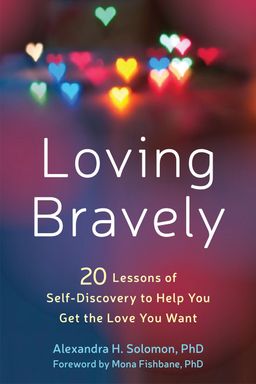
Loving Bravely cover

Loving Bravely

by Alexandra H Solomon

Loving Bravely guides you through self-discovery to find lasting love. By understanding personal needs and challenging societal norms, the book provides practical strategies to build authentic, enduring relationships, transforming how you connect with partners.

Loving Bravely: The Courage to Know Yourself in Love

What if loving someone deeply started with loving yourself first? In Loving Bravely, psychologist and professor Dr. Alexandra H. Solomon argues that the foundation of healthy and lasting love is not a perfect partner, but what she calls relational self-awareness—the ability to understand how your past, beliefs, and patterns shape the way you show up in relationships. Solomon contends that to love bravely is to journey inward, to face the stories, fears, wounds, and hopes that define how you love, and then bring that self-knowledge compassionately into your connection with others.

Drawing from her decades of experience teaching Northwestern University’s acclaimed course “Marriage 101” and counseling couples through The Family Institute, Solomon reframes love as a lifelong classroom, not a fairy tale. She invites readers to approach love as a learning process that demands reflection, accountability, authenticity, and courage. Love, she insists, will “grow your ass up,” forcing you to confront yourself: your attachment patterns, cultural conditioning, gendered scripts, and avoidance of vulnerability. Through twenty practical lessons organized into four parts—Self-Reflection, Self-Awareness, Self-Expression, and Self-Expansion—Solomon guides readers to build emotional maturity step by step.

Love as a Classroom

At the heart of Loving Bravely is the metaphor of love as a classroom. In the same way that safe driving requires practice and instruction, love too requires study, feedback, and emotional training. Solomon argues that most of us spend far more time learning to drive than learning to love. Through her teaching, she’s witnessed how students often enter adulthood with little preparation for relational challenges, burdened by myths of effortless romance. The cultural fixation on weddings and love stories, she observes, masks a deeper neglect for love education. Without the skill of relational self-awareness, many people repeat old family patterns or remain stuck when difficulties arise.

Her central goal is to move us from asking “How can I find the right person?” to “How can I be the right person?”—a shift from seeking completion to cultivating wholeness. When we face conflict or frustration, rather than blaming our partner, she encourages curiosity: “What is this teaching me about myself?” This stance transforms love into a growth arena, placing both partners as co-learners in a dynamic process of evolution.

The Practice of Relational Self-Awareness

Solomon’s framework centers on relational self-awareness—a practice of continually recognizing how your internal world interacts with your partner’s. It is not self-absorption; rather, it’s a mindful acknowledgment that every emotion, reaction, and story you bring into love has roots in your history. The book’s exercises, such as journaling prompts and dialogues, help readers unpack these origins: What did you learn about love growing up? How did your parents handle conflict or affection? Which childhood wounds replay in your adult intimacy? Awareness, Solomon reminds us, facilitates choice. Once you name your patterns, you reclaim control from your autopilot responses.

She introduces the transformative process of Name–Connect–Choose as the core tool for change: Name what’s happening, Connect to the feelings beneath it, and Choose your next action consciously. This method empowers you to rewrite old scripts with compassion and maturity. For example, instead of reacting defensively in conflict, you might name your fear of rejection, connect with your vulnerability, and then choose to communicate with empathy. Over time, this mindful loop creates emotional safety and resilience in your relationships.

“All the skills in the world won’t help you love better unless they rest on a foundation of curiosity about yourself.” — Alexandra Solomon

From Me to We: The Four Parts of Loving Bravely

Part 1, Self-Reflection, invites you to confront your past—your family, your early attachments, and the stories that shaped your concept of love. These lessons highlight how revisiting childhood with compassion breaks transgenerational cycles of dysfunction. Part 2, Self-Awareness, explores how cultural messages, gender roles, and media fairy tales skew our love expectations. By identifying these scripts, you gain the freedom to write your own narrative. Part 3, Self-Expression, turns that awareness outward. Here, Solomon focuses on communication, sexual authenticity, and conflict repair—the daily practices that make love sustainable. Finally, Part 4, Self-Expansion, guides you into forgiveness, presence, and self-compassion, the spiritual dimensions of love that allow you to grow through pain instead of being defined by it.

Throughout these sections, Solomon combines research from attachment theory, mindfulness, neurobiology (inspired by experts like Sue Johnson and Dan Siegel), and real-life stories from clients and students. She weaves science with story, insight with practice, making complex psychological ideas accessible. Each lesson closes with “Steps Toward Loving Bravely,” practical exercises such as crafting your life story, interviewing your parents about love, or reflecting on your body’s relationship to touch. These activities translate lofty ideas into embodied action.

Why Courage Matters

To love bravely, Solomon emphasizes, is an act of sustained courage. Brave love is not the absence of fear or conflict, but the willingness to stay open and curious in the mess of intimacy. It means loving your partner and yourself through imperfection, acknowledging that both joy and suffering are teachers. Love requires what she calls “the both/and”—the ability to hold contradictions with compassion: independence and connection, pleasure and pain, strength and tenderness. In the end, the goal isn’t perfection but presence—the ongoing practice of showing up as your most authentic, aware, and compassionate self, again and again. Solomon’s book is an invitation to that lifelong practice: to live and love as a student of yourself, committed to learning how to love wisely and well.


Understand Your Past to Shape Your Present

Dr. Solomon begins the journey of love where it truly starts—your past. She reminds you that long before you chose partners or defined your ideals of romance, you were already absorbing lessons from your first classroom: your family. Whether through nurturing connection or painful dysfunction, your early caregivers wrote the first chapters of your love story.

The Family as the First Love Classroom

Your family home provided models for giving, receiving, and withholding love. Solomon explains that your attachment style—whether secure, anxious, or avoidant—was largely formed before your second birthday and continues to influence how you bond and seek intimacy as an adult. Watching your parents’ relationship, whether gentle or full of hostility, became your first template for what love looks like. This learning continues even through silence; the absence of affection or communication may teach as much as overt behavior.

In her example of a student named Lena, who comes from a family marked by addiction and abuse, Solomon demonstrates that awareness—not the past itself—determines whether we repeat our family’s patterns. As therapist and author Terrence Real describes, inherited dysfunction acts like a generational wildfire until one person dares to face the flames. By exploring her inherited wounds, Lena learns to honor her pain without letting it drive her future relationships.

The Name–Connect–Choose Method

Solomon introduces her signature healing framework—Name, Connect, Choose. This approach turns reflection into action:

  • Name: Acknowledge your family’s truths—what was tender and what was harmful.
  • Connect: Feel the emotional impact without judgment. Avoid diminishing or rationalizing painful experiences.
  • Choose: Decide how these lessons will inform, not determine, how you love today.

This method isn’t about dwelling on the past but integrating it, allowing knowledge to fuel compassion and empowerment. When you name a painful truth—like realizing a parent’s neglect has shaped your fear of intimacy—you reclaim authorship of your story. Connection transforms shame into empathy, and conscious choice frees you to love differently.

From Victimhood to Authorship

The lesson echoes Solomon’s refrain: love asks you to move from victim to author. The past influences you, but it does not define your destiny unless left unexamined. She illustrates this with Alexia, a client who once blamed every breakup on her partners. Through therapy, Alexia shifted from seeking flawless partners to becoming self-aware—realizing how her reactivity and familial scripts shaped her expectations. For the first time, she stopped “fixing them” and started evolving herself.

Ultimately, Solomon hopes you will approach your past with both courage and tenderness. “No enemies within,” she reminds us—you cannot heal what you hate. Owning your past is not about blame, but integration. When you look at your history honestly, you give yourself—and your relationships—the chance to grow from truth instead of trauma.


Crafting and Owning Your Life Story

Every relationship begins with a story—the one you tell about who you are. In Lesson 2: Craft Your Story, Solomon shows that understanding your narrative is a prerequisite to healthy love. As she writes, “Storytelling yields understanding within a person and between people.” Knowing your story allows you to move from reacting to authoring, from fragmented past to coherent identity.

Life Stories as Emotional Maps

Drawing from personality psychology, Solomon highlights the theory—pioneered by Dan McAdams—that our life story is our personality. It’s how we connect the dots among past experiences, shaping identity and defining meaning. The tone of this narrative, more than the events themselves, predicts emotional well-being. Those who construct coherent, hopeful stories thrive; those whose narratives are fragmented or victimized struggle in relationships. (McAdams found a similar link between “redemptive” stories and resilience.) Crafting your story intentionally allows you to transform chaos into coherence.

Core Issues: The Vulnerabilities Beneath the Story

From this narrative lens emerges the idea of core issues—the recurring emotional themes that surface again and again in love: fear of rejection, need for control, or belief in unworthiness. Solomon likens these vulnerabilities to emotional allergies: hidden sensitivities that flare up when touched. Her story of Mark and Tonya illustrates the transformation that comes from confronting these wounds. Mark’s traumatic past of sexual abuse fed a lifelong victim narrative that led to infidelity. Only when he faced his pain honestly, standing “in the story rather than running from it,” could he rebuild trust and intimacy with Tonya. Through accountability and self-compassion, his story shifted from shame to purpose.

Core issues, Solomon emphasizes, are not lifelong sentences but portals for healing. They connect to the health premise from family therapy—that humans are fundamentally whole and loving until pain redirects us. Exploring your tender spots with curiosity, not condemnation, liberates you from being ruled by them.

Becoming the Author

To reclaim authorship, Solomon invites you to play editor of your own life. Create a “table of contents” for your story, noting pivotal chapters, lessons, and turning points. Then, name the upcoming chapters you wish to write. She offers journaling shifts such as “moving from powerless to empowered” or “from abandoned to self-trusting.” This reflective structure allows you to hold both—the pain of old wounds and the promise of future growth. Much like narrative therapy (White & Epston), rewriting your story gives your experiences new meaning.

Ultimately, crafting your story is not about erasing the past but integrating it. As you stand honestly within your narrative—with compassion and coherence—you can love from a place of grounded truth. A partner cannot meet you fully if you are absent from your own story. Solomon’s challenge, then, is simple and radical: before seeking your soulmate, seek your story, because only the self-aware can love bravely.


Awakening to the Present Moment

In Lesson 3: Awaken to Your Life Today, Solomon teaches that love thrives only in the present. You can’t rewrite your story or create intimacy if you are always time-traveling—lost in regret or anxiety. Quoting Eckhart Tolle, she insists that “the present moment is all you have.” Yet most of us spend it elsewhere, rewinding old hurts or fast-forwarding worst-case scenarios.

Haunted by Old Stories

Many of our present conflicts are haunted by the ghosts of earlier pain. In one striking case, Solomon counsels Leticia, who lashes out at her partner Owen for a trivial mistake—forgetting to pick up her car. The disproportionate fury, Solomon realizes, was not about the car but unhealed terror from Leticia’s childhood with an abusive mother. In moments of anger, the frightened little girl inside her reemerges, and her partner becomes “the unpredictable parent.”

Brave awareness broke the cycle. When Leticia learned to name her inner child and share her history vulnerably, she and Owen forged a deeper intimacy. His empathy turned her triggers into opportunities for healing instead of warfare. The lesson: present reactions often conceal ancient wounds, and compassion—not control—is the key to peace.

The Power of Both/And Thinking

To stay anchored in the now, Solomon borrows from dialectical behavior therapy (DBT) and its idea of holding “both/and” truths. Love, she explains, is inherently paradoxical: “My partner can disappoint me and still love me. I can feel angry and grateful at the same time.” Rigid black-and-white thinking (“He’s terrible” or “I’m crazy”) narrows reality; dialectical thinking widens it. This flexibility changes fights into conversations and self-criticism into curiosity.

Leticia learned to think dialectically: Owen forgot her car “and” he loves her deeply. This open stance allows relationships to breathe and emotions to flow. Solomon likens it to upgrading from a flat sketch to a layered painting—thicker, richer, truer.

Parenting Yourself from Within

Emotional maturity, Solomon says, means learning to soothe yourself when old pain surfaces. Borrowing from mindfulness and attachment theory, she reframes self-soothing as “becoming a parent to yourself.” Just as a caregiver comforts a child after a nightmare, you must comfort your own inner child in moments of fear or shame. She recalls calming her own pre-speech jitters by picturing her younger self and saying kindly, “You don’t have to do this. The adult me can handle it.” Compassion, not scolding, brings calm.

Through mindfulness, you learn to notice thoughts like clouds—appearing, shifting, passing—without judgment. Doing this during conflict or anxiety keeps you anchored in the present, where love lives. The past has lessons; the future has potential. But belonging to this moment, fully awake and compassionate, is what turns relationship into a sacred practice.


Boundaries: The Space Where Love Grows

In Lesson 5: Establish Healthy Boundaries, Solomon reframes boundaries not as walls but as the breathable space that allows love to thrive. Drawing from family systems theory and Mona Fishbane’s metaphor of the “picket fence,” she explains that connection and protection must coexist for intimacy to flourish. Boundaries mark where “you” end and “not-you” begins; without them, relationships collapse into control or chaos.

The Anatomy of Boundaries

Healthy boundaries, she explains, integrate both closeness and individuality. They vary across cultures and families—touch, privacy, and openness may mean different things depending on upbringing. Solomon distinguishes three types:

  • Porous boundaries: When you absorb others’ emotions or take responsibility for their lives.
  • Rigid boundaries: When you block intimacy and shut others out completely.
  • Healthy boundaries: When you stay connected while maintaining your sense of self.

Using these categories, Solomon analyzes real scenarios: Maria, who always phoned her mother after every date, recognized that her porous boundaries blurred her intuition; her mother’s judgments drowned her inner voice. Learning to answer gently, “I don’t have anything to share right now,” helped her hear herself again. In contrast, Isaac’s rigid boundary with his critical father melted when he learned to say, “I’m sorry you feel that way; I’m having the time of my life.” That one sentence contained love and strength—the essence of balance.

Differentiation and the We

Solomon builds on Murray Bowen’s concept of differentiation—the ability to be both connected to and separate from your family of origin. Falling in love requires shifting primary loyalty from your parents to your partner while keeping healthy attachment intact. Too much enmeshment suffocates new relationships; total disconnection breeds isolation. The “picket fence” imagery captures ideal differentiation: each generation sees the other clearly but respects boundaries.

Ultimately, successful intimacy requires flexibility—boundaries that stretch and contract with life’s rhythms. Healthy partners can say, “Come closer” or “I need space,” without fear. Boundaries, Solomon concludes, are acts of love: they protect authenticity, sustain respect, and ensure that the “we” never swallows the “me.”


Communicating with Awareness and Courage

One of Solomon’s most practical teachings arrives in Part 3, where she dissects how communication—our tone, words, and timing—creates or corrodes love. Conflict, she insists, is inevitable, but how you fight determines whether love deepens or dies. When communication turns reactive, couples feel trapped in blame and shame, mistaking high emotional volume for intimacy. The antidote? Replace reactivity with awareness.

Linear vs. Systemic Conflict Stories

We often narrate fights as cause and effect—“You hurt me” or “I messed up.” Solomon distinguishes these linear conflict stories from systemic ones. The first seeks a villain; the second seeks understanding. Systemic stories capture the cycle—your reactions fueling your partner’s and vice versa. In her example, Marius accused Scarlett of violating his privacy by checking his e-mails. In a linear story, she’s the sole offender. But the systemic version reveals the full dance: Marius avoided discussing job stress, Scarlett felt shut out, she snooped for information, he grew defensive. Both suffer; both participate. This lens transforms enemies into partners in healing.

Respecting the Pause

Conflict management starts with Solomon’s favorite mantra: “Respect the pause.” Instead of reacting through fight or flight, she teaches couples to pause—the space Viktor Frankl called “our power to choose our response.” This microsecond of mindfulness moves you off the neurological “low road” of the limbic system into the “high road” of the prefrontal cortex, where empathy and restraint live (a concept expanded in Daniel Siegel’s Mindsight). Techniques like slow breathing, naming the emotion, or signaling a “safe word” help reclaim that pause. Doing so turns reactive breakups into reflective responses.

From Reactivity to Vulnerability

Once you pause, dig deeper. What’s beneath the anger? Solomon distinguishes secondary emotions (anger, irritation) from primary ones (fear, shame, loneliness). Expressing the latter bridges distance; expressing the former builds walls. She demonstrates this through Tess, who nearly erupted at her boyfriend Devon after seeing him talk to another woman. Naming the story of her night, Tess realized her rage masked shame—fear she wasn’t enough. Speaking from that fear, not fury, invited tenderness instead of conflict. Vulnerability, Solomon writes, is the ultimate act of bravery in love.

Her communication framework echoes masters like Brené Brown (on vulnerability) and Sue Johnson (on emotion-focused therapy), yet her language feels refreshingly accessible. She encourages replacing “You need to” with “I feel”; “Why did you?” with “What kept you from?”; and “always” or “never” with “lately” or “it seems.” These subtle shifts transform criticism into connection. As couples adopt “intimacy-inviting” speech, respect returns, trust rebuilds, and compassion fills the pauses that once brimmed with blame.


Forgiveness, Self-Compassion, and Growth

True love, Solomon teaches in Part 4, is impossible without forgiveness—of others and yourself. You will hurt and be hurt. The measure of a relationship is not flawlessness but repair. Through her lessons on apology, self-compassion, and forgiveness, Solomon maps the emotional terrain of healing, blending psychology, spirituality, and tenderness.

Practicing a Loving “I’m Sorry”

For many, apologizing feels like defeat. Solomon reframes it as love in motion. An apology, she says, acknowledges impact, not just intent—it’s about taking responsibility instead of defending your ego. Her client Kevin, raised in a family where no one admitted wrongdoing, used sarcasm to deflect guilt. Learning to apologize honestly (“It’s not you; I’m just frustrated”) broke decades of emotional paralysis. Solomon advises framing mistakes as forgetfulness (“I forgot my true loving nature”) or unskillfulness (“I haven’t yet learned how to handle this better”). This removes shame and opens learning. A complete apology, she adds, is a full sentence: “I’m sorry.” No buts attached.

Forgiving Again and Again

Forgiveness, she writes, is “another name for freedom.” It is not condoning or forgetting, but choosing peace over resentment. Drawing from Oprah Winfrey and Byron Katie, Solomon defines forgiveness as releasing the wish that the past could be different. Her metaphor of “mixing paint” captures this transformation: the navy blue of pain gradually lightens as white forgiveness swirls in. Like healing an old injury, forgiveness is a process of recovery, not cure—you may still ache when touched, but you’re stronger for it. Boundaries, she stresses, are forgiveness’s companion: without them, old wounds reopen.

In stories of couples recovering from infidelity or families navigating hurt, she shows that forgiveness requires both accountability and compassion. One must own hurtful choices while trusting one’s own resilience. Whether forgiving an ex or yourself, the goal is not to erase pain but to reclaim joy.

Becoming Your Own Ally

Finally, Solomon addresses the deepest repair: self-forgiveness. Shame, she warns, is corrosive—it says “I am wrong” rather than “I did wrong.” Borrowing from Kristin Neff’s research, she outlines three pillars of self-compassion: self-kindness (treating yourself like a friend), common humanity (remembering everyone suffers), and mindfulness (seeing emotions without judgment). In Andrew, a man paralyzed by unemployment shame, she illustrates how self-loathing sabotages both success and intimacy. Only when Andrew began talking to himself kindly could he reconnect with his wife and life purpose. Self-compassion, Solomon concludes, is not indulgence—it’s the foundation of all courage.

Through forgiveness and compassion, love becomes less about control and more about surrender. You stop fighting life and learn to “ride the waves”—the final metaphor Solomon leaves us with. As she ends, she writes not about perfection but presence: accepting impermanence, embracing change, and trusting yourself to rise again. To love bravely, you must first love fully—and that begins with you.

Dig Deeper

Get personalized prompts to apply these lessons to your life and deepen your understanding.

Go Deeper

Get the Full Experience

Download Insight Books for AI-powered reflections, quizzes, and more.