
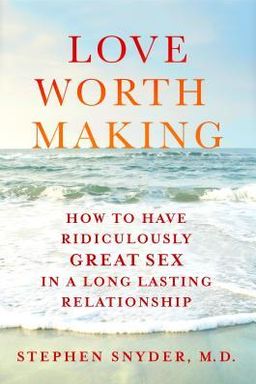
Love Worth Making cover

Love Worth Making

by Stephen Snyder

Love Worth Making is a transformative guide to enhancing intimacy in long-term relationships. Dr. Stephen Snyder combines real-life examples and expert insights to unravel the emotional complexities affecting sexual connections, offering readers practical strategies for maintaining passion and overcoming barriers to fulfilling intimacy.

Rediscovering the Sexual Self: The Heart of Good Sex

When was the last time you felt truly alive during sex—not just physically satisfied, but emotionally connected and utterly yourself? In Love Worth Making, Dr. Stephen Snyder argues that the key to great sex isn’t better technique, more toys, or exotic positions—it’s rediscovering your sexual self. That part of you is honest, childlike, emotional, and completely authentic. But many of us have lost touch with it, buried beneath layers of performance, pressure, and self-consciousness.

For Snyder, sexual fulfillment isn’t just about mechanics—it’s an emotional and spiritual reconnection to the self and to one’s partner. His core argument is radical in its simplicity: sex becomes great when we stop trying so hard and start paying attention to what we actually feel. He explains that good sex flow naturally from emotional openness, not friction, fantasy, or force. The book guides you through the hidden rules that govern desire and intimacy, showing that when couples understand their emotions, sexual satisfaction follows.

Modern Confusion About Sex

We live in an age of unprecedented sexual information: apps for hookups, endless pornography, and medicalized solutions for performance problems. Yet, Snyder observes, couples are no happier—or more fulfilled—than before. He notes that people know more about sex than ever, but understand it less. The proliferation of advice, science, and techniques has turned sex into work instead of play. As he puts it humorously in his introduction, “Your wife is not a lawn mower.” You can’t simply pull the cord right and expect her to start. The key isn’t stimulation—it’s connection.

What couples truly crave, Snyder contends, is not erotica but erotic intimacy—sex that deepens love and builds emotional peace between partners. This “sex of the heart” cannot be packaged or purchased. It is nurtured by presence, gratitude, acceptance, and vulnerability. Snyder’s thirty years as a psychiatrist and sex therapist have convinced him that the emotional dimension of sex is what people are truly seeking, even when they come for help with physical issues.

The Sexual Self as the Core of Intimacy

A key construct throughout the book is what Snyder calls the sexual self. The sexual self is deeply honest but has a limited vocabulary—usually just “yes” or “no.” Like a child, it can’t fake joy or pretend desire. He urges readers to listen to this inner part, instead of overriding it with expectations, pressure, or guilt. When you trust your sexual self, it teaches you how to connect more deeply and enjoy yourself fully. The therapy he describes often involves helping people get out of their own way and stop forcing what doesn’t feel right.

When the sexual self thrives, sex becomes natural, unforced, and full of warmth. When it’s silenced, sex turns mechanical and guilt-ridden. Snyder’s therapy stories—such as Carmen, who feared she was “broken” because she could only climax in the bathtub, or Paul, who lost erections precisely when he fell in love—reveal that the body’s refusals are often the sexual self’s way of saying “no.” Every “malfunction” signals an emotional truth waiting to be understood.

Sex, Emotion, and the Childlike Heart

In one of the book’s central insights, Snyder writes that sex never really grows up. At its best, sex reawakens the playful, needy, and innocent parts of us that learned to love in infancy. He draws parallels between erotic connection and the primal bond between mother and child—full of touch, smell, delight, and mutual absorption. When lovers laugh, touch, and lose themselves in each other, they return to this earliest emotional home. It’s why, he says, lovers call each other “baby.”

This childlike dimension of eros explains both its sweetness and its volatility. The sexual self is selfish, demanding, and easily wounded—qualities that adults often try to repress instead of embracing. But accepting the sexual self’s innocence and egoism paradoxically allows for more generous connection. Snyder argues that being selfish in the right way—self-loving, pleasure-seeking, unashamed—is essential for passion.

The Rules of Good Sex

Throughout the book, Snyder distills what he calls the rules of the heart—laws of emotional and erotic gravity that create good sex. These include accepting your partner as they are, attending to your own arousal rather than trying to give pleasure, not forcing outcomes (especially orgasm), and cultivating patience instead of performance. Sex, he insists, should be easy. If it feels like work, you’re probably misaligned with your emotional truth.

In contrast to most self-help sex manuals that teach “how to,” Snyder guides readers toward “how to be.” Like mindfulness practice, his approach emphasizes attention, presence, and nonjudgment. When you stay present with your sensations and emotions, pleasure unfolds naturally. The sexual self simply does what it knows how to do—if you’ll let it.

Why This Matters

At its heart, Love Worth Making is about reclaiming sex as a path to emotional aliveness. It challenges the performance-driven, porn-influenced ideal of endless novelty, reminding you that the most erotic moments often come from authenticity, not acrobatics. In long-term relationships, where routine can dull desire, Snyder offers hope by showing that passion can deepen through honesty, faith, and attention—not fade. He reframes sexual intimacy as emotional abundance, a discipline of returning again and again to your own heart and to the person beside you. The result isn’t just better sex; it’s love worth making.


The Honest Language of Desire

According to Snyder, one of the most fundamental truths about sex is that desire speaks only one language—“yes” and “no.” He calls this the limited vocabulary of the sexual self. Yet, most couples ignore this simple emotional language in favor of rules, expectations, or obligations. When you override your sexual self’s truth, desire dies.

Listening to the Sexual Self

In one early case study, a young woman named Carmen tells Snyder she can’t feel anything during sex with her husband, Scott. She worries she’s broken. But when they sit on the couch and kiss—without pressure for intercourse—she feels alive again. The difference? On the couch, her body could say “yes.” In bed, her body had been saying “no,” but she kept pushing past it to please her husband. Snyder shows her that every “symptom”—from numbness to loss of arousal—is her sexual self’s way of sending a message.

He teaches her to stop trying to “perform consent” and instead honor her body’s honesty. Over time, she rediscovers pleasure in small, authentic moments—first through self-touch, then by sharing that pleasure with her husband. The breakthrough comes when she realizes that nothing about her is “wrong.” The path to good sex isn’t correction—it’s acceptance.

Acceptance: The Essential Vitamin

Snyder calls acceptance “vitamin A” for sex. Your sexual self needs to feel accepted exactly as it is—curious, shy, stubborn, kinky, or simple. When you accept yourself and your partner, inhibition softens naturally. This idea echoes the approach of therapists like Carl Rogers, who argued that unconditional positive regard is the foundation of growth. In sex therapy, Snyder adapts this principle to the bedroom: only when your sexual self feels safe from judgment can it play freely.

Why Pressure Kills Arousal

Carmen’s husband Scott, like many men, equated “good sex” with giving his wife an orgasm. Snyder empathizes but points out the flaw: when sex becomes a job, desire suffocates. Instead, he urges Scott to stop forcing outcomes and start enjoying his own arousal—trusting that his pleasure will invite hers. When both partners stop performing and start listening, the natural “yes” reappears. This lesson, Snyder emphasizes, applies everywhere: the sexual self blossoms only in emotional honesty.


Infantile Roots of Eros

One of Snyder’s most striking insights is that our sexual feelings are deeply connected to infancy. In Chapter 3, “Be My Baby,” he writes that the best lovemaking mirrors the intimacy between a mother and her newborn: touch, gaze, scent, and complete surrender. In this view, good sex reawakens the experiences of being held and enjoyed simply for existing. Modern lovers unconsciously seek that primal joy of being adored.

Sex as a Return to Innocence

When lovers laugh uncontrollably or lose themselves in each other’s eyes, they return to the childlike state of total enjoyment that first taught them love’s language. Snyder likens good sex to mother-infant bonding—intimate, nonverbal, and emotionally pure. This helps explain why sex can make us feel euphoric when it’s good and devastated when it’s not: it touches the deepest layers of attachment.

He illustrates this through Paul, a young banker who lost his erection with a woman he truly loved. Rather than diagnose a physiological issue, Snyder connects the problem to emotional vulnerability. Falling in love reactivated Paul’s early experiences of dependence and fear of loss. Only when the woman affirmed that she loved him—and that she “liked the way he smelled” (a primal gesture)—did his body relax. The sexual self, Snyder suggests, can only thrive when it feels emotionally safe.

Scent, Touch, and the Body’s Memory

Snyder beautifully describes how scent evokes the earliest emotional memories—like the smell of a baby’s head or a parent’s shirt. The happiest couples, he notes, often say the secret of their bond is, “We like how each other smells.” He reframes erotic chemistry as the adult echo of the child’s profound longing to be held and known. Sex, in this sense, is nature’s way of reminding us that love was originally tactile and physical.

Far from reducing desire to biology, Snyder elevates it to an emotional compass pointing back to our beginnings. When we surrender to the baby-like vulnerability of sex—letting go of pride, fear, and performance—we become capable of both giving and receiving love in its purest form. That, he argues, is the true ecstasy eros offers.


Healthy Narcissism and Erotic Power

In Chapter 4, “Selfishly Yours,” Snyder reclaims a taboo idea: good sex requires a healthy dose of self-love. He distinguishes between pathological narcissism (self-absorption without empathy) and healthy narcissism (confidence, pride, and self-acceptance). The sexual self, he insists, is inherently narcissistic—it wants to be adored, worshipped, and made to feel extraordinary. When partners suppress this, passion wanes.

The Power of Selfishness

Many lovers think the key to satisfaction is being generous—focusing on giving pleasure. Snyder flips that logic. Erotic vitality, he writes, comes from selfish passion—wanting your partner so much that generosity flows naturally. “What’s more erotic,” he asks, “a lover who wants to give you pleasure, or one who wants to take pleasure in you?” Desire, by its nature, is selfish. When both partners claim that right, mutual ecstasy follows.

He tells of a husband desperate to please his wife, who responds only with irritation. When Snyder speaks privately to her, she confides, “I just want him to stop fumbling and devour me.” His politeness, done in the name of consideration, had smothered passion. Her subconscious wanted his unapologetic appetite. Snyder emphasizes: passion requires confidence. Submission to niceness is death to eros.

Power and Play

Power dynamics, Snyder argues, are woven into erotic life. Whether gentle or bold, every act of sex involves a dance of dominance and surrender. He cites psychological research and the fantasies collected by Nancy Friday in My Secret Garden to show that even so-called “powerless” fantasies often carry a secret triumph. The thrill of being desired, pursued, or overpowered is, paradoxically, a form of power.

For Snyder, sexual maturity means embracing these primal impulses rather than sanitizing them. When you and your partner can play with power—neither abusing nor denying it—you access a deeper erotic truth. Love allows selfishness without cruelty; power without fear. That, he says, is what makes passion sustainable over time.


The Art of the Easy

When Snyder declares, “Life is difficult. Sex should be easy,” he challenges the way most people approach intimacy. In Chapter 5, he explains that the essence of good foreplay—and good sex—is enjoyment. When sex feels like work, it fails. The body resists pressure; the sexual self dislikes goals. Real desire arises spontaneously when you stop trying to make things happen.

Why Effort Backfires

Snyder’s patients often treat sex like a to-do list: “getting her wet,” “giving him pleasure,” “performing oral sex the right way.” He argues that these efforts destroy spontaneity because they shift attention from pleasure to performance. Sex isn’t about doing—it’s about feeling. His advice is blunt: if either partner feels like they’re working during sex, stop immediately. Take a breath. Start again only when you both want to, not because you should.

In story after story—like Jill, who couldn’t climax without a painful fantasy until she learned gentleness—Snyder shows that relaxation and self-compassion reignite arousal faster than pressure ever could. The “art of the easy” is about cultivating the right conditions for nature to take its course, much like gardening: you don’t pull the petals open; you nurture the soil.

Practical Tools: Simmering and the Two-Step

Snyder introduces simple techniques for keeping erotic energy alive. Simmering means sharing quick moments of arousal—like a kiss, an embrace, or a whispered compliment—without letting them lead to intercourse. These micro-moments of connection sustain erotic warmth even in busy lives. Another practice, The Two-Step, invites couples first to rest quietly together, then to follow any natural stirrings of desire without judgment. Both practices are mindfulness for the body: presence without pressure.

In Snyder’s world, good lovers are not technicians but gardeners of feeling. They know that the mind’s interference kills joy. When you replace anxiety with curiosity and approval, pleasure finds you. This return to ease isn’t laziness—it’s mastery disguised as simplicity.


Desire, Mindfulness, and Faith

The book’s final chapters expand from the bedroom to the soul. Snyder contends that maintaining sexual connection over decades demands something deeper than novelty: it requires faith. Faith, for him, isn’t religious dogma but emotional coherence—the ability to trust that even in dry spells or disappointments, the heart knows how to return to love.

In long-term relationships, Snyder observes, desire naturally waxes and wanes. Many couples panic when passion fades, assuming something’s broken. But, he suggests, loss of desire is simply an invitation to stop forcing and start listening again. By practicing mindfulness and “sanctifying the ordinary,” couples learn to rediscover inspiration in small, quiet moments—a shared breath, a touch, or a morning glance.

Mindfulness as Erotic Presence

Inspired by the work of Jon Kabat-Zinn and W. Timothy Gallwey (The Inner Game of Tennis), Snyder adapts mindfulness to sex therapy. When you pay nonjudgmental attention to your sensations and breath, you enter what he calls “the stillness from which arousal grows.” His clients, like Carmen years later, learn to integrate yoga-like breathing and awareness, creating a fusion of calmness and excitement that transforms routine sex into sacred play.

He even compares great lovemaking to prayer: a clearing of distractions so you can receive inspiration. In this sense, sex becomes an act of devotion—what he calls “the sanctification of the ordinary.” When approached with awareness and gratitude, ordinary affection can become extraordinary.

Faith and the Cycle of Love

Through stories of mature couples—like Emily and Sam, who rediscover connection after decades—Snyder demonstrates that mature sex is less about fireworks and more about flow. Love, like spirituality, deepens through endurance. He urges couples to see sex not as a performance to maintain but as a lifelong dialogue with the soul. Great sex at seventy, he insists, isn’t about stamina—it’s about wonder.

Snyder closes with a poetic reminder from his mentor Avodah Offit: even as bodies age and passions mellow, sex can remain “a celebration of life’s capricious glory.” It’s the sacred art of saying “yes”—again and again—to joy, vulnerability, and the person beside you. That, he writes, is faith in motion.

Dig Deeper

Get personalized prompts to apply these lessons to your life and deepen your understanding.

Go Deeper

Get the Full Experience

Download Insight Books for AI-powered reflections, quizzes, and more.