
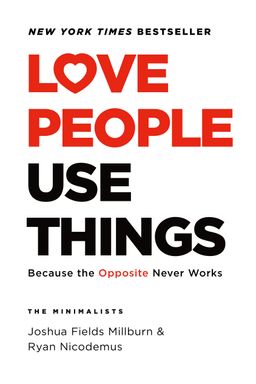
Love People, Use Things cover

Love People, Use Things

by Joshua Fields Millburn and Ryan Nicodemus

Love People, Use Things is a transformative guide to minimalism, offering insights into how living with less can enhance relationships, creativity, and personal fulfillment. Discover practical tips for decluttering your life and aligning with your core values.

Loving People and Using Things: Finding Meaning Beyond Modern Excess

Have you ever felt surrounded by things yet strangely empty inside? In Love People, Use Things: Because the Opposite Never Works, Joshua Fields Millburn and Ryan Nicodemus—known globally as The Minimalists—ask why so many of us are drowning in possessions but starving for connection. Their answer is simple yet profound: our culture has reversed the natural order of life. We love things and use people when it should be the other way around.

At heart, the authors argue that minimalism is not about ascetic deprivation or counting objects—it’s about living intentionally, freeing yourself from clutter to rediscover what truly matters: relationships, purpose, health, creativity, community, and contribution. They weave their own stories of loss, excess, and renewal through seven key relationships that shape a meaningful life—our relationships with stuff, truth, self, values, money, creativity, and people.

The Crisis That Changed Everything

Millburn begins the book amid the pandemic lockdown of 2020, reflecting that catastrophe often reveals what is essential. A world built on "consumer confidence" crumbled when people stopped buying. We learned quickly that stockpiles and possessions couldn’t replace community and trust. This crisis reframed minimalism not as a trendy movement but as a survival philosophy—intentional living as humanity’s best preparation for adversity.

Throughout the preface, he contrasts decadence and distraction with what he calls the new necessity—clearing away clutter to recover meaning. The pandemic became a mirror, forcing individuals to notice that their vast homes and overflowing storage spaces often housed little of real value. “Our things,” the authors write, “tend to get in the way of what’s truly essential—our relationships.”

What It Means to Live Intentionally

Through intertwined storytelling, Millburn and Nicodemus redefine minimalism as the practice of asking one transformational question: “How might your life be better with less?” It’s not about subtraction for its own sake; it’s about creating space for more—more freedom, creativity, community, and love. This expansion through reduction echoes lessons found in Stoic philosophy, Buddhist mindfulness, and the writings of Thoreau. But unlike the ancient sages, The Minimalists turn theory into practice through modern examples: their ‘Packing Party’ experiment, decluttering case studies, and minimalist rules such as the No Junk Rule and Just in Case Rule.

“Minimalists don’t focus on having less; they focus on making room for more.”

Their message moves beyond decluttering the physical—to what they call existential clutter: the emotional baggage, toxic relationships, unpaid debts, and endless digital distractions that congest our inner lives. Simplifying your stuff merely opens the door to the deeper work of simplifying yourself.

Seven Relationships That Define a Meaningful Life

The book unfolds as a journey through the seven essential relationships. First, we confront our Stuff—possessions as physical symptoms of inner turmoil. Then comes Truth—facing honesty and vulnerability rather than convenient lies. Self explores health, well-being, and growth. Values asks whether our daily choices align with what we claim to care about. Money reframes finances as freedom rather than status. Creativity encourages contribution through creation, not consumption. And finally, People—reminding us that meaningful relationships are the ultimate point of simplification.

Each of these sections is built on stories: Millburn sorting through his late mother’s possessions, Nicodemus staging his “Packing Party,” pandemic survivors rediscovering connection, and families like the Kirkendolls whose literal house burned down yet found peace through detachment. The message is universal—you can lose everything and still gain freedom when you realize that your worth isn’t measured in things.

From Consumerism to Connection

Millburn often compares consumer culture to a spiritual addiction. Like any dependency, it offers instant gratification—dopamine highs from purchases—but deepens discontent over time. He reminds readers that Americans now spend more on shoes, jewelry, and watches than on higher education and throw away 81 pounds of clothing a year. Happiness is replaced by anxiety because possessions require endless maintenance, debt, and attention. A trillion dollars a year is spent on nonessential goods while real savings evaporate. “The things we own,” he warns, “end up owning us.”

In contrast, living with less doesn’t mean deprivation—it means liberation from false freedom. True wealth isn’t found in accumulation but in the ability to let go. Minimalism becomes a path to what psychologists call psychological reclamation: reclaiming your time, your attention, and your relationships from clutter.

Why This Matters Now

Whether you’re facing burnout, debt, loneliness, or digital overload, this book insists that simplicity isn’t a luxury—it’s a way back to humanity. The pandemic revealed that our economy of endless growth was fragile; our lives depended not on what we bought but on whom we loved. Millburn closes the preface with a call echoing ancient wisdom yet tailored to modern urgency: “The best time to simplify was a decade ago. The second-best time is now.”

By the end of this journey, you realize that minimalism isn’t the destination—it’s the vehicle. It helps you travel lighter on the path toward what truly endures: loving people and using things, because the opposite never works.


Our Relationship with Stuff

Millburn and Nicodemus start with the most visible problem—our stuff. They point out that the average American household owns over 300,000 items yet feels anxious and unhappy. Their claim is chilling: possessions are physical manifestations of our internal turmoil. Chaos in homes reflects chaos in hearts.

The Hidden Costs of Ownership

Every object comes with unseen costs—maintenance, storage, cleaning, and psychological burden. Millburn lists dozens of ways things drain us: repainting, replacing batteries, fixing, protecting, charging. The true cost far exceeds the price tag. “We better choose carefully what things we bring into our lives,” he warns, “because we can’t afford every thing.”

Yet the authors acknowledge that minimalism is not about abstinence but about intention. They divide belongings into three piles: essentials (food, shelter, clothing), nonessentials (items that add value but aren’t required), and junk (everything else). The task is simple: get rid of the junk so essentials and valued items can breathe. This practical framework mirrors Marie Kondo’s idea of “only keeping what sparks joy” but is more utilitarian—remove what doesn’t add value, even if it once did.

Stories of Letting Go

Millburn’s life story shows how minimalism begins with pain. After his mother’s death, he faced three houses’ worth of her belongings crammed into one apartment. Sorting through decades of possessions, he realized something transformative: “Our memories are not in our things; our memories are inside us.” That insight prompted him to cancel his storage unit, donate nearly everything, and photograph sentimental items before letting them go. Letting go became both emotional and spiritual liberation.

Likewise, Nicodemus’s “Packing Party” experiment offered a playful path to revelation. He boxed up everything he owned and unpacked only what he needed for three weeks. At the end, 80 percent of his belongings remained untouched. When he sold or donated the rest, he felt, for the first time, “free for the first time in my adult life.” Their stories became the foundation of The Minimalists movement and inspired millions to declutter not only homes but minds.

Consumerism as Religion

The authors liken consumerism to faith in false gods. Advertising works like sermons, preaching salvation through acquisition. Americans are bombarded with 4,000–10,000 ads daily. Edward Bernays, the father of modern PR and nephew of Freud, learned to manipulate unconscious desires rather than reason. Millburn cites this lineage to show how we’ve become believers that more equals happiness. But it’s an empty church—he reminds us that Rolexes don’t buy time, Mercedes cars don’t deliver freedom, and big homes don’t promise safety.

“You might survive if you need less—and you can thrive, even in crisis, if your relationships are thriving.”

The antidote is awareness. The easiest way to declutter, Millburn says, is not to bring the clutter home in the first place. He introduces rules like the 20/20 ‘Just in Case’ Rule—anything you discard that you truly need later can be replaced for under $20 in under 20 minutes. These small principles turn minimalism into an everyday discipline—a counter-practice against impulse.

Finding Freedom

Ultimately, the relationship with stuff is not about austerity but freedom. When you clear physical clutter, you free energy and attention to nurture relationships, creativity, and well-being. Jason and Jennifer Kirkendoll’s story encapsulates this truth: their relentless accumulation turned into despair, until a serendipitous disaster—a literal dumpster fire—destroyed all their possessions. Shockingly, they felt liberated, because their love, not their things, remained. The authors remind you that you too can experience this freedom intentionally, without waiting for catastrophe.

In the end, minimalism with stuff is really about the internal art of discernment—learning to recognize enough. “Enough,” they write, “is the sweet spot where intentionality intersects with contentment.” Once you reach it, you aren’t poor, and you aren’t deprived; you’re free.


Living Truthfully and Facing Shame

Millburn’s second relationship—Truth—dives into the painful territory of deceit, shame, and growth. Beneath our social facades, many of us live lives incongruent with our authentic selves. Through stories of addiction, infidelity, and family trauma, he argues that truth is simple—but simple isn’t easy.

The Cost of Lies

Drawing from personal failures—the affair that ended his first marriage, the years of dishonesty during his corporate climb—Millburn insists that lies are shortcuts that cost far more than they save. Borrowing inspiration from Sam Harris’s Lying, he describes dishonesty as internal pollution that rots integrity. “A fairy tale well told isn’t more true,” he says; each deception trades long-term peace for momentary ease.

His mother’s story deepens the lesson. A former nun turned alcoholic, she taught him humor and compassion but also the dangers of running from truth. Her death from cancer precipitated his moral reckoning. Sorting through her possessions, he realized that most people avoid hard truths because facing them means confronting who they’ve really become. Comfort, he concludes, is a liar—it keeps us stagnant because change demands discomfort.

Guilt, Shame, and Significance

The authors dissect the difference between guilt and shame using insights from psychology (Mary Lamia’s work on emotional theory). Guilt means “I did something bad.” Shame means “I am bad.” Shame corrodes your identity until you believe your mistakes define you. But when you act congruently with your values, you transform shame into significance—earned self-worth rather than attention-seeking validation.

Millburn shows how our culture amplifies unearned significance through instant gratification—the likes, retweets, and material trophies that masquerade as meaning. True significance, he writes, grows through effort, accountability, and contribution. He recalls teaching his daughter Ella to value effort over innate talent: instead of telling her “You’re good,” he praises her specific actions—“You played a great game.” Significance, like character, must be built, not bought.

Fear, Openness, and Healing

Telling the truth often means facing fear—the fear of confrontation, rejection, or loss. Millburn writes that fear is the antithesis of freedom. “We choose to be afraid, which means we can also choose to live without fear.” His own transformation came from publicly revealing shameful chapters—cheating, addiction, selfishness—turning secrecy into sunlight. By making peace with discomfort, he found liberation.

“If you avoid pain, you avoid life. And through the pain, you learn more about yourself than you ever thought possible.”

Ultimately, truth for Millburn isn’t about radical transparency—it’s about responsible honesty. You don’t need to share every thought; silence sometimes has more value than speech. Quoting his friend Nate Green, he advises, “Speak only when your words are more valuable than silence.” Through that discipline, truth becomes an engine for simplicity, clarity, and real connection.

Living truthfully means living without the need to clear browser histories—nothing to hide, nothing to fear. When you live that way, your life finally aligns with who you want to become.


The Self and the Art of Well-Being

In the third relationship—Self—Millburn steps inward, exploring health, depression, and self-care. Early in adulthood, he chased success at the expense of his physical and mental health. Later illness and emotional collapse taught him that real prosperity starts with stewardship of the self.

The Body as Stewardship

After contracting E. coli in Brazil and suffering a prolonged digestive disease, Millburn learned that control over possessions means little if you lose control over your body. He connects this insight to minimalism: caring for your health is the ultimate intentional act. You can’t contribute to others if you neglect yourself.

Free Medicines: Food, Exercise, Sleep, Sunlight

Drawing on experts like Dr. Thomas Wood and Matthew Walker (Why We Sleep), he distills well-being into four “free medicines.” Eat real food—not entertainment. Move daily—exercise is medicine. Sleep without guilt—rest is rejuvenation, not laziness. Seek light—sunlight recalibrates your rhythm and mood. He warns about the “busy badge of honor” that glorifies exhaustion while masking burnout. Self-care, he writes, isn’t indulgence; it’s responsible maintenance of the vessel through which you serve others.

Through stories of Packing Party participants, he shows how decluttering improved physical health. Marta Ortiz’s recovery from stress-related illness came when she simplified her commitments and diet. “Eliminating the noise from my life helped me hear what was truly important—my well-being.”

Depression and Rediscovery

Millburn shares his descent into what he calls “The New Great Depression,” triggered by illness and loss. From once being “Mr. Outstanding,” an optimist greeting coffee shop baristas at dawn, he tumbled into despair. Yet he reframed pain as part of adventure—“Every foundation was once a ditch.” Recovery demanded patience, humility, and community support. He compares his own breakdown to his hometown Dayton’s tornado tragedy: rebuilding comes only after destruction. The metaphor reminds that healing the self often requires tearing down old identities.

“A healthy man wants a thousand things; a sick man wants only one.” —Confucius

His conversation with self-care advocate Randi Kay expands this lesson: self-care is the act of tuning into your true needs and “acting accordingly.” Identifying stressors, setting boundaries, and rejecting guilt become gateways to healing. Simplicity isn’t about fewer things—it’s about fewer excuses.

By the end of this chapter, the minimalist life is revealed as bodily and psychological stewardship. Living deliberately includes what you eat, how you sleep, and whom you allow to influence your mind. Care for yourself not to escape suffering but to serve others from strength. That’s intentional living turned inward.


Values: Aligning Actions with What Matters

Millburn and Nicodemus argue that understanding your values is the compass for meaningful living. Without clear values, you compromise everything—honesty, health, relationships—in pursuit of fleeting pleasures. This chapter turns minimalism from a physical practice into an ethical philosophy.

The Object A Illusion

Drawing from psychoanalyst Jacques Lacan’s “Object A,” Millburn explains our obsession with the next shiny goal—the house, promotion, partner—that promises everlasting happiness but inevitably disappoints. Desire constantly moves the goalpost. When that illusion collapses, we swing to another obsession. Real stability comes only when we detach identity from external achievement and instead ask whether our actions reflect our foundational values.

The Four Levels of Values

He introduces four strata of values:

  • Foundational values: health, relationships, creativity, growth, and contribution—the pillars of a full life.
  • Structural values: personal principles like autonomy, sincerity, humility, and restraint.
  • Surface values: changing interests such as aesthetics or hobbies.
  • Imaginary values: obstacles masquerading as virtues—busyness, comfort, popularity.

This hierarchy operates like a home: solid foundation, sturdy frame, pleasant facade. But the fences of imaginary values keep us trapped. Once you see that perfection, productivity, or comfort aren’t moral goals, you can let them go. The authors urge an annual “Values Worksheet” ritual—reflecting, discussing with an accountability partner, and realigning goals.

Pleasure vs. Joy

They differentiate four types of well-being—pleasure, happiness, contentment, and joy. Pleasure is cake, fleeting. Happiness is a healthy meal. Contentment is a lifelong diet. Joy transcends all—it involves contribution and communion with others. Like Aristotle’s eudaemonia, joy is fulfillment born from virtue. When you act in accordance with your values, joy arises naturally—it can coexist even with pain or loss.

Millburn contrasts this with modern addiction to junk happiness: drunk shopping, overconsumption of entertainment, or loyalty to convenience. Minimalism helps you move from external rewards to internal alignment—less chasing, more choosing.

Choosing Principles over Perfection

He encourages lowering expectations but raising standards—a nod to Coach John Wooden’s philosophy. Success is not hitting arbitrary metrics but living up to your principles daily. When you stop aiming for perfect outcomes and focus on high standards of honesty, discipline, and kindness, growth becomes intentional. “If you’re not growing, you’re dying,” he writes—but growth must be chosen, not imposed.

In the end, values are not slogans; they’re lived behaviors. When your short-term actions make your future self proud, minimalism turns into integrity. Life shrinks and expands according to what you value—so choose carefully.


Money and Freedom

Few topics expose our modern contradictions like money. Millburn and Nicodemus show that financial clutter mirrors emotional clutter. Debt, they argue, is the chief thief of freedom. Their remedy is not earning more, but spending intentionally.

The Illusion of Success

Millburn recounts his own paradox: by age twenty-eight, he earned six figures and controlled 150 retail stores—yet was drowning in debt, anxiety, and dread. He bought Lexuses, tailored suits, houses with “more toilets than people.” Everything looked successful; everything felt hollow. Like Neal Gabler’s “financial impotence,” he lived paycheck to paycheck at $200,000 a year. True success, he realized, was his friend Jamar from Cincinnati—joyous, debt-free, and free to give. “Debt-free,” Millburn writes, “is the new pay raise.”

Breaking Debt Addiction

Influenced by finance mentor Dave Ramsey, the authors present a clear seven-step path: create a budget, build a $1,000 emergency fund, pay off debts small to large (“debt snowball”), then save, invest, and give. These baby steps freed Millburn from six-figure debt within four years. He replaced consumption with contribution—delivering pizzas to pay bills, eating at home, selling his cars. His insight resonates: you can’t spend your way out of debt.

Money, they insist, is not evil; it’s an amplifier. It magnifies your existing behaviors—generous people become more generous, reckless ones more reckless. The goal is not abstention but stewardship. “Be a bonobo, not a chimp,” Millburn jokes, referencing primate studies showing bonobos share food while chimps hoard. Generosity builds trust; greed isolates.

Minimalist Economics

The authors envision a “minimalist economy” powerfully different from consumer capitalism. Instead of chasing growth through overconsumption, intentional spending strengthens communities. Support local businesses, favor experiences over possessions, invest in health and learning. They warn that consumption-as-stimulation is destructive—like “fixing a cracked mirror with a hammer.” When you buy with purpose, not impulse, each dollar becomes a reflection of your values.

Millburn also challenges the myth that minimalism belongs only to the wealthy or the poor. Minimalism benefits anyone discontented by the status quo—rich or struggling—because it’s about choices, not income. He closes with a universal formula: budget, spend less than you earn, get out of debt, invest for the future, and use your resources to contribute. Freedom is measured not by wealth but by absence of financial stress.


Creativity and Contribution

Relationship six—Creativity—transforms minimalism from personal therapy into societal impact. For Millburn and Nicodemus, creating is the highest form of giving. When you contribute something meaningful, you replace consumption with expression.

Overcoming Procrastination and Distraction

Millburn confesses that he spent years “aspiring to write” while avoiding the work. His cure for procrastination was ritual: “Sit in the chair.” That phrase becomes mantra—creativity arises through discipline, not inspiration. Borrowing from Cal Newport’s Deep Work, he makes de-distraction central to artistry. He compares modern smartphone addiction to smoking: “Scrolling is the new smoking.”

He champions digital minimalism—turning off notifications, greyscaling screens, and practicing “Screenless Saturdays.” Removing noise restores focus. He cites cognitive studies showing your phone rewires your brain’s gray matter much like drugs do. The antidote is mindful technology use—treat tools as tools, not appendages. “If you remove one distraction,” he warns, “the rest become visible—and that’s when the creative work begins.”

Creating Value, Not Content

The authors separate creation from noise. “Don’t create content—create value,” Millburn insists. He contrasts artist Paul Johnson (Canyon City), whose music lost soul under commercial pressure, only to rediscover passion by quitting the industry and playing again for love. When he stopped chasing money, art returned. Genuine creativity, like minimalism, thrives on constraint. “Unlimited resources can stifle creativity,” Millburn writes—echoing Pixar’s principle that boundaries spark innovation.

In opposition to viral obsession, he promotes trust over attention. Success isn’t going viral; it’s adding value habitually. “Before every tweet, book, or podcast,” he says, “I ask, ‘Will this add value?’”

“Real creatives don’t create for attention; they create because they can’t not create.”

Creativity as Connection

The authors see creativity as communication of love. Ken Coleman’s “three E’s”—equip, encourage, and entertain—offer a framework for meaningful art. Whether writing, teaching, or filmmaking, the goal is to equip others with tools, encourage them to act, and entertain them enough to stay engaged. Creativity becomes contribution—a way of loving the world back.

By embracing imperfection, Millburn echoes Elizabeth Gilbert (Big Magic): “Don’t let the perfect be the enemy of the good.” Discipline replaces anxiety; creation replaces consumption. You build meaning not through flawless art but through continuous presence.

In the minimalist worldview, creativity completes the circle: after simplifying, you have space to create and give. That’s how life’s clutter becomes art.


Matters of People and Love

The seventh relationship—People—is both culmination and conclusion. Millburn turns outward again, asserting that minimalism ultimately exists to deepen human connection. You can’t change people, he writes, but you can change which people surround you.

Understanding Personality and Proximity

Drawing on Carl Jung’s and Myers-Briggs’ frameworks, he shows how knowing your personality helps you set boundaries respectfully. Introverts and extroverts recharge differently; misunderstanding this creates strain. For years Millburn lived as an extrovert because society demanded it, until solitude taught him that quiet doesn’t equal loneliness—it restores presence.

The Three Circles of Relationship

He divides relationships into primary (closest family and friends), secondary (supportive acquaintances), and peripheral (casual contacts). Problems begin when we give most of our time to peripheral people. Real intimacy grows through intentional investment. Quality outweighs quantity. His story with wife Rebecca illustrates this: by scheduling minimalist “Wednesday resets”—moments of undistracted connection—they keep love alive amid life’s noise.

Millburn offers the delightful metaphor of the Us Box: each relationship contains a shared space where both partners must contribute and receive. Giving without getting breeds exhaustion; taking without giving breeds exploitation. Reciprocity, not recordkeeping, sustains love.

Boundaries, Compassion, and Letting Go

Healthy relationships require clear boundaries, what psychologists Henry Cloud and John Townsend call “property lines around the self.” These include physical, emotional, mental, and spiritual boundaries. Communicating them creates safety and prevents resentment. Marshall Rosenberg’s “Nonviolent Communication” complements this with four steps: observation, feeling, need, and request. Together they turn confrontation into compassion.

When relationships become toxic, Millburn advises either acceptance or moving on. Acceptance means resetting expectations; moving on means choosing freedom over familiarity. Marta Ortiz’s abusive relationship serves as warning and hope—she escaped when she realized love can exist from afar but shouldn’t coexist with harm. “A toxic person,” Millburn insists, “is entitled to nothing.”

“The best relationships are those in which you care about the other person more than you care about yourself.”

Forgiveness and humility become the final stage of decluttering. Sometimes the toxic person is you. To heal, you must apologize, learn, and change behavior rather than make excuses. Ego sustains conflict; apology dissolves it. Relationships end not with winners but with lessons. Millburn quotes Erwin McManus: “If you have a dream in which people are simply tools for your outcome, that’s not a dream—it’s a nightmare.”

The Meaning of Love

The book closes with an eloquent meditation on love. Language fails us—English uses one word for everything from burritos to soulmates. True love, Millburn concludes, “doesn’t keep score.” Like tennis’s zero, real love equals nothing—because love multiplies only when expectations vanish. You can lose possessions, status, even certainty, but if you love people and use things, you’ll never lose meaning.

Minimalism’s ultimate destination is not simplicity—it’s intimacy. When the clutter fades, what remains is connection: honest truth, healthy self, clear values, free money, creative contribution, and loving relationships. That’s the real wealth Millburn and Nicodemus invite you to own.

Dig Deeper

Get personalized prompts to apply these lessons to your life and deepen your understanding.

Go Deeper

Get the Full Experience

Download Insight Books for AI-powered reflections, quizzes, and more.