
Idea 1
Learning to Escape Mental Prisons
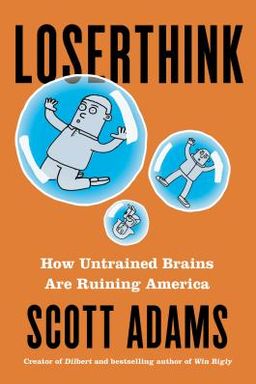
Have you ever caught yourself arguing online, feeling certain that your opponent was insane—only to realize later that your own logic might have been flawed? In Loserthink: How Untrained Brains Are Ruining America, Scott Adams, creator of Dilbert and trained hypnotist, argues that most of us stumble through life using bad mental habits that trap us in what he calls “mental prisons.” These prisons are built from unproductive thinking patterns—habits that feel rational but actually blind us to truth, creativity, and useful action.
Adams contends that you don’t have to be stupid or uneducated to suffer from loserthink. In fact, highly intelligent people might be more vulnerable, because intelligence without mental discipline can reinforce false confidence. The cure, he says, isn’t a higher IQ—it’s learning how to think across multiple disciplines the way scientists, engineers, economists, historians, leaders, and entrepreneurs do.
The Problem of Untrained Thinking
Adams opens by identifying a universal truth: no one is formally taught how to think. Schools train us to retain information and follow rules, not to examine assumptions or evaluate evidence. The result is a world full of apparently smart people believing absurd things. He coins the term loserthink to describe unproductive reasoning habits—like mind reading, overconfidence, moral superiority, or focusing only on one variable in a complex situation. These habits aren’t the result of low intelligence but of limited exposure. If you’ve never learned to think like an engineer, a psychologist, or an economist, you’re missing crucial tools for understanding reality.
He recounts how his own experience across fields—engineering, hypnotism, business, and cartooning—taught him valuable perspectives on systems, incentives, and persuasion. Each discipline adds a new filter through which to interpret the world more accurately. The more filters you have, the fewer traps you fall into.
Navigating a Politically Warm World
One of the book’s central ideas is what Adams calls “Political Warming.” Just as carbon in the atmosphere heats the planet, the business model of modern media—rewarding outrage, clicks, and emotion—has “heated up” our political climate. He argues that fake news, biased coverage, and the viral outrage of social media have trapped society in a perpetual “fight-or-flight” state. We now live in separate reality bubbles where each side’s version of truth feels self-evident.
According to Adams, the polarization isn’t because people have become worse but because incentives have changed. Media companies can now measure audience reactions with granular precision, so they optimize headlines and narratives not for accuracy but for emotional activation. The outcome: people mistake emotional stimulation for truth. Like climate change, this “warming” is a structural byproduct of technology, not a moral decline.
Training the Mind Across Disciplines
Adams’ solution is what you might call cross-disciplinary mental fitness. He introduces the reader to a panorama of thinking habits from various professions. Psychologists notice cognitive biases and projection. Engineers think in terms of cause and solution, not blame. Leaders understand directional truth—getting the right trajectory matters more than being precisely right. Economists teach cost-benefit comparison, while scientists demand testable evidence and humility before uncertainty.
Each profession offers unique lenses that, when borrowed, help you escape biased thinking. This approach echoes ideas from Charlie Munger’s Poor Charlie’s Almanack, which celebrates the power of “mental models.” Adams updates that tradition for the modern digital era, using humor and real-world examples—from his dog misreading his intentions to political tribes misreading each other—to show how easily humans invent false narratives.
Freedom from Mental Prisons
Throughout Loserthink, Adams offers an optimistic message: you can break out of your illusions. You do this by training yourself to ask better questions, imagine alternative explanations, test ideas small before going big, and judge people by how they respond to mistakes—not just by the mistakes themselves. Once you see your mental walls—once you realize how your filters shape perceptions—they weaken automatically.
In the final sections, Adams moves from diagnosis to vision. He argues that if enough people learn productive thinking, society could unlock what he calls the Golden Age Filter—the ability to notice how extraordinary human progress already is and focus our collective effort on solving the few remaining problems intelligently. Poverty is plummeting, technology is exponential, and war is declining; the main thing keeping us miserable is our habit of thinking poorly about everything.
In short, Loserthink is a guide to intellectual self-defense in an age of misinformation. It reminds you that being wrong and being right feel exactly the same—and that the only way to find truth is to learn how to think better than your instincts would have you think.