
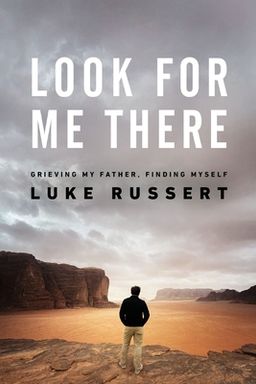
Look for Me There cover

Look for Me There

by Luke Russert

In Look for Me There, Luke Russert embarks on a transformative journey through grief after losing his father. Traveling across the globe and exploring his inner world, he discovers how to embrace uncertainty and forge his own path, offering readers a profound reflection on healing and personal growth.

Grieving Loss, Finding Self, and Rediscovering Purpose

What do you do when the person who defined your world is suddenly gone—and you realize you don’t know who you are without them? In Look for Me There: Grieving My Father, Finding Myself, Emmy Award–winning journalist Luke Russert wrestles with that question after the sudden death of his father, Tim Russert, the beloved host of Meet the Press. The younger Russert had built his own career in his father’s shadow, but when grief and identity crises collide, he makes a radical decision: to leave behind a prestigious job, wealth, and Washington’s power circles to travel the world alone and rediscover his own meaning in life.

Russert’s memoir is far more than a travelogue—it's a spiritual and existential journey through sixty-seven countries and countless emotional landscapes. He blends intimate storytelling, soul-searching reflection, and vivid cultural detail as he explores how grief and privilege, ambition and authenticity, can coexist. What results is a deeply personal meditation on love, mortality, and the quest to belong to yourself when everything else is stripped away.

The Father’s Shadow: A Life of Inheritance

The book begins with the heartbreaking day Russert loses his father in 2008. Tim Russert’s death was not just a family tragedy—it was a national mourning. For Luke, only twenty-two and newly graduated from college, that loss upends his world. His father had been his mentor, his moral compass, and his North Star. Luke recalls preparing his father’s eulogy, reading from Big Russ and Me—his father’s own memoir—about the power of faith and acceptance of death. But even as Luke publicly honored his father with grace, the private pain remained unprocessed. This initial event lays the foundation for the book’s central idea: grief doesn’t end when condolences do—it demands transformation.

Success as Survival—and the Empty Pull of Legacy

Following Tim’s death, Luke finds himself swept into the professional world his father once ruled. He accepts a job at NBC News, becoming a congressional correspondent at only twenty-three. He quickly gains recognition for his reporting and his poise. But success feels hollow. Russert faces public scrutiny, accusations of nepotism (“the son of America’s journalist”), and internal doubts about deserving his role. He begins to suspect that career achievement might be camouflage for unresolved grief. The more he succeeds, the further he feels from the self his father had raised him to be. When former House Speaker John Boehner urges him in 2015 to “get out” before he becomes a lifer consumed by the system, Russert realizes how little fulfillment power and prestige bring. The words haunt him—and ultimately become the catalyst for his exodus from media.

The Journey Outward and Inward

In 2016, Russert leaves NBC and embarks on a years-long odyssey across the globe—through Maine, Patagonia, Cambodia, Rwanda, Japan, Iceland, Russia, and the Holy Land. His travels become symbols of his interior evolution. Each place tests him, reshapes his values, and reframes what connection means: Maine’s isolation teaches him peace, Patagonia shows humility before nature’s grandeur, Cambodia and Vietnam display history’s scars and forgiveness, and Rwanda reminds him of resilience after trauma. At every stop, he reflects on the tension between seeking freedom and seeking belonging. A chronic struggle with anxiety and the haunting memory of his father’s “widow maker” heart attack make him question whether he can ever outrun fear—or grief itself.

Spiritual Reconciliation and Purpose

The book’s arc bends toward spiritual clarity. After losing direction through indulgence, burnout, and existential fatigue, Russert finds redemption in moments of unguarded reflection—meditating in Buddhist temples in Cambodia, crying beneath a rainbow in Iceland on the tenth anniversary of his father’s death, and finally kneeling at Christ’s tomb in Jerusalem. He comes to believe that grief’s transformation depends on vulnerability, not victory. Healing comes not from escaping pain but embracing it; from shedding the roles assigned by legacy and allowing himself to be seen as imperfect, insecure, yet worthy. Russert’s final realization echoes his father’s favorite biblical phrase: “To whom much is given, much is expected.” For Luke, privilege is no longer about opportunity—it is about responsibility to live authentically and serve truthfully.

Why This Journey Matters

Russert’s narrative resonates beyond his family legacy. It mirrors what psychologist Carl Jung described as the “individuation” process: the painful but necessary departure from the inherited self to become who you truly are. Grief, as Russert shows, is both descent and revelation. Like Joan Didion’s The Year of Magical Thinking or Cheryl Strayed’s Wild, his memoir reminds you that losing someone forces you to confront what it means to live. By the end, “Look for Me There” becomes less about searching for the dead and more about rediscovering the living. It asks you, with empathy and clarity: when the noise fades, who will you be once you start listening to your own voice?


The Shock of Loss and Public Grieving

Luke Russert’s grief begins in the most public way possible—with a phone call from NBC News while he’s abroad in Italy in June 2008. In Look for Me There, he recounts how he learns of his father’s collapse and sudden death from a massive heart attack, dubbed “the widow maker.” The moment freezes time: he’s twenty-two, freshly graduated, far away from home, and thrust into adulthood before he feels ready. The scene of discovering death across an ocean mirrors the way trauma often arrives—instantaneous, disembodied, and impossible to absorb.

Public Legacy Meets Private Pain

Tim Russert’s death turns into a national event. As host of Meet the Press, he was a cultural figure whose death makes headlines across America. Luke and his mother, Maureen Orth, themselves public figures, must confront grief under cameras and lights. Russert’s book painfully shows the contradiction of mourning privately while performing composure publicly. He delivers his father’s eulogy to an audience that includes presidents and senators—Obama, McCain, Pelosi, Biden—but writes that he remembers only speaking to friends in the back rows, “just talking about my dad.” That tension between public legacy and private love becomes one of Russert’s lifelong meditations. How do you grieve a parent who belonged to the world as much as to you?

The Rituals of Responsibility

In the aftermath, Luke instantly assumes emotional and logistical duty. He arranges family calls, manages NBC producers, and organizes funeral details that feel more like state ceremonies than family gatherings. Those responsibilities—a mixture of obligation and devotion—prompt premature maturity. The act of “holding it together,” a phrase he repeats often, becomes both coping mechanism and prison. He stops crying not because he heals but because duty replaces emotion. The funeral’s rainbow over Washington, DC becomes his sign that his father’s spirit remains nearby; yet in hindsight, it symbolizes the paradox of “moving on” while being forever anchored to loss.

Why This Stage Matters

Psychologically, this early chapter captures what grief theorist Elisabeth Kübler-Ross calls the stage of “bargaining through action”—when loved ones try to restore order by doing something. For Russert, the act of writing his father’s eulogy helps process trauma. He even consults his father’s old book for guidance, quoting passages about faith and acceptance. Yet what he discovers later is that no amount of composure can substitute for confrontation. His journey begins the moment he realizes mourning cannot be finished—it must evolve. The chapter’s emotional honesty sets a universal tone: grief doesn’t make you special; it makes you human.


Living in a Legacy: Success and Suffocation

After Tim Russert’s death, Luke steps into the world his father mastered—Washington’s political media machine. At twenty-two, NBC executives praise his poise; Larry King invites him on-air to discuss youth politics. Russert initially thrives, gaining visibility as one of the youngest correspondents on network television. Yet the book illustrates how rapid success tied to family legacy can suffocate self-discovery. His experience parallels psychological research on “role foreclosure,” when individuals adopt an inherited identity without questioning whether it’s theirs.

The Nepotism Paradox

Russert’s meteoric career sparks media attention—and backlash. Online critics label him privileged, mock his appearances, and attribute his achievements to his father’s name. The blog headlines sting: “Luke Russert Sucks Big Time,” “Get This Fat Smarmy Jackass Off My TV.” This public hostility drives his internal conflict. He knows his opportunities stem from Tim’s legacy, yet every attack intensifies his need to prove competence. His father’s favorite lesson—“To whom much is given, much is expected”—becomes both moral compass and source of guilt. The book uncovers the emotional cost of inherited privilege: endless proving without peace.

Workaholism and Identity Collapse

At NBC, Russert learns Washington’s rhythms—the late nights, ego battles, and relentless ambition. He calls the news industry “harrowing,” marked by rivalries and transience. In time, his work at Congress becomes both sanctuary and cage. He covers major stories, wins an Emmy, hosts shows, and interviews leaders. Yet exhaustion and cynicism replace curiosity. Speaker John Boehner’s advice—that he “not become a creature” of the Hill—pierces through Russert’s burnout. Shortly after, anxiety attacks begin: tremors in tracking booths, fear of inheriting his father’s fatal heart condition, and panic in Capitol tunnels. These episodes reveal how unresolved grief morphs into physical distress, how striving for success can disguise suffering.

The Turning Point

By 2016, after nearly eight years at NBC, Russert confronts his disillusionment head-on. Politics feels performative, journalism reactive, and his life like an echo of someone else’s. He wonders, “Am I addicted to its fame?”—a question that becomes the ignition for leaving it all behind. His resignation defies expectation: a man at the peak of opportunity abandoning it to wander. That leap into uncertainty marks the book’s true genesis. In psychological terms, it’s the “dark night of the soul” phase, when external validation collapses and only introspection remains. (Similar existential turning points appear in Viktor Frankl’s Man’s Search for Meaning and Cheryl Strayed’s Wild.) Russert’s choice begins the pilgrimage from success to significance.


Travel as Therapy and Transformation

What happens when you leave everything familiar—career, city, and identity—to find yourself? For nearly three years, Luke Russert’s answer unfolds in motion. Travel becomes not escapism but self-exposure; every country becomes a mirror. Across sixty-seven destinations, he discovers that physical landscapes often reveal emotional ones. Each chapter abroad acts like a therapy session without a therapist: the wilderness confronts fear, strangers challenge assumptions, and solitude amplifies introspection.

Maine and the Birth of Freedom

Russert begins in Maine’s forests, driving his late father’s truck with his pug, Chamberlain. Alone for the first time, he feels terrified—but free. The tranquility of nature, unmediated by emails and deadlines, becomes his baptism into self-reliance. When near-miss danger on a logging road forces quick reflexes, survival unlocks joy. He calls it “our baptism”—a rebirth into the “church of living free.” Maine teaches him a foundational truth echoed later: peace doesn’t appear in productivity; it emerges in presence.

Latin America: Lessons in Family and Faith

In Patagonia, Buenos Aires, Paraguay, and Uruguay, Russert reconnects with his mother, Maureen Orth, herself a pioneering journalist and former Peace Corps volunteer. Their travels reveal generational contrasts—her discipline versus his spontaneity. Yet beneath arguments and cultural discoveries lies intergenerational love. Together they explore Evita’s gravesite, trek through Uruguay’s coast, and visit Paraguay’s humble markets. Watching his mother’s vitality, Russert realizes the duality of parenting: one provides stability through structure, the other through audacity. He learns that his mother’s restless energy—long criticized—is actually resilience inherited from strong Catholic roots. (In family psychology, this tension mirrors the polarity between “order” and “adventure” archetypes.)

Asia and the Confrontation with Faith

In Cambodia and Vietnam, Russert encounters the coexistence of suffering and serenity. He meditates in Angkor Wat beside Buddhist monks, finding peace through breathing. The moment echoes centuries-old wisdom: “To embrace suffering is to understand life.” In Vietnam, visiting the Hanoi prison where John McCain was held, he reflects on forgiveness and the futility of hatred. Later, in Japan’s Hiroshima, he weeps before a child’s blood-stained trousers, realizing that human cruelty and grace share the same soil. Travel exposes his empathy as much as his privilege—leading him eventually to ask, “What am I doing with what I’ve been given?”

Rwanda, Iceland, and Rebirth

Moments of awakening crest in Rwanda’s mountains and Iceland’s waterfalls. Hiking alongside gorillas with his mother rekindles his appreciation for her courage and his own ability to lead and care. On the tenth anniversary of his father’s death, a rainbow over Iceland’s Skógafoss waterfall mirrors the one at Tim’s funeral—a divine handshake across time. Crying beneath the rainbow, Russert integrates grief and growth; he stops running from pain and begins conversing with it. Travel, once therapy through distraction, becomes transformation through attention. By journey’s end, Russert’s passport becomes a record not of countries visited but of consciousness expanded.


Facing Anxiety, Addiction, and the Limits of Freedom

Freedom, Russert learns, often disguises avoidance. While traveling, he battles anxiety, burnout, and self-sabotage. The independence he once idolized leads to isolation and excess. In Sri Lanka, a confrontation with a reckless driver spirals into anger and emptiness; later, drunken nights in Texas expose loneliness and self-loathing. These episodes serve as cautionary tales: escaping routine doesn’t resolve inner chaos—it magnifies it.

The Descent into Disconnection

By the time he reaches Sri Lanka and West Texas, Russert’s vibrant curiosity wanes. He stops engaging strangers with empathy, fixates on photos for social media, and drinks excessively. “I might as well be back in the Capitol cafeteria,” he writes, realizing his habits from Washington—the performance, the posturing—follow him abroad. In Marfa, Texas, he immerses himself in a hollow party culture, culminating in hangovers and despair. Looking into a motel mirror, he admits, “I don’t even look like me anymore.” That admission marks a brutal but necessary awareness: even freedom can become its own addiction if unexamined.

The Physiology of Fear

Russert’s recurring panic stems from intergenerational trauma—the fear of dying like his father. Every chest pain evokes memories of Tim’s fatal heart attack. His therapist later diagnoses clinical anxiety, confirming what psychologists such as Bessel van der Kolk note: trauma lives in the body. These moments highlight how grief perpetuates through physiology, not just emotion. To heal, Russert must stop “white knuckling life” and embrace vulnerability, an insight many readers facing chronic stress will recognize.

Owning Up and Reclaiming Health

Upon returning to DC after years abroad, a cardiologist’s warning about his deteriorating health becomes a wake-up call. Russert begins running, praying, and therapy—tools not for productivity but for peace. He learns that asking for help is not weakness but courage. Therapy guides him to unearth grief and fear he long deflected. He sees that anxiety cannot be solved by control; it must be understood by compassion. This self-repair phase transforms “freedom from” into “freedom with.” He discovers stability as the ultimate adventure: choosing life commitments, confronting self-image, and forgiving himself for imperfection. His healing reframes escapism into endurance.


Faith, Meaning, and Redemption in the Holy Land

The culmination of Russert’s odyssey unfolds in Israel and the surrounding Middle East—a sacred confrontation between faith and fear. In Jerusalem, Bethlehem, and Hebron, he experiences spirituality through intimacy rather than doctrine. The Holy Land becomes both pilgrimage and mirror: what he sought in motion—meaning, closure, and self-definition—he finally finds in stillness, kneeling before history’s oldest altars.

Encounter with Faith Beyond Walls

At Hebron, he prays in both synagogue and mosque, symbolizing reconciliation between divided faiths. “A blast wall between them ain’t it,” he writes after speaking with soldiers and Palestinian children. By transcending doctrine, he inhabits what theologian Thomas Merton called “the universal Christ consciousness,” recognizing holiness in coexistence. This dual prayer marks his spiritual maturity: faith is no longer inherited—it’s chosen.

Finding the Father Again

In Bethlehem’s Church of the Nativity, where Christ was born, Russert imagines a father meeting his son for the first time and recalls his own father’s whisper to him as a newborn: “Never has a papa loved a baby so much.” That recollection fuses personal and divine love; the sacred turns domestic, and the domestic sacred. Later, at Christ’s tomb in the Church of the Holy Sepulchre, Russert kneels and asks for purpose. The tomb trembles beneath his forehead as if answering. A priest touches his shoulder, grounding him in reality. The moment teaches him that revelation isn’t thunder—it’s whisper.

Faith as Self-Acceptance

Russert’s prayer crystallizes into an imperative: “Notice.” He realizes his father’s voice has always guided him—not externally, but internally. The pilgrimage ends at Jerusalem’s Western Wall, where he slides a prayer into the cracks: “I have fought the good fight. I have finished the race. I have kept the faith.” The verse, his father’s favorite, now belongs to him. His grief transmutes into gratitude; his search for Tim Russert becomes communion with his own soul. He no longer begs for permission to live freely. He understands that inheritance isn't imitation; it's embodiment. In the Holy Land, he stops looking for signs—and starts living as one.


The Courage to Become Your Own Person

Ultimately, Look for Me There is not just about travel or mourning—it’s about identity. Russert’s transformation echoes the universal struggle between expectation and authenticity. For years he lived by other people’s definitions: son of Tim Russert, NBC correspondent, DC insider. But through loss, solitude, and reflection, he learns the hardest skill of adulthood: self-ownership.

Letting Go Without Losing Love

Russert realizes that fully living doesn’t mean abandoning those we lost—it means integrating their spirit into our own. His father’s lessons on duty, faith, and goodness endure not as obligations but inner voice. “I don’t have to look for you,” Luke writes in the book’s final pages. “Your love is within me.” This realization captures what grief researcher David Kessler calls the “sixth stage of grief”—finding meaning. When attachment evolves into inspiration, loss ceases being a wall and becomes a window.

Becoming the Author of His Life

Russert ends his journey by writing this book itself—a form of healing and declaration. From therapy sessions to marathon journaling in San Francisco, he translates chaos into clarity. Writing turns introspection into service, allowing his pain to help others find direction. His closing letter to his father mirrors Tim’s own letter to him from Big Russ and Me: a generational dialogue about duty and dignity. Through authorship, Russert completes the circle: he evolves from the son who needed guidance to the man who gives it.

Why It Matters to You

If you’ve ever wondered whether grief can become growth or privilege can evolve into purpose, Russert’s story offers hope grounded in humility. It shows that meaning isn’t inherited or achieved—it’s chosen. His travels, therapy, and faith converge on one universal truth: becoming yourself requires courage to release perfection and embrace humanity. Like Russert, you learn that fulfillment doesn’t come from running farther; it comes from stopping long enough to listen—to grief, to grace, and to the voice that’s already yours.

Dig Deeper

Get personalized prompts to apply these lessons to your life and deepen your understanding.

Go Deeper

Get the Full Experience

Download Insight Books for AI-powered reflections, quizzes, and more.