
Idea 1
Thinking for the Long Term: Becoming Great Ancestors
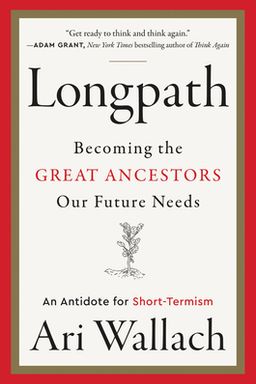
How do you make choices today that will still matter hundreds—or even thousands—of years from now? In Longpath, futurist and strategist Ari Wallach asks you to zoom out of your short-term mindset and see yourself as part of humanity’s much larger continuum. He argues that to thrive on an increasingly unstable and interconnected planet, we must consciously become great ancestors—people who act with the future in mind.
Wallach’s core claim is that our civilization is trapped inside what he calls the “short-term loop”—a culture addicted to instant gratification, quarterly profits, and short attention spans. Yet the global crises of our era—from climate change to social fragmentation—demand long-term, empathetic, and cooperative thinking. His answer is the Longpath mindset—a new way of seeing, feeling, and acting that carries you beyond the immediate moment and into the flow of generations past, present, and future.
Three Dimensions of Longpath Thinking
At its core, Wallach defines Longpath as having three integrated pillars. First is transgenerational empathy—a practice of seeing yourself as a link in a chain of being that stretches backward to your ancestors and forward to your descendants. Second is futures thinking—the ability to imagine multiple possible, plausible, and desired futures, rather than clinging to what Wallach calls the “Official Future” fed to us by institutions, media, and habit. The third pillar is telos, a Greek term meaning “ultimate purpose.” It asks: What is our collective destination as a species? What’s the point of all this?
Each of these pillars becomes a mental and emotional muscle that expands your sense of time and responsibility. The goal isn’t just to plan ahead—it’s to feel the long term inside your body, decisions, and relationships.
Why We Need Longpath Now
Wallach situates this mindset within what he calls an Intertidal era—a moment like the place between the ocean and the shore, where the ground shifts constantly and survival depends on adaptation. Humanity has reached such an Intertidal period, caught between the old systems that are collapsing (industrial capitalism, rigid nationalism, extractive economics) and the new ones still emerging. In these moments of chaos, small changes can create huge transformations—if we know how to channel them.
Rather than view the Intertidal as simply crisis, Wallach reframes it as opportunity. Just as barnacles, mussels, and sea life find ingenious ways to thrive in turbulent tides, we, too, can use change to reimagine how to live, work, and cooperate for centuries to come. The Longpath lens gives us tools to steady ourselves amid complexity and to intentionally shape evolution itself.
Emotion as a Guiding Force
A surprising theme in Wallach’s work is that emotion isn’t a distraction from rationality—it’s our evolutionary gift. He notes that Western culture, since the Enlightenment, has sidelined feeling as irrational. But Wallach argues that emotions like empathy, awe, gratitude, and compassion are technologies of long-term thinking. They are how we connect across time, how we imagine the experiences of the unborn or understand the mistakes of our ancestors. In essence, Longpath isn’t just about reasoning better—it’s about feeling more deeply.
This emotional dimension makes the concept highly accessible. You don’t need a PhD to start practicing Longpath; you only need to pay attention to your reactions, to pause before defaulting to short-term impulses, and to ask better questions about your impact over time.
Living as a Longpath Mindset
Throughout the book, Wallach shares a blend of science, philosophy, and lived stories—from a student missing a homework deadline to his own family’s legacy of Holocaust survival—to show how ordinary choices ripple through centuries. Longpath isn’t an abstract theory; it’s a daily practice. When you pause before reacting, when you choose sustainability over speed, when you ask, “What kind of ancestor am I being right now?” you’re Longpathing.
Wallach also balances optimism with urgency. He acknowledges that the same technologies connecting us can destroy us through misinformation, surveillance, or unchecked AI. Yet, precisely because humans are imaginative and emotionally adaptive, we can co-create futures that are more equitable, compassionate, and enduring—if we deliberately choose to.
From Individual Choice to Collective Culture
Ultimately, Wallach envisions a humanity that flourishes not through rugged individualism but through collective foresight and empathy. The Longpath mindset invites you to shift your identity from “me” to “we,” recognizing that your joy, your legacy, and your survival depend on how well you nurture the web of life around you. By combining introspection, empathy, and action, you contribute not only to your own well-being but to the flourishing of those yet to come. As Wallach reminds us, “There is no individual salvation.” Flourishing, like survival, is a team sport that spans generations.