
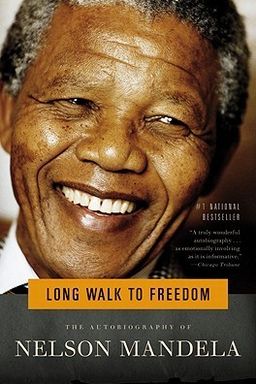
Long Walk to Freedom cover

Long Walk to Freedom

by Nelson Mandela

Nelson Mandela''s ''Long Walk to Freedom'' chronicles his life from humble beginnings to becoming an iconic leader against apartheid. This powerful autobiography offers profound insights into resilience, leadership, and the fight for justice, inspiring readers worldwide.

The Making of a Leader and a Liberation

What makes a person into a moral leader rather than a mere revolutionary? In Long Walk to Freedom, Nelson Mandela tells a story that interlaces personal growth, cultural identity, and political struggle to answer that question. His narrative is both autobiography and argument: it insists that freedom is not bestowed but earned through disciplined courage, strategic patience, and moral clarity.

You begin with Mandela’s childhood in Mvezo and Qunu, deeply embedded within Thembu and Xhosa traditions that teach respect, consensus, and service. His father’s defiance against colonial authority and his initiation at Tyhalarha become formative events—psychological blueprints for later political resilience. From clan structure and oral stories he learns that leadership begins with listening and ends with responsibility.

Roots, Education, and Awakening

Mandela’s path through Clarkebury, Healdtown, and Fort Hare shows how colonial education both opens and constrains minds. You see Christian schools imposing British norms while inadvertently nurturing African self-consciousness. The Student Representative Council boycott becomes his first test of principle over conformity. These formative years teach that adapting the enemy’s tools—law, language, and organization—can be revolutionary strategy. (Parenthetical note: like Gandhi’s law training or Martin Luther King Jr.’s theology, Mandela’s schooling converts Western forms into liberation instruments.)

Johannesburg and the Birth of Political Networks

The move to Johannesburg in the 1940s exposes racial capitalism and urban struggle. Working at Crown Mines and then as a clerk for Lazar Sidelsky under Walter Sisulu’s mentorship, Mandela enters networks that fuse economic survival and political organizing. Alexandra’s crowded townships teach him adversity; Sophiatown’s cultural ferment teaches pluralism. The partnership with Oliver Tambo in their law firm becomes both moral and professional activism—defending people criminalized by apartheid’s racial codes.

From Youth League to Defiance

The Congress Youth League’s creation in 1944 injects militancy into the aging ANC. Under Anton Lembede, Tambo, and Sisulu, Mandela learns that youthful passion must become disciplined strategy. The 1952 Defiance Campaign, organized around deliberate law-breaking and voluntary imprisonment, transforms nonviolent protest into mass mobilization—a moment when protest becomes nation-building. Yet the experience also exposes the limits of moral persuasion against violent repression, nudging Mandela toward political realism.

Charters, Trials, and Evolution

The Freedom Charter of 1955 expands beyond African nationalism into a multiracial vision—"The People Shall Govern"—built through collective input. That inclusivity provokes schism: Africanists found the PAC and later the Sharpeville crisis demonstrates how fractured leadership amplifies tragedy. The Treason Trial (1956–61) becomes Mandela’s lesson in legal endurance; the Rivonia Trial (1963–64) becomes his transformation into a global moral symbol. Together they show law as both weapon and theatre, capable of exposing injustice.

Repression, Underground, and Armed Struggle

State violence—bannings, killings, Sharpeville—forces strategy to evolve. The M‑Plan decentralizes organization; Umkhonto we Sizwe’s creation in 1961 marks the shift from protest to calculated sabotage. Mandela’s diplomacy across Africa and military training in Ethiopia illustrate continental interdependence. He and his comrades seek to preserve moral limits within violent necessity—sabotage without civilian harm—a balance between ethics and efficacy.

Prison and Persistence

The Rivonia verdict commutes death to life, sending Mandela to Robben Island. Prison becomes struggle in microcosm: hunger strikes, secret committees, and the “University” of collective learning. Mandela converts suffering into institution-building—legal aid for inmates, political lectures, and solidarity structures. Robben Island becomes not a tomb but a school of governance and resilience.

Loss, Negotiation, and Renewal

Behind the heroism lies cost: family separation, Winnie’s persecution, his mother’s and son’s deaths. Yet isolation becomes leverage: private talks with officials open channels to negotiation. Mandela’s patience and refusal to renounce principle enable CODESA and eventual multiparty democracy. The 1994 election closes the narrative with reconciliation and reconstruction—proof that leadership means transforming pain into possibility.

Core understanding

Mandela’s life maps freedom as a process from belonging to resistance to governance. You learn that moral conviction must be paired with strategic flexibility, and that dignity is both personal armor and national currency.


Roots of Character and Moral Grammar

Mandela’s childhood among the Thembu gives you the first key to his leadership style: culture as moral training. In Qunu he learns patience and respect, the Xhosa practice of consensus, and the belief that authority means listening before deciding. His father’s defiance before colonial magistrates plants the seed of resistance—leadership as courage grounded in tradition.

Ritual and Responsibility

Tyhalarha’s circumcision ceremony transforms boys into men who must serve the community. Mandela’s initiation name, Dalibunga, signifies creation and leadership; his clan name, Madiba, gives ancestral legitimacy. These traditions fuse pride with duty. (Note: similar to Chinua Achebe’s use of Igbo ritual to explore communal ethics.)

Family and Oral Learning

Through tales told by elders—chiefs, praise-singers, and griots—Mandela absorbs historical examples of justice. Village games and chores teach endurance and cooperation. The eventual move to Mqhekezweni under Regent Jongintaba exposes him to governance firsthand. These experiences shape his later notion that consensus and humility must guide political authority.

Lesson

True leadership is cultural before it is political; the moral grammar learned in family life becomes the syntax of public integrity.


Education and the Awakening of Conscience

Formal education introduces Mandela to both subjugation and possibility. Mission schools teach British civility and promote Western ideals of advancement—but inadvertently create thinkers capable of questioning domination. Miss Mdingane’s act of naming him “Nelson” symbolizes colonial reshaping; yet the young man uses that identity to access broader worlds.

Student Activism and Courage

At Fort Hare University, the boycott of the Student Representative Council becomes Mandela’s ethical crucible. He resigns rather than betray his peers, choosing collective dignity over personal education. This moment anticipates his later willingness to sacrifice career for faith and justice. Education thus becomes not assimilation but awakening.

Cosmopolitan Formation

Fort Hare’s environment merges diverse influences—African intellectuals like Z.K. Matthews and poet Krune Mqhayi—who restore pride in African heritage. Mandela and Oliver Tambo’s friendship blends academic debate with political vision. Sporting contests, dance lessons, and etiquette training prepare Mandela to move between worlds—rural and urban, African and European—without losing selfhood.

Insight

Education’s highest form is self-questioning; to learn under colonialism is to learn how to resist it intelligently.


Building Organizations and Strategies of Change

Mandela’s political maturity unfolds through organization. From Sisulu’s office to Youth League meetings at Orlando, he learns that ideas need structure. Direct action evolves under the Youth League’s guidance—Anton Lembede’s Africanism demands self-reliance; Oliver Tambo’s prudence ensures discipline; Mandela bridges idealism and pragmatism.

The Defiance Campaign and Its Lessons

In 1952 you witness the first mass coordinated resistance: volunteers defy unjust laws and embrace arrest. Mandela coordinates participants nationwide, demonstrating that organization transforms courage into collective power. The campaign reveals limits too—state retaliation and the need for long-term planning spur the creation of structures like the M‑Plan.

The Freedom Charter and Ideological Debate

Z.K. Matthews’ call for a unifying blueprint yields the Freedom Charter—a document that transcends race and becomes the moral constitution for the anti-apartheid movement. Its democratic ideals provoke state repression and internal division, yet it anchors the ANC’s philosophy. Mandela’s defense against charges of communism during the Treason Trial clarifies that equality and shared wealth are moral imperatives, not ideology.

Political principle

Organized resistance requires moral clarity and procedural skill—a movement succeeds when ethics and logistics reinforce each other.


From Nonviolence to Armed Struggle

Sharpeville’s massacre marks the turning point when faith in peaceful protest collides with state brutality. Nonviolence, once tactical, now seems insufficient. Mandela and his colleagues form Umkhonto we Sizwe in 1961 to pursue sabotage without civilian harm—a moral calibration balancing resistance and restraint.

Strategy and Structure

The MK High Command—Mandela, Joe Slovo, Walter Sisulu—systematizes sabotage operations against power stations and transport lines. Mandela’s diplomatic travels across Africa secure training in Ethiopia and political recognition from leaders like Nyerere and Haile Selassie. MK’s cell system reflects lessons from the M‑Plan’s decentralization. Its founding manifesto insists this new phase seeks freedom, not vengeance.

Ethics and Consequences

You learn how moral constraint defines MK’s distinctiveness: avoiding civilian deaths distinguishes revolution from terror. Yet the Rivonia raid and Operation Mayibuye papers expose the risks of preparation—how strategy can be criminalized. Mandela’s arrest closes the chapter of open resistance but inaugurates the era of symbolic leadership.

Strategic takeaway

When peaceful avenues collapse, responsibility demands finding courageous yet moral alternatives—the disciplined use of power without loss of humanity.


Imprisonment, Resistance, and Education

Robben Island becomes Mandela’s long test of endurance. Life sentences could silence speech but not thought. Under harsh warders and isolation, he and comrades build parallel institutions—legal committees, covert communications, and an internal governance system to sustain unity.

Solidarity and Tactical Discipline

From hunger strikes to administrative court tactics, prisoners fight injustice through procedure rather than impulse. Satirical nicknames and legal petitions turn humiliation into resistance. Helen Suzman’s interventions prove external oversight vital. Mandela’s principle—contest unfairness through law, not aggression—keeps morale intact.

The ‘University’ and Intellectual Continuity

Education inside confinement develops into a transformative force. Syllabus A covers history, economics, and ethics; drama performances and choir sessions nurture spirit. Mandela’s nighttime writing sessions and the smuggled manuscript become acts of preservation. Prison converts oppression into a classroom of leadership. (Note: this pattern echoes Vaclav Havel’s prison letters as acts of moral resistance.)

Enduring idea

Knowledge, when shared under duress, becomes defiance. Learning and solidarity turn captivity into construction—the building of future leadership in the ruins of constraint.


Personal Cost and Private Resolve

Mandela’s personal ordeals illuminate the psychological tax of leadership. While he leads from prison, his family endures systematic persecution. Winnie’s repeated arrests and bannings, his mother’s and son’s deaths, and decades of separation expose how oppression works through intimate cruelty.

Resilience and Sacrifice

Winnie’s activism—joining pass protests while pregnant, facing solitary confinement—reveals shared commitment to struggle even at domestic cost. Mandela’s acceptance of limited compromises (e.g., allowing a pass for contact) shows pragmatic love. Denied funerals, he turns pain into inner composure, modeling emotional endurance as political strength.

Family and Reconciliation

Later years bring bittersweet reconnection with daughters Zenani and Zindzi under restricted visits. These glimpses convince Mandela that freedom must include personal healing. His eventual separation from Winnie after release reflects honest acknowledgment that revolutionary dedication can fracture personal bonds. Leadership, he argues, cannot exempt one from human cost.

Emotional insight

Every public victory carries private loss; integrity means facing both without bitterness.


Negotiation, Transition, and Reconciliation

Mandela’s isolation in the 1980s becomes gateway to statesmanship. Secret dialogues with Justice Minister Kobie Coetsee and Intelligence head Niel Barnard mature into formal talks that dismantle apartheid step by step. His central principle—never renounce armed struggle without reciprocal actions—anchors negotiation integrity.

From Private Talks to Public Accords

The Groote Schuur and Pretoria Minutes establish phased confidence-building measures. The shift from individual to institutional dialogue culminates in CODESA, where constitutional compromises secure plural democracy. Mandela’s tone with President de Klerk balances forgiveness and firmness: reconciliation without erasure of guilt.

Violence, Crisis, and Leadership

Episodes like Boipatong and Bisho threaten collapse. Mandela’s reaction—public mourning coupled with strategic mass action—resurrects trust. The murder of Chris Hani shows how chaos can be quelled by moral authority; Mandela’s televised appeal for calm prevents civil war. His release, Nobel Prize, and presidency mark the transformation of prisoner into peacemaker.

Overarching idea

Reconciliation demands imagination: the courage to talk with oppressors, the patience to build institutions, and the foresight to turn vengeance into justice.

Dig Deeper

Get personalized prompts to apply these lessons to your life and deepen your understanding.

Go Deeper

Get the Full Experience

Download Insight Books for AI-powered reflections, quizzes, and more.