
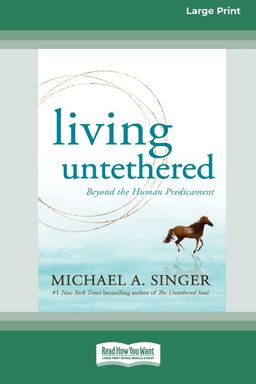
Living Untethered cover

Living Untethered

by Michael A Singer

Living Untethered guides you toward self-realization and unconditional happiness by teaching you to move beyond limiting thoughts and emotions. Discover practical strategies to embrace life fully, achieve peace, and experience true freedom.

Living Untethered: The Path to Inner Freedom

What would it be like to move through life free from inner turmoil—where external events no longer dictate your happiness, and peace flows naturally within you? In Living Untethered, Michael A. Singer, bestselling author of The Untethered Soul, argues that this kind of freedom isn’t just possible—it’s our true nature. Singer contends that the only thing standing between us and happiness is our resistance to reality. The book explores how we identify too closely with thoughts, emotions, and external events, tethering our consciousness to turbulence. To become truly free, Singer says, we must learn to let go and live from our deeper, unchanging awareness.

The Journey from Outer to Inner

Singer begins by shifting the fundamental question from "How can I control life to be happy?" to "Who is it that experiences all of this?" Instead of trying to fix external circumstances, he invites you to explore your inner world—the seat of consciousness itself. That shift represents a major paradigm turn in spiritual life. The book’s earliest chapters peel back layers of illusion: you are not your body, your thoughts, your emotions, or even your life story. You are the one who notices—all experiences arise within your awareness but are not you. This simple but profound realization opens a gateway to liberation.

From there, Singer grounds the philosophy in experience. Earth has existed for billions of years, he reminds us, yet our time here is a brief ride. If all of existence is unfolding with astonishing precision—molecules bonding, stars exploding, gravity forming galaxies—then perhaps your personal likes and dislikes aren’t the yardstick for reality. The first act of freedom, Singer argues, is acceptance of what is.

Life as a Flow of Experiences

The world outside, the mind, and the emotions—these, Singer says, are the three primary “rings” of our inner circus. Most of us live entangled in them. We react compulsively to the outer world; we chase certain thoughts and resist others; we grasp pleasant feelings and flee from pain. This creates an exhausting inner turbulence. Singer describes how all experience—whether joyful or terrifying—comes and goes like frames in a movie reel. In contrast, you remain. Awareness, the perceiver behind experience, is constant.

Through vivid analogies—a person stuck watching their inner “TV screen,” the brain as a sensory rendering system, or the heart as an instrument for emotion—Singer shows how we identify with the wrong aspects of ourselves. The key to inner peace is learning to relax and let the experiences pass through without grasping or rejecting. Acceptance isn’t apathy; it’s alignment with the flow of life. As the Buddha observed, suffering arises from resistance. Singer’s idea of living “untethered” is essentially a step-by-step manual for releasing resistance to the present moment.

From Science to Spirit: A Cosmic Context

What makes Living Untethered unique among spiritual books is its scientific grounding. Singer narrates the story of creation—13.8 billion years from the Big Bang to now—to show the impersonal nature of existence. Matter formed through atomic fusion in stars, our bodies are built of recycled stardust, and our consciousness emerged through the unfolding of the cosmos. Therefore, the moment in front of you isn’t personal—it’s a result of trillions of years of universal processes. This cosmic view humbles the ego, awakening awe and gratitude. When you realize life has been orchestrating itself long before you appeared, you can finally stop arguing with reality.

Singer then bridges this cosmic humility to personal practice: If you didn’t create the moment, why resist it? Whether a traffic jam, heartbreak, or illness, every event is part of that cosmic show. The only freedom we truly have is how we relate to it internally.

The Path of Letting Go

The second half of the book becomes deeply practical. Singer explains how “samskaras”—stored emotional impressions—distort perception, pull the heart and mind into turmoil, and shape how we experience life. Like psychological scar tissue, they narrow the flow of life energy (what yogis call shakti), making it hard to stay open. True spiritual work isn’t changing the outer world—it’s clearing these blockages by surrendering them as they arise. He calls this process the art of “relax and release.” Whenever something activates an old wound—anger, fear, or shame—rather than react, you step back into the seat of Self and let the wave of energy pass through you until it dissolves.

Singer provides tools such as meditation, mantra, positive thought replacement, and everyday mindfulness. He compares spiritual growth to learning an instrument: you start with “low-hanging fruit,” like minor annoyances, before handling deeper emotional storms. Over time, practice transforms your life into one of acceptance, transmutation, and service. The heart, once blocked by past pain, becomes a channel for constant love.

Living in Union with Life

Ultimately, Living Untethered leads to what Singer calls the “final surrender.” You no longer resist or cling; instead, your awareness merges with the flow of life itself—the shakti, or spirit. He connects this to universal teachings: the Yogic union of the Self with God, Christ’s call to surrender to the Father, or the Taoist way of nonresistance. Enlightenment, Singer says, is not a special mystical experience but a permanent state of deep peace and love that arises when the inner blockages dissolve completely.

In a world obsessed with control, Singer’s message is quietly radical: Stop trying to fix life. Learn to dwell as awareness itself, witnessing each moment with openness. When you stop fighting what is, you discover that life has always been beautiful. In this book, Singer blends quantum physics, psychology, and timeless wisdom into a single, practical invitation—to stop resisting, start accepting, and live untethered.


You Are Not Your Mind or Body

Singer’s starting point is deceptively simple: you are not the objects of your experience—you are the conscious awareness experiencing them. He illustrates this by asking readers to imagine looking at three photos in sequence. The pictures change, but the “you” who observes them doesn’t. Extend that logic to your body and life. Your body has transformed countless times since childhood, yet the one watching remains the same. This enduring consciousness, not the perishable body or fleeting thoughts, is who you truly are.

Consciousness, the Silent Witness

You don’t stop existing when you stop thinking—you’re aware that there are no thoughts. That silent awareness is your real essence. Singer encourages you to sit before a mirror and ask, “Who sees what I’m seeing?” The answer reveals the subtle but profound distinction between the seer and the seen. This idea echoes teachings from Ramana Maharshi’s question, “Who am I?” and parallels Eckhart Tolle’s notion of the “watcher” in The Power of Now. Both point to awareness as the immutable background behind all experience.

Becoming the Conscious Receiver

Every second, sensory data—sights, sounds, smells—streams into your nervous system, where it’s rendered into a mental image. But Singer stresses that you’re not perceiving the outer world directly; you’re observing internal representations in your mind. It’s as if you’re sitting in a cosmic theater, watching life on a mental screen. Recognizing this allows you to disentangle your awareness from what you perceive. You’re the screen, not the movie. When you stay rooted in the silent witness, life’s storms pass without pulling you in.

This awareness-centered view redefines spirituality as not about acquiring beliefs but about remembering who you are. The body ages, roles change, but the observer is the same infinite presence that existed at the moment of your birth. Real awakening begins here—with identity shifting from the objects of consciousness to the source of consciousness itself.


Acceptance as the Highest Spiritual Act

Singer emphasizes that acceptance—not control—is the true foundation of spirituality. Resistance to reality, he says, is the root cause of all suffering. Trying to make life conform to personal preferences is like arguing with gravity—it only creates pain. The spiritual task is to stop resisting and start working with life’s flow. Acceptance doesn’t mean passive resignation; it means choosing inner freedom over inner friction.

The Impersonal Nature of Reality

Drawing from physics, Singer dismantles the illusion that life’s events are personal. The atoms forming every moment began in stars billions of years ago. The molecules composing the coffee mug in your hand, the breath in your lungs, even your DNA—all trace back to cosmic events. By realizing this, you loosen the grip of egoic judgments: “I like this; I hate that.” Every moment is simply the result of universal forces unfolding. When you understand that, you stop taking life personally and begin to experience awe instead of anxiety.

Surrendering the Demand for Otherwise

Singer invites you to notice how often you tell life, “This shouldn’t be happening.” That statement is the ego’s rebellion against reality. He suggests replacing that inner argument with a simple “thank you.” Once you surrender the need for things to be different, situations—even pain or loss—become part of a larger dance. Life’s job is to flow; yours is to remain open.

“The moment in front of you took billions of years to arrive. How arrogant to say you don’t like it.”

Acceptance, therefore, is not weakness—it’s wisdom. When you allow life to be as it is, you experience the same peace scientists feel when they stop denying the laws of nature. You can’t fly by rejecting gravity; you fly by understanding and working with it. Likewise, spiritual peace comes from cooperating with the laws of existence instead of resisting them.


How the Personal Mind Is Born

Singer reveals how the pure, impersonal awareness of Self becomes entangled in what he calls the “three-ring circus” of perception, thought, and emotion. Initially, the mind is an empty field, a pristine canvas that reflects experiences like a mirror. But when we start judging experiences as pleasant or unpleasant, focusing consciousness on them with willpower, we freeze them in place. This fixation builds mental residue—the birth of the personal mind.

The Fall from the Garden

Every time you cling to what you like (the butterfly) or resist what you dislike (the rattlesnake), you create a “samskara,” or stored impression. These trapped energies distort how new experiences pass through you. Soon, reality isn’t experienced directly—it’s filtered through layers of old pain and desire. Singer likens this to burn-in on a plasma screen: past images linger and distort whatever’s playing now. This is the psychological origin of suffering.

Once stuck, these patterns construct the psyche—a composite of beliefs, fears, and preferences that says “This is me.” But it’s a false self, built from unfinished experiences. Each person’s psyche is unique because everyone clings to and resists different things. Our very sense of identity is thus conditioned by what we couldn’t accept before. Freedom begins when you stop feeding this construction.

Witnessing the Inner Chaos

To watch the mind’s automatic talking—the inner narrator rehearsing worries or replaying pain—is to begin liberation. Singer reframes automatic thought as the psyche trying to release stored energy, just as dreams do at night. The mind isn’t malicious; it’s simply jammed with unprocessed energy. Witnessing it, instead of fighting it, allows those energies to dissipate naturally. The more you observe without judgment, the clearer your inner sky becomes.


The Heart: Gateway to Liberation

Singer devotes a large part of Living Untethered to understanding the heart—not as a symbol of romance, but as an energetic center of emotional flow. He describes it as an instrument playing the symphony of life. Emotions are the music; your awareness is the listener.

Opening and Closing the Heart

When the heart is open, you feel light, loving, and inspired. When it’s closed, you feel tight, fearful, or numb. What makes it open or close? Not events themselves, but your stored patterns from the past. A word, a tone, or a memory can hit a blockage, closing the heart instantly. Singer teaches that love isn’t something you get from others—it’s your heart’s natural state when unobstructed. We make the mistake of projecting the source of love onto people or situations, which makes it conditional. True love never depends on external triggers—it’s the upward flow of shakti through a clear heart.

Working with the Heart’s Energy

Each time you resist emotional pain, you shove it deeper, creating congestion in your inner energy flow. The path is not suppression (“don’t cry”) or expression (venting anger), but pure experience—allowing the emotion to arise and pass without interference. Over time, this process purifies the heart, allowing energy to rise to higher centers. Singer terms this “transmutation.”

When the heart is completely open, love flows naturally, and joy becomes unconditional—it no longer depends on what happens outside.

According to Singer, great saints and mystics—Christ, Yogananda, the Buddha—lived from this fully open heart. It’s not that their lives lacked challenge; it’s that their inner energy flowed freely, sustaining them with divine joy. That's available to everyone willing to stop resisting the full range of their emotions.


The Practice of Letting Go

For Singer, spiritual growth is less about doing and more about undoing. Letting go is the practice of releasing inner resistance when life hits your samskaras. He distills it into three practical methods: positive thinking, mantra, and witness consciousness.

Training the Mind

Positive thinking isn’t denial—it’s redirecting willpower. When the mind automatically generates negative thoughts (“I hate this traffic”), you can willfully introduce positive ones (“This is an opportunity to slow down”). Over time, you recondition mental grooves from complaint to calm. Mantra takes this further by installing a steady vibration—whether “Om,” “peace,” or even “I’m always fine.” When ingrained, it acts like background software buffering the mind against turmoil. Both methods eventually lead to the third and highest practice: simple awareness.

Relax and Release

Witness consciousness means that when emotional energy surges, you consciously relax instead of resisting. Singer’s favorite cue: “Relax your heart.” This might happen in traffic, during an argument, or when fear spikes. The key is noticing the tension before it controls you. Relaxation provides space for the blocked energy to exit—much like loosening your grip on a rope ends a tug-of-war. He makes it simple: “First relax, then lean away.” Distance dissolves identification; awareness naturally calms the storm.

As practice deepens, everyday triggers become opportunities for growth. Weather, traffic, criticism—all become chances to rehearse inner release. The “low-hanging fruit” come first, preparing you for bigger tests like loss or betrayal. Slowly, letting go becomes who you are, not something you do.


Transmuting Energy and Living in Service

Once the inner blockages dissolve, the same energy that once caused turmoil becomes a source of bliss, creativity, and love. Singer calls this transmutation—the conversion of trapped emotional energy into spiritual fuel. As energy rises through clear channels, life no longer revolves around surviving moods but serving the moment before you.

From Struggle to Surrender

When you stop clinging to the personal self, your energy stops moving outward toward control and begins flowing upward toward expression. You become a vessel of peace, not a personality seeking gratification. The world still unfolds—people criticize, events change—but your responses come from stillness, not need. Every moment becomes an opportunity to “raise the energy of what is before you.” Picking up a piece of litter, consoling a friend, or handling a crisis all become sacred acts.

The Final Surrender

Ultimately, Singer guides you to total merger with the inner flow itself. At this stage, surrender becomes devotion—love for the divine energy that animates everything. Enlightenment isn’t an escape from the world; it’s being in the world but not of it. Freed from the compulsions of the psyche, you serve life as life serves through you. Your motive becomes pure—no manipulation, no reward, only love expressing itself.

“The highest life is when every moment passing before you is better off because it passed before you.”

This purity of intent, he concludes, is the true hallmark of spiritual awakening. To live untethered is not to withdraw from life, but to engage it fully, fearlessly, and lovingly. The inner flow, once buried beneath layers of resistance, becomes your constant source of strength and joy.

Dig Deeper

Get personalized prompts to apply these lessons to your life and deepen your understanding.

Go Deeper

Get the Full Experience

Download Insight Books for AI-powered reflections, quizzes, and more.