
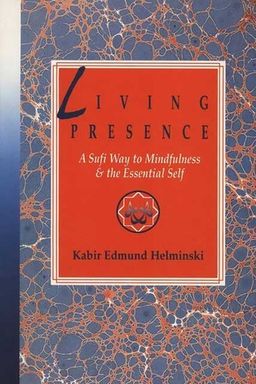
Living Presence cover

Living Presence

by Kabir Edmund Helminski

Living Presence explores Sufism''s ancient teachings as a remedy for our ego-driven world. By becoming mindful and connecting to the infinite spirit, readers can transform their lives, embracing kindness, intention, and vitality. This book offers practical insights into living more humanely in today''s fractured society.

Living Presence: The Sufi Path to Mindfulness and the Essential Self

Have you ever felt like you were moving through life half-awake—caught between tasks, endlessly reacting, but rarely present? Kabir Helminski’s Living Presence (Revised): The Sufi Path to Mindfulness and the Essential Self offers a radical yet warmly human invitation: to awaken fully into presence—the condition of being truly here, consciously connected to the Divine source of life that pulses through every breath you take.

For Helminski, a renowned Sufi teacher and translator of Rumi, presence is not a mystical abstraction but a deeply practical state of awareness. It bridges spirituality and ordinary living, offering a way to integrate mind, body, and soul. He argues that the human being is intended to be a mirror—a reflector of Spirit in material form. Yet modern culture, dominated by distraction and ego, has made us forget this purpose. Our task, then, is to awaken remembrance—the conscious return from fragmentation to wholeness, from self-absorption to soulful aliveness.

The Core Proposition: Presence as the Human Work

Helminski’s central argument is that human beings were created to embody the Divine qualities—compassion, creativity, patience, humility, and love—yet we cannot do so while trapped in mechanical habit. The work of life, or what Sufis call the Great Work, is to awaken these qualities through conscious presence. This is the Sufi version of mindfulness—an integrated, embodied, spiritually charged awareness that connects us to the Source. Through the cultivation of presence, our self-centered mind comes into relationship with Spirit, giving birth to what he calls the “soul.”

The book journeys through the anatomy of the human psyche—self, heart, and spirit—showing how these faculties interact. The self (ego) experiences thoughts and emotions; the heart senses love, conscience, and subtle knowing; and the spirit is the radiant essence of Life itself. The more our self aligns with spirit, the more “soulful” we become. Thus, Living Presence is both a map and a manual for the evolution of consciousness.

The Spiritual Landscape: From Fragmentation to Integration

Helminski frames contemporary life as a kind of spiritual exile. Humanity dwells in what he calls “the city of separation,” enslaved by egoism, fear, and endless distraction. We chase fleeting pleasures, define ourselves by social roles, and mistake mental chatter for life. Yet, as the Sufi tradition teaches, humility, remembrance (dhikr), and attentiveness can restore our connection to the Source. Presence turns the inner chaos into a living temple of awareness.

He describes how this process unfolds: first, by discovering inner stillness through attention and meditation; second, by balancing inner and outer life, service and contemplation; and finally, by dissolving the ego in love—'dying before you die,' as Rumi puts it. The goal is not withdrawal from the world but integration—to live consciously in the body, heart, and intellect so that every gesture becomes worship.

The Transformative Method: Attention, Remembrance, and Love

Throughout the book, Helminski offers precise tools for awakening. Attention is the cornerstone: by observing our thoughts, emotions, and bodily sensations, we gather the scattered fragments of our being. Remembrance then deepens this process, tuning the heart to divine presence through prayer, silent observance, or the invocation of the sacred (dhikr). And above all, love—ordinary and divine—acts as the transformative solvent, dissolving the illusion of separateness. This triad forms a spiritual science of becoming conscious.

Helminski stresses that awakening is not meant to make you “special.” True spirituality leads to humility, not performance. The ultimate fruit of presence is service—to give of oneself naturally, in alignment with what he calls the “Divine Milieu” that pervades existence. Those who embody presence radiate warmth, clarity, and love, becoming catalysts for transformation in others.

Why This Matters Today

In a world of overstimulation and fractured attention, Helminski’s teaching feels prophetic. Long before 'mindfulness' became a self-help buzzword, Living Presence articulated a vision of consciousness far richer than relaxation or stress management. The Sufi path insists that true awareness must be rooted in divine remembrance—it is mindfulness infused with love and aim. This vision resonates with the teachings of mystics like Thomas Merton, Eckhart Tolle, and Thich Nhat Hanh, yet its language is uniquely Sufi: poetic, embodied, and relational.

Ultimately, Helminski suggests, spiritual maturity means living as if God were as near as your own heartbeat. The measure of awakening is not mystical experience but the depth of one’s humility, gratitude, patience, and love. Presence, remembrance, and Love are not escape routes from the world but the very ways through which the world is sanctified. “Our task,” he reminds us, “is to create the civilization of Paradise here on Earth.”


Self, Heart, and Spirit

To understand the path of awakening, Helminski begins with a simple but profound model: the human being as a trinity of self, heart, and spirit. Each aspect corresponds to a different level of awareness, and the balance among them determines whether we live in fear and confusion or in love and creative intelligence.

The Self: Personality and the False I

The self is the cluster of thoughts, emotions, habits, and social conditionings that make up our everyday identity. It is the “I” that wants to be recognized, defended, and comforted. The self can either function as a useful agent or as a tyrant—what Sufis call the nafs or lower self. When unillumined by spirit, this self becomes reactive, self-centered, and fragmented. It feeds on comparison and thrives on the illusion of separateness.

Helminski notes that most of us confuse this personality for our true being. We are enslaved to our own roles: the “hard worker,” the “good parent,” the “wounded victim.” Spiritual work begins when awareness turns inward and notices this machinery in action. Meditation, presence, and intention slowly unmask the personality’s defenses, leading to humility and openness.

The Heart: The Bridge Between Self and Spirit

If the self is the actor, the heart is the director. In Sufi psychology, the heart is not merely emotional but deeply intelligent—a subtle organ of knowing that perceives through love. It contains both subconscious and supraconscious faculties, allowing communication with the unseen world. When the heart is pure, it becomes a mirror capable of reflecting Divine Light. When clouded by ego and distraction, it distorts reality.

“The mirror of the heart,” Helminski writes, “becomes clear through remembrance.” Every act of conscience, kindness, or stillness polishes that mirror. Even ordinary interactions—listening with empathy, forgiving another—are spiritual practices when done with presence. The heart therefore functions as the meeting ground of humanity and divinity.

The Spirit: The Infinite Source Within

The spirit is the essence of our being, the “breath of God” mentioned in the Qur’an. It is beyond space and time, a direct emanation of the Divine that animates all life. We don’t possess this spirit—it possesses us. When the self and heart come into harmony, the spirit shines through, transforming the personality into a transparent lens for creativity, love, and wisdom.

For Helminski, spiritual development means progressively shifting identification—from the ego to the heart, and from the heart to the spirit. Only then do we discover that we were never separate from the Whole. This experiential knowing is what the Sufis call gnosis, or direct knowing—something that philosophers only describe but mystics embody.

(In comparison, psychologist Abraham Maslow’s concept of self-actualization parallels this movement: from basic survival needs to peak experiences and self-transcendence. But in Sufism, Helminski stresses, the journey is animated not by ambition but by love.)


Polishing the Mirror of Awareness

“There is a polish for everything,” said the Prophet Muhammad, “and the polish for the heart is the remembrance of God.” Helminski builds much of his teaching around this metaphor. The heart is like a mirror that has become dull from layers of dust—our fears, reactions, and conditioning. Spiritual practice is simply the act of polishing this mirror so that it can reflect divine light clearly once again.

Layers of Dust: The Conditioning of the Self

The “dust” comprises our compulsive emotions, attachments, and misinterpretations of life. We suffer because we take these distortions as reality. A person obsessed with others’ approval, for example, is trapped in a circle of anxiety that prevents real seeing. Another may live in resentment, unable to receive the grace surrounding them. Awareness, Helminski explains, is the solvent that begins to dissolve these layers. Without judgment, we observe how fear or anger arises and passes. With each observation, a little light shines through.

The Practice of Presence

To polish the heart, one must live with conscious attention. Presence is not limited to meditation cushions—it extends into daily tasks. Washing dishes, driving, listening to a friend: all become opportunities to practice being here. This simple awareness realigns the conscious and subconscious, gradually harmonizing our inner world. As Helminski writes, “Every act done with presence is remembrance.”

He also cautions that culture itself polishes in one way and dulls in another. Modern life floods us with images of consumption, aggression, and competition, all of which cloud perception. Recognizing this, we must consciously choose what we allow to impress the mind—refusing to “eat spoiled food” in the form of constant media negativity.

From Reflection to Radiance

Eventually, polishing leads not only to reflectivity but to radiance. The heart becomes luminous, a lamp rather than a mirror. In Rumi’s words—whom Helminski often quotes—the human being becomes “a witness of infinite beauty.” Thoughts and emotions cease to dominate perception; instead, every moment becomes a window onto the Real. This purified awareness does not retreat from life—it shines through it.

(This echoes Zen master Dōgen’s teaching that enlightenment is not somewhere else but “to carry yourself forward and experience the ten thousand things through being.” Helminski’s Sufi vocabulary gives this insight a devotional warmth—a seeing that is inseparable from loving.)


Overcoming the Tyranny of the False Self

Helminski calls the ego without spirit “a tyrant.” In Living Presence, he devotes several chapters to understanding and transcending the false self—the bundle of fears, desires, and roles that separates us from reality. The goal is not to annihilate the ego but to transform it into a servant of the heart.

Understanding the False Self

The false self (what Sufis call nafs al-ammara) is shaped by fear and desire. It’s the inner chatter that says “I am better than others,” or “I am worthless.” Both self-importance and self-hatred are two sides of the same illusion. This egoic mind seeks control by projecting meaning outward—acquiring possessions, status, or recognition to fill an inner void.

However, as Helminski observes, repression of the ego is as unhealthy as indulgence. Many spiritual seekers fall into “ego wars,” trying to destroy their humanness rather than integrating it. True humility means befriending the ego, not hating it—channeling its drive and energy toward service and creativity.

Transformation Through Love and Awareness

Helminski suggests that love is the only real tamer of ego. Where self-condemnation would harden us, love melts us. Through presence and remembrance, the tyrant self awakens to the Source it had forgotten. Each time we remember to serve others rather than our own needs, the ego learns its rightful place. In this alchemy, power becomes grace.

The Community of Egolessness

The surrender of the ego naturally births community. A circle of lovers—those who live in remembrance—creates what Helminski calls “a civilization of Paradise.” The Sufi lodge, or dergah, represents such a community: refined manners, service, generosity, and friendship become the outer reflection of inner freedom. Practicing humility here is not self-erasure but rootedness in the truth that all being is One.

(This insight parallels the Christian contemplative Thomas Keating’s teaching that “the dying of the false self” leads to a new Self-in-God. Both traditions emphasize transformation through love’s humility rather than denial.)


Listening Within: The Path of Conscious Attention

Meditation, for Helminski, is not escapism but a disciplined act of listening. He calls it “the refinement of attention”—the way we polish the awareness so we can hear the whisper of Spirit beneath the mind’s chatter. By learning to listen within, you alter the structure of the brain itself and awaken what he calls the “real I.”

Awakening Attention

Attention is the first act of will. What you attend to, you become. Helminski distinguishes between passive attention (reacting to random stimuli) and active attention (directed awareness). With practice, active attention generates its own energy—allowing freedom from compulsive thinking and emotional inertia. Meditation, sensing the body, and conscious breathing all activate this higher form of attention.

From Observation to Presence

As you listen inwardly, you begin to witness the mechanisms of thought without identifying with them. You see how worry carries over from one context to another, how past experiences shape the present. The observer grows stronger, producing an inner spaciousness that liberates life energy trapped in reaction.

Helminski notes that not all inner dialog is harmful; the mind’s associative process can be creative if guided by real questions and purpose. The key is to sustain presence while letting the subconscious digest experience. “Living with a real question,” he writes, “makes the mind harmonious and creative.”

Perceiving Being

Listening within trains us to perceive Being—the timeless, changeless quality behind forms. Normally, the mind registers only differences and movement, but through conscious attention we can sense the stillness behind phenomena. This dual awareness—of the moment’s dynamism and its eternal background—is the essence of meditation. In this state, thought becomes creative rather than reactive.

(Like Eckhart Tolle’s “watcher” or Krishnamurti’s “choiceless awareness,” Helminski’s practice anchors awakening in the Sufi dimension of love and remembrance. The observer is not detached rationality but a loving presence that feels through the heart.)


Faithfulness, Grace, and the Alchemy of Effort

Helminski explores how faith and effort weave together as the fabric of transformation. In Sufism, faith (iman) is not blind belief but trust substantiated by knowledge. It arises when the heart recognizes the benevolent intelligence behind all events. Effort, meanwhile, is not strain but the alchemical tension between yes and no within us—the discipline that awakens higher will.

Faith as Centering the Heart

Faith means having a single reference point—a magnetic center around which your being organizes. Without faith, you are fragmented, chasing conflicting aims. The faith Helminski describes is not dogmatic; it’s experiential trust in the unfolding mercy of existence. Like the mystic Rabia al-Adawiyya, who refused to pray for paradise or fear hell, this faith expresses radical devotion: wanting only what God wants.

The Creative Power of Effort

Effort transforms potential energy into conscious will. Every real decision brings Being into action. When you affirm something—patience, generosity, forgiveness—a denying force inevitably appears: distraction, frustration, or doubt. The alchemy of effort happens when you center yourself amid these polarities. Instead of repression, you transmute friction into awareness. Sufi teachers call this “remembering through difficulty.”

Grace and the Three Keys

Helminski frequently cites the mystic Simone Weil: “We must not wish the disappearance of our troubles but the grace to transform them.” Grace, he writes, is always flowing from the Source; it is we who must become receptive. The three keys that unlock grace are humility, gratitude, and love. Through these, difficulties become teachers and even suffering reveals mercy in disguise.

In combining faith and effort, Helminski restores balance to a culture addicted to both overexertion and cynicism. Faith grounds you in trust; effort gives that trust arms and legs. Together, they constitute what he calls “the alchemy of conscious evolution”—human beings participating in the divine transformation of life itself.


The Religion of Love and the Freedom of the Soul

In his later chapters, Helminski shifts from the psychology of presence to the metaphysics of love and freedom. Drawing from Rumi, Ibn Arabi, and the Qur’an, he presents the Sufi path as the religion of Love—a living current that transcends dogma and reveals the essence of all faiths.

Love as the Force of Being

“Never think of love as the goal,” his teacher once told him; “Always think of it as the cause.” Love, in Sufi cosmology, is the creative power of existence itself—the divine yearning that brings the universe into being. Every attraction, from molecular bonding to human affection, expresses this underlying love. To purify our love is to tune our individual being to the cosmic harmony of Spirit.

Helminski identifies three levels of love: desire (eros), friendship (philia), and unconditional generosity (agape). Each level refines the soul’s capacity for relationship, expanding from self-centered longing to universal compassion. The more we love consciously, the more transparent we become to the “Beloved” who lives through us.

Freedom Through Surrender

Freedom, paradoxically, arises through surrender. The ego seeks power and control, but the soul knows liberation only by aligning with divine will. True freedom, Helminski writes, is the freedom not to obey the ego’s demands. The journey from survival to service uncovers the joy of being in harmony with the Creative Power. “Ultimate servanthood is ultimate freedom.”

This teaching echoes in Rumi’s poetry: “Without cause God gave us Being; without cause give it back again.” When we live as loving instruments of the Whole, we transcend the duality of gain and loss. Love becomes not an emotion but a state of participation in divine creativity.

A Civilization of the Heart

Helminski concludes that awakening is not private ecstasy but the foundation of a new culture—a civilization rooted in compassion, respect, and shared remembrance. The Sufi lodge, he notes, was historically a social microcosm where art, ethics, and service were one. Today, he calls for communities of conscious lovers who embody presence in action: “Our ecological function is Love.”

(In spirit, this vision parallels Teilhard de Chardin’s “Omega Point” and Martin Buber’s “I–Thou” relationship—both seeing evolution as a movement toward unity through love. For Helminski, this is not philosophy but lived prayer.)

Dig Deeper

Get personalized prompts to apply these lessons to your life and deepen your understanding.

Go Deeper

Get the Full Experience

Download Insight Books for AI-powered reflections, quizzes, and more.