
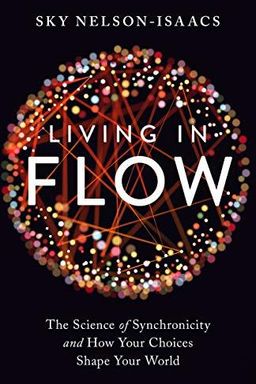
Living in Flow cover

Living in Flow

by Sky Nelson-Isaacs

Living in Flow offers a transformative journey into the science of synchronicity, revealing how to align your life with natural rhythms. Discover practical strategies for overcoming fears, embracing authenticity, and creating a life filled with ease, joy, and fulfillment.

The Responsive Cosmos

The Responsive Cosmos

What if the universe doesn’t merely act upon you but responds to how you act within it? In Living in Flow, Sky Nelson‑Isaacs proposes that reality is not static but responsive—a dynamic field that aligns with your intentions, emotions, and choices. He blends insights from physics, psychology, and spirituality to explain how everyday coincidences, or synchronicities, can reflect meaningful connections between your inner world and the outer one.

Flow and Synchronicity: Two Faces of Participation

Flow, based on Mihaly Csikszentmihalyi's famous concept, is the state of complete absorption in activity, when skill and challenge balance and self-consciousness dissolves. Synchronicity, from Carl Jung, describes meaningful coincidences that lack clear causal explanation. Nelson‑Isaacs argues they are connected: when you act from flow, synchronicity increases because the world reflects your internal harmony. Fleming’s penicillin discovery exemplifies this—he was open and observant, and the world responded with insight. Similarly, a student named Evita’s bold self‑advocacy led to a surprising opportunity—an academic connection that unlocked her chosen program. When you align with life, life aligns with you.

Physics as Metaphor and Mechanism

Nelson‑Isaacs borrows language from quantum mechanics to build his model. Quantum measurements depend on how the observer participates; so do life’s outcomes. The book’s physics stories—Wheeler’s delayed‑choice experiments and Bohm’s implicate order—serve as analogies, not mystical proof. They reveal that observation might retroactively shape history. From that viewpoint, your actions bias which branches of possibility mature into reality. (Note: mainstream physics does not fully endorse this extrapolation, yet the metaphor remains valuable for understanding agency.)

The Tree of Possibilities: A Living Map of Choice

Visualize all potential futures as branches on a tree. Each branch contains people, events, and experiences. When you act, you climb and select branches, giving weight to particular outcomes. Nelson‑Isaacs calls this meaningful history selection: the act of influencing which possible history unfolds through your alignment and emotion. Apples on the tree symbolize qualitative experiences—connection, safety, creativity—rather than literal events. When you orient your actions toward a feeling (say, belonging), apples representing that feeling accumulate. You may not meet your friend Anne, but you might meet Maggie and achieve the same qualitative fulfillment. Actions are not mechanical causes but expressive signals that bias probability space toward meaning.

Flow as Practice, Not Belief

This responsive-cosmos model is not magical thinking. It’s a pragmatic invitation to notice patterns and act with awareness. Flow becomes the discipline of staying present enough to perceive synchronicity, while synchronicity becomes the feedback loop showing that your choices matter. The outcome may not always be what you expect, but when you act authentically, boldly, and from the heart, events often organize themselves meaningfully.

Core insight

The universe is not random or moralistic—it is responsive. When you act from clarity and feeling, you participate in selecting which possible version of reality manifests, and synchronicity is the signature of that participation.

Throughout the book Nelson‑Isaacs bridges physics with lived experience to teach a practical art: how you can combine emotional honesty, intentional action, and an open heart to move through uncertainty with meaning. Flow is not escape—it’s engagement—and synchronicity is the echo of your participation in a responsive world.


Feelings as Navigational Signals

Feelings as Navigational Signals

Nelson‑Isaacs insists that feelings—not thoughts—steer meaningful choices. Borrowing from Antonio Damasio and Paul Ekman, he distinguishes emotions (biological reactions) from feelings (our conscious awareness of those reactions). Feelings are how you sense the direction of flow: they reveal what experiences carry life-significance. Acting while numb or dishonest about your emotions breaks alignment with the responsive cosmos.

Qualia and the Life Urge

Philosophers call the texture of lived experience qualia—the feel of tasting chocolate or being seen by a friend. When you seek flow, you are really seeking particular qualia: peace, connection, inspiration. Each action acquires meaning by the quality of experience it tends to produce. Cleaning the kitchen becomes meaningful if you anticipate the feeling of calm it brings. This turns feeling into a guiding compass rather than a byproduct of success.

Hidden Feelings and Synchronicity

Unacknowledged emotions—grief, shame, insecurity—still influence which branches of the tree grow apples. They send signals to the world, whether you notice them or not. An unresolved conflict can produce misaligned synchronicities that repeat until the hidden emotion surfaces. The author describes moments in his family and home renovation when pausing to feel rather than control shifted circumstances—opening creative solutions that logic couldn’t find. To create meaningful coincidences, you have to know what you actually feel.

Practical takeaway

You influence external outcomes not by manipulating circumstances but by transforming your inner stance. Feel authentically first, then act from that clarity, and the world will often respond in kind.

Learning to recognize and align your feelings makes flow reliable rather than accidental. It is the first gate in cultivating synchronicity and the bridge between psychological reality and physical responsiveness.


Choosing Branches of Possibility

Choosing Branches of Possibility

In Nelson‑Isaacs’s signature metaphor—the Tree of Possibilities—each branch represents a potential future. Your actions, intentions, and feelings determine which branch thickens and which dwindles. You can imagine every choice as a move that selects a cluster of experiences. Once you commit, missed branches dissolve; dwelling on what might have been ("counterfactual regret") confuses the physics and the psychology of responsiveness.

Apples as Experiential Rewards

Apples decorate branches that produce desired qualitative experiences. They are metaphors for connection, creativity, or peace. When you repeatedly act toward certain feelings—practicing, asking, networking—you increase the density of apples there. Evita’s proactive call to her department grew apples of opportunity that later ripened into acceptance. The point is not to predict outcomes but to sustain your participation until you reach apples that match what you’ve been feeling toward.

Counterfactual Indefiniteness and Presence

Once a choice is made, alternate branches are no longer part of your lived universe. Regretting paths not taken wastes attention that could nourish the branch you inhabit. Physics calls this “counterfactual indefiniteness.” In practical terms, it’s a call to presence: inspect the apples within reach instead of mourning imaginary ones. Flow thrives on that acceptance.

Guiding principle

Acting consistently in the direction of feelings you value weights the branches where those experiences can appear. You are shaping probability through purposeful participation.

Understanding life as a tree of possibilities helps you view coincidences as feedback and regret as noise. You may not control the whole tree, but your orientation decides what kind of fruit can grow where you stand.


Symbolic Momentum and Bold Action

Symbolic Momentum and Bold Action

Synchronicity gains strength through repetition. Nelson‑Isaacs calls this phenomenon symbolic momentum—a cumulative weight of aligned choices that makes certain outcomes more probable. Momentum emerges not from speed but from coherence: when your actions, values, and feelings aim toward a consistent experience, reality begins to lean that way.

The Power of Repeated Choice

Like compounding interest, every small step adds symbolic weight. Sending résumés, composing music, or making calls each puts energy toward a branch’s apples. Nelson‑Isaacs uses examples from his own career, such as receiving an unexpected call to direct music after months of aligned effort. These patterns mirror statistical amplification—small intentional acts accumulate until something tips into manifestation.

Boldness Creates Asymmetry

Bold risks reshape the tree itself. A decisive leap breaks uniform patterns, introducing asymmetry that favors desired outcomes. Evita’s bold phone call didn’t guarantee success; it created a condition where success could occur. The author reframes courage as practical physics—a way to re-weight reality.

Collective Momentum

Symbolic momentum scales to societies. Movements like #MeToo or civil rights transformations show how countless small honest acts can abruptly reconfigure culture. The same dynamic that operates in personal synchronicity operates collectively: focused choices ripple outward and become visible change.

Leverage point

A single courageous act carries nonlinear influence. When aligned with authenticity and heart, one bold decision can tilt many branches toward constructive outcomes.

Symbolic momentum teaches you to trust the long game. Every authentic gesture reshapes probabilities. Persistence and boldness—tempered by compassion—are the means by which synchronicity becomes a reliable companion rather than a lucky accident.


Living from the Heart

Living from the Heart

Nelson‑Isaacs contrasts two orientations: ego and heart. The ego acts from fear, evaluation, and protection. The heart acts from compassion, service, and authenticity. The heart lens unlocks flow because it dissolves self-consciousness and focuses awareness on connection.

Heart over Ego

When you act from ego—trying to look competent or avoid failure—you restrict creativity. When you act from heart, you tune into what you love and serve someone else’s moment. Fear recedes as meaning expands. The Cheeseboard night, when the author gave his nephew and daughter the stage rather than taking it himself, embodies this principle: the small, heart-led choice created synchronicity that benefited everyone.

The Social Dimension of Heart

Heart-based living connects to community and justice. The author notes that privilege can dull urgency for authenticity, while struggle can push people closer to their core humanity. Acting from heart therefore not only creates personal synchronicities but expands empathy across difference. Awareness of privilege becomes another gateway to meaningful participation.

Heart practice

Shift attention from self-image to service. Ask, “What is loved here, and how can I help it grow?” Acting on that question often reveals synchronistic openings that logical effort could not design.

Living from the heart is neither sentimental nor passive—it’s strategic. By choosing compassion over control, you align personal and collective branches toward creative, synchronistic outcomes.


Authenticity and Public Courage

Authenticity and Public Courage

Authenticity is both personal integrity and a catalyst for synchronicity. Nelson‑Isaacs shows that when you act honestly—even publicly—you shape the environment for everyone’s flow. Courageous authenticity breaks fear loops and activates responsive patterns.

Rewiring Fear

Authenticity requires retraining your body’s reaction to fear. The author advises re‑experiencing small fears safely—speaking up, performing, or expressing disagreement—and noticing that disaster rarely follows. This rewiring frees you to express truth without preemptive contraction.

Public Acts of Authenticity

Stories of confronting hate in store displays, asking strangers for humane action in an airport line, or accepting a spontaneous musical invitation all demonstrate how honest, visible acts activate synchronicity. Sara Bareilles’ song “Brave” appears as cultural shorthand for this courage. Authenticity is not self-display; it is service through transparency.

Living truthfully

When you act from your authentic center, synchronicity often occurs through you rather than to you. You become the hinge through which chance becomes meaning.

Public authenticity transforms ordinary spaces into laboratories of connection. Each honest act sends a signal that the responsive cosmos can amplify, producing ripples of trust, creativity, and alignment.


LORRAX: Practicing Flow Daily

LORRAX: Practicing Flow Daily

To make responsiveness practical, Nelson‑Isaacs devised the LORRAX method—Listen, Open, Reflect, Release, Act, Repeat. It’s a six-step cycle for navigating synchronicity and cultivating flow in real life. Whether choosing a restaurant or leading a team, you can use LORRAX to balance receptivity and decisiveness.

Six Steps

  • Listen: Notice subtle cues and surprising inputs without dismissing them.
  • Open: Suspend judgment and allow possibility.
  • Reflect: Ask what is needed—food, peace, creativity—and check alignment with values.
  • Release: Let go of forcing outcomes or defending ego.
  • Act: Take concrete, timely steps toward alignment.
  • Repeat: Iterate. Each cycle increases symbolic momentum.

The author uses examples from personal and organizational life—the broken hot tub conversation that led to a speaking gig and the family chore experiment that created smoother collaboration. Small pivots compound over time.

How to begin

Next time you encounter something unexpected, run it through LORRAX: listen to the input, open, reflect, release rigidity, act from heart, and repeat. Flow grows through practiced responsiveness.

LORRAX turns theory into habit. It teaches you to treat daily life as a field experiment in responsiveness, refining intuition and courage through repetition.


Abundance, Grief, and Gratitude

Abundance, Grief, and Gratitude

The book ends by reframing abundance not as endless gain but as a field of mixed blessings. There are always more possibilities than you can hold. Choosing one path means losing others, and learning to grieve those losses is central to staying in flow.

The Fig Tree of Choice

Using Sylvia Plath’s fig tree image, Nelson‑Isaacs explains that each fig is a life branch—career, relationship, adventure. Grieving unused figs reframes choice not as scarcity but as bittersweet abundance. Gratitude grows authentically once grief is honored.

Restorative Justice for the Soul

When you miss opportunities, practice inner justice: include your soul, face the truth, make amends, and reintegrate. This heals the rupture between past choices and present flow. Research on awe and humility aligns with this view—accepting vastness helps humans act generously and ethically.

Dual stance

Grieve what’s lost and be grateful for what remains. This dual awareness keeps you flexible enough to pick new apples on the tree of possibility.

In this final lesson, abundance becomes emotional maturity: accepting flux and loss while staying open to new coincidences. Only by including grief can you participate joyfully in the responsive cosmos.

Dig Deeper

Get personalized prompts to apply these lessons to your life and deepen your understanding.

Go Deeper

Get the Full Experience

Download Insight Books for AI-powered reflections, quizzes, and more.