
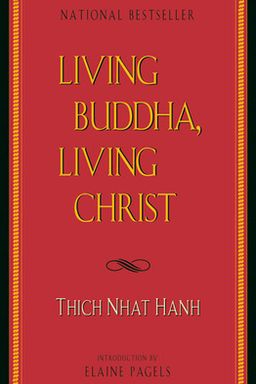
Living Buddha, Living Christ cover

Living Buddha, Living Christ

by Thich Nhat Hanh

Living Buddha, Living Christ delves into the shared wisdom of two of the world''s most influential spiritual leaders, revealing their common teachings on love, compassion, and understanding. Thich Nhat Hanh offers profound insights into how these faiths can enrich one another and guide us toward a more peaceful, mindful life.

Living Buddha, Living Christ: Discovering Sacred Presence Beyond Boundaries

How can you awaken fully to the sacred in everyday life—whether you call it the Buddha within or the Christ within? In Living Buddha, Living Christ, Vietnamese Zen master and peace activist Thich Nhat Hanh invites you to see faith not as belief but as direct experience of reality. He argues that the living presence of Jesus and the Buddha is found not in dogma but in embodied awareness—what he calls mindfulness, or touch with the Holy Spirit. Through this vision, you begin to transcend boundaries between traditions and rediscover the vitality that flows through all authentic spiritual practice.

Hanh contends that both Buddhism and Christianity spring from one living source: the energy of love, understanding, and awakened awareness. He contrasts this living spirituality with the rigidity that often arises when religions become trapped in doctrines and exclude others. True spiritual life, he says, is like an almond tree blooming when asked to speak of God—it manifests aliveness, compassion, and openness.

Bridging Two Traditions Through Experience

Hanh does not attempt theological compromise or a superficial mix-and-match of religions. Instead, he demonstrates how dialogue begins with living experience. Having shared Eucharist with Father Daniel Berrigan and walked alongside Martin Luther King, Jr. and Thomas Merton, Hanh acknowledges how deeply Christians can embody the spirit of compassion that Buddhists call bodhisattva energy. When practitioners from any tradition embody love and understanding, he says, they touch the living Christ and the living Buddha who are beyond historical confines. The historical Jesus or Siddhartha Gautama shows the map, but the living Buddha and living Christ arise through our own awakening here and now.

From Dogma to Direct Experience

Rather than arguing conceptual theology, Hanh teaches that you encounter the sacred by being fully alive. When you breathe mindfully, smile, or listen deeply, you touch the same reality that Jesus called the Holy Spirit and the Buddha described as mindfulness. “Discussing God,” he writes, “is not the best use of our energy. If we touch the Holy Spirit, we touch God not as a concept but as a living reality.” In practice, the way to encounter both Buddha and Christ is to cultivate peace, awareness, and nonattachment in your own heart. Dialogue between religions becomes a practice of seeing and loving rather than of competing claims to truth.

The Spirit of Interbeing

One of the central ideas linking the book is interbeing—the insight that everything is interconnected and nothing exists independently. Like a flower made of non-flower elements (sun, rain, minerals, and time), Christianity and Buddhism inter-are. When you see this, barriers between faiths dissolve. The concept recalls the Christian idea of the Trinity’s oneness—Father, Son, and Holy Spirit mutually dwelling within each other. “Be still and know that I am God,” says the Psalm; “Be still” corresponds to Buddhist calming (samatha), and “Know” corresponds to deep insight (vipasyana). Through stillness and insight, you touch the living presence of God or ultimate reality within yourself.

Why It Matters in Our Time

Hanh’s merging of two sacred traditions matters because he models how spirituality can heal divisions—between religions, nations, and even inner conflicts. Drawing on his experiences during the Vietnam War and in exile, he teaches that peace begins by making peace within yourself. If you can reconcile opposing forces inside you—anger, fear, and misunderstanding—then true dialogue and compassion become possible outside. His call to humanity is clear: to move beyond labels and practice the living truth embodied by both Buddha and Christ.

By the end of Living Buddha, Living Christ, you see that mindfulness and the Holy Spirit are two expressions of one universal energy. To be truly alive in this moment is to touch nirvana and the Kingdom of Heaven simultaneously. You realize that faith is not mere belief but awareness, that spirituality is not belonging to one tradition but awakening to life itself. This understanding prepares you for the book’s deeper lessons—the power of mindfulness, the practice of compassionate dialogue, and the discovery that peace is found in the present moment.


Mindfulness and the Holy Spirit

Thich Nhat Hanh equates mindfulness with the Holy Spirit—the energy of presence, healing, and transformation common to both Buddhist and Christian traditions. In Florence, a Catholic priest told him, “The Holy Spirit is the energy sent by God,” and Hanh immediately felt recognition. In Buddhism, mindfulness is the energy that helps you know what is happening in yourself and around you. When you sit, walk, or eat in awareness, you call forth understanding and compassion—the same qualities Christians attribute to the Spirit of God.

Experiencing Spirit in Ordinary Life

Mindfulness is not abstract; it starts with simple awareness of breathing. Hanh teaches, “Breathing in, I calm my body; breathing out, I smile.” This is a living Eucharist of the body and spirit, a way to encounter divinity through the ordinary. When you breathe consciously or smile, peace fills your body, and you become aligned with creation itself. In Christianity, touching the Holy Spirit brings healing; in Buddhism, mindfulness heals suffering by restoring harmony between body and mind. Both aim to awaken love and understanding—the true signs of holiness.

Touching Presence Through Practice

For Hanh, to be mindful is to be fully alive. Most of the time we live in the past or future, but mindfulness anchors us in the present moment—our true home. In his Plum Village community in France, he taught monks, nuns, and laypeople to stop when the bell rings and breathe. “Listen, listen,” they recite, “this wonderful sound brings me back to my true home.” The home he refers to is the living presence of the Spirit, not a physical place. When we touch the present moment deeply, we touch God itself. (In Catholic Eucharist, bread and wine symbolize this same timeless presence.)

Healing as the Sign of Spirit

Both in the Bible and in Buddhist sutras, healing comes when we touch love directly. Jesus healed those who touched him; the Buddha was called the King of Healers. Hanh observes that this miracle arises not from supernatural power but from profound understanding—a touch of mindfulness. “When you touch deep understanding and love, you are healed,” he writes. Each of us carries the seed of the Holy Spirit, the capacity to heal and transform. The practice is to touch this seed through awareness so that it blossoms into loving action.

In Florence, hundreds gathered at a Christian retreat where Hanh taught that mindfulness can renew Christian practice itself. When the bell tolls, when you share bread, or when you greet another with awareness, the Holy Spirit reveals itself. His message is simple yet radical: the presence of God is not found only in churches, scriptures, or rituals, but in your direct, mindful contact with life. To be mindful is to be filled with the Holy Spirit; to breathe consciously is to participate in divine creation. In this way, your daily life becomes prayer, and the Kingdom of God is no longer a distant promise but a reality available now.


Dialogue: The Key to Peace

Dialogue, for Hanh, is not mere conversation—it’s the foundation of peace. He developed this insight while witnessing the Vietnam War, where violence arose from competing ideologies and religious exclusivism. “People kill and are killed because they cling too tightly to their own beliefs,” he says. The most essential practice of peace is to let go of views and listen deeply. In both Buddhism and Christianity, authentic dialogue is an act of healing: it transforms wrong perceptions into understanding.

Peace Through Nonattachment to Views

Hanh’s Order of Interbeing, founded during the war, teaches, “Do not think the knowledge you presently possess is changeless, absolute truth.” This echoes Jesus’ message of humility. When you hold your opinions too tightly, suffering follows. Dialogue begins when you admit your partial understanding and open to others’ viewpoints. Through meditation and compassionate listening, you see that both sides are victims of ignorance. This insight dissolves hostility, turning confrontation into connection.

Dialogue in Action

Hanh recounts a vivid story: an American soldier spit on the head of his young disciple, Brother Nhât Tri. Anger surged in the monk, who considered leaving to fight. Hanh urged him instead to see that the soldier, too, was a victim—of wrong policies and wrong views. By seeing that, Brother Nhât Tri stayed and served as a peace worker. This moment shows that dialogue starts inside the heart, where anger turns to compassion. (Similar to Martin Luther King’s vision of nonviolence as “building beloved community.”)

Deep Listening and Transformation

Real communication requires deep listening—a practice of silence and attention. “When participants are willing to learn from each other, dialogue takes place just by their being together,” Hanh writes. The goal is not assimilation but transformation. You allow the truth in another tradition to change you. Dialogue must begin within yourself; if you make peace internally, peaceful dialogue with others naturally arises. Meditation thus becomes preparation for peacemaking.

Peace between religions precedes peace in the world. Hanh’s message resonates with theologian Hans Küng’s statement: “No peace among nations without peace among religions.” By practicing nonattachment to views and listening with compassion, you dissolve barriers of belief. True dialogue doesn’t erase differences—it honors them while discovering shared humanity. This insight shifts peacework from negotiation to spiritual practice, where every act of listening becomes sacred.


Interbeing: The Nature of Oneness

One of Thich Nhat Hanh’s most profound contributions is his teaching on interbeing. This term means that all things exist in relationship; nothing stands alone. A flower inter-is with the sun, clouds, and earth. Likewise, Buddhism inter-is with Christianity, and you inter-are with every person's joy and suffering. Seeing through interbeing releases you from separation—the root of all conflict. It connects Buddhist emptiness (sunyata) with the Christian mystery of the Trinity and the Spirit encompassing all creation.

Seeing Through the Eyes of Wholeness

In the book, Hanh illustrates interbeing with the famous teaching: when you look deeply into a flower, you see everything there—clouds, sunshine, minerals, time, and space. A flower is made entirely of non-flower elements. Likewise, no religion, nation, or self is isolated; everything depends on everything else. Once you see interbeing, compassion arises naturally because you realize harming another is harming yourself. “Whenever there is understanding, compassion is born,” he writes.

Faith as Confidence in Interbeing

Hanh redefines faith not as belief in divine authority but as confidence in your and others’ ability to awaken. In Buddhism, faith means trusting in human potential; in Christianity, it means trust in God’s love. When you understand interbeing, you see both as the same—faith in love and understanding itself. (Comparable to the mystical theology of Meister Eckhart, who said, “The eye with which I see God is the same eye with which God sees me.”)

Interbeing as Social and Spiritual Practice

Interbeing also means dissolving false boundaries in society. In Vietnam, colonialism allied Christianity with domination, causing division between faiths. Through the practice of interbeing, Hanh reverses this legacy—honoring both traditions as “beautiful flowers” in one garden. True faith does not exclude; it embraces difference. You can feel fully alive as a Buddhist, Christian, Jew, or Muslim while recognizing that all traditions share the roots of love and compassion.

To see through interbeing is to see through the eyes of God. Separation vanishes, leaving only the living unity of all things. When you touch the nature of interbeing within yourself, peace becomes real—not a distant goal but a state of being. You realize that every smile, every breath, already contains the essence of Buddha and Christ. This insight is the spiritual foundation for everything Hanh teaches: compassion, dialogue, and the experience of sacred life in the present moment.


The Practice of Mindful Living

Living Buddha, Living Christ is a manual for mindful living amid daily life. For Hanh, to live mindfully is to embrace each moment as sacred. He offers practical exercises—mindful breathing, eating in silence, walking meditation—that transform ordinary activities into communion with life. Each practice echoes both Buddhist meditation and Christian prayer. Mindfulness becomes not just personal therapy but the way to touch the Holy Spirit continuously.

Every Moment Is Sacred

“The miracle is not to walk on water,” Hanh says, “but to walk on the green earth in the present moment.” Mindful living turns the simplest acts—drinking tea, washing dishes, smiling—into expressions of enlightenment. When you eat in awareness, you touch the whole cosmos in your food—the clouds and rain that nourished the grain. The Eucharist, Hanh explains, is a “strong bell of mindfulness.” The bread and wine are not symbols but living reality—the body of God interwoven with the body of the world.

Reverence for Life

Mindful living also manifests as ethical conduct. Hanh presents the Five Wonderful Precepts: reverence for life, generosity, responsible sexual behavior, loving speech, and mindful consumption. Each precept is not a rule but a conscious direction. To practice them brings joy and stability to your body, family, and society. This corresponds to Jesus’ teachings in the Sermon on the Mount—blessed are the peacemakers, love your enemies, forgive others. Living ethically, in both traditions, is living as peace itself.

Touching the Kingdom Now

In mindfulness, the sacred is immediate. You do not need to die to reach Heaven; Heaven is already here when you touch the present moment deeply. This insight echoes Jesus’ statement, “The Kingdom of God is within you.” For Hanh, nirvana and the Kingdom are identical experiences—the extinction of notions and awakening to reality as it is. Practice makes you aware that the ultimate dimension (God or nirvana) and historical dimension (daily life) are one.

Living mindfully does not mean withdrawing from the world but engaging it with clarity. Hanh calls this “engaged Buddhism”—meditating while doing social work, helping refugees, teaching peace, rebuilding villages. Every mindful step contributes to collective healing. When you breathe and smile, the Spirit moves through you and through society. The boundary between prayer and action dissolves; your life itself becomes worship.


Faith Beyond Dogma

Faith, in Hanh’s approach, is alive—an evolving experience, not a static belief. He warns that clinging to rigid doctrines leads to intolerance and despair. “Who is not unique?” he asks in response to Pope John Paul II’s claim that Christ is absolutely unique. Every person and tradition manifests unique aspects of the sacred. True faith grows by practice and insight, not by defending exclusivity. Through direct experience, faith becomes freedom rather than confinement.

Living Belief Through Experience

Both Buddha and Christ invite followers to verify truth through their own lives. When you pray or meditate deeply, you touch ultimate reality directly. This experience evolves continuously, just as a tree grows. If your faith doesn’t evolve, one day your beliefs can collapse and you fall “into the abyss of doubt,” as Thomas Merton called it. Faith must renew daily through mindfulness, compassion, and love.

Beyond Concepts of God and Nirvana

Concepts cannot capture the divine. Christian mystics like Gregory of Nyssa speak of God’s “darkness”—a reality beyond comprehension. Likewise, Hanh teaches that nirvana cannot be grasped by thought. Both traditions emphasize experiential knowing, or nonconceptual realization. When you surrender your ideas about God or self, you enter what he calls “total surrender”—the release that reveals peace. To touch the ground of being (or dharmakaya) is to know that you are already part of ultimate reality.

Universal Faith as Interbeing

Faith beyond dogma is inclusive. You can be Buddhist and Christian because both share human experience. When you see someone overflowing with love and understanding, Hanh says, “You know that they are very close to the Buddha and to Jesus Christ.” Religion becomes not identity but practice; not belief but awakening. Real faith doesn’t divide; it unites through compassion.

When faith springs from experience, words about God or enlightenment lose their exclusivity. You stop arguing who owns salvation and start living it. Hanh’s faith beyond dogma empowers you to move freely between traditions, to touch truth directly, and to live each moment as divine revelation. The ultimate test of faith is not adherence but aliveness—the capacity to see, love, and be present.


Touching Nirvana and the Kingdom of God

At the culmination of Living Buddha, Living Christ, Hanh unites the Buddhist concept of nirvana with the Christian idea of the Kingdom of Heaven. For him, both represent the same reality—the ultimate dimension always available here and now. “You do not have to die to enter the Kingdom of God,” he writes, “the Kingdom of God is available now.” Similarly, the Buddha taught that nirvana is not a place or time but the extinction of notions—birth, death, being, and nonbeing. By living with mindfulness, you transcend these dualities and realize freedom.

Touching the Ultimate Dimension

The moment you breathe consciously or smile to a leaf, you touch eternity. A leaf decomposes but continues as soil and new leaves. This is manifestation rather than birth and death. St. Francis, seeing an almond tree bloom in winter, experienced this same revelation: life and spirit are always present. Touching the ultimate dimension means seeing divine continuity in all forms. You realize that heaven is not somewhere else—it is this life perceived deeply.

Beyond Notions of Being and Nonbeing

Hanh cautions that we cannot speak accurately about the ultimate. “Concerning that which cannot be talked about, we should not say anything,” he quotes Wittgenstein. Words fail; only direct experience reveals truth. When you extinguish notions of separation—God there, self here—you melt into oneness. The wave realizes it is water. In that realization, fear disappears. Death becomes transformation, not annihilation.

Practice as the Path to the Other Shore

The Buddha called liberation “reaching the other shore.” But, Hanh clarifies, the other shore is not separate—it is this very shore seen with awakened eyes. The Christian equivalent is entering eternal life within time. “Resting in God,” he writes, is touching the same dimension Buddhists call nirvana. Whether through prayer, contemplation, or mindful breathing, you return to the water within the waves. Life and eternal life coexist.

Once you touch this reality, peace arises naturally. You no longer seek salvation outside yourself; you embody it. Your faith expands beyond doctrines into direct awareness. In this moment, Buddha and Christ unite as expressions of one truth. Everything—the tree, the smile, the breath—becomes revelation. The practice is simple but profound: pause, breathe, and recognize that the divine has never left you. This is nirvana. This is the Kingdom of God.

Dig Deeper

Get personalized prompts to apply these lessons to your life and deepen your understanding.

Go Deeper

Get the Full Experience

Download Insight Books for AI-powered reflections, quizzes, and more.