
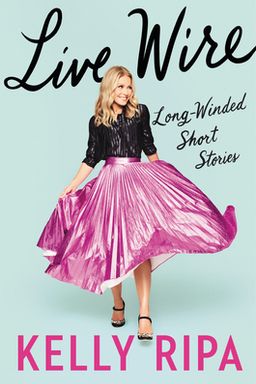
Live Wire cover

Live Wire

by Kelly Ripa

In Live Wire, Kelly Ripa shares a series of humorous and heartfelt essays about her three-decade journey in the entertainment industry. Through personal stories, she reveals the challenges and triumphs of balancing a high-profile career with motherhood, offering readers relatable insights and empowering lessons on resilience and self-advocacy.

Living Unfiltered: Kelly Ripa’s Bold Honesty About Identity, Work, and Womanhood

How do you keep your sense of self when the world only knows your public persona? In Live Wire, Kelly Ripa—a decades-long television icon—invites you behind the glossy curtain of morning talk shows, celebrity culture, and marriage to reveal the messy, hilarious, and authentic truth of her life. Through a series of personal essays, she argues that what truly connects women isn’t perfection but imperfection—the grit, sweat, doubts, and comic disasters that make up a real life.

Ripa contends that living authentically means embracing the contradictions between self-perception and public expectation. She writes about fame, aging, motherhood, imposter syndrome, and marriage with a tone that feels like a late-night conversation between friends. She doesn’t pretend to have it all; instead, she demonstrates how hard-won humor and vulnerability become survival tools in a world where women—especially on camera—are expected to be endlessly likable and polished.

The Power of Humor and Self-Awareness

At the heart of Ripa’s storytelling lies her comedic timing and radical self-awareness. She disarms with humor—like describing her accidental Valium-induced acceptance speech or being upstaged by Jeff Bezos’s rocket-shaped spacecraft on live TV—and then drops hard truths about ambition, power, and self-doubt. These contradictions are intentional. She uses laughter not as escape but as a diagnostic tool, helping both herself and her audience confront uncomfortable realities about aging, sexism, and the pressures of public life. (Think Nora Ephron’s I Feel Bad About My Neck but with more F-bombs and television cables.)

A Career Built on Contradictions

Ripa’s career, spanning All My Children to Live!, to producing alongside her husband Mark Consuelos, offers a microcosm of how women navigate visibility and expectation. She reveals that performing your own identity on live television is the hardest role of all—because unlike a character, your real self evolves. Her essays trace how she learned to shape that constantly shifting persona, not through PR spin but through lived experience and public vulnerability. Ripa’s willingness to make missteps publicly—to mispronounce, overshare, or literally faint during sex (as one unforgettable chapter recounts)—becomes proof that survival in the limelight depends not on polish, but on persistence.

Marriage, Motherhood, and Mortality

Equally central is her portrayal of marriage and motherhood. Ripa and Consuelos’s relationship, captured with both affection and friction, becomes a case study in balancing intimacy with independence. Her reflections on raising three children—Michael, Lola, and Joaquin—while hosting a daily live television show expose the emotional calculus of modern motherhood: the time-versus-money matrix every working woman knows. Even amid comic chaos—kids vomiting mid-road trip, career transitions, or family drama—she always circles back to gratitude and perspective. To her, survival isn’t glamorous; it’s funny, messy, resilient, and above all real.

Why It Matters: Radical Transparency in the Public Eye

What makes Live Wire resonate is Ripa’s refusal to hide the truth behind the talk-show smile. In a media age obsessed with curated authenticity, she practices the opposite—unfiltered honesty. She acknowledges everything: imposter syndrome, sexism, anxiety, physical insecurities, and the absurdities of fame. Each essay becomes an act of rebellion against the fiction of effortless female success. Her argument isn’t that life gets easier; it’s that comedy, candor, and community make the chaos survivable. As a reader, you don’t just laugh at Ripa’s anecdotes—you see yourself in them.

Ultimately, Live Wire is about finding strength through imperfection, humor through pain, and confidence in vulnerability. For Ripa, connection—not control—is the real measure of success. Whether she’s confessing the agony of writing a book or the absurdity of fame, her essays remind you that we’re all just trying to stay grounded while living on our own live wire.


The Juggling Act: Work, Fame, and Imposter Syndrome

Kelly Ripa begins her book confronting one of the most relatable psychological traps: imposter syndrome. While driving with her husband Mark Consuelos and kids in a traffic jam, the concept surfaces, and she realizes that—even after decades on television—she still doubts her competence. This confession sets the tone for her reflections on professional insecurity, showing how even household-name success doesn’t silence inner criticism.

How Doubt Fuels Drive

Ripa illustrates how her anxiety about being “found out” actually powers her tireless work ethic. She jokes about being risk averse, microneedling her butt from sitting so long writing the book, and second-guessing every public announcement—even worrying that Prince Harry’s memoir launch might overshadow her own. Beneath the self-deprecation lies an honest picture of perfectionism: she fears mediocrity, yet the fear keeps her creating. (Psychologists often note this paradox—that perfectionism and insecurity coexist in high achievers.)

Public Persona vs. Private Reality

Ripa’s essay “Much Ado About Imposter Syndrome” explores how performing yourself for millions of viewers becomes its own existential puzzle. Playing “Kelly Ripa” on television often felt harder than any acting role—because she had to be the confident version of herself even when she felt lost. She quips, “Playing yourself on television is the hardest role I’ve ever had,” exposing the emotional labor of self-presentation familiar to anyone with a public-facing career.

From Soap Opera Sets to Talk Show Stages

Her account of moving from All My Children to Live! captures how she navigated a male-dominated media world. Despite early career acclaim, she never fully shook the feeling of being the “new girl” or “not good enough.” Even her encounters with industry legends—like James Patterson and Bill Clinton casually advising her to write a memoir instead of essays—trigger her insecurities. Rather than pretending confidence, Ripa exposes its construction, layer by layer, turning what could be celebrity confession into feminist realism.

Reframing Success

Ultimately, Ripa concludes that imposter syndrome isn’t failure—it’s feedback. The constant questioning means she’s still curious, still evolving. Writing Live Wire becomes a metaphor for claiming her narrative on her own terms. As she says, even at fifty, she isn’t “unqualified to write this book”—she’s proof that growth never ends. For any reader juggling identity, success, and self-doubt, Ripa delivers both laughter and liberation.


Marriage as Comedy and Compromise

Few books about marriage sound as funny or real as Kelly Ripa’s Scenes from a Real Marriage. She treats her relationship with Mark Consuelos not as a picture-perfect Hollywood romance, but as a living sitcom filled with arguments, passion, and absurd moments—like nearly electrocuting herself with rubbing alcohol the night before their secret wedding or fainting during sex in a leotard. These vignettes strip away romantic fantasy to show love as an ongoing negotiation of power, humor, and endurance.

The Elopement as Metaphor

Ripa recounts how she and Consuelos eloped to Las Vegas days after breaking up, exemplifying impulse and obstinacy as cornerstones of their marriage. They navigated chaos from the start—different temperaments, strong wills, and career ambitions. Their story challenges traditional scripts of romance by equating love with stubborn loyalty rather than perfection. She writes, “Marriage is work... and it’s not for wimps. Marriage is for warriors.”

Fighting, Forgiving, and Flirting

Ripa’s humor keeps domestic conflict relatable. Whether arguing over traffic on the Long Island Expressway or “asshole syndrome,” there’s an undercurrent of affection in every spat. She and Mark weaponize sarcasm as love language—proof that laughter often substitutes for resolution. Her anecdotes about near disasters, jealousy, and reconciliation show that comedy can be emotional therapy, similar to how Erma Bombeck and Nora Ephron used humor to examine intimacy.

Defining Partnership Through Growth

Through marriage, Ripa discovers compromise not as surrender, but as evolution. The couple survives fame and childrearing by adapting. Her reflection on their twenty-five-year anniversary transforms cliché into insight: every partner must sometimes go to war not against—but for—one another. Her analogy about roots growing in different directions beautifully captures enduring love that remains strong without suffocating individual growth.

In a culture saturated with performative relationships, Ripa’s unfiltered candor feels revolutionary. Marriage, she insists, is not about looking like the couple on a cake—it’s about surviving together, one absurd, tender battle at a time.


Motherhood and Mortality

Ripa’s essays on motherhood are both comic and horrific. In “Don’t Let Your Husband Pick Your Death Clothes,” she recounts a near-death postpartum fainting episode that sent her to the ER mid-nursing, wearing a leotard and Mark’s soccer pants. The story’s slapstick absurdity morphs into existential reflection: women endure unimaginable physical and emotional strain in silence—then shrug it off with humor so their families don’t collapse.

The Myth of the Competent Parent

Ripa skewers the unrealistic standards of motherhood. She mocks the idea that good parents prepare toddlers for emergencies or keep perfect homes; she barely knew her zip code, let alone how to plan for disaster. Yet beneath the comedy lies poignant guilt—about missing moments with her kids or appearing less than patient. She transforms maternal imperfection into authenticity, echoing Anne Lamott’s Operating Instructions in her mix of laughter and faith in survival.

Sex, Health, and Shame

Her discussions of female health—breastfeeding, C-sections, and ovarian cysts—are brutally honest. She refuses the sanitized motherhood narrative, exposing the embarrassment and taboos surrounding women’s bodies. When her husband faints at her epidural but still asks when they can have sex again, the absurdity doubles as commentary on gender blindness to women’s pain. Through candor, Ripa reclaims autonomy over her own narrative of birth and recovery.

Mothering While Working Live

Juggling an infant and a national broadcast, Ripa embodies the struggle of modern mothers performing competence while privately unraveling. Yet by naming her contradictions—fear, resentment, pride—she carves a new model of motherhood defined not by control but resilience. Her mantra, “You can’t die from embarrassment,” evolves into wisdom: vulnerability is survival’s secret weapon.


Aging in a Culture That Fears Women’s Wrinkles

In “Aging Gracefully: The Big Lie,” Ripa tackles one of the most universal yet stigmatized experiences: women growing older. With her signature humor, she demolishes the myth that aging can—in any public profession—be done gracefully. She argues that in the entertainment industry and on social media, age isn’t celebrated, it’s punished.

Confessions of Cosmetic Reality

Unlike most celebrities, Ripa confesses every procedure—Botox, Fraxel laser, fillers, even considering fat transfer breast augmentation. She turns self-consciousness into satire, mocking tabloids that invented plastic surgery stories about her until she decided to get the real work done. For Ripa, transparency is rebellion. Speaking honestly about vanity becomes feminist honesty—challenging cultural hypocrisy around women’s maintenance while men age into “silver foxes.”

Comedy as Self-Defense

She merges personal anecdotes with social critique—attacking trolls who shame women’s faces while hiding behind anonymous profiles. Ripa’s comedic timing turns cruelty into commentary: if your neck looks like a vagina, own it. Humor reframes humiliation into power, echoing the way Tina Fey used comedy to dismantle sexism on 30 Rock.

Honesty Over Grace

Ultimately, aging gracefully is impossible if grace means silence. Ripa’s manifesto is both hilarious and liberating—she doesn’t ask for permission to feel vain, angry, or insecure. By speaking the unspeakable truths about cosmetic insecurities, she transforms shame into solidarity. She reminds you that evolution, not perfection, is the only standard worth meeting.


The Courage to Be Embarrassed

In “The Good News: You Can’t Die from Embarrassment,” Ripa proves her thesis with dizzying comic flair. Whether fainting after sex, taking accidental Xanax before an award speech, or claiming to ‘save a life’ with Richard Gere, she shows that humiliation, not acclaim, shapes true confidence.

Owning Every Mortifying Moment

Ripa embodies radical candor. Her readiness to narrate bodily functions, marriage mishaps, or celebrity faux pas invites readers to see embarrassment not as weakness but human currency. She transforms cringe into connection—the beating heart of authenticity. As researcher Brené Brown argues, vulnerability builds real power; Ripa performs that theory through comic storytelling.

Fame and Fallibility

Ripa’s celebrity world is filled with absurdity: morning shows where every mistake is live, dinners with Richard Gere turning into chaos. Yet rather than hide behind PR polish, she doubles down on honesty. Her willingness to look foolish becomes an act of humanization in an industry that demands glamour. “Humiliation made me bulletproof,” she jokes—and she’s serious.

What Embarrassment Teaches You

For Ripa, embarrassment is growth’s cost. Every cringe expands empathy. Every failure becomes comedy gold. Learning not to die from it means learning to live with grace, humor, and honesty—traits that outlast fame itself.


Evolving Into Authenticity

In the final chapters and epilogue, Ripa reflects on identity, career, and motherhood’s transitions—the empty nest, evolving family dynamics, and lessons from her decades in the spotlight. Her reflections connect her earlier themes—imperfection, humor, and resilience—into one overarching idea: authenticity is not static but continually rewritten.

Letting Go Without Losing Yourself

Her account of sending her children to college becomes a metaphor for aging and identity. As she faces an “empty nest,” she redefines herself outside motherhood and media performance. It’s bittersweet yet empowering—recognizing that endings are beginnings in disguise. Her mantra that “the days are long, but the years are short” offers comfort to anyone facing transitions.

Humor as Emotional Lifeline

Even in grief and nostalgia, Ripa’s wit carries through. She jokes about replacing her family with dogs and Twizzlers, but the humor underscores deep truth: laughter helps metabolize change. Like Erma Bombeck, she turns domestic life into spiritual reflection, learning that survival means embracing impermanence.

Leaving the Stage on Her Own Terms

Her epilogue, “What Epilogue Is This?”, captures the paradox of her career—she thrives under public scrutiny yet yearns for privacy. She admits she has difficulty ending things, but her writing gives her closure. Stepping offstage becomes an act of self-definition: she’s not the perfect host, wife, or mother—she’s a person still learning how to be herself. And in sharing that, Ripa gives readers permission to do the same.

For Kelly Ripa, living ‘on a live wire’ means risking embarrassment, imperfection, and truth—all for the sake of connection. That’s the courage of authenticity, and her essays leave you feeling that sometimes the most polished version of yourself is the one willing to confess the mess.

Dig Deeper

Get personalized prompts to apply these lessons to your life and deepen your understanding.

Go Deeper

Get the Full Experience

Download Insight Books for AI-powered reflections, quizzes, and more.