
Idea 1
How Little Bets Unlock Big Breakthroughs
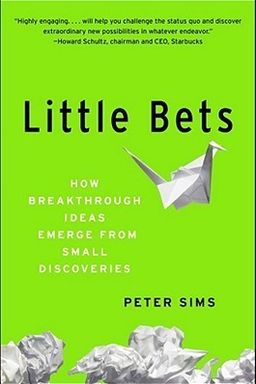
How can failure, confusion, and mistakes become the most powerful tools for success? In Little Bets, Peter Sims argues that the greatest innovations and creative breakthroughs rarely arrive as flashes of genius—they emerge through a disciplined process of small, affordable experiments he calls little bets. Instead of waiting for one perfect idea, Sims contends you can learn faster, adapt intelligently, and ultimately achieve more by embracing uncertainty through action.
At the heart of Sims’s argument is a simple but radical shift: you don’t start with big bets; you start with tiny steps. Each little bet is a modest, low-risk experiment that allows you to learn about what works, what doesn’t, and what you couldn’t have predicted in advance. Think of Chris Rock testing his material in small comedy clubs, Jeff Bezos cultivating Amazon’s culture of experimentation, or Frank Gehry crafting rough paper models before designing Disney Hall—each embodies the principle that discovery happens by doing, not just by planning.
From Big Bets to Little Bets
Sims opens with contrasting examples: Hewlett-Packard’s later obsession with billion-dollar projects that failed, versus its founders’ earlier willingness to build just a few calculators as experiments. Big bets assume certainty; little bets assume uncertainty and prioritize learning. Instead of focusing on expected returns, little bets follow what researcher Saras Sarasvathy calls the affordable loss principle—you determine what you can afford to lose and learn from there. In complex fields or creative endeavors, this mindset dramatically increases your odds of discovering valuable innovations.
The Growth Mindset Behind Experimentation
Learning through small steps requires the right mental framework. Sims draws heavily on psychologist Carol Dweck’s distinction between a fixed mindset and a growth mindset. People who believe ability is static avoid failure; those who see ability as expandable through effort treat failure as feedback. Pixar’s leaders embody the growth mindset through a culture of “going from suck to non-suck,” openly iterating flawed ideas until brilliance emerges. Their willingness to fail forward fuels constant reinvention—a lesson any individual or team can internalize.
Learning by Doing—and Failing Quickly
Little bets encourage you to prototype ideas rapidly, fail early, and learn fast. Sims praises “shitty first drafts” (borrowing from Anne Lamott) and Pixar’s thousands of evolving storyboards as examples of low-cost experimentation. This is healthy perfectionism: striving for excellence without paralysis. By failing quickly, you avoid investing too much in bad ideas and reveal unexpected paths forward. Even Barack Obama’s campaign team applied this principle, prototyping digital media strategies—from mobile ringtones to YouTube videos—to learn what mobilized supporters most effectively.
Play, Constraints, and Questions
Creativity thrives on play, not rigid control. Sims shows, through Pixar’s playful practice of “plussing” (building on ideas with “yes, and…” instead of “but”), how humor and improvisation deactivate your inner critic and open space for new possibilities. Frank Gehry’s architecture teaches another lesson: use constraints as creative fuel. When boundaries are clear—budget, time, materials—they focus attention on solving defined problems. The same principle drives agile software development, which transforms giant projects into manageable “smallified” tasks requiring quick learning cycles.
Immersion and Observation Lead to Insight
To make productive little bets, Sims advises immersing yourself deeply in unfamiliar worlds. He tells how Muhammad Yunus discovered microfinance by studying Bangladeshi villagers firsthand instead of relying on economic models—a powerful illustration of learning from the worm’s-eye view rather than the bird’s-eye perspective. Similarly, Pixar animators scuba dive and observe real fish behaviors to inform their films. Curiosity and firsthand observation generate insights that no amount of abstract planning could yield.
Iterating Toward Small Wins
Finally, Sims shows how small wins accumulate into breakthroughs. Just as Edison’s light bulb emerged after thousands of experiments, Pixar’s short films paved the way for Toy Story. Small successes build momentum, confidence, and capabilities—what psychologist Karl Weick calls “concrete outcomes of moderate importance.” Each win illuminates the next step, shaping bigger opportunities without ever demanding clairvoyance about the future.
Ultimately, Sims argues that little bets are more than a business strategy—they are a mindset for living creatively and courageously. When you approach uncertainty with curiosity, prototype your way forward, and treat challenges as experiments, you transform fear into discovery. Life itself, Sims reminds us, is a creative process. It all begins with one little bet.