
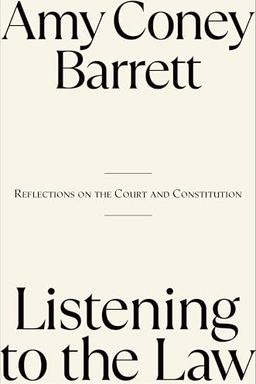
Listening To The Law cover

Listening To The Law

by Amy Coney Barrett

The Supreme Court justice explains her approach to interpreting the Constitution and recounts some personal and professional experiences.

Law, Not Will

How can you tell when judging is faithful to law rather than to a judge’s personal will? In this book, Amy Coney Barrett argues that American judging is an exercise in constraint: the commission and oath, the Court’s procedures, and the methods of interpretation all exist to curb power and channel it through the Constitution’s text and our democratically enacted statutes. She contends that judicial legitimacy depends on humility—doing what the law requires even when you dislike the result—and that you, as a citizen, should evaluate the Court by its fidelity to law, not by whether it advances any political agenda.

Across the chapters, you encounter a single through-line: durable institutions require self-restraint and shared methods. You start with the symbols that bind the office (the commission, the oath, the black robe), move through the Court’s human and procedural routines (collegiality, oral arguments, conference, opinion assignment, and the indispensable work of clerks), and then explore the interpretive disciplines that anchor decision-making (originalism for the Constitution, contextual textualism for statutes, and careful use of canons). Along the way, you see how limits—Article III standing, the Rule of Four, “cases or controversies,” and narrow emergency relief—keep the judiciary within its lane while preserving space for democratic politics.

The Office and Its Bindings

Barrett invites you to begin with the small ceremonies that compress big ideas. The commission appoints you “according to the Constitution and Laws,” a reminder that your authority hinges on written law, not personal conscience. The oath to “administer justice without respect to persons” commands impartiality, not outcomes that feel right. Even the black robe—popularized by Chief Justice John Marshall to signal humility—teaches that the justice is merely the voice of law, not the protagonist of the story. (Note: The book highlights that Barrett’s commission, signed by President Trump, was delivered during a successor administration—an vivid symbol of judicial independence from partisan chains.)

Discipline in a Human Institution

Judges are human and face temptations. The book contrasts a Solomon-style vision—wisdom unconstrained—with Madison’s realism: “If men were angels...” The Constitution therefore equips judges with both external and internal restraints, from life tenure that insulates them from public pressure to professional traditions that soften disagreement. Barrett emphasizes habits—shared lunches, no-case-talk at the table, welcome rituals, and Scalia’s maxim to “attack ideas, not people”—that turn fierce debate into durable cooperation. History supplies cautionary tales (Justice McReynolds’s rancor, post–Brown ostracism of Justice Hugo Black) and exemplars (Marshall’s boardinghouse culture) that show how relationships shape the law’s stability.

From Docket to Decision

You watch the Court triage thousands of certiorari petitions, grant roughly sixty merits cases per term, and navigate emergency applications with restraint. Oral argument, especially the post‑COVID “cleanup round,” tests ideas in real time. At conference, the Chief speaks first; the most senior justice in the majority assigns the opinion; drafts circulate, votes can shift, and the final bench statement publicizes a carefully reasoned result. The Arellano decision’s announcement before newly sworn military lawyers becomes a reminder that opinions affect lives, not just law school hypotheticals.

How to Read the Law

Substance matches process. For constitutional questions, the book commends original public meaning: what informed readers understood at ratification (Crawford v. Washington’s history of the Confrontation Clause; Kyllo v. United States translating “search” to thermal imaging). For statutes, you see contextual textualism—ordinary meaning in context, not wooden literalism (United States v. Locke construes “prior to December 31”; Wooden v. United States groups related burglaries into one “occasion”). Canons help where words run out, and the major questions doctrine demands unusually clear authorization for policies of “vast economic and political significance” (Biden v. Nebraska). The book also counsels caution with legislative history and allows only narrow corrections for scrivener’s errors.

Boundaries, Rights, and Federalism

The judiciary’s power to “say what the law is” (Marbury v. Madison) carries equally strong limits: standing and “cases or controversies” (Valley Forge; Murthy) keep courts out of advisory opinions. Federalism ebbs and flows—from McCulloch and Wickard’s breadth to Lopez, Morrison, and NFIB’s limits—while the Constitution’s mix of rules and standards plus Article V’s amendment process balances stability and change (see the Twenty-Second Amendment). On unenumerated rights, the Glucksberg framework demands a “careful description” and deep historical rooting; the Dobbs decision applies that test to reject abortion as a fundamental right and return the issue to democratic channels.

Why This Matters for You

Barrett’s point is practical: read opinions, not headlines; expect judges to follow text and history; and engage politically when law leaves policy to you. Judicial restraint is not abdication. It is the system’s design to keep courts in their lane, legislatures accountable, and liberty safeguarded by rules that outlast personalities. (In contrast, “living constitutionalist” approaches emphasize evolving values; the book argues that disciplined originalism better preserves democratic legitimacy while still allowing application of old words to new problems.)


The Office And Its Oath

Barrett starts small to teach something big: the commission, the oath, and the robe are guardrails that tether you to law over personal preference. The clerk reads a commission rooted in phrasing from the nation’s earliest days, appointing you to act “according to the Constitution and Laws.” You swear to “administer justice without respect to persons” and to discharge your duties “faithfully and impartially.” Those phrases are not theater; they are constraints that matter case by case.

Commission, Ceremony, Continuity

Sitting in John Marshall’s chair for investiture, Barrett felt the continuity of a role larger than any person. The black robe, adopted in its simplicity by Marshall, signals institutional humility—an antidote to celebrity judging. Even a quirky detail—the commission signed by one president but delivered under another—reinforces independence from partisan cycles. These details reinforce a central message: the office precedes the officer, and you occupy it as a trustee.

Duty Over Preference

The oath binds you to text and precedent, not to your own sense of ideal justice. That’s why Justices Scalia and Kennedy protected flag burning in Texas v. Johnson despite personal distaste; they believed the First Amendment’s logic compelled the result. Justice Sotomayor in Terry v. United States expressed moral unease yet followed Congress’s narrow resentencing coverage. Barrett describes voting to uphold Dzhokhar Tsarnaev’s death sentence despite her personal opposition to capital punishment. The lesson is hard but clear: fidelity to enacted law sometimes hurts, and that is the point of constraint.

Temptations And the Right Response

Judges face inner pull (your own politics) and outer pressure (media, friends, elites). The Constitution anticipates both by giving life tenure and salary protection, empowering judges to make unpopular decisions. When conscience truly conflicts with duty, the honest course is recusal, not doctrinal manipulation. In short, transparency and integrity preserve the Court’s legitimacy far more than popular applause for any single outcome.

Symbols That Teach Restraint

Rituals turn values into habits. Barrett recounts her parents robing her at her Seventh Circuit investiture as a tactile reminder that she was stepping into a role with duties that outlast any occupant. The robe’s anonymity keeps the focus on reasons, not personalities. (Note: Alexander Hamilton’s writings in The Federalist similarly urge a judiciary of judgment rather than force or will—a frame the book embraces.)

Key Idea

You are not a philosopher-king. You are an officer under law. The commission and oath exist to remind you every day.

What This Means For You

If you evaluate the Court by whether it advances your preferred policies, you’ll misread its purpose. Instead, look for signs of discipline: adherence to controlling text, respect for precedent when applicable, candid recognition of limits, and recusal when conscience precludes faithfulness. That standard protects both liberty and democracy by keeping hard policy choices where they belong—with you and your representatives.


Human Court, Structured Process

Behind the marble, the Court is a workplace that runs on trust, routines, and quiet generosity. Barrett’s first days featured welcome notes, small kindnesses for her family, and practical help from colleagues. Those daily habits enable nine independent chambers to produce coherent opinions that guide a nation.

Collegiality as a Work Tool

Collegiality isn’t just niceness—it is how you build majorities. Scalia’s mantra—“I attack ideas. I don’t attack people”—captures a culture where sharp disagreement doesn’t destroy cooperation. The Court cultivates this with traditions: weekly lunches where cases are off-limits, spouses’ gatherings, and welcome dinners tailored to newcomers (Barrett’s was New Orleans‑themed). When tempers flare, these rituals remind you that colleagues are human beings, not avatars of opposing camps.

History’s Warnings and Models

Chief Justice John Marshall’s boardinghouse era illustrates how shared life produced stable, unified opinions. By contrast, Justice McReynolds’s refusal to speak to some colleagues shows how personal rancor can imperil institutional work. After Brown v. Board, Justice Hugo Black endured ostracism, a cost of independence the book insists is worth paying for fidelity to law. These stories underscore a practical truth: better relationships yield better law, especially under stress.

How Cases Move

The merits process begins with briefs—parties, amici, and often the Solicitor General’s views. Clerks prepare bench memos; justices form a preliminary read before argument. Oral argument is a working session, not theater, now capped by a sequential “cleanup” round that ensures every justice can probe unanswered points. Conference follows a strict order (Chief first, then seniority), with the most senior justice in the majority assigning the opinion. That assignment is strategic: choose an author who can keep five votes.

Drafting, Circulation, Announcement

Clerks draft, but justices own. Drafts circulate; colleagues request edits; votes can shift as reasoning refines. Upon release, the author delivers a bench statement that compresses monthslong analysis into minutes. Barrett recalls announcing Arellano before newly sworn military lawyers—an unforgettable reminder that tidy logic affects real officers, families, and futures.

The Essential Role of Clerks

Clerks multiply a justice’s capacity: reviewing thousands of cert petitions (often through the cert pool), drafting memos, checking citations, and stress-testing arguments. They are junior by design—an annual turnover that prevents dependence and ensures the justice remains the legal decision-maker. “Clerk families” form lasting networks, but the opinion’s voice remains the justice’s alone. (Note: Many justices, including Barrett, once clerked on the Court—a generational apprenticeship that sustains professional standards.)

Key Idea

Collegiality is a production technology. You cannot write durable majority opinions without it.

Your Takeaway

If you want to understand a decision, read the opinions, not the headlines. Watch how arguments and drafts shape reasoning. Notice the quiet signals of respect across chambers; those are often the conditions that make persuasion—and thus law—possible.


Docket, Emergencies, And Limits

The Supreme Court sits atop a judicial pyramid and exercises selective review. It takes the long view: uniformity over error correction, rules over ad hoc fixes. Understanding its docket and limits helps you see when the Court acts—and when it rightly refuses to.

From Thousands to a Few

Most cases begin in district courts, move to courts of appeals, and end there. Of thousands of petitions, the Court grants roughly sixty merits cases per term. The Rule of Four allows a minority of justices to grant review, but grants signal interest, not outcomes. Percolation matters: sometimes the Court waits, letting lower courts generate competing analyses and factual records before weighing in.

The Emergency Docket

More emergency applications—on immigration, abortion, environmental rules—now reach the Court. Emergency relief requires irreparable harm and a fair prospect of certiorari, not just strong feelings or political urgency. Barrett warns against using the emergency docket as a merits preview; haste risks mistakes and undermines the disciplined virtues of full briefing and argument. The message to you: emergencies are for emergencies, not for policy shortcuts.

Article III Boundaries

Courts decide “cases or controversies,” not hypotheticals or political questions. Standing demands a concrete injury traceable to the defendant and redressable by the court. Valley Forge and Murthy show how claims falter when plaintiffs cannot link government action to a personal, cognizable harm the court can remedy. These gatekeeping rules protect separation of powers by keeping courts out of advisory roles.

Judicial Review With Restraint

Marbury v. Madison established the power to say what the law is, but did so in a posture of restraint—asserting constitutional review while denying the specific remedy. Barrett invokes an Odysseus metaphor: the Constitution’s ropes and beeswax restrain both majorities and judges from temptations that would imperil liberty. That vision embraces both power and boundaries.

Federalism’s Dynamic Balance

From McCulloch’s generous reading of national power to Wickard’s New Deal breadth and then to Lopez, Morrison, and NFIB’s reasserted limits, the Court calibrates federal-state balance case by case. Aim too far toward national uniformity and you swallow state sovereignty; lean too hard on state autonomy and you cripple national solutions to national problems. The balance is dynamic, not fixed, and the opinions trace this dialectic over time.

Key Idea

Selective review, careful emergency standards, and justiciability limits are not evasions—they are how a court preserves legitimacy and constitutional design.

Practical Takeaway

Don’t read too much into cert grants, denials, or emergency orders. Look instead for the Court’s adherence to uniform standards that protect both the judiciary’s role and your democratic space.


A Written Constitution’s Flexibility

A written Constitution trades off adaptability for stability, yet it builds flexibility into its fabric. Barrett shows you where rigidity protects and where room to maneuver remains. The interplay among entrenched text, general standards, and ordinary legislation lets the country adapt while preserving core commitments.

Entrenchment and Article V

Once you print foundational rules, you make them hard to change. Article V requires supermajorities in Congress and the states. That’s why the Twenty‑Second Amendment, born after FDR’s four terms, transformed Washington’s voluntary two-term example into binding law. If later generations prefer a three-term presidency, they must persuade a supermajority. Entrenchment stabilizes expectations but narrows future choices—by design.

Rules and Standards

The Constitution mixes bright lines (presidential age, two terms) with standards (“due process,” “unreasonable searches,” “necessary and proper”). Standards carry principles forward into new contexts. The Fourth Amendment’s “unreasonable” label, for instance, let Kyllo v. United States treat thermal imaging that reveals home life as a “search” even without physical intrusion. Old words preserved a timeless privacy value against new technology. (Compare to Justice Harlan’s “reasonable expectation of privacy” approach in Katz; Barrett’s account emphasizes grounding in text and history.)

Legislation Does the Detailing

Because the Constitution is short—fewer than 8,000 words—Congress must fill in the policy details. Statutes like the Clean Air Act or Clean Water Act implement broad constitutional authorizations with specific programs. You change those detailed choices more easily—by elections and ordinary legislation—rather than by constitutional amendments or judicial re-writes. The arrangement keeps high-level commitments stable while allowing policy responsiveness.

Dead Hand or Living Tool?

The book’s answer to “dead hand” worries is two-fold: amend what must change; apply general terms to new facts while honoring original meaning. You can repeal statutes, elect new lawmakers, and press for amendments where consensus exists. Meanwhile, standards channel value-laden judgments through institutional processes that are democratically accountable or judicially disciplined.

Key Idea

Rigidity guards what we most care about; flexibility lives in standards and statutes that adapt those commitments to new realities.

Your Role

You aren’t stuck with yesterday’s policies. The system invites you to engage: vote, lobby, legislate, and, when necessary, amend. The courts’ job is to keep the constitutional frame steady while ensuring that democratic processes—not judicial preferences—do the day-to-day governing.


Original Meaning, Modern Problems

Originalism, in the book’s modest form, asks you to find the Constitution’s original public meaning—how informed readers understood the words when adopted—and then apply that meaning to today’s disputes. It is not mind-reading of framers’ private intentions; it is a historical-linguistic inquiry anchored in text, context, and practice.

How to Do Originalism

You consult sources that reveal usage: Blackstone’s Commentaries, state constitutions, ratification debates, period dictionaries, and early court decisions. The question is what a skilled user of the language would take the words to mean. Courts already do this when ordinary meaning matters; originalism extends the practice to constitutional text. (Note: This approach contrasts with living constitutionalism, which emphasizes evolving values; Barrett argues original public meaning better preserves democratic accountability.)

Crawford and Confrontation

Crawford v. Washington examined the Sixth Amendment’s guarantee to confront “witnesses against” the accused. Using English common law and early American practice, the Court concluded that “testimonial” out‑of‑court statements require cross-examination. The method weds history to text: define “witnesses” as understood in 1791, then apply that category today.

Kyllo and the Fourth Amendment

Kyllo shows how old words handle new tech. The Court treated sense-enhancing devices aimed at a home as “searches” when not in general public use, respecting the home’s core privacy at the amendment’s heart. The category “search” retains its historical core while flexing to new tools. The book treats that as application, not evolution: same principle, new facts.

Precedent and Modesty

Originalism doesn’t ignore stare decisis. Once the Court has interpreted a provision (as Crawford did), later cases usually start there. The approach has its greatest force absent controlling precedent or where precedent proves unworkable. Barrett’s “modest” originalism fits the Court’s real-world habit of blending text, history, and precedent rather than treating history as a trump card in every case.

Key Idea

Original public meaning anchors interpretation; principled application, not policy preference, carries the meaning forward.

Practical Benefit

For you, originalism’s virtue is predictability. It ties the Court to enacted words the people ratified, not to nine Justices’ sense of justice. That discipline, the book argues, is how constitutional law remains law—stable enough to guide conduct, flexible enough to address modern disputes.


Unenumerated Rights, Carefully Defined

Not every liberty appears in the constitutional text. The Due Process Clause has supported recognition of some unenumerated rights, but the book insists those rights must be deeply rooted in history and tradition and carefully defined to avoid judicial freewheeling. When the asserted right lacks historical pedigree, the issue typically returns to democratic fora.

The Glucksberg Test

Washington v. Glucksberg sets the template: define the claimed right precisely and ask if that specific liberty is deeply rooted and implicit in ordered liberty. Framing matters: “a right to assisted suicide” (not broad “bodily autonomy”) lacked the historical foundation to qualify as fundamental. That discipline cabins judicial discretion and preserves the people’s power to legislate on contested moral questions.

Dobbs and Abortion

Dobbs v. Jackson Women’s Health Organization applied Glucksberg’s history-and-tradition method to reject abortion as a fundamental right because many jurisdictions criminalized it historically. Roe and Casey, the Dobbs majority argued, departed from that method by treating abortion as part of an amorphous privacy right. Returning the issue to legislatures reinvigorates democratic deliberation, even as it produces divergent state policies.

Balance and Limits

The history-and-tradition test doesn’t deny all unenumerated rights; it protects long-recognized liberties like marriage, procreation, contraception, and parental control. But it resists expanding the Due Process Clause into a roving charter for contemporary values. That approach aims to protect minority rights with deep historical roots while leaving unresolved social controversies to voters when history does not compel a judicial answer.

Institutional Modesty

For Barrett, the test embodies judicial modesty. Courts should not constitutionalize hard policy judgments in the absence of historical warrant. If you want to secure a new right prospectively, the path runs through elections and, if necessary, constitutional amendment—not through creative reinterpretation of general clauses.

Key Idea

Careful description plus deep history is a filter that preserves liberty without converting judges into super-legislators.

Your Takeaway

When courts reject claims to newly asserted rights, that is not the end of the conversation. It is an invitation to democratic politics, where you retain the power to legislate, compromise, and, with sufficient consensus, entrench new rights by amendment.


Reading Statutes, Not Minds

Statutory cases dominate the Court’s docket, and the book’s message is crisp: courts interpret enacted words, not hazy notions of legislative purpose. Textualism is contextual, not literalist; it uses grammar, structure, ordinary meaning, and relevant canons to resolve ambiguity. Legislative history is treated with caution, and only obvious scrivener’s errors warrant judicial correction.

Text Over Purpose

United States v. Locke illustrates the point: “prior to December 31” meant before December 31, even if a filing on that date might better fit perceived policy aims. By contrast, Holy Trinity v. United States (exempting clergy from a sweeping labor statute based on perceived purpose) is a cautionary tale: privileging spirit over letter risks rewriting the law. King v. Burwell, which sustained ACA subsidies on federal exchanges despite “established by the State” language, shows purposivism’s modern echoes—the book argues the reading strained the text to rescue a policy design.

Contextual Textualism

Textualists ask how ordinary speakers would understand words in context. Smith v. United States split over whether bartering a gun for drugs “uses” a firearm; Scalia’s dissent argued “use” in context means employing something for its distinctive purpose. Wooden v. United States read “occasion” as everyday English would—grouping closely related acts into one event. Dictionaries are tools, not masters; context rules. (Note: This approach aligns with modern linguistics-informed judging seen in cases like Bostock, though the book emphasizes ordinary meaning over policy-driven gloss.)

Legislative History and Errors

Committee reports and floor statements often reflect staffers, lobbyists, or after-the-fact insertions; they are not law and frequently point in all directions. Courts now treat them as background at most. Still, judges may fix obvious scrivener’s errors—a missing word that renders a statute nonsensical—but will not “correct” hard compromises or ambiguous drafting choices that could be deliberate.

Canons and Major Questions

Linguistic canons (like the last‑antecedent rule) mirror how people read lists and modifiers. Substantive canons protect values—constitutional avoidance, federalism, tribal rights, lenity for criminal defendants. The major questions doctrine asks for a clear statement before an agency claims power of “vast economic and political significance.” In Biden v. Nebraska, the Court read “modify” to mean modest adjustments and demanded crystal-clear authorization for $430 billion in loan forgiveness—concluding the statute did not supply it. Bond v. United States likewise narrowed a chemical weapons law to avoid transforming local misdeeds into federal crimes without clear congressional say-so.

Key Idea

When stakes are extraordinary, ordinary words usually don’t suffice; Congress must speak unmistakably if it means to shift major policy power.

Your Toolkit

When you read a statute, start with text in its full context; test readings with grammar and structure; stay skeptical of legislative history; and use canons to resolve, not invent, meaning. This method respects democratic compromise and keeps judges in the role the Constitution assigns: interpreters, not editors.

Dig Deeper

Get personalized prompts to apply these lessons to your life and deepen your understanding.

Go Deeper

Get the Full Experience

Download Insight Books for AI-powered reflections, quizzes, and more.