
Idea 1
Light as Humanity’s Oldest Language
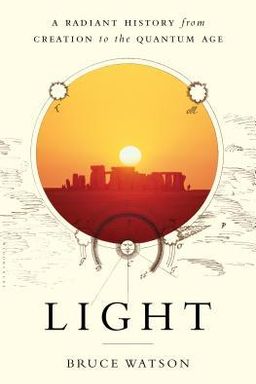
Bruce Watson’s sweeping history of light begins with a simple truth: before science, light was humanity’s first myth, metaphor, and measure of the world. Across time and geography—from Stonehenge at dawn to the Ganges at sunrise—humans turned to light to explain beginnings, gods, perception, and knowledge. In this global odyssey you watch light evolve from sacred symbol to scientific subject, and eventually to the digital photons that power the twenty-first century.
Creation and the Sacred Dawn
Watson begins with creation myths scattered from Genesis to the Gilbert Islands. Whether light bursts from divine command (“Let there be light”) or from a god vomiting the sun (in the Bushongo tale of Bumba), each story establishes illumination as the first proof of existence. The five archetypes of creation—Earth Diver, World Parent, Ex Nihilo, Emergence, and Cosmic Egg—converge on that gift: light as goodness, order, and revelation. Rituals like solstice gatherings at Stonehenge reenact that ordering of chaos, reasserting cosmic rhythm in human life.
In Genesis light exists before the sun and moon, a conceptual shift that let Western thought treat light as more than a physical property. This theological nuance—light as independent essence—opens the intellectual space for physics centuries later. It is the hinge on which Watson’s entire story turns: how reverence becomes reasoning.
From Vision to Inquiry
Light also teaches humanity how to see and how to ask. Ancient theorists like Empedocles, Aristotle, and Euclid debate whether light comes from the eye, from objects, or through a medium like Aristotle’s aether. Each answer changes what seeing means—inner fire, outer imprint, or waves traveling through an invisible sea. Watson portrays this as the birth of science: the transformation of mythic wonder into testable curiosity. When Ptolemy dips a brass disk into water to measure refraction, he inaugurates the method of measurement that still defines empirical reasoning.
Faith and the Radiant Divine
If myth creates sacred light and philosophy questions it, faith transforms it into revelation. Zoroaster divides the universe into light and darkness; Mani builds his doctrine on light’s imprisonment in matter. Paul’s conversion on the road to Damascus—the blinding photism—spins theology from vision. Christian creeds declare Christ “Light from Light,” while Eastern faiths celebrate enlightenment as inner brightness. In Buddhism’s “clear light” and in the Bhagavad Gita’s “splendor like a thousand suns,” illumination replaces fire with consciousness. Whether mystical or empirical, light still means knowledge breaking into ignorance.
The Book’s Thesis
Watson’s unifying argument is that human progress follows the trajectory of light itself—from unknowable origin to measurable wave, from divine gift to an engineered tool. Each culture, scientist, or artist adds another refraction to the beam: sacred, philosophical, technological, and finally existential. To understand light is to understand how humanity learns to see—symbolically and scientifically. (Note: This viewpoint recalls Jacob Bronowski’s The Ascent of Man, where scientific imagination fulfills ancient awe rather than abolishing it.)