
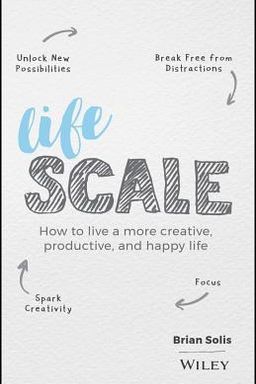
Lifescale cover

Lifescale

by Brian Solis

Lifescale tackles the modern dilemma of digital distraction, offering actionable strategies to regain focus, enhance creativity, and pursue meaningful goals. Brian Solis guides you to redefine success and happiness, leading to a more productive, creative, and fulfilling life.

Lifescaling: Reclaiming Focus and Living with Purpose

When was the last time you truly felt present—free from notifications, mental chatter, and the pull of technology? In Lifescaling, Brian Solis argues that modern life, hijacked by digital distraction, has fractured our creativity, drained our attention, and blurred our sense of purpose. Solis contends that the antidote isn’t productivity hacks or technological restraint—it’s a process of conscious rediscovery. He calls this journey Lifescaling: a deliberate effort to “scale life,” rekindling creativity, redefining success, and reconnecting with authentic happiness.

This book is both a diagnosis and a prescription for our fractured age. Solis begins by exposing how technology and multitasking have rewired our brains, trading focused creation for shallow consumption. From there, he introduces powerful practices drawn from psychology, mindfulness, and creative disciplines to rebuild sustainable focus. These include reclaiming attention, nurturing creativity, cultivating purpose, and visualizing a vivid future. Each component builds toward intentional living—an existence defined not by endless scrolling, but by awareness, gratitude, and growth.

The Crisis of Attention

At the heart of Lifescaling lies a realization: distraction is not just habitual—it’s engineered. Social media platforms and app designers exploit psychological triggers like variable rewards (a concept borrowed from slot machines) to keep us hooked. Solis likens our constant multitasking to an addiction that erodes memory, creativity, and emotional intelligence. He cites research showing that multitasking lowers IQ, diminishes empathy, and even reduces brain gray matter. But it’s not just our devices; it’s our mindset. We’ve come to mistake busyness for productivity and attention for validation.

Through examples like Netflix’s CEO declaring sleep its “top competitor,” and Tristan Harris warning of the attention economy’s “race to the bottom of the brain stem,” Solis makes clear: we’re living in a cognitive arms race, and our attention is the currency. Awareness, he says, is the first step to recovery. By recognizing the manipulation behind digital habits, you reclaim the agency to choose how you spend time and mental energy.

Creativity as the Cure

Once awareness is achieved, Solis invites readers to reconnect with their innate creativity—the source of human innovation and fulfillment. Drawing from figures like Walt Disney, Maya Angelou, and Pablo Picasso, he reminds us that everyone is born an artist. Creativity, far from a luxury, is what keeps the spirit alive. Solis contrasts early childhood creativity—the fearless play of drawing castles or imagining dragons—with adulthood’s conformity to efficiency and fear of failure. Citing Ken Robinson’s TED Talk, he underscores that we are “educated out of creativity.” The goal is to rekindle that spark—to remember that creative expression, big or small, is vital to joy and purpose.

Creativity creates flow, a state of total immersion where time disappears and productivity soars. (Mihaly Csikszentmihalyi’s research on “flow” complements Solis’s argument, showing that creative engagement produces lasting happiness far beyond temporary pleasure.) The more we practice creativity, the more fulfilled we become—it’s the fountain of youth and the key to resilience.

Purpose and Lifescaling

Yet creativity alone is not enough; it must be directed by purpose. Life purpose, Solis explains, is the “North Star” that gives our actions meaning. He draws inspiration from Oprah Winfrey, Richard Branson, and Matthew McConaughey, each of whom crafted personal mission statements as compasses for life decisions. Through stories of transformation—from consultant Hélène Tragos Stelian redefining her mission at 50, to Solis himself reclaiming creativity through his work—he guides you to articulate your own purpose statement.

This process begins with introspection: What truly matters? What brings energy, fulfillment, and joy? Through structured exercises—the “Purpose of Life Questions” and “Pillars of Purpose”—you define values, connect them to daily habits, and identify sustaining pillars like family, health, creative expression, and gratitude. The result is not just clarity but empowerment: a written map to navigate distraction and direct effort meaningfully.

Visualizing and Living It

In later chapters, Solis introduces visualization and deep work as the engines that transform purpose into reality. Vision boards and action plans serve as visible reminders of your goals, reinforcing commitment. He draws from Pixar’s storyboarding techniques and Zingerman’s “visioning” model to show how detailed mental imagery translates aspiration into action. Visualization, coupled with what Cal Newport calls “deep work”—undistracted engagement with meaningful tasks—becomes a sustainable cycle of growth.

Finally, Lifescaling is not a destination but an evolving practice. Like climbing, creative living demands continuous recalibration. Solis compares it to navigation by stars—your purpose as the North Star that guides, not bounds. Through mindfulness, gratitude, and positivity, Lifescaling transforms every day into an act of creative intention. The journey is lifelong, but each moment lived mindfully, each project pursued with purpose, is a triumph over distraction—and a step toward creative, conscious living.

Key Understanding

Solis’s central insight is simple but revolutionary: reclaiming creativity and focus isn’t about limiting technology—it’s about expanding awareness and aligning life to purpose. Lifescaling helps you rediscover who you are, silence distractions, and live fully—a blueprint for thriving in an age that constantly fragments your mind.


Awareness: Waking Up from Digital Distraction

Awareness is the first step that unlocks the Lifescaling journey. Solis calls it an awakening—the moment you realize how deeply digital technologies have colonized your mind. Through gripping examples, like the endless scroll and the addictive design of apps, he reveals that distraction is not accidental. Our attention has become the most valuable resource in the digital economy, traded by companies that profit from keeping us hooked.

The Manipulation of Attention

Solis draws parallels between social media use and gambling. Citing B.J. Fogg’s work at Stanford’s Behavior Design Lab, he shows that persuasive design exploits our neurological wiring through intermittent variable rewards—the unpredictable distribution of likes, notifications, or comments. Every refresh is a pull of a slot-machine lever. This cycle floods the brain with dopamine and oxytocin, fostering dependency and emotional volatility. The outcome? Endless engagement but decreasing satisfaction.

Leaders like Tristan Harris and Sean Parker have admitted that major tech platforms intentionally manipulate human vulnerabilities for profit, creating what Harris calls “a race to the bottom of the brain stem.” Solis’s warning is stark: the tools built to connect us have instead engineered addiction, anxiety, and distraction.

The Cognitive and Emotional Costs

These distractions aren’t harmless. Solis integrates research from psychologists like Clifford Nass and neuroscientists Daniel Levitin to show how multitasking sabotages our brain. Constant task-switching consumes cognitive energy, depletes attention residue, and increases cortisol levels. Long-term effects include reduced memory retention, emotional instability, and even gray matter loss in the anterior cingulate cortex—the part responsible for empathy and self-control. Essentially, technology isn’t just shaping behavior; it’s reshaping our brains.

The Gift of Awareness

But awareness itself is liberating. “Awareness is awakening,” writes Solis. He compares the realization of addiction to noticing a stalled car before it breaks down permanently. Once you see what’s happening, you can take ownership—to repair, redirect, and reclaim your focus. Awareness transforms “fear of missing out” (FOMO) into “finally over missing out”—the recognition that presence and creation are richer than distraction and consumption.

Central Message

You were not put on this planet, Solis reminds, to validate yourself through likes and comments. Awareness lets you step off the treadmill of distraction. It’s not about rejecting technology—it’s about reclaiming your power to choose how you engage with it.


Refocus: Reclaiming Deep Attention

After awakening to distraction, Solis guides you through the practical art of reclaiming focus. He argues that attention is life’s currency, and how we spend it determines who we become. Drawing from Cal Newport’s concept of 'Deep Work,' Solis describes focus as a discipline—a muscle that must be retrained through daily practice.

The Myth of Short Attention

You’ve likely heard that humans now have shorter attention spans than goldfish. Solis debunks this myth, showing that attention hasn’t disappeared—it’s simply been hijacked by habits. The issue isn’t incapacity; it’s conditioning. By practicing small 'attention hacks'—structured breaks, single-task rituals, and strategic prioritization—you begin rewiring your brain for sustained focus.

Techniques for Rebuilding Focus

  • Start mornings with important creative work before email or meetings, when your cognitive capacity peaks.
  • Turn off notifications—each ping steals 25% of your task efficiency.
  • Use the Pomodoro Technique: 25-minute sprints with short breaks to rebuild concentration.
  • Reconnect with mindfulness; pause, breathe, and refocus whenever mental chatter intrudes.

These methods may seem small, but together they chip away at distraction’s hold. Each focused sprint becomes a micro-victory in reclaiming one’s creative center.

From Multitasking to Flow

Multitasking, Solis explains, is modern mythology. We aren’t performing multiple tasks—we’re rapidly switching between them. This constant toggling erodes creativity and self-awareness. True productivity lies in single-tasking: immersing fully in one meaningful endeavor at a time. Over time, immersion leads to flow—a state of deep enjoyment and heightened performance identified by psychologist Mihaly Csikszentmihalyi.

Key Lesson

Focus is freedom. When you stop flitting between tasks and immerse fully in what matters, you reclaim not just productivity but presence. Refocusing isn’t a time management tactic—it’s a spiritual act of attention.


Purpose: Living Guided by Meaning

Purpose is the cornerstone of Lifescaling—the axis around which creativity and happiness revolve. Solis insists that purpose isn’t found by chasing it externally; it’s discovered by looking within. In a culture obsessed with goals, fame, and material success, he urges you to redefine success as purposeful living.

Defining True Purpose

Solis cites psychologist Steve Taylor, who calls purpose “a fundamental component of a fulfilling life.” Purpose orients you in a world of distractions—it’s both compass and fuel. He illustrates this through Hélène Tragos Stelian’s story: after decades of 'mindless' living—choices guided by habit rather than intention—she reinvented her life at fifty by articulating a mission around empowering women. By combining interests and values, she found alignment, energy, and direction.

Crafting Your Purpose Statement

Like Stelian, Solis encourages crafting a written purpose statement. This document becomes your North Star. He draws inspiration from Bill Gates, Oprah Winfrey, Richard Branson, and Amanda Steinberg, who each defined concise life missions rooted in teaching, empowering, or creating joy. Solis’s own statement centers on using creativity to help others understand how technology transforms human behavior.

Through exercises—evaluating childhood passions, current emotional gaps, and aspirational growth—you articulate your own “what for” rather than “why.” Purpose becomes less about self-definition and more about contribution. It’s deeply personal, yet expansive, connecting self-growth to collective impact.

Pillars of Purpose

Solis visualizes purpose as seven pillars: Liquidity, Family, Health, Friendship, Creativity, Connection, and Gratitude. Each represents a dimension of meaningful life. You nurture them daily as if balancing stones; too many spread thin, too few stagnate growth. Living purposefully means tending these pillars intentionally, knowing progress is imperfect but cumulative.

Guiding Thought

Purpose is not discovered; it’s designed. When you write it down and live by it, every decision gains direction. That clarity transforms ordinary tasks into meaningful acts.


Positivity and Mindset: The Brain’s Rewiring

A positive mindset powers the Lifescaling engine. Solis explains that positivity isn’t naïve optimism—it’s active mental training. Citing research from Martin Seligman (Positive Psychology) and Carol Dweck (Growth Mindset), he shows how thought patterns shape reality: positive thought expands creative possibilities; negative thought shrinks them.

From Fixed to Growth Mindset

People with fixed mindsets see talent and outcomes as static, leading to defensiveness and fear of failure. Growth-oriented thinkers view abilities as malleable, embracing challenges as catalysts for learning. This transformation, Solis reveals, is neurobiological—through deliberate reframing and gratitude, you can physically alter brain pathways. He references Norman Doidge’s The Brain That Changes Itself: “Thought changes structure.” Every positive intention rewires cognition toward resilience.

Practical Positivity Exercises

  • Write a daily gratitude list of things, experiences, or people you appreciate.
  • Start mornings with affirmations or inspirational quotes that set emotional tone.
  • Notice negative thoughts, pause, and reframe them: “What’s right about this wrong?”
  • Use mindfulness breathing to anchor attention in the present when anxiety arises.

The Power of Positive Doing

Positivity goes beyond thinking—it manifests through action. Solis cites Thomas Jefferson’s maxim: “I’m a great believer in luck, and I find the harder I work, the more I have of it.” Research by Richard Wiseman supports this: “Lucky” people create their own fortune by expecting good outcomes, staying alert to opportunity, and transforming setbacks into growth. Every positive act compounds like interest, reinforcing optimism’s structure in the brain.

Core Takeaway

Positivity isn’t passive belief—it’s a daily discipline. Each grateful thought and constructive effort rewires your brain toward creativity, resilience, and joy.


Visualization: Imagining the Future into Being

Solis champions visualization as the bridge between ambition and achievement. Visioning, he explains, transforms abstract aspiration into tangible motivation. It’s the mental act of seeing success as though it already exists—building belief and clarity that guide real-world action.

The Zingerman Example

Through Zingerman’s “visioning model,” Solis demonstrates practical visualization. Co-founder Ari Weinzweig encourages entrepreneurs to write vivid stories of future success—descriptions full of sensory detail, emotion, and community impact. One example: a farmers market vision written before launch described sights, smells, and interactions so vividly it later unfolded almost exactly as written. Visioning, Solis writes, is not magical manifestation—it’s clarity-driven planning that mobilizes motivation.

The Vision Board Practice

Vision boards serve as tangible reminders of goals. When Solis and his wife faced heartbreak in their adoption journey, they created a visual representation of their dream family. This process rekindled hope and guided next actions—not through mysticism, but emotional restoration and intentionality. Visualization invokes belief, which directs effort; seeing is rehearsing success.

Action Boards and Planning

Solis builds on visualization with “action boards”—visual plans with measurable steps. Research supports this: Neil Farber found that students who visualized detailed application plans were more successful than those who merely imagined winning. Write goals, then outline steps, timelines, and potential challenges. Display them regularly—each glance reinforces neural commitment, making intention habitual.

Essential Idea

You can’t create what you can’t see. Visualization turns vague dreams into detailed blueprints, connecting imagination to disciplined action.


Deep Work and Flow: Diving Beneath Distraction

Creativity thrives in depth, not in shallows. Solis draws from Cal Newport’s Deep Work to show how undistracted concentration produces exceptional results. In an era that glorifies busyness, Lifescaling invites you to go deep—to prioritize meaningful creation over shallow busyness.

The Art of Diving Deep

Deep work, writes Solis, is “attention without distraction.” Newport’s research shows that focus enables mastery and efficiency. Solis adapts this framework through four modes: monastic (long, uninterrupted solitude), bimodal (daily blocks of focus), rhythmic (scheduled sprints), and journalistic (snatching deep focus when possible). Each style reminds you that creative immersion must be ritualized—planned space and time where concentration is sacred.

The State of Flow

Flow is deep work’s reward. Described by Mihaly Csikszentmihalyi, flow occurs when challenge meets skill, when the self dissolves into creation. Solis compares this to free divers who train to hold breath longer—the more practiced your focus, the deeper your flow. Like Disney’s relentless curiosity or athlete Mandy Harvey’s emotional resilience, sustained attention transforms effort into transcendence.

Measuring and Improving

Borrowing from business strategy, Solis suggests tracking creative ROI through a “scorecard”—a simple visual of goals versus progress. This feedback loop sustains motivation and prevents drift. Each session of deep focus multiplies mastery and happiness, reinforcing neural pathways for sustained creativity.

Anchoring Insight

Deep work is the antidote to distraction. It replaces scattered effort with concentrated excellence. Every focused hour deepens skill, purpose, and joy—your creative breath held beneath the noise.

Dig Deeper

Get personalized prompts to apply these lessons to your life and deepen your understanding.

Go Deeper

Get the Full Experience

Download Insight Books for AI-powered reflections, quizzes, and more.