
Idea 1
A Life Scored by Songs
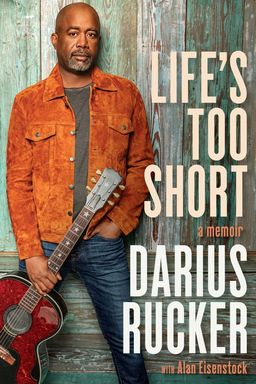
What’s the handful of songs that could tell your story—honestly—if you hit “play” right now? In Life’s Too Short, Darius Rucker argues that a life can be mapped, healed, and reinvented through the songs that haunt it. He contends that identity isn’t a single arc but a playlist: each track a season, each chorus a decision, each bridge a reckoning. But to hear that truth, you must get close to the speakers—close enough that melody becomes memory and the lyric becomes a choice.
Rucker’s memoir is not a linear “then I did X” celebrity recap. It’s a mixtape of twenty-three songs and the stories that made (and nearly unmade) him: a poor but vibrant Charleston childhood; a college dorm jam that became Hootie & The Blowfish; the rocket-to-planet-ubiquity of cracked rear view; the excess that followed; grief that deepened his voice; racism he refused to let harden his heart; an unlikely second act that remade country radio; and an endnote that doubles as a beginning—“Life’s Too Short.”
Why this matters to you
You won’t read this book to memorize chart positions. You’ll read it to reverse-engineer how a kid who sang Al Green into a salt shaker became a frontman who could rock stadiums with “Hold My Hand,” and later a country singer who took “Don’t Think I Don’t Think About It” to number one—the first solo Black artist to do so since Charley Pride (1983). You’ll see how a person builds a tribe when family fractures, how to create when gatekeepers say “no,” and how to retool your craft without betraying your core. If you’re staring down a reinvention, or wrestling with grief, or trying to go from basement practice to “booked,” Rucker’s road-tested moves will feel surprisingly usable.
What the book covers
First, it shows you what obsession done right looks like. As a child, Rucker didn’t just like songs; he lived inside them (think Cal Newport’s “deliberate practice,” but for ear and soul). Then it shows you how communities—glob (Sheldon), Squirt (David), Juan, White Boy Rick (the lone white kid in the crew), surrogate dads like Mr. Campbell, and later lifers like manager-turned-confidant Chris Carney—become scaffolding when family is complicated. You’ll watch a band self-invent in a dorm room, hone in bars, hand-sell a DIY EP (Kootchypop) to 65,000 customers, and force a major label to catch up.
You’ll also see joy and darkness walk hand in hand: a near-drowning in Hawaii saved by Woody Harrelson; a final bedside concert for his mother (Nanci Griffith’s “I Wish It Would Rain,” sung a hundred times); stadium highs, drug binges, Sinatra’s nod, Al Green’s fire, and a roadie’s sober warning—“I’ve never seen anybody go the way Hootie goes.” The book doesn’t cloak racism either. From a white neighborhood’s school bus that never served his block to slurs at frat gigs, to writing “Drowning” about the Confederate flag on the statehouse, Rucker shows you how to respond with craft, not corrosion.
The pivot—and proof
Finally, Rucker details a strategic reinvention that many artists dream of and few pull off. With producer Frank Rogers and label head Mike Dungan (Capitol Nashville), he lugged a guitar to 110 radio stations, earning spins a handshake at a time. Result: three straight number ones, Opry induction (invited by Brad Paisley, inducted by Vince Gill), and a diamond single (“Wagon Wheel,” with Lady A on harmonies). Along the way, he heeds Chrissie Hynde’s advice—“It’s not about you; it’s about them”—and starts loving the duty of playing the hits because the hits belong to the people. (See also Springsteen’s ethos in Born to Run.)
What you’ll take with you
Expect a playbook for craft (live inside one song until it reprograms you), for community (collect keepers, from Mr. Campbell to Letterman), for career (ship your “Kootchypop” before asking for permission), for courage (sing your grief until it sings back), and for reinvention (hand-sell the new you, station by station). If you need a nudge, a mirror, or a map, Rucker’s mixtape makes a simple case: life is too short to sort-of-like your song—so love it out loud. And when the crowd shouts for the chorus they gave you, sing it like a prayer.