
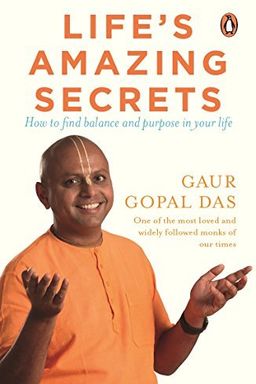
Life’s Amazing Secrets cover

Life’s Amazing Secrets

by Gaur Gopal Das

Life''s Amazing Secrets by Gaur Gopal Das offers transformative insights into achieving happiness and balance. By focusing on personal growth, spiritual practice, and meaningful relationships, readers learn to navigate life’s challenges and find their purpose. This guide is a must-read for anyone seeking a fulfilling and purposeful life.

Finding Balance and Purpose in Life

Have you ever felt that one aspect of your life—work, relationships, or personal growth—seems to dominate everything else, leaving you feeling off-balance? In Life’s Amazing Secrets: How to Find Balance and Purpose in Your Life, monk-turned-life-coach Gaur Gopal Das invites you to reflect on this imbalance and offers a spiritually grounded yet practically actionable path toward harmony. Drawing on Eastern philosophy, modern psychology, and personal stories, Das argues that true happiness arises not from external success but from inner alignment—a balance between four key areas of life: personal life, relationships, work life, and social contribution.

Through an engaging conversation between the author and a successful yet discontented man, the book becomes a metaphorical journey—like a car ride—where each “wheel” represents a component of balanced living. Das contends that happiness, like driving a car, depends not only on whether all four wheels are inflated and aligned, but also whether the driver holds the “steering wheel” of spiritual awareness.

The Car of Life: Four Wheels and a Steering Wheel

Das’s central metaphor—a car with four wheels and a steering wheel—anchors the book’s structure. Each wheel symbolizes a dimension of life that must remain in equilibrium with the others. They are:

  • Personal Life: Cultivating gratitude, mindfulness, and spiritual discipline to stabilize inner well-being.
  • Relationships: Speaking sensitively, forgiving others, and associating with positivity to enrich human connections.
  • Work Life: Developing self-awareness, healthy competition, and integrity to find meaning at work.
  • Social Contribution: Living beyond oneself through service, compassion, and an attitude of selfless sacrifice.

The “steering wheel” adds another dimension—an inner compass grounded in spirituality. Das identifies four spiritual practices that help maintain direction: sadhana (daily spiritual practice), sanga (association), sadachar (integrity), and seva (service). Without these, he warns, even a well-balanced life can lose its purpose and direction.

A Story that Teaches through Dialogue

The book unfolds as a long, personal conversation between the monk (Das) and a man named Harry Iyer, a wealthy executive from Mumbai who feels stuck and unhappy despite outward success. Their interaction begins with an anecdote about Harry forgetting his car keys—an incident that becomes symbolic of forgetting the “keys to happiness” in one’s journey toward success. Through humor and compassionate storytelling, Das gradually helps Harry uncover what’s missing: purpose, reflection, and gratitude.

Each chapter blends fable-like storytelling with spiritual teaching. When traffic halts their conversation, the traffic jam itself becomes a symbol of mental congestion. Harry’s emotional “traffic jam” of stress, disconnection, and ambition is cleared as the monk introduces him—and by extension, the reader—to simple, timeless practices of inner wellness. The narrative mimics a coaching conversation but feels more like a heart-to-heart mentorship—a spiritual bridge between ancient wisdom and everyday stress.

Why Balance Matters Now

Das situates his teachings in the context of modern life’s paradox: the more we achieve externally, the emptier we often feel internally. The book argues that technological advancement and social competition have intensified humanity’s external growth while neglecting inner growth. Echoing philosophers like Aldous Huxley and spiritual writers such as the Dalai Lama and Robin Sharma, Das asserts that the problem isn’t the existence of challenges but our attitude toward them. The ability to choose our response, not control events, defines happiness.

Balance, therefore, emerges as both an external and internal alignment. Externally, it means adjusting priorities—sometimes giving work more focus, other times family or self-care. Internally, it means nurturing values, attitude, and spiritual orientation. Maintaining internal “air pressure” in the tires—our outlook—prevents emotional punctures that stall life’s journey. Ultimately, gratitude, mindfulness, forgiveness, and service become the fuel that propels us forward.

From Philosophy to Practice

What sets Life’s Amazing Secrets apart from abstract self-help books is its practicality. Beyond inspiration, Das provides specific exercises: gratitude logs, reflection prompts, forgiveness worksheets, and ikigai mapping tools (inspired by Japanese philosophy). These help readers translate spiritual wisdom into daily actions. You’re encouraged to “press pause,” “count blessings,” ask “why worry?” and live deliberately. Each small act is meant to rewire your responses and build emotional discipline.

This approach—rooted in experience rather than preaching—bridges modern psychology and timeless Indian spirituality. Like Viktor Frankl’s emphasis on meaning in Man’s Search for Meaning, Das reframes spirituality as practical purpose, not renunciation. His own life—from engineer at Hewlett-Packard to monk in Mumbai—embodies this synthesis of modernity and mindfulness. The book ultimately mirrors his mission as a “Monk Who Speaks to Millennials”: to help ordinary people live spiritually without leaving their worldly responsibilities.

A Journey toward Integration

The book’s narrative culminates not in Harry’s enlightenment but in his reconnection—with his wife, with purpose, and with gratitude. The final chapters reveal that true transformation isn’t about escaping life’s chaos but learning to navigate it with grace. Das closes the story with an emotional full circle: Lalita’s pregnancy symbolizes renewal and the birth of hope. It’s a literal and metaphorical reminder that when balance, gratitude, and purpose align, life flows again.

“Happiness does not come automatically,” Das reminds us. “We must choose to live happily, with integrity and with balance.”

Thus, Life’s Amazing Secrets invites you to pause, realign, and drive your life with intention. The journey isn’t about perfecting every wheel—it’s about keeping the car moving, knowing where you’re going, and remembering that the steering wheel of spirituality keeps you on the path of purpose.


Growing through Gratitude

Gaur Gopal Das insists that gratitude isn’t merely a polite “thank you” but a profound mindset that shapes perception and resilience. In the chapter “Growing Through Gratitude,” he illustrates how cultivating gratitude shifts you from dwelling on what’s missing to recognizing the abundance already present in your life. Through anecdotes, humor, and poignant real-life struggles, he demonstrates that gratitude is the root of emotional growth and inner peace.

Shifting Perception: Seeing Positivity Amidst Problems

Das emphasizes that the mind, like the tongue obsessing over a seed stuck in our teeth, tends to fixate on irritations rather than on what’s working well. His guru, Radhanath Swami, once corrected his habit of focusing on negativity by advising him to train his mind to notice the positive first. Gratitude, then, becomes the mental discipline of consciously perceiving what is right rather than what is wrong.

He recounts humorous and humbling experiences from his ashram—like his frustration at long bathroom queues or faulty management—only to realize that positivity doesn’t mean denial of problems but the ability to approach them constructively. The lesson is timeless: when you change the way you look at things, the things you look at change. (This reflection parallels cognitive-behavioral practices in modern psychology.)

The Story of Gandharvika: Gratitude in Hardship

Das’s most moving illustration of gratitude comes from the real-life story of a young girl named Gandharvika, who battled Burkitt’s lymphoma at just four years old. Her parents endured endless cycles of chemotherapy, relapse fears, and financial exhaustion, yet they continually expressed gratitude—for doctors, friends, and their spiritual community. Despite her prognosis, Gandharvika’s positivity and prayers inspired even hospital nurses to explore spirituality. Against all odds, she recovered.

Through this story, Das reframes gratitude not as blind optimism but as strength amidst suffering. Even when life feels cruel, gratitude invites support, resilience, and hope. You can’t always change your circumstances, but you can change your response.

Practising Gratitude Daily

Das offers practical exercises to build gratitude into habit. He suggests keeping a gratitude log: each morning, list three to five people or events you’re thankful for, then choose one to thank through action later that week. Gratitude involves three stages—recognize the good done to you, remember it deeply, and reciprocate through kindness. Like exercising a muscle, gratitude grows through repetition until it becomes a natural state of being.

“It’s not the happy people who are grateful; it’s the grateful people who are happy.”

Gratitude, then, is the foundation of joy. It helps you see that even your struggles contain hidden gifts—from lessons learned to love received. By counting blessings rather than burdens, you build emotional immunity. As Das concludes, happiness grows not by addition of possessions, but by multiplication of appreciation.


Speaking Sensitively and Building Relationships

Relationships, Das explains, are like delicate glass—strong enough to last a lifetime, yet fragile enough to shatter with a few harsh words. Speaking sensitively is therefore not optional; it’s vital. Whether with a spouse, colleague, or stranger, our communication style determines the health of our connections. Das composes this idea through memorable anecdotes that remind us to handle others with care.

The Airport Encounter: A Lesson in Listening

Das recalls meeting a woman named Manasi at an airport who harshly criticized his spiritual organization. Rather than retaliate, he listened empathetically and apologized for her past negative experience. Only later did she realize he was the very teacher whose classes she had admired online. In that humbling moment, she recognized that sensitivity disarms hostility. Das demonstrates that compassionate communication transforms friction into understanding.

Attitude Shapes Interaction

He extends the lesson through a simple metaphor: when we treat objects like a “bucket” harshly, we develop a habit of insensitivity that seeps into how we treat people. Every careless kick of a bucket or dismissive word desensitizes our conscience. The way we act toward things mirrors how we act toward human beings. True respect begins with mindfulness in all we do—whether folding clothes, speaking to a waiter, or responding to criticism.

Cultivating Sensitivity at Home

With characteristic humor, Das discusses how familiarity breeds contempt, especially in marriages. The key is awareness: before reacting, ask, “Could my words heal or hurt?” By consciously softening tone, monitoring body language, and validating others’ feelings, you build emotional equity. Treating even trivial moments—like a disagreement—with respect prevents emotional debt from accumulating.

Ultimately, speaking sensitively is a daily spiritual practice. As Solomon said and Das quotes, “A gentle answer turns away wrath.” Words can be swords or seeds; what you plant, you will harvest later in your relationships.


The Power of Forgiveness

Forgiveness, for Das, is both an art and a discipline. It requires empathy, perspective, and courage to let go—without condoning injustice. In “Forgiveness,” he explains how resentment poisons the mind and how true forgiveness liberates both the giver and the receiver.

Understanding the Emotional Layers

Das uses the story of Sita and Laxman from the Ramayana to illustrate empathy behind forgiveness. When Sita accused her loyal brother-in-law Laxman unjustly, his pain could have turned into anger. Yet, understanding her fear and emotional turmoil, he responded with compassion rather than resentment. Forgiveness, Das concludes, begins with understanding why someone acted the way they did.

Separating Person from Problem

In your own life, Das advises, detach behavior from identity: say “There is a problem between us” rather than “You are the problem.” This subtle shift keeps communication constructive and helps you release anger without denying justice. His forgiveness worksheet at the back of the book codifies this process in reflective questions: identify the incident, empathize with their state, and consciously decide how you wish to move forward.

Forgiveness and Justice

Das differentiates between personal and societal forgiveness. Personally, you can let go to heal your heart. Socially, crimes—like the 2012 Delhi rape case he cites—demand justice to safeguard society. Spirituality, then, is not naïve passivity but wise discernment. Forgiveness on a human level must coexist with firmness on a moral level.

When practiced rightly, forgiveness dissolves inner toxicity and restores balance. As Martin Luther King Jr. wrote, “Darkness cannot drive out darkness; only light can do that.” Das translates this into everyday wisdom: forgiving others is how you free yourself.


Competing Without Comparison

Competition, Das argues, is healthiest when it’s against who you were yesterday—not against who someone else is today. Through stories from his youth, his professional acquaintances, and real workplace examples, he shows how comparison breeds envy, while self-improvement breeds excellence.

Jealousy vs. Healthy Ambition

Das recounts failing a college talent audition not because he lacked skill, but because another student bribed the sound engineer out of envy. That anecdote highlights how insecurity disguises itself as ambition. True ambition, by contrast, seeks mastery rather than domination. (He parallels this with Steve Jobs’s philosophy that creativity comes when you stop competing and start creating.)

In workplaces—like the story of Jaymin, the photographer sabotaged by jealous colleagues—Das observes how unbridled competition erodes integrity. Short-term victories gained through deceit end in loneliness and guilt. Only self-competition, the drive to refine your own virtues, leads to lasting joy and success.

Becoming the Best Version of Yourself

Das invokes Matthew McConaughey’s Oscar speech, where the actor calls his future self his “hero.” Competing with yourself means constantly chasing a higher version of who you can become. Small daily improvements compound into character transformation. Whether learning a new skill, controlling anger, or deepening kindness, your only rival is yesterday’s you.

“Don’t compare your chapter one to someone else’s chapter twenty.”

Healthy competition, then, is not about being better than others; it’s about becoming your best self.


Discovering Purpose Through Ikigai

Why do you wake up in the morning? To pay bills—or to fulfil a deeper purpose? In his chapter on self-discovery, Das introduces the Japanese concept of ikigai—your reason for being. He guides you to find where your passion, skills, societal needs, and livelihood intersect.

Unwrapping Your Gifts

Das compares self-discovery to unwrapping a gift: the effort of peeling back layers creates excitement and joy. Everyone has hidden potential waiting to be revealed through reflection and experimentation. He illustrates this through the story of Sairaj, a young student who chose cooking over engineering despite academic excellence. With his parents’ support, Sairaj followed his passion for hospitality instead of societal pressures. The family’s acceptance reflected true understanding of ikigai: success aligned with joy, not convention.

Love What You Do, Do What You Love

For those already deep into careers, Das suggests a dual approach—learn to love what you have to do while gradually making time to do what you love to do. You don’t need to quit your job immediately; you can integrate purpose through small projects, hobbies, or social ventures. If you crave environmental work but have a corporate role, volunteer weekends for eco-causes. Over time, purpose and profession can merge naturally.

Das’s blend of ikigai and spirituality transforms goal-setting into soul-setting. When passion serves others, work becomes worship. The spark of what you love becomes the flame that lights the world.


Spirituality and Success

Can spirituality and ambition coexist? Das dispels the myth that spiritual people lack drive or competitiveness. In his discussion on work life, he integrates lessons from the Bhagavad Gita and real-world leadership, showing how the most powerful form of success blends purpose, ethics, and service.

Redefining Ambition

Citing Krishna’s counsel to Arjuna, Das clarifies that spirituality doesn’t mean renouncing ambition but redirecting it toward service. The Gita’s wisdom—“Act, but without selfish desire”—encourages working hard for collective good, not ego gratification. Achievement, in this view, is sacred when resources are used for others’ betterment. Earning wealth isn’t wrong; hoarding it without compassion is.

The Sage and the Snake: Assertiveness with Values

Das narrates a parable: a sage advises a venomous snake to stop biting villagers. The snake obeys but becomes victimized because it forgets to hiss. The saint clarifies, “I told you not to bite, but never said stop hissing.” Spirituality, Das explains, does not mean weakness—it means strength guided by conscience. You can stand firm without harming others. In workplaces, assertive integrity protects dignity without aggression.

When ambition serves compassion, and success is guided by humility, spirituality doesn’t kill ambition—it fuels it with purpose.


Living with Integrity and Service

Integrity, Das concludes, is the hallmark of an evolved soul. True spirituality isn’t about how loudly you preach but how quietly you live your values. He dramatizes this philosophy through a real story from Mumbai’s Rathayatra festival, where a temple cart accidentally dented a luxury car. The monks left a note taking responsibility and offering compensation. The car owner, stunned by their honesty, donated generously to the temple instead. Character, Das insists, speaks louder than words.

The Three Aspects of Character

  • Vichaar: Philosophy or worldview that shapes your ethics.
  • Aachaar: Actions that express that philosophy in real life.
  • Prachar: Demonstrating integrity so visibly that it inspires others without needing words.

Das’s emphasis mirrors Stephen Covey’s view in The 7 Habits of Highly Effective People: integrity builds trust, and trust builds influence. In Das’s framework, character is spirituality in motion—when you instinctively act rightly even when no one is watching. It’s contagious; it transforms communities through example rather than argument.

For Das, living with integrity prepares the heart for the final, most fulfilling wheel—social contribution through selfless service.


Selfless Service: Expanding the Circle

Das’s final wheel of life centers on seva, or selfless service—the evolution from selfishness to contribution. Using powerful symbols—a candle giving light while melting, an ice cream melting for itself—he contrasts living for others with living for pleasure. Happiness, he asserts, expands as you move from self-centered gain toward compassionate giving.

The Ice Cream, the Candle, and the Oxygen Mask

To serve effectively, you must first maintain your own stability. Just as flight attendants advise securing your oxygen mask before helping others, Das notes that you must nurture your own emotional, physical, and spiritual well-being. Self-care isn’t selfish—it’s a foundation for sustained service. This is the balance between “selfish” and “selfless.”

From Family to Nation to Humanity

Das illustrates service starting at home through the story of Lata Khare, a 65-year-old woman who ran a marathon barefoot to pay for her husband’s medical treatment. Her love symbolized pure devotion. From there, Das broadens the scope with Brigadier Sunil Kumar’s acts of sacrifice for fellow soldiers on the battlefield, showing that selflessness can scale from the home to the nation.

Seva: The Highest Joy

Culminating in the story of a London-based dentist volunteering in rural India, Das notes how spiritual service merges skill and compassion. True seva contains three elements: right action (ethical conduct), right intention (selfless motive), and right mood (loving heart). When you serve in this spirit, joy becomes automatic. You stop pursuing happiness and begin radiating it.

“The service you do for others is the rent you pay for your room here on earth.” —Muhammad Ali

In the book’s closing moment—when Harry and Lalita learn they are expecting a child—Das beautifully restores the cycle of hope: serving love yields new life. When your four wheels of life align and your steering wheel of spirit remains steady, life’s amazing secrets are no longer secrets—they’re your daily reality.

Dig Deeper

Get personalized prompts to apply these lessons to your life and deepen your understanding.

Go Deeper

Get the Full Experience

Download Insight Books for AI-powered reflections, quizzes, and more.