
Idea 1
Life Is in the Transitions: Rewriting the Human Journey
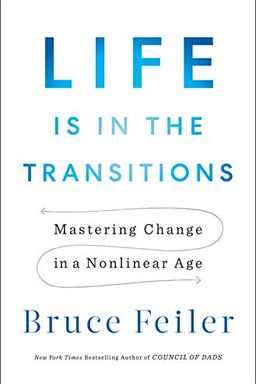
What if the script you were taught about life — school, job, marriage, retirement — was never true? In Life Is in the Transitions, Bruce Feiler argues that the old idea of a linear, stage-based life has collapsed. Instead, modern life unfolds as a nonlinear series of disruptions and reinventions. Feiler’s message is radical but deeply practical: you can learn to navigate upheaval as a skill, not a crisis.
The End of the Linear Life
For centuries, Western cultures imagined life as a staircase: predictable stages rising toward success, then falling into decline. This linear narrative shaped religion, education, psychology, even self-help—think of Erikson’s developmental stages or Gail Sheehy’s midlife crisis model. Feiler shows through historical analysis that this idea was an artifact of industrial and mechanized time, not of human nature. Life once was seen as cyclical, rhythmic, and story-like.
That staircase has crumbled. Data and experience show that modern people live out of order: marriage, childbearing, and career all arrive at diverse ages or not at all. Cultural multiplicity and shifting economies mean predictability is gone. Clinging to the old blueprint now breeds shame and anxiety—making people feel they’ve failed just because their timeline differs.
The Life Story Project: A New Map of Modern Lives
Feiler’s insights rest on his Life Story Project — 225 interviews, coded for 57 variables of emotion, timing, and transition. He built both qualitative and quantitative foundations: people across all fifty U.S. states told him how they reinvent themselves after disruption. Through this data he uncovered recurring patterns: disruptors (the 52-card deck of interruptions), lifequakes (major turning points), and life transitions lasting years.
The results overturn myths: the average person experiences one disruption every 12–18 months and three to five lifequakes per lifetime, each lasting an average of five years. In other words, you’ll spend nearly half your adult life adapting to change. You’re not “off track”—you’re in the middle of the normal human story.
From Chaos to Craft: The Tools of Transition
Feiler reframes transitions as craft. The Life Story Project reveals seven tools people use to move through upheaval: Accept It, Mark It, Shed It, Create It, Share It, Launch It, and Tell It. Acceptance and ritual mark the emotional beginning; shedding and creativity form the middle; sharing, launching, and storytelling ensure lasting integration. Together, they provide a structured way to turn rupture into renewal.
Each phase has its landmarks: the long goodbye (letting go), the messy middle (experimenting), and the new beginning (reclaiming purpose). You might lose identity, wander, and later find meaning through a chosen project or reshaped narrative. feiler demystifies these evolutions through vivid profiles: Amber Alexander enduring loss pileups, Jamie Levine reprioritizing family after her daughter’s illness, and Christian Picciolini transforming his neo-Nazi past into activism.
The ABCs of Meaning: Agency, Belonging, Cause
Underlying every transition is a search for meaning. Feiler organizes these needs into three pillars — Agency (me: control and mastery), Belonging (we: relationships and community), and Cause (thee: service and purpose). These ABCs correspond to shapes people use to describe their lives: lines, circles, and stars. You might begin agency-first and later shift toward belonging or cause — that movement is called shape-shifting. For instance, a burned-out executive may pivot into parenting or teaching, while an activist might return to family care.
Feiler’s research shows that healthy transitions involve rebalancing these pillars. When one collapses, the others can stabilize you. (As Viktor Frankl similarly observed, meaning—through work, love, or suffering—makes survival possible.)
From Storytelling to Renewal
Ultimately, Feiler argues that recovery isn’t about restoring the old story; it’s about telling a new one. He calls this process autobiographical occasion: a ritual or conversation where you rewrite your narrative—often by sharing it. Telling your story converts chaos into coherence, moving from contamination (“this ruined me”) to redemption (“this reshaped me”). The act of narration, he insists, doesn’t just describe recovery—it helps produce it.
The New Skill of Modern Life
Feiler’s conclusion is both empirical and moral: humans are now defined not by stability but by the ability to transition. Change isn’t an interruption; it’s the organizing principle of twenty-first-century life. By expecting disruption, marking it, sharing it, and telling it, you transform chaos into creativity. Life no longer unfolds as a straight line but as a sequence of arcs, loops, and reinventions — a nonlinear, lifelong story you get to author again and again.
Core message in one line
You can’t stop disruptions — but you can master transitions. The key is not predicting the future, but learning to rewrite your story when it changes.