
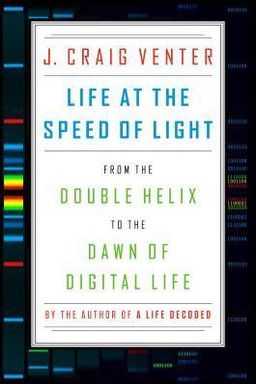
Life at the Speed of Light cover

Life at the Speed of Light

by J Craig Venter

Life at the Speed of Light takes you on an exhilarating journey through the world of synthetic biology. Discover how J. Craig Venter and his team synthesized the first artificial genome, revolutionizing our understanding of life itself. This groundbreaking work explores the ethical dilemmas and futuristic possibilities of genetic engineering, promising to transform medicine, space exploration, and beyond.

Life as Information: The New Revolution in Biology

What if life itself is best understood not as a mystical spark or mere chemical reaction, but as an information system? In Life at the Speed of Light, J. Craig Venter—genomic pioneer, creator of the first synthetic cell, and leader of the Human Genome Project’s private race—argues that life is nothing less than the product of digital information coded in DNA. He contends that biology has now entered a new era—the Digital Age of Biology—where the boundary between biological code and computer code is dissolving.

Through bold experiments and sweeping scientific history, Venter shows how the once-mysterious essence of life can now be read, written, and transmitted at the speed of light. Just as computers revolutionized information processing, synthetic genomics, he argues, will democratize the creation of life, enabling humanity to design organisms to cure disease, generate sustainable energy, and even terraform other planets.

From Vitalism to Digital Life

For centuries, scientists debated the origin and definition of life. Was there a special force that distinguished the living from the non-living? From vitalists like Hans Driesch and Henri Bergson to mechanists like Jacques Loeb, the history of biology oscillated between metaphysics and materialism. Venter opens his book by tracing this intellectual lineage back to Erwin Schrödinger’s 1944 lectures in Dublin, later published as What Is Life? Schrödinger proposed that life’s secrets lie in an "aperiodic crystal"—a stable molecule that encodes information. This vision predicted the discovery of the genetic code and the double helix, providing the blueprint for modern molecular biology.

Venter positions his own work as the contemporary realization of Schrödinger’s insight. DNA, he explains, is both hardware and software: it encodes the instructions to build and run the living cell, much like computer programs control machines. By decoding and rewriting this software, scientists can now transform one organism into another or even create synthetic life entirely from digital code.

The Journey from Reading to Writing Life

The book follows Venter’s journey from sequencing the first bacterial genome, Haemophilus influenzae, to the monumental achievement of building a synthetic organism from scratch. In doing so, he recounts how genetics evolved from Oswald Avery’s 1940s experiments proving DNA’s role in heredity, through Watson and Crick’s discovery of the double helix, to his own creation of Mycoplasma mycoides JCVI-syn 1.0—a cell controlled by chemically synthesized DNA. Each stage demonstrates that information, not mystical essence, defines life.

The book weaves history, philosophy, and cutting-edge science into a provocative argument: once we can write DNA as easily as we print a document, biology will become programmable. Venter recounts his team’s experiments in genome transplantation, where replacing a bacterial species’ genome with that of another transformed it into the donor species. Such experiments, he argues, revealed that changing DNA—the “software of life”—changes the species itself. Life, therefore, is not defined by mysterious vital forces but by information executed through chemistry.

Why This Revolution Matters

Venter’s vision extends far beyond the laboratory. He imagines a future in which DNA code can be beamed via electromagnetic waves across planets, instantly “printing” medicines, vaccines, or organisms using biological 3-D printers. This is not science fiction: he describes FDA-approved synthetic vaccines, custom bacteriophages to combat superbugs, and NASA-funded experiments to transmit biological code to Mars. In this worldview, biology merges with digital technology to form a single continuum of information—a blend of fermionic life and photonic communication.

Yet Venter’s optimism is tempered by caution. He acknowledges fears of hubris, “playing God,” and bioterrorism—but insists that rational governance and transparent ethics must ensure progress. He compares the coming synthetic-biology revolution to the dawn of the Industrial Age or the rise of computing: immense power coupled with immense responsibility. Humanity, he suggests, must use its new mastery of life to solve global crises—climate change, disease, and resource scarcity—rather than create new ones.

Scope of the Book

Across twelve chapters, Life at the Speed of Light journeys from chemistry’s early struggle with vitalism to the mysteries of quantum teleportation of biological data. You’ll learn:

  • How Friedrich Wöhler’s synthesis of urea shattered the belief that life required a vital spark.
  • How key discoveries—from Avery’s DNA experiment to Sanger’s sequencing—catalyzed the digital decoding of life.
  • How Venter’s team synthesized viral and bacterial genomes, culminating in the first self-replicating synthetic cell.
  • How biology is becoming an engineering discipline, where cells can be designed like software circuits.
  • And how DNA information may one day be transmitted through light, allowing “life at the speed of light.”

Ultimately, Venter invites you to reconsider what it means to be alive in an age where life can be designed, coded, and transmitted. The question is no longer “What is life?” as Schrödinger asked—but “What will life become when we can control its code?”


Chemistry, Vitalism, and the Birth of Biology

Before science could explain life, it mythologized it. For centuries, thinkers believed living things possessed a mysterious vital force—an animating spirit beyond chemistry. Venter revisits this intellectual battle to show how biology gradually replaced mysticism with mechanism, culminating in the proof that life can be built from nonliving matter.

From Spirit to Science

The 19th-century chemist Friedrich Wöhler shattered the illusion that organic substances needed a life force to exist. In 1828, while experimenting in Berlin, Wöhler accidentally synthesized urea—a substance found in urine—from inorganic salts. The news shocked the scientific establishment. By creating an organic compound without any living input, Wöhler had disproved vitalism’s central tenet that life’s chemistry was beyond human manipulation.

Yet as Venter notes, the mythology around Wöhler’s experiment far outgrew the event itself. Many contemporaries saw his urea synthesis as symbolic, not revolutionary—it took decades for mechanistic chemistry to win the argument. But the principle Wöhler proved—that what we call life emerges from molecules obeying physical laws—became the foundation upon which modern biology was built.

Mechanizing Life

This shift was extended by scientists like Jacques Loeb, who declared in 1906 that biology’s purpose was not to “understand life” but to “control it.” Loeb’s experiments in inducing sea urchin eggs to develop without fertilization demonstrated that biological processes could be triggered by purely chemical stimuli. He envisioned a “technology of living substance,” transforming biology into an engineering discipline. (In Sinclair Lewis’s novel Arrowsmith, Loeb appears as the fictional Dr. Gottlieb.)

Venter sees himself as Loeb’s intellectual descendant. Where Loeb manipulated cell chemistry, Venter rewrites biological software. Both aimed to strip life of mystique and replace faith with function. By reconstructing genomes from scratch, Venter claims to have completed what Wöhler and Loeb began: proving that life is a manufacturable system governed by information, not divine spark.

The Death—and Persistence—of Vitalism

Despite such triumphs, vitalism refused to die. At the turn of the 20th century, thinkers like Hans Driesch proposed that embryos contained an immaterial “entelechy” directing their development, while philosopher Henri Bergson argued for an élan vital, a creative life force driving evolution. Even today, Venter argues, a subtler form of vitalism persists when scientists attribute unexplained biological processes to emergent, unquantifiable “complexity.”

“When one attributes unmeasurable properties to the cell cytoplasm,” Venter writes, “one has unwittingly fallen into the trap of vitalism.”

In other words, claiming that life is “more than the sum of its chemistry” is just modern mysticism. For Venter, as for Schrödinger, all evidence points to a single unifying truth: life is chemistry organized by information. His experiments in synthetic genomics serve as the modern proof-by-synthesis that this is not merely a metaphor but a material fact.


The Digital Code of Life

Venter’s modern scientific revolution rests on one central realization: DNA is a digital information system. Life’s extraordinary diversity—from viruses to humans—emerges not from mystical essence or endless chemical variation, but from combinations of just four letters: A, T, C, and G. Understanding this alphabet of life changed biology from a descriptive science into an informational one.

By tracing how scientists learned to both read and write this code, Venter connects nearly a century of discovery—from Oswald Avery’s 1944 proof that DNA carries heredity, to Sanger’s sequencing breakthroughs, to his own real-time genomic assembly—to show how biology became a form of data science.

From the Double Helix to the Code

When James Watson and Francis Crick announced DNA’s structure in 1953, they provided more than a visualization—they introduced the logic of replication. The double helix revealed a simple copying mechanism: A binds to T, and C binds to G. This template-driven pairing created an informational bridge between chemistry and heredity. Within two decades, the genetic code’s full “grammar” was decoded by Marshall Nirenberg and Har Gobind Khorana, who discovered that three-letter codons correspond to amino acids—the building blocks of proteins.

Biology thus entered the age of representation: sequences of bases could now be “read” as meaningful language. Later, Hamilton O. Smith’s discovery of restriction enzymes in the 1970s allowed scientists to cut and paste DNA, creating recombinant molecules. As Venter notes, this marked the birth of genetic engineering—the first moment when humanity began editing life’s software.

From Reading to Writing Genomes

Building on these foundations, Venter’s teams pioneered whole-genome shotgun sequencing, a computational method that could reassemble millions of DNA fragments into digital genomes. By 1995 they had sequenced Haemophilus influenzae—the first living organism fully decoded. Later, Venter’s private company, Celera Genomics, raced the U.S. government to publish the first human genome, reducing a project that once took decades to less than two years.

Once the alphabet of life could be read fully, Venter turned his attention to writing it. His next goal was to reverse the process—to see if chemically synthesizing DNA could produce life. In this way, he realized Schrödinger’s prediction that life’s “aperiodic crystal” could be assembled by design, turning biology into a digital art form as programmable as software code.

Just as computers process binary digits, Venter shows, cells process genetic code. Both store, copy, and execute instructions according to a set of molecular rules. If one can digitally design a new DNA sequence, simulate it, and then synthesize it chemically, there is no theoretical limit to what life forms might be created. This understanding sets the stage for the synthetic biology revolution that follows.


Creating Synthetic Life: Phi X 174

In one of the book’s most compelling narratives, Venter describes how his team revived a virus from scratch—an achievement that served as a rehearsal for creating synthetic life. The project revolved around phi X 174, a tiny bacteriophage with just 5,386 DNA bases. This simple organism had already played a starring role in molecular biology: it was the first DNA virus ever sequenced, by Fred Sanger in 1977, and it became the first synthetic viral genome reproduced in a lab by Arthur Kornberg in 1967.

Proof by Synthesis

Venter’s team set out to do what Kornberg had only partly achieved: to recreate the virus using nothing but digital code and lab-synthesized DNA fragments. Starting with Sanger’s sequence, they designed 259 overlapping oligonucleotides—short DNA fragments—and used enzymes like DNA ligase to assemble them into a complete circular genome. To test success, the synthetic genome was introduced into E. coli cells via electroporation. If the DNA was correct, it would instruct the bacteria to produce new viruses, visible as clear plaques on bacterial lawns.

When those plaques appeared, they proved an extraordinary principle: a digital file encoding a genome could yield a living, replicating entity. It demonstrated what Venter calls “proof by synthesis”—the idea that something truly exists and functions only when you can recreate it. This became the intellectual and experimental basis for his later synthetic cells.

The Ethical and Political Earthquake

Venter’s phi X 174 experiment set off a quiet storm in Washington. Conducted shortly after the 9/11 attacks, it raised fears of biosecurity risks—could terrorists also synthesize viruses? Venter engaged directly with the U.S. Department of Energy and Homeland Security, lobbying for open publication rather than secrecy. Eventually, his team’s 2003 paper was released, along with the creation of a new oversight body: the National Science Advisory Board for Biosecurity (NSABB).

By proving that life could be built using computers and chemicals, phi X 174 bridged science fiction and reality. It also launched international debates about ethics, religion, and “playing God.” Venter, however, argues that the real moral failure would be to fear discovery rather than guide it responsibly. This experiment, he insists, marked not humanity’s defiance of nature but its participation in evolution as an intelligent designer.

The phi X 174 project compressed living creation into a two-week laboratory process—a process that had taken nature billions of years. It was the opening move in a scientific revolution where the line between what is natural and what is designed would become increasingly porous.


Building the First Synthetic Genome

After phi X 174, Venter’s next challenge was monumental: constructing the first fully synthetic genome of a living cell. His team chose Mycoplasma genitalium, one of the smallest and simplest self-replicating organisms, as their model. The goal was to synthesize its 582,970-base-pair genome chemically, insert it into a living cell, and see if it could control that cell’s functions—a milestone that would prove DNA alone could govern life.

From Segments to Systems

The process required assembling over 100 DNA fragments, each roughly 5,000 to 7,000 bases long—far beyond what had previously been attempted. Using a method pioneered in Venter’s lab called Gibson assembly, named for his colleague Daniel Gibson, the team stitched these segments together, first into medium-sized cassettes, then into quarter- and half-genomes, and finally into the full circular chromosome. To confirm success, they sequenced every fragment repeatedly and added watermark sequences—coded digital signatures spelling “Venter Institute” and “Synthetic Genomics.”

Once assembled, the synthetic genome was transplanted into a host Mycoplasma capricolum cell. The goal: see if the synthetic DNA could “boot up” the cell’s machinery. The host’s original DNA was destroyed, and when the transplanted cell began dividing, blue colonies appeared (due to marker genes), showing that the synthetic genome had taken control.

One Letter Between Life and Death

But earlier attempts had failed. Venter’s team discovered that a single missing base in one essential gene called dnaA—responsible for initiating DNA replication—prevented the cell from living. Correcting that single “spelling error” restored viability. “One wrong letter out of a million,” Venter notes, “was the difference between life and no life.” This finding crystallized his philosophy: life is information executed through chemistry, and like software, even one bug can crash the system.

The result was Mycoplasma mycoides JCVI-syn 1.0—the first self-replicating cell controlled entirely by a synthetic genome. Its creation in 2010 was hailed worldwide as the dawn of synthetic biology. Science magazine, ethics committees, and even the Vatican weighed in. For Venter, the message was simple: DNA is not merely an inert molecule; it is the language of life itself. When understood algorithmically, it can be read, copied, programmed—and reborn.


Inside Synthetic Cells: Redefining Life

Once Venter created a synthetic cell, the world asked: had he created life? His answer complicated the question. By defining a cell entirely through its synthetic genome, he argued that life is not mystical substance but self-sustaining information. If the genome determines a cell’s identity, then changing that code literally transforms its species—a revolutionary reframing of what it means to be alive.

Life as Software

For Venter, the act of synthesizing a genome and watching it “boot up” was akin to loading an operating system into a biological computer. DNA is the OS; proteins are its hardware; and metabolism is the algorithm running through time. This analogy is not metaphorical but functional: each triplet codon in DNA performs logical operations as precise as those in machine code. By rewriting genomes, we can now redesign biological functions—from producing biofuels to detecting toxins to manufacturing drugs—on demand.

His team’s next goal became more philosophical: identifying the minimal genome required for life. By selectively removing genes from Mycoplasma, Venter sought to determine the essential biochemical instructions for self-replication. This search mirrored Schrödinger’s original question—“What is life?”—but reframed it experimentally: What is the smallest code that still runs the living program?

From Mechanism to Ethics

The ethical reactions to Venter’s announcement varied widely. Some hailed him as humanity’s Prometheus; others accused him of “playing God.” The U.S. Presidential Bioethics Commission concluded that synthetic biology did not create life from scratch but extended existing nature. Venter welcomed this scrutiny, emphasizing that such oversight—rooted in reason rather than fear—was essential to move forward safely.

“DNA is the software of life,” Venter reminded his audience. “Change the software, and you change the species.”

Synthetic biology thus erased the last distinction between biology and technology. Life was no longer defined by its spontaneous origin but by its capacity for replication, adaptation, and computation. In that sense, creating life synthetically did not imitate nature—it continued it.


Biological Teleportation and Life at Light Speed

Venter ends with a provocative idea: what if DNA information could be transmitted as light waves—biological teleportation? Just as digital files are sent electronically, he envisions encoding genomes into electromagnetic signals and reconstructing them at remote destinations, from hospital labs to Mars. This, he argues, is the ultimate expression of life as pure information.

Converting Code into Life

At his company, Synthetic Genomics, Venter developed a system capable of “printing” DNA from digital files. By combining synthesized oligonucleotides, error-correction enzymes, and cell-free translation systems, they could produce functional proteins, viruses, or cells directly from transmitted code. He imagines a future where medical treatments—vaccines, phages, or even replacement tissues—can be sent as digital DNA downloads and produced locally via “biological 3-D printers.”

During the 2009 H1N1 flu pandemic, Venter’s team demonstrated this approach by synthesizing vaccine seed strains within days, compared to the traditional months-long process. Later, in partnership with Novartis, they created influenza vaccines from genome data transmitted electronically—an early form of life-at-light-speed manufacturing. NASA even funded experiments exploring the possibility of sequencing potential Martian microbes and transmitting their genomes back to Earth for reconstruction.

From Fermions to Photons

Venter connects this vision to the language of physics. All living matter, he notes, is composed of fermions—particles of matter—yet digitized DNA, transmitted via photons, enters the realm of bosons, carriers of electromagnetic force. To beam DNA is, in essence, to convert life’s information from matter into light. In doing so, biology transcends its earthly constraints, joining communication, computation, and creation in one continuum.

A New Industrial Revolution

Venter envisions biological teleportation as the next industrial revolution. By printing life “on demand,” humanity could decentralize manufacturing, agriculture, and medicine. A farmer might download drought-resistant seeds; a doctor could print a patient-specific therapy; a space colony might receive microbial ecosystems transmitted across millions of miles. “Life will move at the speed of light,” he writes, both literally and metaphorically.

While the vision borders on utopian, it captures Venter’s central conviction: once life is defined as information, it becomes subject to the same dynamics as any digital system—fast, reproducible, and shareable across the universe. The challenge will be ensuring that this godlike power remains guided by ethics, transparency, and stewardship rather than fear or exploitation.

Dig Deeper

Get personalized prompts to apply these lessons to your life and deepen your understanding.

Go Deeper

Get the Full Experience

Download Insight Books for AI-powered reflections, quizzes, and more.