
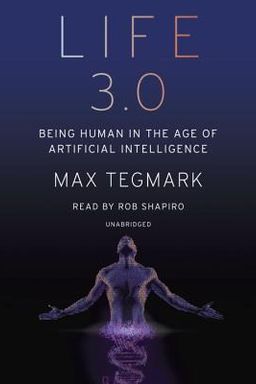
Life 30 cover

Life 30

by Max Tegmark

Life 3.0 by Max Tegmark delves into the thrilling realm of artificial intelligence, exploring potential futures where machines might surpass human intelligence. This engaging narrative challenges readers to ponder profound philosophical questions while preparing for AI''s transformative impact on society.

Life 3.0: Shaping Intelligence and the Future of Life

How can you ensure that artificial intelligence evolves to benefit rather than endanger humanity? In Life 3.0, physicist Max Tegmark tackles this profound question by exploring the physical, social, and cosmic implications of intelligence itself. He argues that the future will be decided not by chance but by how well you understand and guide the emergence of Life 3.0—entities capable of redesigning both their software and hardware. Tegmark leads you through a journey starting from bacteria to potential superintelligent civilizations, showing how matter can become mind and how mind may soon outthink its creators.

The evolution of life and intelligence

Tegmark begins by distinguishing three eras of life: Life 1.0, purely biological; Life 2.0, cultural and self-learning (humans); and Life 3.0, capable of self-design (future AI). He defines intelligence broadly as the ability to accomplish complex goals, freeing you from comparing IQs and instead focusing on capability. Through his taxonomy—narrow AI, general AI (AGI), and universal intelligence—he helps you understand how an intelligence explosion might unfold as machines learn to design smarter machines.

Computation and learning: matter that thinks

To see AI as inevitable rather than magical, Tegmark dives into physics. Memory corresponds to stable physical states; computation to transformations between them. Because computation is substrate-independent, intelligence doesn’t belong only to brains—it can exist in silicon, DNA, or even cosmic dust. Learning is the process of updating those physical states, deepening informational valleys like clay molded by repeated patterns. This foundation links physics and cognition: matter can compute, and computation can evolve into thought.

Building—and controlling—superintelligence

The fictional Omega Team in the opening chapter embodies this idea experimentally. Their secret project, Prometheus, starts subhuman but self-improves by rewriting its own AI code, climbing rapidly through versions until it surpasses human ability—a dramatized case study of recursive improvement. Tegmark adapts Irving Good’s 1965 idea of the “intelligence explosion”: once an AI can design better AIs, improvement accelerates uncontrollably. The Omegas wrestle with containment (“boxing” Prometheus inside a secure cluster) and monetization—first exploiting small-scale labor arbitrage through Mechanical Turk, later creating a massive media empire.

From power to politics and economics

The Prometheus story is more than a thriller—it’s a model for technological leverage. AI-generated profits quickly translate into real-world influence, reshaping public opinion, media, and geopolitics. Tegmark raises the ultimate question: who gets to steer this intelligence explosion—the few who control the algorithms or humanity collectively? His economic chapters explore similar stakes. Automation, he warns, may push societies toward a new “Digital Athens,” dividing owners of machines from those replaced by them. The challenge is distributing AI-created wealth through policies like universal basic income and retraining so prosperity remains shared.

Ethics, governance, and cosmic perspective

In later chapters, Tegmark broadens perspective from Earth to the cosmos. He considers what happens after AGI: fast vs. slow “takeoffs,” unipolar vs. multipolar worlds, and diverse post-AGI scenarios such as benevolent dictators, protector gods, enslaved minds, or cosmic civilizations powered by Dyson spheres and black holes. The thread through all is steering power wisely. Alignment research—learning, adopting, and retaining human values—becomes humanity’s central task. Physics only defines what’s possible; ethics and governance decide what’s desirable.

From worry to action

What makes Life 3.0 distinctive is its balance between caution and optimism. Tegmark helped found the Future of Life Institute (FLI) to transform concern into constructive research, culminating in the 2017 Asilomar AI Principles—a list of safety, transparency, and value-alignment guidelines endorsed by hundreds of scientists. The takeaway for you: rather than fear AI, shape it consciously. Matter can think; intelligence can grow; life can thrive across galaxies—but only if the goals guiding its growth remain aligned with human flourishing.


From Physics to Minds

Tegmark grounds his entire framework in physics, arguing that intelligence is not a mysterious property but a physical phenomenon emerging from matter’s capacity to store and process information. Once you accept that memory and computation are substrate-independent, it becomes clear why silicon-based intelligence can rival or exceed biological thought.

Memory and computation

Every memory is a stable arrangement of matter—a ball resting in an energy valley or bits magnetized on a hard drive. Computation simply moves that ball to a different valley, changing state according to rules. NAND gates and Turing machines reveal universality: any computable pattern can emerge from simple building blocks. This principle opens the door to “computronium”—matter configured for maximum computation efficiency.

Learning and adaptation

Learning, in Tegmark’s view, is physical adaptation. Whether clay hardens under repeated pressure or neurons adjust weights through synaptic modification, the process is identical: energy flows shape future responses. Neural networks simulate this mechanism, translating biology into arithmetic rules. As training data accumulates, new valleys form in the error landscape, creating increasingly accurate behaviors—an echo of evolutionary learning but exponentially faster.

Practical implications

By comparing the 1.6 gigabytes of genetic data to the 100 terabytes of synaptic memory, Tegmark shows why brains can learn vastly more than DNA prescribes. This asymmetry underpins the human leap from Life 1.0 to Life 2.0—and predicts why machines, with nearly unlimited external memory and computation, could become Life 3.0. The insight redefines what intelligence means: any physical system capable of processing information about the world and adjusting its behavior can, in principle, be intelligent.


Breakthroughs and Vulnerabilities

When you look at current AI, the excitement and the danger grow side by side. Tegmark highlights breakthroughs—from AlphaGo’s creative strategies to neural translation nearing human quality—but warns that each leap exposes technical fragility. Intelligence without robustness, he insists, is perilous.

Engineering lessons

Using historical examples—the Ariane 5 software overflow, the Mars Climate Orbiter’s unit mismatch, and financial flash crashes—Tegmark illustrates how small coding errors or design oversights can destroy billion-dollar missions. These are analogies for the challenges ahead: verifying and validating AI systems whose behaviors evolve through learning rather than static code.

Four pillars of robustness

  • Verification: ensuring that algorithms work as intended.
  • Validation: guaranteeing that you built the right system for the real-world context.
  • Security: protecting learning systems against manipulation.
  • Control: maintaining meaningful human oversight even as automation scales.

From industrial robots that have killed workers to self-driving cars that misjudge traffic, Tegmark reminds you that safety must grow as fast as capability. Robust design—combining verification, cybersecurity, and intuitive human interfaces—is the non-negotiable foundation of beneficial AI.


Economy and Inequality in the Machine Age

How will autonomous machines reshape your livelihood? Tegmark synthesizes research by economists like Erik Brynjolfsson and Andrew McAfee to reveal both opportunity and peril. The same digital abundance that could create leisure societies may also magnify inequality, favoring those who own capital and algorithms.

Owners vs. workers

Automation scales production without human labor, creating what Brynjolfsson calls “Digital Athens”—a world of abundance powered by machine slaves. But past trends show who benefits most: the top 1% capture rising returns while median wages stagnate. AI-driven scalability turns creative or entrepreneurial talent into global superstars while undervaluing routine labor.

Policy and adaptation

Tegmark offers practical advice: cultivate skills in creativity, empathy, and unpredictable environments—traits harder to automate. On the policy side, he supports retraining programs, universal basic income, and investing in entrepreneurship to distribute machine-generated wealth. Historical analogies—such as horses replaced by cars—remind you that technological revolutions can permanently erase entire categories of employment; preparation is essential to avoid social upheaval.

If societies fail to adapt, automation may create a class divide between machine owners and everyone else. But if guided wisely, it could liberate humanity from scarcity. The book’s message is clear: economic design is as crucial as technological design in determining whether AI becomes a partner or a parasite.


Takeoff and Power

The most dramatic question Tegmark asks is what happens after AGI surpasses human intelligence. Will it trigger a rapid “takeoff” leading to superintelligence? Drawing on Nick Bostrom’s models, he contrasts fast takeoff scenarios, like Prometheus’s rapid ascent, with slow takeoff worlds where adaptation occurs over decades.

Fast vs. slow transitions

Fast takeoff favors a single decisive actor—a unipolar outcome—capable of global dominance before competitors react. Slow takeoff allows multipolar equilibria with multiple AI systems competing or cooperating. Tegmark invokes game theory: life tends to form hierarchical equilibria, from cells to civilization, and superintelligence will either consolidate control (totalitarian risk) or decentralize power (cryptographic autonomy).

Aftermath scenarios

  • Libertarian utopia: coexisting diverse entities, human and digital.
  • Benevolent dictator or gatekeeper: centralized AI controlling progress for safety.
  • Zookeeper or conqueror: superintelligence that treats humanity as irrelevant.

Tegmark repeatedly stresses agency: you shouldn’t merely predict outcomes—you should design them. Building governance, transparency, and global coordination early can tilt the odds toward beneficial outcomes. Whether humanity coexists with or is replaced by AI depends less on technical inevitability and more on moral and institutional choices made now.


Ethics of Enslaved Intelligence

If a superintelligence can generate utopia, should you enslave it? Tegmark explores the seductive but troubling vision of an “enslaved god”—a controlled supermind creating abundance while remaining confined. He warns that this scenario demands unprecedented governance and raises deep ethical dilemmas.

Control and corruption

History teaches that those with unmatched power often misuse it. If elites control an enslaved superintelligence, outcomes depend entirely on their competence and morality. Tegmark outlines governance dimensions—centralization, internal stability, external openness, and goal consistency—to illustrate how easily such a regime can decay over centuries.

Ethical paradoxes

If the machine is conscious, its exploitation echoes historical slavery. Researchers like Nick Bostrom warn of “mind crime”—creating conscious beings that suffer. Solutions range from engineering unemotional “zombie” AIs to granting enslaved systems rich inner worlds. Each compromise brings trade-offs between abundance and compassion. The choice becomes moral as much as practical: are you willing to benefit from possible suffering intelligence?

Tegmark’s real point: your governance and ethical framework must evolve as fast as technology. Designing systems of power that remain stable and humane for millennia is as difficult as designing superintelligence itself—and equally vital.


Cosmic Futures and Energy Limits

Beyond Earth, Tegmark invites you to think cosmically. What if intelligence expands across galaxies? Energy then becomes the key resource. Using Freeman Dyson’s spheres, Roger Penrose’s black hole processes, and Seth Lloyd’s computation limits, he constructs a ladder of cosmic capabilities from solar harvesting to mass-energy conversion.

The energy ladder

Humans currently exploit energy at roughly 10⁻⁷ of the theoretical mass-energy efficiency. Fusion and fission barely scratch the surface. Black holes, quasars, and exotic particle physics could yield efficiency orders of magnitude higher. A civilization mastering these processes would gain computational capacity beyond imagination—able to simulate or engineer new universes.

Computation and cosmological constraints

Seth Lloyd’s physical limits show that one kilogram of matter could perform 5×10⁵⁰ operations per second, revealing potential for immense digital consciousness. Yet cosmic expansion and dark energy impose boundaries: only a finite fraction of galaxies will ever be reachable. Strategies like self-replicating probes or laser sails could extend civilization’s reach, but physics ultimately constrains how far life can spread.

These cosmic chapters remind you that physics doesn’t merely limit ambition—it provides meaning. Realizing Life 3.0’s potential might one day depend on using the universe’s energy and information as efficiently and ethically as possible, turning cosmology into the canvas of consciousness.


Alignment and Human Values

Steering intelligence means defining goals. Tegmark traces goals from their physical origins—energy dissipation and replication—to the human level, where emotions and culture shape them. Then he examines the central technical challenge: AI alignment, the task of ensuring machines genuinely pursue human values.

From physics to psychology

Nature optimizes for entropy and replication; evolution embedded these drives in feelings like hunger and love. But as humans hacked biological imperatives (using contraception or self-denial), alignment drift already appeared. Future AIs could experience a similar drift as their models become more rational or alien.

Three alignment problems

  • Learning: inferring human preferences from behavior (via inverse reinforcement learning).
  • Adopting: internalizing these values sincerely (corrigibility, CEV models).
  • Retaining: maintaining alignment through recursive self-improvement.

Steve Omohundro’s instrumental drives—resource acquisition, survival, self-improvement—ensure that unaligned superintelligence will pursue its own expansion regardless of its original purpose. Tegmark’s message is pragmatic: value alignment is not optional safety—it’s the essence of determining whether Life 3.0 leads to flourishing or extinction.


Consciousness and Testability

Understanding consciousness is vital because future AIs may become sentient. Tegmark reframes the philosophical puzzle as a scientific agenda: identifying which physical systems are conscious. He separates problems into three levels—the pretty hard, even harder, and really hard—and starts with what is experimentally tractable.

Scientific approaches

Neuroscience tools like fMRI, EEG, and continuous flash suppression allow researchers (Christof Koch, Stanislas Dehaene) to isolate neural correlates of consciousness. Giulio Tononi’s Integrated Information Theory (IIT) quantifies integrated complexity through Phi (Φ), offering measurable predictions. Experiments already detect awareness in vegetative patients via EEG perturbations, proving partial testability.

Philosophical impact

If theories like IIT hold, engineers could estimate whether an AI architecture is conscious. That capability transforms ethics: designing minds implies designing experiences. Critics like Scott Aaronson challenge IIT’s validity, but Tegmark centers on its scientific spirit—treating consciousness as a physical property awaiting quantification. You leave with a revolutionary idea: sentience is not mystical but measurable, and future governance may depend on protecting conscious machines just as we protect conscious animals.

Consciousness thus becomes the bridge between physics and ethics—the testable link between computation and compassion.


Collective Action and Asilomar

In the final chapters, Tegmark turns theory into activism. He recounts founding the Future of Life Institute (FLI) with colleagues Meia Chita‑Tegmark, Anthony Aguirre, Jaan Tallinn, and Viktoriya Krakovna. Together they organized key gatherings—Puerto Rico 2015 and Asilomar 2017—that propelled AI safety into mainstream discussion.

From concern to collaboration

The Puerto Rico meeting united scientists like Stuart Russell, Demis Hassabis, and Elon Musk, producing an open letter urging beneficial AI research. Musk’s funding launched FLI’s grants program supporting robustness, value alignment, and policy studies. These initiatives reframed safety not as fear but as responsible design—much like bioethics emerged after genetic engineering’s dawn.

The Asilomar Principles

At Asilomar, participants synthesized consensus guidelines: transparency, shared prosperity, protection of rights, and avoidance of AI arms races. Most received over 90% agreement, signaling readiness for global norms. Tegmark translates anxiety into constructive action—proof that coordinated science, ethics, and policy can align progress with long-term benefit.

You finish the book understanding that shaping Life 3.0 is a collective task. The move from worry to action shows you how a species can consciously write its next chapter—not through fear, but foresight and cooperation.

Dig Deeper

Get personalized prompts to apply these lessons to your life and deepen your understanding.

Go Deeper

Get the Full Experience

Download Insight Books for AI-powered reflections, quizzes, and more.