
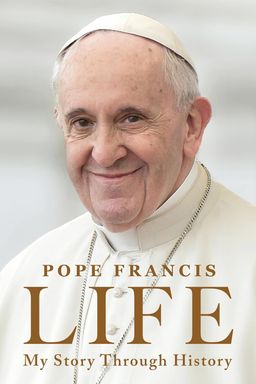
Life cover

Life

by Pope Francis With Fabio Marchese Ragona

Pope Francis weaves the story of his life with historical events from 1939 to the present. Translated by Aubrey Botsford.

A Life as History’s Compass

What do you do with memories that feel too large for one life—childhood war bulletins on the radio, moon dust on a black-and-white TV, crowds tearing down a wall, a city choking on dust on 9/11, a rain-swept, empty St. Peter’s Square? In Life, Pope Francis (with journalist Fabio Marchese Ragona) argues that memory is not nostalgia—it is a moral compass. He contends that when you re-read your life inside the larger story of the world, you recover the wisdom to choose peace over power, welcome over fear, tenderness over ideology. But to do that, you have to listen—first to the cries of history’s victims, and then to the quiet movements of conscience.

This book is a conversational, scene-by-scene “memoir in history.” It opens with a toddler Jorge Mario Bergoglio in 1939 Buenos Aires, hearing Neville Chamberlain announce war as his grandmother, Rosa, scoops him up for prayer. From there, the narrative follows a time line of twentieth- and twenty-first-century milestones—the Shoah, Hiroshima, the Cold War and McCarthyism, the moon landing, Argentina’s 1976 military junta, the fall of the Berlin Wall, the birth of the European Union, 9/11, the global financial crisis, Benedict XVI’s resignation, and the COVID-19 pandemic. At each stop, Francis offers two lenses: a ground-level memory (neighbors, a teacher’s name, a dish of ravioli on a Sunday, the feel of a payphone’s metal coins) and a moral reading (Why do wars begin? What does technology serve? How do you accompany the poor? What does a pastor do in a dictatorship?).

What the author argues

Francis’s core claim is stark and simple: history is a school for mercy. He believes evil’s disguises—ideology, idolatry of money, clericalism, nationalisms—recur across decades, but so do antidotes: a people’s piety, the courage of witnesses, the stubborn work of building bridges, and the humble discernment that listens for God’s invitation in unexpected places. You see this pattern when his grandmother, an Italian migrant, teaches him first prayers and first words in Piedmontese; when a Marxist chemist-boss, Esther Ballestrino, mentors his teenage self in rigor and political literacy; when a Jesuit rector-physician in Hiroshima, Pedro Arrupe, improvises field medicine with boric acid after the bomb; when the future pope hides seminarians from Argentina’s death squads; when he kneels in Auschwitz and later kisses the tattoo of survivor Lidia Maksymowicz.

What you’ll discover

You’ll see how a vocation is born in an ordinary Monday—September 21, 1953—when a 16-year-old, en route to a student picnic, wanders into the Basilica of San José de Flores, confesses to a dying priest (Fr. Carlos Duarte Ibarra), and feels chosen: Miserando atque eligendo. You’ll watch him argue through the Cold War with communists without becoming one; thrill at the moon landing while warning that technology without ethics dehumanizes; move boxes on the day of Argentina’s 1976 coup and then find ways—phone booths, disguises, ruses—to rescue the vulnerable; watch Maradona score “the hand of God” goal while learning that play can form the heart; cheer in 1989 as a wall falls and learn to distrust all walls; reimagine Europe as a family, not a spreadsheet; revere first responders on 9/11; walk with cartoneros and pilgrims to Our Lady of Luján amid the 2001–08 economic shocks; and finally stand in a storm-swept piazza during COVID, begging the crucified Christ, “Meté mano—play your part, please.”

Why it matters now

Francis’s memoir lands in a world again flirting with catastrophe—nuclear talk resurfaces, algorithms manipulate attention, migrants drown, conspiracy thickens, the planet warms. He insists that the way out is not cleverness but conversion: reforming hearts (and institutions) so that the Church becomes a field hospital and society learns to prefer the margins to the center. He sketches a Church that is smaller, humbler, less clerical (echoing Joseph Ratzinger’s 1969 radio forecast), yet more missionary, synodal, and close to those long excluded, including LGBTQ persons, while holding doctrinal lines on sacraments. For leaders in and beyond religion, Life is a manual on proximity-in-crisis: ride the bus, cook the Sunday pasta, refuse the limousine and the red shoes, return gifts to the poor, and in the worst hour—like March 27, 2020—stand alone, hold the monstrance high, and keep the world’s hope lit.

Remembering as moral action

“Our life is the most precious ‘book’ we have been given... And yet, precisely in that book, one finds what one pointlessly seeks elsewhere.” The point of telling his story within History is not self-display; it is a call to you to read your own life aloud—so you can choose mercy over amnesia and become, in your place, a bridge-builder.


War, Memory, and a Peacemaker’s Formation

Francis learned early that war is never abstract. As a nearly three-year-old in 1939, he heard on the radio that Britain had declared war on Germany. In the Bergoglio kitchen, the coffee steamed, the floor still damp from mopping, and his grandmother Rosa gathered him to pray. Open letters arrived from Italy stamped “OPENED BY CENSOR,” reporting men hiding at Bricco Marmorito who watched for a woman’s red shawl—the signal to flee because patrols were near. For a boy in Buenos Aires, far from the European front, war had faces and codes, not theories.

The Shoah, up close and personal

In 1941, news filtered through: Jews were being herded into cattle cars and disappeared. At supper, his mother Regina slammed a pan down and choked out, “He’s a monster!”—Hitler. Jewish friends of his father had relatives gone silent in Europe. Decades later, Pope Francis would walk through Auschwitz and Birkenau in silence and, meeting survivor Lidia Maksymowicz, kiss the tattooed number on her arm. He carries the ache into the present, decrying new spikes in antisemitism after the 2023 Middle East escalation (echoing Elie Wiesel’s warning that memory must become a conscience).

Hiroshima’s field hospital theology

When two atomic bombs ended the war in the Pacific, people in Buenos Aires struggled to grasp what an “atom bomb” even was. Years later, young Fr. Bergoglio heard Fr. Pedro Arrupe’s eyewitness account of Hiroshima: the Jesuit novitiate shattered, the city a “lake of fire,” almost all physicians dead, novices turned into orderlies. Arrupe, trained in medicine, improvised care with a sack of boric acid dissolved in water to treat burns until help came. Francis’s conclusion today: the use (and even the possession) of nuclear weapons is immoral—a stance he reiterated in Hiroshima in 2019 (think of Thomas Merton’s similar spiritual protest against nuclearism).

From radio bulletins to a peacemaker’s habits

Francis connects the dots from Pius XII’s 1939 plea—“Nothing is lost with peace; all may be lost with war”—to his own ministry. Ending war requires more than cease-fires; it requires the slow, daily habit of nonviolence: no cruelty in speech (no “rumor-mongering”), no abuse of power, and a readiness to forgive so that cycles of revenge don’t harden. His childhood’s only brush with combat—a scuttled German battleship near the River Plate and its captain, Hans Langsdorff, who chose suicide rather than more killing—becomes an early parable: choices matter, even when history is raging.

In today’s wars (Ukraine, Gaza, Yemen, DR Congo, Myanmar), he refuses partisanship and begs for civilian protection, dialogue, and disarmament. He warns that the “dispersed Third World War” is fueled by the arms trade’s profits, and that the worst illusion is thinking violence “works.” Your takeaway: keep memory close. Remember the children “whose eyes don’t smile,” and let that memory set the boundaries of your politics, your speech, and your consumption.

War’s spiritual diagnosis

Francis links the machinery of war to idolatry: the worship of power, profit, and ideologies that erase faces. The antidote is concrete: welcome migrants; lift up the poor; practice daily forgiveness; and refuse the subtle violences—mockery, manipulation, clerical arrogance—that seed larger conflicts. (Compare to Václav Havel’s “living in truth.”)


Migrants, Poverty, and the Politics of Mercy

Mercy isn’t sentimental in Francis’s telling; it’s biographical and political. His grandparents fled economic hardship in Piedmont, delayed by a failed land sale that, providentially, kept them off the Princess Mafalda—which later sank off Brazil, killing 300+. They arrived in Buenos Aires in 1929, cloaks far too heavy for the summer heat, savings sewn into a fox-fur collar. At home, Piedmontese was the language of lullabies. No wonder his “first mother tongue,” he says with a smile, wasn’t Spanish but dialect. Migration, for him, has names, boats, and aching homesickness.

Meeting the poor, face to face

As a boy, he listened to Polish workers at a dyeworks—refugees from Nazi terror—who both wept for their dead and laughingly taught kids Polish swear words. Later, as archbishop, he walked the dusty alleyways of the villas miserias, sending priests like “Father Pepe” Di Paola into Ciudad Oculta and Villa 21 to accompany children caught in drug markets and families without water. In 2013, his first trip as pope was to Lampedusa, Europe’s migration front door, to mourn refugees lost at sea.

Economy: who is the market for?

Francis’s economic critique is tethered to real crises he lived through. When Argentina imploded in 2001—bank accounts frozen, presidents fleeing by helicopter—he opened churches as field hospitals: free meds, bread ovens under bridges, parish doors all night. When Lehman Brothers collapsed in 2008, he saw lines at New York food banks and concluded, “This economy kills,” if it treats people as instruments of speculation. In Fratelli Tutti, he writes: market freedom cannot trump the dignity of the poor; the market must be civilized to serve integral human development (compare to Amartya Sen’s capabilities approach).

Popular piety and the immune system of faith

Mercy gets muscle not only from policy but from a people’s devotions. Each October, over a million pilgrims trudge 35+ miles to Our Lady of Luján. As archbishop, Francis heard confessions straight through the night: tattooed twenty-somethings, jobless parents, students bargaining with heaven for graduation. He calls popular piety the Church’s “immune system”—it keeps faith from becoming an elite hobby. He recounts a father keeping vigil outside the locked basilica, begging the Virgin for his deathly ill daughter—and returning to find her inexplicably healed. Whether you interpret that as miracle or meaning-making, he argues, it forms citizens who see the poor not as abstractions but neighbors.

Policy-wise, he urges Europe to be a community, not a calculus—sharing the migration load across north and south (as the Maastricht vision intended), resisting “suicidal individualism,” and remembering that statistics without faces become cruel.

Action for you

Welcome has levels: a donated meal, a listening ear, advocacy for fair housing or regularization, and resisting narratives that criminalize the stranger. Start small—shake a neighbor’s hand, learn a name—then scale your mercy to match your influence.


Discernment: Finding a Call in Stormy Times

Francis’s spirituality is practical: discernment is how you read the “book” of your life with God. His pivotal scene isn’t in a monastery but on a busy spring Monday, September 21, 1953. Sixteen-year-old Jorge, dressed for a student picnic, feels a tug, ducks into the Basilica of San José de Flores, and confesses to Fr. Carlos Duarte, a priest with leukemia. “God was waiting for me,” he writes. He leaves the church stunned, skips the party, goes home in silence. Years later, his episcopal motto becomes Bede the Venerable’s phrase about Jesus’s gaze on Matthew: Miserando atque eligendo—looked upon with mercy, and chosen.

Córdoba: the dark night that purified

Not every call feels luminous. After leading Argentina’s Jesuits (1973–79) and then serving as rector, he was “exiled” in 1990 to Córdoba—cell 5 of the Jesuit residence—for almost two years: a confessor, a cook, a caregiver, mostly silent. Rumors said he’d been sidelined or even refused phone messages. He rejects that tale as unfair but concedes the time was “dark,” a school in humility that softened authoritarian instincts. He devoured 36 of 40 volumes of Ludwig Pastor’s History of the Popes, wrote two books (Reflections on Hope and Sin and Corruption), and learned again to “smell of the sheep.” The lesson: setbacks are not detours but depth.

Ignatian habits that hold in any age

His toolkit is classic Jesuit: daily examen (review your day before God), find God in all things (even laboratories and soccer pitches), discern spirits (does a movement lead to life or to self-preoccupation?), prefer the poor (because they evangelize you), and keep moving outward (a self-referential Church “gets sick,” he told cardinals in 2013 in the 3-minute speech that catalyzed his election).

Vocation, revisited

The call recurs: at age 21 he nearly dies of a lung infection; a Dominican nurse, Sr. Cornelia Caraglio, adjusts his penicillin dose and saves him. In 1969, on the cusp of ordination, fear surfaces again—and is met with Paul VI’s words to the Apollo astronauts about courage and curiosity. In 2013, when Benedict XVI resigns (he hears it first from journalist friend Gerry O’Connell), discernment becomes communal: signals from fellow cardinals (“Don’t forget the poor,” whispers Cláudio Hummes at the decisive ballot) confirm the inward nudge to choose the name Francis and the path of a poor Church.

For you, discernment starts where you are: in a lab with a demanding boss, on a city bus with a rosary, in a hospital room learning your vulnerability. Ask: Where did I feel most alive today? Where was I turned in on myself? What next small step leads toward love?

A portable prayer

Francis keeps a youthful “profession of faith” in his desk, ending: “I expect the surprise of every day…” Make your own one-page creed and revisit it when fear, success, or criticism distort your inner compass.


Technology’s Promise, Limits, and Boundaries

Francis is a child of radio and cinema who became a bishop under television, a pope in the age of social media. He doesn’t romanticize or demonize progress; he interrogates its aim. Two scenes anchor his view. First, 1969: the Jesuit house in San Miguel packs into a chilly TV room to watch Armstrong’s footprint darken lunar dust. He marvels, argues with a few conspiracy-murmurers, and then warns: progress “must be in harmony with humankind’s ability to manage it.” Second, 1945: Hiroshima. Fr. Arrupe’s “lake of fire” sears the boundary—nuclear weapons, even possessed as deterrents, are immoral because they anchor security in terror.

Algorethics—governing the new powers

On AI, Francis proposes algorethics: shaping algorithms to respect the person, protect truth, and serve the common good. He has warned about deepfakes and manufactured “evidence” corrupting public trust (think of Shoshana Zuboff’s surveillance capitalism critique). His criteria come from Catholic social teaching’s four beacons: human dignity, justice, subsidiarity (decisions as close to people as possible), and solidarity. If a technology—prenatal screening to embryo destruction, “surrogacy markets,” or lethal algorithms—treats people as means, it’s off-limits.

A consistent ethic of life

Francis’s most controversial boundary: from “womb to tomb” protection. He calls abortion “murder” and pleads for conscience protections, while pairing that conviction with social supports for mothers and material welcome for those in crisis. Agree or disagree, note the throughline: the same logic that denounces nuclear weapons and AI manipulation also objects to commodifying embryos and women’s bodies. His target isn’t science but the market’s colonization of the human.

Fear, curiosity, and humility

Paul VI’s message to the Apollo 11 crew—“Honor, greetings, and blessing to you, conquerors of the moon” who must also “bring to her… the voice of the Spirit”—becomes Francis’s template: bless boldness, school it in humility, and aim it at service. He even stopped watching TV in 1990 (after stumbling on “scenes not good for the heart”) to guard his inner attention. That abstinence isn’t a program for everyone, but it’s a parable: tech is a tool, not a tyrant; set your habits accordingly.

Your move: ask of any breakthrough at work or home, “What human good does this enlarge? Who bears its hidden costs? What guardrails keep dignity central?” Then design, code, or choose accordingly.

Two hard lines

• No to nuclear weapons—possession included (deterrence breeds fear). • No to technologies (or markets) that instrumentalize persons—embryos, women’s bodies, or the poor—under any pretext. (Compare to the “consistent ethic of life” articulated by Cardinal Joseph Bernardin.)


Courage and Conscience under a Dictatorship

March 24, 1976: while moving Jesuit curia boxes into the Colegio Máximo, Fr. Bergoglio didn’t yet know a military junta had overthrown the government. Within hours, green Ford Falcons without plates—the regime’s terror cars—cruised past. For seven blood-stained years, tens of thousands disappeared; mothers became sleuths; seminarians, slum priests, and catechists were abducted, tortured, thrown from “death flights.” Francis’s account neither centers himself nor blinks at horror; it focuses on concrete acts of conscience and a reckoning with later accusations.

Hiding, disguising, negotiating

He sheltered seminarians marked for death “under the pretext of spiritual exercises,” warned priests in slums to go temporarily undercover, and forbade novices from walking alone at night. When two Jesuits—Orlando Yorio and Franz Jalics—were abducted (after he had warned them the risk was high), he lobbied Admiral Emilio Massera and Gen. Videla for their release, celebrated a home Mass to corner a meeting, and daily fed updates via payphone to Jesuit superior Pedro Arrupe in Rome. After five months, the two were dumped drugged in a field. He got them out of the country with diplomatic cover.

A friend’s martyrdom and a wound that stayed

His former lab chief and Marxist mentor, Esther Ballestrino—one of the Mothers of Plaza de Mayo—asked him to hide her books (“If they find these, I’m finished”). He did. Later, the regime infiltrated the group via a young officer, Alfredo Astiz; Esther, another founder, and two French nuns were seized and—most likely—thrown into the sea. “Perhaps I didn’t do enough,” Francis says flatly. Years later, he authorized their burial when remains were identified by DNA, and in 2010 calmly answered four hours of judicial grilling; no evidence of collaboration emerged.

Truth without self-justification

He honors Bishop Enrique Angelelli, killed in a staged “accident” for defending campesinos; acknowledges bishops who accepted the junta’s lies; and notes the Church’s bitter divide between those persecuted and those favored by power. His emphasis is on habits: keep files out of curious hands; avoid political talk with chaplains who might inform; get people to safety; and cook Sunday dinner for the community to keep spirits human. It’s moral realism without romance—akin to Oscar Romero’s arc from caution to courageous witness.

For your own contexts—corporate scandals, political purges, culture wars—this chapter offers a test: will you trade proximity to the vulnerable for institutional favor? And if the worst comes, can you resist the itch to dramatize your own role and instead, day after day, protect one more person?

A hard-earned principle

“It was a generational genocide.” Remembering guards against denial; small, steady acts of sheltering others stiffen your spine for larger tests.


From Walls to Bridges: Europe, Dialogue, Synodality

On November 9, 1989, Bergoglio sprinted to a TV and watched Berliners swing pickaxes at a concrete theology: walls. He saw not geopolitics first but faces—old men in tears, families hugging at checkpoints, young people dancing by the Brandenburg Gate. For him, it proved two convictions: oppression ends not only with policies but with prayer and a people’s courage (he credits John Paul II’s 1979 visit to Poland); and every wall—national, racial, ideological, even personal—breeds mafias and fear. The Gospel’s project is bridges.

Europe as family, not factory

In 1992 Córdoba, while cooking a rice timbale for a staff wedding, he glanced at the paper: the Maastricht Treaty had been signed. He didn’t grasp its full significance then; later, as bishop and pope, he came to love the founding vision—subsidiarity, solidarity, shared sovereignty—citing John XXIII and Benedict XVI. He also cites Queen Elizabeth II’s 1992 Strasbourg address: “Decisions need to be taken as close to the citizen as is compatible with their success… Far better the tough talking and controversy… than drab uniformity.” Today, he urges Brussels to recover harmony-in-difference: respect Hungary’s particularities and demand its contributions; share the burdens of migration; prize peoples over numbers.

Synodality: the Church’s internal bridgework

Bridges start at home. Francis imagines a Church that listens before it speaks—a synodal Church—so that bishops “keep watch” over hearts rather than merely “supervise” behaviors (his 2001 Synod language echoes here). He wages a long campaign against clericalism (“a plague”), promotes lay and women’s leadership, and accompanies LGBTQ persons pastorally while keeping the sacramental theology of marriage unchanged (see Fiducia supplicans on spontaneous blessings). The criterion is evangelical: is our stance opening doors to encounter Christ, or slamming them?

Fraternity across religions

After 9/11, he admired New York’s first responders and wept for victims, argued for Islamic leaders to repudiate terror clearly, and years later signed the 2019 “Document on Human Fraternity” with the Grand Imam of al-Azhar—an appeal to make tolerance and shared citizenship practical. He has prayed at Yad Vashem and in Ground Zero’s memorial hall, and hosted mixed groups of hostage and Gazan families in the Vatican in 2023. His method is presence: stand where pain is and name the person, not the label.

Translation to your life: practice “bridge disciplines”—seek first-hand stories beyond your bubble, adopt one concrete shared project with someone who differs from you, and in debates ask, “What wall am I defending? What bridge could we build instead?”

A working definition

Synodality = walking together: listening, discerning, deciding—so the Church looks less like a court and more like a pilgrimage. (For context, compare to Yves Congar’s theology of reform.)


Leading Through Crisis with Proximity

Francis’s leadership playbook is relentlessly local. He gives away gifts, refuses the limousine, rides the bus, cooks Sunday meals, and transforms the grand archbishop’s parlor into a storeroom for donations. That style isn’t cosmetic; it’s crisis-tested. Three case studies—9/11, the Great Recession, and COVID-19—show how “proximity” becomes policy and prayer.

9/11: lament and fraternity

On September 11, 2001, staff clustered around a TV in Buenos Aires as the second plane tore into the South Tower. “Mother of God,” he whispered, head bowed. He praised first responders’ heroism, condemned blasphemous violence in God’s name, and urged Muslims and Christians to walk together, planting seeds that later became the Human Fraternity document. During the bishops’ synod weeks later, he helped steer conversations beyond fear toward mission and justice for the discarded.

2001 & 2008: field hospitals for the poor

When Argentina imploded in 2001, he convened a national dialogue at Caritas, kept parishes open around the clock, installed bread ovens under bridges, and launched triage clinics for unmedicated poor. In 2008, as global markets seized, he warned that Mammon had eclipsed God and insisted the only durable engine is dignified work. At Luján in 2008, his homily’s theme—“Mother, teach us to listen”—became practical advice: most problems shrink when leaders truly listen to families, coworkers, and the poor.

COVID-19: the Statio Orbis

March 27, 2020: in a cold rain, Pope Francis limped alone up to St. Peter’s Basilica’s steps between the Salus Populi Romani icon and the miraculous crucifix from San Marcello al Corso. “We are all in the same boat,” he preached to a world in lockdown, before lifting the monstrance for an extraordinary Urbi et Orbi blessing. He had earlier walked Via del Corso alone to pray before that crucifix—meté mano, he asked Christ: “play your part.” He pushed vaccination in the Vatican, arranged shots for the homeless, and named the temptation of “every man for himself.” He also admitted the environmental paradox: when we stopped, the earth seemed to breathe.

Leadership takeaway: in crisis, be physically present, keep symbols close (bread, cross, names), resist polarizing scripts, and choose actions that dignify the least protected first. Proximity isn’t optics; it’s a theology of incarnation translated into operations.

Human, not superhuman

Francis shares limits: he shelved his COP28 trip on doctor’s orders, jokes about orthopedic shoes, and keeps a letter of resignation on file in case of grave incapacity—while stressing he believes the papal ministry is for life and he has “no cause” to resign. The point is steadiness: do what love requires, within your strength; multiply that strength by community.

A pastor’s KPI

If those farthest from the center feel seen, safer, and more hopeful because of your decisions, you are leading like this pope. Start with one proximate practice this week—ride public transit, take one listening walk, or host a simple meal to hear real stories.

Dig Deeper

Get personalized prompts to apply these lessons to your life and deepen your understanding.

Go Deeper

Get the Full Experience

Download Insight Books for AI-powered reflections, quizzes, and more.